Colette

Hirsch, Edward. “Colette.” On Love. New York: Alfred A. Knopf, 1998.

 Probably the thing that grabbed me first about “Colette” is the fact it’s a mother talking to her daughter about marriage. The dos and don’ts on love. For a man writing from the female perspective it’s pretty cynical. There is a hint of humor when the mother mentions “one of her husbands” implying she hasn’t been all that expert on relationships either.

Favorite line: “Never underestimate the mysteries of love” (p 84)

BookLust Twist: From More Book Lust in the chapter, “Poetry Pleasers” (p 189).

Apple That Astonished Paris

Collins, Billy. The Apple That Astonished Paris. Fayetteville: University of Arkansas Press, 1988.

Such a slim, unassuming little book of poetry! Who knew it would pack a punch of powerful words neatly disguised in short and sweet poems? I have decided Billy Collins is one of my favorite poets. His poetry is not pretentious. It’s within reach; a drinking buddy; a lovable troublemaker disguised in a string of words. There is wild imagination (walking across water and thinking of what the fish below see), seriousness (a former teacher looks back on the “community” of students he has taught), nostalgic (remembering a Tuscany vacation), clever (questioning Basque language), humorous (Smokey the Bear is fed up with warning tourists about forest fires) and moving (how cancer is a bad word). Each poem is about a page long or less. Short enough to read again and again. Let the words soak in and open your mind to fun poetry.

Favorite lines:
“…a jaded traveler with an invisible passport” (p 6).
“The evening hangs in the air like lace” (p 13).
“My sentiments are tangled like kites in the branches of her incomprehension” (p 21).

BookLust Twist: From Book Lust  in the chapter called, “Kitchen-Sink Poetry” (p 139).

Ancestral Truths

Ancestral TruthsMaitland, Sara. Ancestral Truths. New york: Henry Holt & Co., 1993.

To be quite honest I don’t know how this came into my hands. I’ve already read one book in honor of National Sibling Month. This was supposed to be on the list for next year, or maybe even the year after that. I wasn’t supposed to read two sib books in one month. But, suddenly there it was and after I picked it up I couldn’t put it down.

Ancestral Truths is a bizarre tale about a woman who starts a journey climbing a mountain in Zimbabwe with her lover and ends it with her alone with an amputated hand and the nagging doubt of murder in her heart. Reliving her days in Italy and on Mount Nyamgani while on holiday with her large family in Scotland, Clare Kerlake tries to figure everything out. Did she kill her boyfriend? Can she live without her right hand? She comes from a large family and they all have baggage so it’s no surprise when the plot gets a little preachy and over the top. Religion, feminism, mysticism and witchcraft all play a part in this novel. It gets heavy at times but well worth slogging through.

Favorite parts: “She was an amputee, a cripple, stared at discreetly and pitied; or completely ignore, invisible in the embarrassment of strangers” (p 10). “‘You named me,’ Joseph once said irritably, ‘not only  after the only married male virgin in the Church’s calendar, but after the only bloke in history who would take his pregnant  girlfriend on a trip without booking in advance'” (p 110). Last one, “Clare had been embarrassed, self-conscious in her laughter while Julia was free in hers” (p 286).

BookLust Twist: From Book Lust in the chapter called, “Brothers and Sisters” (p 47).

I Remember Church Going

Larkin, Philip. “Church Going.” The Less Deceived. New York: St. Martin’s Press, 1965,

Larkin, Philip. “I Remember, I Remember.” The Less Deceived. New York: St. Martin’s Press, 1965.

The beginning of “Church Going” is the most fascinating. The author visits a church (not his first, nor his last) and describes what he sees and does in this latest church. There is a sense he doesn’t quite believe in the place or his unspoken reason for being there. There is a skepticism in his tone that suggests a deeper disbelief. It begins with the very first line, “Once I’m sure there’s nothing going on” [in the church] (p 28).

“I Remember, I Remember” is a little more straightforward but as equally honest. The speaker is traveling with a friend and discovers a forgotten place from childhood. Immediately, the remembering begins. My favorite line is delivered by the friend, “You look as if you wish the place in hell” (p 38). I can think of a few places in my life where I would have that look!

BookLust Twist: From More Book Lust in the chapter, “Poetry Pleasers” (p 189).

an omelette & a glass of wine

David, Elizabeth. An Omelette and a Glass of Wine. New York: Lyons, 1984.

I think when it comes to writing about food Elizabeth David is an icon. Her books are not only widely read, but evenly more widely discussed and considered bibles in the world of gastronomy. For a woman who cooked the way she did, living all over the world, it is no surprise she is still considered one of the best food writers of all time.
David’s “career” in food writing began in 1947 with a frustration. Unable to get meals she enjoyed she vented her frustration by writing down descriptions of the food she craved, “I sat down…and started to work out an agonizing  craving for the sun and a furious revolt against that terrible, cheerless, heartless food by writing down descriptions of Mediterranean and Middle Eastern cooking” (p 21). And so it began. 

Probably the best surprise to David’s writing is her humor laced with sarcasm. An Omelette and a Glass of Wine is comprised of essays the wrote for well-reputed publications such as Vogue and The Spectator. While the writing is knowledgeable and professional there is an air of whimsy and playfulness running throughout. Here is an example, just to get you started: “He [the waiter] has been five years with the French navy, alors vous comprenez madame je connais les vins, moi. What he doesn’t connait is that I like my Beaujolias cold, straight from my cellar” (p 42). In addition to having thoughtful, knowledgeable essays, An Onelette and a Glass of Wine is peppered (excuse the pun) with wonderful photographs and illustrations. This was a book I enjoyed savoring one essay at a time.

BookLust Twist: From Book Lust in the chapter called, “Food for Thought” (p 91).

If Elizabeth David was alive and I could ask her one question I would have to ask when, exactly, is mayonnaise season and how can I avoid it?

Noblest Roman

Halberstam, David. Noblest Roman. Boston: Houghton Mifflin, 1961.

Noblest Roman is Halberstam’s first book. It is also one of the only two works of fiction he wrote. He would go on to prefer writing nonfiction after One Very Hot Day. It makes me wonder about the artistic preference. Why switch from fiction to nonfiction – never to go back again? It’s like the musician who prefers classical music after years of performing heavy metal. Or the watercolor painter who switches to pencil halfway through his career.

Okay. I’m off track.

Noblest Roman takes place in the south (Mississippi) and is a sly commentary on state level elections and the crookedness that comes about in small, rural communities – especially when bootlegging and prostitution are involved. I found the plot to plod and character development to be contradictory. Everything moved too slow for my taste and while one might argue that is the southern way, I found myself sleeping at the wheel too often. It is curious to note that Noblest Roman was inspired by true Mississippi events. Maybe Halberstam wasn’t that far away from nonfiction after all.

Favorite lines: “He changed the subject from Little Bilbo’s woman because listening to the old man talk about her was almost as bad as listening to her in person” (p 10). Had to laugh at that one.
“By all rights he should have been tired and unshaven and rumpled, but he looked fresh and rested. The campaign did not show on him” (p 49).
‘”I’m an old man, Angelo. Before I had a wife. Now I have a wife and a doctor”‘ (p 106).

BookLust Twist: From More Book Lust in the chapter, “David Halberstam: Too Good To Miss” (p 112).

Why so Few Blacks Study Creative Writing

Eady, Cornelius. “Why So Few Blacks Study Creative Writing.” The Gathering of My Name. New York: Carnegie Mellon University Press, 1991.

Such a long title for such a short poem! Here are the tags words I used for this poem: teacher, education, writing, students, culture, and faith. To me this was all about a growing frustration of a teacher; frustration with his students and their lack of interest in writing. I could almost see the blank stares, the “I don’t get it attitude.” I don’t think this is a cultural problem, but a culture-less epidemic that spans illiteracy and disinterest.

BookLust Twist: From More Book Lust in the chapter called, “Poetry Pleasers” (p 189).

Punch

Feinstein, John. The Punch: One Night, Two Lives, and the Fight That Changed Basketball Forever. Boston: Little, Brown & Company, 2002.

Once I learn of a story, an incident that captures my imagination I have to research it, follow it, own it. The story behind “the punch” was no different. What happened on December 9th, 1977 was such a huge deal I needed to see the actual punch itself. Was it really that bad? That shocking? That horrible? I needed to know. In truth, the video evidence is grainy, distorted. To me, there is no way of knowing just how terrible “the punch” really was from a human nature standpoint. Guess it’s a location thing – you had to be there. If anything, I would call the punch a perfect storm. All of the elements needed to make it a horrific moment were in place: Kermit didn’t know why Rudy was charging at him – out of the corner he saw a figure in red barreling towards him. In the game of basketball you are trained to be aware of your opponent’s existence at all times. Rudy was the opponent in red. Rudy didn’t know Kermit was going to turn around and sock him. He was unaware of the danger as he ran full speed down the court. Fist meets face at full speed. Add another element: strength. Kermit was a strong, powerful man. His punching fist would have floored anyone, even if it didn’t have uninterrupted impact. When he hit Rudy, there was nothing slowing either man down.

What makes the Punch such a fascinating read is not only the play by play of the punch and the events leading up to it, but Feinstein is adament about making the reader understand these two players as people. Sports writing meets biography. There is an urgency to make one understand that both of these men were passionate people before they were passionate players. Feinstein carefully illustrates the tough beginnings, the drive and potential each of these basketball stars demonstrated at an early age, including their schooling, family lives and social circles. Even black and white photographs help bring Kermit and Rudy into reality. What is gracefully missing is, of course, the punch itself.

One of my favorite aspects of the book is Feinstein’s casual tone. Here’s how he describes Kermit meeting his wife, “The story of how she ended up meeting Kermit is a complicated one. It happened because of a friend of a friend who had once dated someone who knew another friend of Kermit’s – or something like that” (p 139).

BookLust Twist: From Book Lust twice – both times in the chapter called, “Sports and Games” (p 225 & 226).

Cancer Come Get Me

Carver, Raymond. “What the Doctor Said.” All of Us, New York: Vintage Contemporaries, 2000.

“What the Doctor Said” is about a patient receiving word from his (?) doctor that he has cancer, a cancer so lethal the doctor “stopped counting” the tumors on one lung. You can’t pray but it won’t make a difference. It’s heart breaking and stark. The message is beyond clear. You. Are. Going. To. Die. No bones about it. No hope. No cure. No way out. Imagine that. You are D-E-A-D.

This poem is perfect timing for me. I have mentioned before I have signed up for a cancer walk. 60 miles in three days. The attitude is yeah-yeah another charity. I’ve even gotten an eye roll. I hear the words: So what? Big freakin’ deal. I shouldn’t take it personally, but it still amazes me. No one has asked how they can help. No one has asked ‘how can we donate to the cause?’ They can’t wrap their brains around the fact that this walk could save a life. This walk, this dollar donated might make a difference. It’s amazing. It’s as if the world has become cynical enough to say “you won’t make a difference so I won’t throw my money away.”

What happens when you get a life threatening illness? What happens when you are told you will die? How does it make you feel to have someone say it won’t help you? The attitude is “so why don’t you go ahead and die? It will be painful but just die because I can’t make a difference. I won’t make a difference.”

Drives me nuts.

Tract

Williams, William Carlos. “Tract.” The Collected Earlier Poems of William Carlos Williams. New York: New Directions, 1951.

This is an ashes to ashes, dust to dust kind of poem. Williams is pleading with his community to spare the glitz and glamour when it comes to burying the dead. He believes in sending a body back to the earth in the simplest way possible. A gentle return, if you will. He asks that his townspeople remember the person for who they were and not who they wanted to be. Do not remember them by the status they kept in society, but rather by the things the departed held dear. Share emotions like grief for they are the true gifts of mourning.

BookLust Twist: In More Book Lust in the chapter, “Poetry Pleasers” (p 189).

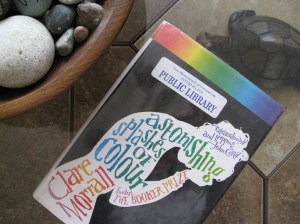
Astonishing Splashes of Colour

MorrallMorrall, Clare. Astonishing Splashes of Colour. New York:  Harper Collins, 2004.

This is the kind of book I could read a thousand times over. This is the style of writing I most identify with. Astonishing Splashes of Colour is so intimate and in-your-face I feel as if Morrall’s main character, Kitty, is leaning in to tell me deep and dark secrets, stories of embarrassing moments, and airing her dirty laundry with a wave of her hand and an air of factual nonchalance. She makes me squirm with her frankness, her vulnerability. Helpless and hopeless, Kitty is the me in the mirror.

Kitty is a thirty-something with something to hide. Her past has as many demons and devils as it does angels. Losing her mother at three years old, the knowledge of an older sister who ran away from home, the fact having four brothers who not only are disconnected from one another but only pretend to be connected to her, the frustrations of having a father who loses himself in painting and has episodes of pouting, the confusion of having an excessively neat husband who lives across the hall in a separate apartment, the heartbreak of a miscarriage Kitty insists on waiting for after school…then there are the colors. Kitty has the uncanny ability to see human emotion, human circumstance as a myriad of color. Her world is not black and white sane, but rather a rainbow of mental chaos. As if all this wasn’t enough everything turns out different from what one would expect. I couldn’t put it down…

Lines I can relate to: “I fight back a wave of giggles that threatens to ripple through me” (p 63). I laugh at inappropriate moments, too.
“I can’t decide which is worse, to not have a mother, or to not have children. An empty space in both directions. No backwards, no forwards” (p 65).
“I would have books around me even if I were blind. I need the smell” (p 138).

There are, of course, many more lines I could quote. This novel, this flash of brilliance definitely resonated with me.

BookLust Twist: From More Book Lust in the chapter called, “Sibs” (p 201).

Table Talk

table talk
Stevens, Wallace. “Table Talk.” Opus Posthumous. New York: Alfred A. Knopf, 1957.

I like the first line best, “Granted, we die for good.” I can just imagine two people sitting around a kitchen table talking about why they like certain things and how it all matters only when you are alive. While all poetry can be manipulated to suit the reader, I believe that Wallace’s philosophical nature comes through in “Table Talk.” There is an awareness to the good things in life; the joys of being alive. It’s almost as if this poem is more than good timing.

BookLust Twist: From More Book Lust in the chapter “Poetry Pleasers” (p 189).

I Go Back

Olds, Sharon. “I Go Back to May 1937.” The Gold Cell. New York: Alfred A. Knopf, 1987.

I must have read “I Go back to May 1937” a dozen times. It’s so personal, so haunting, so intriguing. The narrator (presumably Olds) wishes she could go back to the time just before her parents got married just so she could stop them from getting that together. She wants to warn them of the hurt they will cause each other and their child. Instinctively you want to know more – hurt each other how? Physically? Mentally? Is she talking about divorce? She does say “he is the wrong man.” But!But.But, to stop her parents from falling in love and getting married is to undo her very existence. It’s a dilemma of curious proportions.

BookLust Twist: From More Book Lust in the chapter, “Poetry Pleasers” (p 189).

Red Badge of Courage

Red Badge of CourageCrane, Stephen. Red Badge of Courage. New York: Signet, 1960.

I have heard complaints about Red Badge (language is archaic, plot is meaningless, etc) and while all those points are valid, they don’t take away from the fact that for a person who never saw a day of combat in life Crane does an excellent job portraying a young soldier in battle. I would imagine that anyone facing death would wrestle with the choice to be brave (“heroic” or “patriotic”) or be a coward. To stay and fight or take flight…especially after encountering death up close.
To say that Red Badge of Courage is about a young man in combat during the Civil War sells the story short. Henry is a young man facing many things for the first time in his life and throughout battle he struggles with all of it. It’s a historical snapshot of the psychology of war. It goes beyond whether Henry can be brave or not. Whether he is a true soldier or not.

I haven’t read Red Badge of Courage since high school but the one scene that has always stuck in my mind is when Henry comes across the dead soldier in the woods. I will always picture the blue uniform faded to a shade of green and the ants. The ants crawling on the dead man’s lip. It’s a powerful scene. The other moment I always remember is when Henry longs to be one of the wounded so that he may have his “red badge of courage” too.

BookLust Twist: From Book Lust in the “Civil War Fiction” chapter (p 57).

April Was…

IMG_1207
April was…April was definitely not one of my better months. Car crashes that stuck in the crevices of my psyche, accusations of disloyalty, heart breaking breakups. More ends than beginnings. For everyone, me included. It was a month of surviving. Here are just a few things that kept my head above water: amazing pictures from Arizona, amazingly great friends, amazingly crazy good Indian food, the run that gets better and better..and these books.

Finished for BookLust:

  • Road from Coorain by Jill Ker-Conway (in honor of the best time to visit Australia)
  • Ginger Pye by Eleanor Estes (National  Librarian Week & National Dog Month)
  • Deep in the Green: An Exporation of Country Pleasures by Anne Raver (National Gardening Month)
  • Apologizing to Dogs by Joe Coomer (National Dog Month)
  • Gain by Richard Powers (Earth Day)
  • Case for Three Detectives by Leo Bruce (National Humor Month)

Finished for LibraryThing:

  • Imagine Me and You by Billy Mernit
  • Franklin and Lucy: President Roosevelt, Mrs. Rutherfurd, and the Other Remarkable Women in His Life by Joseph E. Persico (Great timing! RE: Cover of “Newsweek”

And a total of 17 poems.
BookLust books NOT on the list:

  • Love, Loss, and What I Wore by Ilene Beckerman (in honor of National Fashion Month !!?)
  • Language of the Land edited by Martha Hopkins & Michael Buscher (Taxes = Government doc.)
  • Red Badge of Courage by Stephen Crane (start of the Civil War)

I knew  I did a lot of reading during that CrAzY month!