Eagle Has Flown

Higgins, Jack. The Eagle Has Flown. New York: Simon & Schuster. 1991.

Reason read: Jack Higgins was born in July. This finishes the series started in honor of his birth month.

At the end of The Eagle Has Landed a German plot to kidnap Prime Minister Winston Churchill had failed horribly and a massacre ensued. Left in suspense, readers didn’t know if antagonists Liam Devlin and Kurt Steiner survived. Now, in the much-anticipated sequel we learn Steiner did survive. He is being held prisoner in the Tower of London. And who better to rescue Steiner than Liam Devlin who also survived the botched kidnapping? Yes, he survived. Of course he did, he’s the center character. Devlin is the bad guy we all love to hate: poet, daredevil, ruggedly handsome gunslinger, a scholar and, as a member of the IRA, a man who stands by his convictions. He claims to be neutral but wants a united Ireland; he couldn’t care a lick about Nazi Germany but will chose the side with the biggest payout. General Walter Schellenberg is sent to recruit Devlin to the task, but standing in his way is Brigadier Dougal Munro of British Intelligence. He has a few tricks up his sleeve as well and what ensues is a fast paced chase across Europe. True to form, behind every Higgins plot there is an astonishingly resourceful and brilliant woman. This time there are a few. True to Higgins form, expect a twist at the end.

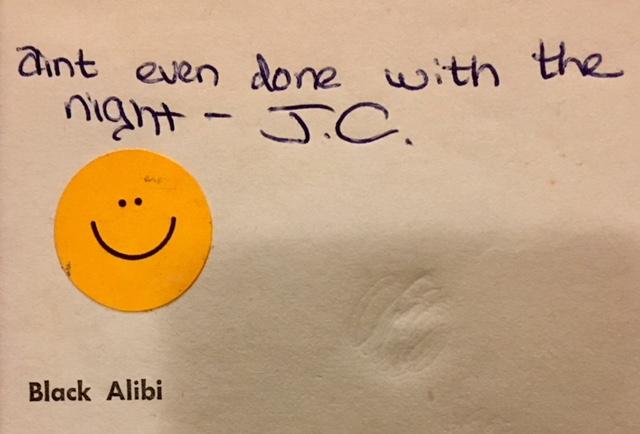
As an aside, I see my reading friend has taken to writing in books again. Shame on you, W.P.!

Author fact: in the blog before I mentioned Higgins wrote this book and Eye of the Needle. This time the author fact is simple. At the time of the publication of The Eagle Has Flown Higgins was living in the Channel Islands off the coast of California. Not be confused with the ones in the English Channel.

Book trivia: Eagle Has Flown is short and fast paced. One could read in a weekend.

BookLust Twist: from Book Lust in the obvious chapter “World War II Fiction” (p 253).

Possession

Byatt, A.S. Possession: a romance. New York: Random house, 1990.

Reason read: Byatt was born in August.

Possession is nothing short of amazing. Byatt invites you down so many different rabbit holes it is impossible to predict where you will end up. Young
academic Roland Mitchell has an obsession with long-dead poet Randolph Henry Ash. He’s in competition with several other scholars researching Ash, all equally as obsessed. They all feel they “possess” the man. When you first meet Roland you cannot help but think of him as a spineless wimp; a bland soul without backbone. From the beginning, you are told he is an unwilling participant in his relationship with girlfriend, Val, by his reluctance to rock the boat with her. The real problem lies in the probability he doesn’t even want the boat at all. All he cares about is researching the life and times of Randolph Ash. This timid nature poses a real problem when he stumbles upon a new fact about Ash, something never reported before. So begins the mystery. Byatt takes us from Roland’s world to Randall’s world. Via letters, journals and poetry a secret is exposed. With the help of another young academic, Roland’s opposite in every way, Roland discovers the truth about his beloved Randall Ash. His own true self is revealed as well.

As an aside, I love concentric circles. I just finished a book about Virginia Woolf and she makes a mention here in Possession. Also, I just finished seeing Natalie Merchant in concert. Christina Rossetti pops up in Natalie’s music and Byatt’s Possession.

Quotations to quote: “The basement was full of the sharp warmth of frying onions which meant she was cooking something complicated” (p 19), “…It did not have for him the magnetic feel of the two letters that were folded into his pocket, but it represented the tease of curiosity” (p 49), and one more, “They sit at table and exchange metaphysical theories and I sit there like a shape-shifting witch, swelling with rage and shrinking with shame, and they see nothing (p 396).

Author fact: at the time of publication Byatt had written five fictions and several nonfictions.

Book trivia: the cover to Possession is a painting of Sir Edward Burne-Jones called “The Beguiling of Merlin.” I have to admit, Merlin is a little freaky looking.

Nancy said: Pearl said Possession is probably Byatt’s best known work but not her favorite.

BookLust Twist: from More Book Lust in the chapter called “All in the Family: Writer Dynasties” (p 6).

Stranger in a Strange Land

Heinlein, Robert. Stranger in a Strange Land. Read by Christopher Hurt. Blackstone Audio, Inc., 1996.
Heinlein, Robert. Stranger in a Strange Land. New York: Ace Books, 2003.

Reason read: July is Heinlein’s birth month. Read and listened to in his honor.

Stranger in a Strange Land is everything you would expect from a 1960s cult classic written six years before the infamous Summer of Love. Originally published in 1961 Stranger’s main character, Valentine Michael Smith, is a far out dude; literally, as he is a man raised by the inhabitants of the planet Mars. His gifts of telekinesis, telepathy, and “grokking” make him a mystic, a guru, and finally a cult leader (once humans dismiss the notion of killing him for being a freak). Being born on Mars, like any good self-respecting alien, he has issues with language barriers and differing cultures once arriving on Earth. His first conflict is not understanding a money-grubbing reporter out to sell his story. His second is not comprehending the female species…two problems that exist for some humans in this day and age. The third and most confusing barrier is understanding his own sexuality. Let me back up. When “Mike Smith” was under the threat of media exploitation, Nurse Jill and a colleague “kidnapped” him to keep him safe. Smith ended up at the home of doctor/lawyer/writer Jubal Harshaw who lives a very Charlie’s Angels kind of existence with three bubbly, beautiful secretaries (one blonde, one brunette and one..you guessed it, redhead).  It is here, at Jubal’s estate in the Poconos mountains that Smith learns about women (after he tries to kiss Jubal and is immediately rebuffed).
A word of warning to those agnostic, atheist or otherwise unmoved by religion. After chapter part three Heinlein gets heavy with the Bible, church, the idea of sin and so forth. It’s a crucial part to the story as Mike starts his own church, becoming that cult leader I spoke of earlier.

As an aside, Jubal’s sarcasm and wit sort of reminded me of Francis Underwood in House of Cards. It didn’t help that Christopher Hurt reads with a slight southern accent.

Quote I liked (From Valentine Michael Smith), “I want to spit back at the camel and ask him what he’s so sour about” (p 383).

Author fact: Heinlein was a military man with the U.S. Navy.

Book trivia: Stranger in a Strange Land won Heinlein his second Hugo Award and is considered by most to be his “masterpiece.” Another piece of book trivia: Three years after Heinlein’s death his wife worked to get Stranger republished in its original, uncut version.

Nancy said: Heinlein is best known for Stranger in a Strange Land according to Pearl. She called it a “cult classic” (p 108).

BookLust Twist: from Book Lust in the chapter called “Robert Heinlein: Too Good To Miss” (p 108).

Pharos Gate

Bantock, Nick. The Pharos Gate: Griffin & Sabine’s Lost Correspondence. San Francisco: Chronicle Books, 2016.

Reason read: because Nick Bantock is one of my favorites.

I can’t remember what I said in my Griffin & Sabine review way back when except to say I know I mentioned my ongoing love affair with this series. How could I not? It’s evocative of a very sensual time in my life. I was introduced to Griffin and Sabine by a passionate summer romance. This man made mixed tapes, baked cinnamon scones, read Shakespeare and even wrote poetry, one word at a time, on rose petals. He took me shelling, canoeing and on searches for sunsets. He made my friends want to puke from jealousy. We read to each other as Griffin and Sabine. But, I digress..

Griffin and Sabine. I sigh to hear their names. Their backstory is such: Griffin is an artist in damp and dreary London. One day he receives an unusual postcard from a woman claiming to have the ability to see his art as he is creating it…except Sabine is somewhere in the South Pacific. Trying to make sense of her unusual voyeurism into his creativity before it is fully formed forces Griffin to continue a correspondence with her. Soon they fall in love without ever meeting. [Been there.] Subsequent volumes have Griffin and Sabine trying to cross the enormous divide to see each other face to face, but like any decent romance, their efforts are thwarted at every turn. In Pharos Gate the star-crossed couple discover a safe place to meet: at Pharos Gate in Alexandria. With the help of a friend Griffin sets off across the globe to reach his love. And reach her, he does. But! I haven’t really ruined it for you. Supposedly this is the final book in the series and yet Bantock leaves his audience hanging once again…Yes, they meet but then what? We don’t know. I adore it.

Eagle Has Landed

Higgins, Jack. The Eagle Has Landed. New York: Holt, Rinehart and Winston, 1975.

Reason read: Higgins was born in the month of July.

The entire premise of The Eagle Has Landed is based on the fact that a small group of German paratroopers had safely arrived in England and were about to do the unthinkable, they were about to kidnap Winston Churchill. If Mussolini can be rescued from an enemy hotel then surely Churchill could be taken while on a discreet “vacation.”
There is so much to like about The Eagle Has Landed (code for Liam Devlin’s safe drop into enemy territory). There is also so much that could potentially go wrong with Higgins’s technique. First, the frame narrative is the author, Jack Higgins himself, researching a botched attempt to kidnap the Prime Minister, Winston Churchill during the final moments of World War II. Giving away the plot in the very beginning of a novel is a risky move. where is the suspense? Why read on knowing the Germans failed? Second, the majority of the story is told from the point of view of the antagonists. Why be on their side?
Why care about the enemy? Because Liam Devlin is an irresistible bad guy. You want him to succeed and you don’t know why. He’s a charming cad; the kind of guy everyone loves to hate. That’s why. You keep reading because Higgins has spun the plot. Yes, you may know the Germans failed to kidnap Churchill but…did Devlin survive?

The one line that caught my eye and mind: “Words become meaningless, the mind cuts itself off from reality for a little while, a necessary breathing space until one is ready to cope” (p 18).

Author fact: Higgins also wrote The Eagle Has Flown, also on my list. His (supposedly) most famous book, Eye of the Needle, is not on my list.

Book trivia: The Eagle Has Landed is based on true events. According to Higgins, “at least” fifty percent is fiction but the reader must decide for herself how much of the rest is a “matter of speculation.”

Nancy said: Nancy called the stories of Jack Higgins “some of the best World War II thrillers” (p 253). I would definitely agree.

BookLust Twist: from Book Lust in the chapter called “World War II Fiction” (p 253).

August and Alaska

If I was California dreaming in July, then I will be Alaska cruising in August. Since there were a few books on the July list I didn’t finish I am punishing myself by not starting my August list until the July list is completely cleared. This is a first and totally off the Challenge protocol. Here’s how the reading should go:

To Finish:

  • Henry James: the Middle Years by Leon Edel (280 pages to go)
  • Stranger in a Strange Land by Robert Heinlein (300 pages to go)

When those are finished I can tackle the AUGUST READS:

Fiction:

  • Possession by A.S. Byatt ~ in honor of Byatt’s birth month

Nonfiction:

  • Miami by Joan Didion ~ in honor of Castro’s birth month

Series Continuations:

  • Henry James: the Master the Treacherous Years by Leon Edel (will this series ever end? Apparently, I am eager for it to be over since I skipped a volume!)

Early Review:

  • Invisible No More: Police Violence Against Black Women and Women of Color by Andrea J. Ritchie

July Unraveled

What can I tell you about July? What a crazy effed up month! For my state of mind it was better than the last simply because the Kisa and I ran all over California for a week. I was terribly distracted from the run and the books. Once you see the numbers you’ll understand. For the run I conquered only two runs in sunny CA and totaled 20.5 miles for the entire month. Here are the books:

Fiction:

  • Anna and Her Daughters by D.E. Stevenson
  • The Eagle Has Landed by Jack Higgins

Nonfiction:

  • Pacific Lady by Sharon S. Adams
  • Hawthorne: a Life by Brenda Wineapple

Series Continuations:

  • Moment of War by Laurie Lee

Early Review for LibraryThing:

  • The World Broke in Two by Bill Goldstein

Did Not Finish (still reading):

  • Henry James: The Middle Years by Leon Edel -STILL! Since June!
  • Stranger in a Strange Land by Robert Heinlein

Never Started (didn’t arrive in time):

  • In Tragic Life by Vandis Fisher

Anna and Her Daughters

Stevenson, D.E. Anna and Her Daughters. New York: Rhinehart & Company, Inc., 1958.

Reason read: July is Ice Cream month and ice cream makes me happy. Nancy Pearl has a chapter in More Book Lust called “Cozies” and this made me think of being happy…I know, I know. It barely makes sense.

I anticipated this book to be overly sappy. The quick and dirty review: A widowed mother brings her three near-adult daughters home to Scotland after learning she can no longer afford high society London. Her daughters couldn’t be more different from each other and yet all three Harcourt sisters fall in love with the same man…cue the violins and weepy music.
Now for the long version:
Told from the first person perspective of youngest daughter, Jane, life turns upside down when mother decides to leave London and return to her pre-marriage home of Ryddelton, Scotland. Gone are the dreams of going to Oxford for an education. But Jane, not being as pretty nor outgoing as her sisters (as mentioned way too many times), soon meets Mrs. Millard and learns she is capable of becoming a successful (and published) author. Her dreams are only overshadowed by her eldest sister, Helen, when she wins the affections of the man whom with all three sisters fall in love. Of course the prettiest sister wins the boy, but not all is lost. It’s not really a spoiler alert to say all four Harcourt women (mother Anna included) find their way to some kind of romance.
Jane is a wonderful character. Caring and considerate, she demonstrates perfect manners no matter the situation. I found myself admiring her for her attitude.

Line worth remembering, “You have to be in the position of needing things very badly indeed before you can appreciate possessing them” (p 105). Very true. And another, “And I saw how foolish I had been to fuss and worry about “the right approach” because “the right approach” to all our fellow creatures is to just love them” (p 228). Amen.

Book trivia: I think Anna and Her Daughters should have been titled Jane and Her Family because it isn’t Anna’s perspective readers receive, it’s Jane’s.

Nancy said: Pearl described Stevenson as a writer of “gentle reads” (p 58). I would agree.

Author fact: Stevenson wrote over forty books and was a poet before becoming a novelist. I’m reading three of her fictions for the Challenge but sadly, none of her poetry.

BookLust Twist: as previously mentioned, from More Book Lust in the chapter called “Cozies” (p 58).

July with a Bang

The one good thing about July is that I am starting to train for a half mara in October. I am praying this gets me out of my funk…

Here are the books:

Fiction:

  • The Eagle Has Landed by Jack Higgins ~ in honor of Higgins’s birth month
  • Anna and Her Daughters by DE Stevenson ~ in honor of July being Ice Cream Month (this is further explained in the book review).

Nonfiction:

  • Hawthorne: a Life by Brenda Wineapple ~ in honor of Hawthorne’s birth month
  • Pacific Lady by Sharon Adams ~ in honor of July being Ocean Month

Series Continuations:

  • Henry James: the Middle Years by Leon Edel (didn’t finish in June) ~ to continue the series started in April in honor of James’s birth month.
  • A Moment of War by Laurie Leeto continue the series started in honor of April’s Madrid festival.

Early Review for LibraryThing:

  • The World Broke in Two: Virginia Woolf, T. S. Eliot, D. H. Lawrence, E. M. Forster, and the Year That Change Literature by Bill Goldstein

Key to Rebecca

Follett, Ken. The Key To Rebecca. New York: William Morrow & Company, Inc. 1980.

Reason read: Follett was born in June.

To set the scene: it’s 1942 in North Africa and the Germans are winning the Second Great War.
Alexander Wolff is a clever yet psychotic man with a deep seeded grudge against the British. Born to look like and pass as an Englishman but with a German past, he has an affinity for helping Hitler win the war. His good looks, deadly skills and unflinching temperament make him the perfect proficient spy, especially when he is able to seduce any woman he wants into aiding and abetting his every crime.
Major William Vandam is a hard drinking yet dedicated military man with a growing obsession with catching Wolff. A lonely widower with a ten year old son, he struggles to balance a home life while always frustratingly one step behind Wolff. When he meets and enlists the help of lovely Elena the burning question is will she help Vandam or be drawn into Wolff’s charming ways? As Natalie Merchant warns, “you’ll fall under an evil spell just looking at his beautiful face” (“Build a Levee”).
At the center of this cat and mouse chase is Daphne du Maurier’s  famous novel, Rebecca. Buried deep within its pages is code designed to alert the Germans to the British military plans.
This is a fast paced adventure across the arid Sahara and down the darkened streets of Cairo. The characters as well as the action keep you riveted. I read it in four days time.

Author fact: Follett also wrote Eye of the Needle and Jackdaws; the latter being on my Challenge list.

Book trivia: Key to Rebecca is based on true events.

BookLust Twist: from More Book Lust in the chapter called “Lines that Linger; Sentencing that Stick” (p 143).

June Jumping

I see June as jumping over spring. We went from low 50 degree temps to mid 90s overnight. Not sure what to make of this abbreviated spring. I’m not sure what to make of myself either. I all but stopped running (eleven miles for the entire month). Even when I was home on Monhegan I didn’t lace up. My only saving grace is I’m to start training for a half in July. Sigh…

Here are the books:

Fiction –

  • American Pastoral by Philip Roth ~ in honor of Father’s Day (AB)
  • Under the Gypsy Moon ~ by Lawrence Thornton
  • The Key to Rebecca by Ken Follett

Nonfiction –

  • Death, Taxes and Leaky Waders by John Gierach
  • Provence by Ford Madox Ford (DNF)

Series Continuations –

  • Cider with Rosie (illustrated) by Laurie Lee
  • Henry James: the Middle Year by Leon Edel (not finished yet)

For the Early Review program for LibraryThing:

  • Upstream: Searching for Wild Salmon, From River to Table by Langdon Cook
  • The World Broke in Two by Brian Goldstein (not finished yet)

Here are the short stories –

  • “Artie Glick in a Family Way” by Joseph Epstein
  • “Executor” by Joseph Epstein
  • “Mendocino” by Ann Packer
  • “Babies” by Ann Packer
  • “General Markman’s Last Stand” by Tom Paine
  • “The Spoon Children” by Tom Paine
  • “Someone to Watch Over Me” by Richard Bausch
  • “Aren’t You Happy for Me?” by Richard Bausch

“Spoon Children”

Paine, Tom. “The Spoon Children.” Scar Vegas and Other Stories.New York: Harcourt, Inc., 2000.

Reason read: June is Short Story Month

Tom Paine has this ability to climb inside a character and absorb its persona so well you could swear he’s writing based on an intimate memory of his own. The people you meet in “The Spoon Children” are so believable and memorable you want to know what happens to them long after the story ends. You also have to wonder if the story isn’t a little autobiographical in the process. No wonder critics call him a ventriloquist.

BookLust Twist: from More Book Lust in the chapter called “Good Things Come in Small Packages” (p 102).

“Someone to Watch Over Me”

Bausch, Richard. “Someone to Watch Over Me.” The Stories of Richard Bausch. New York: HarperCollins Publishers, 2003.

Reason read: June is short story month

“Someone to Watch Over Me” is like a slow moving train wreck. From the moment the story begins one can tell it is not going to end well…for anyone. Ted and Marlee are celebrating their one year anniversary at a restaurant Ted’s ex-wife recommended. Ted’s mistake number one is telling Marlee it was Tilly’s choice in the first place. Mistake number two was waiting until they were in the parking lot of said recommendation before sharing that tidbit. Mistake number three, the killing blow, was Ted actually taking Marlee there at all. Both spouses have a skewed idea of what it means to take care of the other.

Author fact: Richard Bausch is the twin brother of author Robert Bausch.

Book trivia: There are 42 stories in The Stories of Richard Bausch.

BookLust Twist: from More Book Lust in the chapter called “Good Things Come in Small Packages” (p 102).

“Aren’t You Happy For Me?”

Bausch, Richard. “Aren’t You Happy for Me?” The Stories of Richard Bausch. New York: HarperCollins Publishers, 2003.

Reason read: June is (still) short story month.

Richard Bausch has this amazing ability to make you feel as if you have been plopped down smack in the middle of the drama belonging to someone else. In “Someone to Watch Over Me” the reader could have been another restaurant patron at a nearby table, overhearing Ted and Marlee’s marital spat. In “Aren’t You Happy For Me?” the reader is witness to a different kind of marital breakdown. This time two parents at the end of their marriage react differently to their daughter’s dual announcement of pregnancy and engagement to a man forty plus years her senior. Ballinger is hung up on the fact the man is nearly twenty years older than himself while Ballinger’s wife can only hope her daughter finds happiness for some period of time.

Author fact: I am reading four other titles by Richard Bausch.

BookLust Twist” from More Book Lust in the obvious chapter “Good Things Come in Small Packages” (p 102).

“Babies”

Packer, Ann. “Babies.” Mendocino and Other Stories. New York: Vintage Contemporaries, 2003.

Reason read: June is short story month.

“Babies” in the epitome of pregnant woman syndrome. Women who worry they might be pregnant as well as women who yearn to become a mother see pregnant women everywhere. It becomes a taunt; a nagging. This is what happens to the lead character in “Babies.” Everywhere she looks, women are getting pregnant and she can’t even get a date. Try as she likes, she can’t share in their joy event when three women she works with are with child all at the same time.

Telling quote, “I want to have a baby, but I can’t think of having a husband” (p 54). In this day and age this thinking is becoming (or already is?) the norm.

Author fact: Packer is a past recipient of a James Michener award.

BookLust Twist: from More Book Lust in the chapter “Good Things Come in Small Packages” (p 102).