Code Book

Singh, Simon. The Code Book: The Science of Secrecy from Ancient Egypt to Quantum Cryptography. New York: Anchor Books, 1999.

My first September book and I started it a little late. I think it got to me by September 8th.

Much like how Mark Kurlansky makes a subject like salt interesting, Simon Singh makes all things code fascinating. From the very beginning The Code Book was informative and interesting. Peppered with photographs and diagrams, The Code Bookrecounted the events in history where the ability to break a code (or not) meant life or death. Beginning with Queen Mary of Scot’s attempted plot to murder Queen Elizabeth on through the first and second World Wars. The only time I really got bogged down was, of course, when Singh would get a little too detailed with mathematical explanations of more difficult codes and ciphers.

Love love love this line (from the introduction): “The only people who are in a position to point out my errors are also those who are not at liberty to reveal them” (p xvii). Brilliant!
Another good line: “This was clearly a period of history that tolerated a certain lack of urgency” (p 5). This sentence doesn’t make such sense as is. What I need to explain is that during the period of 480 B.C. secret messages were written on the shaved scalps of messengers. To disguise the message there was a waiting period while the messenger’s hair grew back in. I wish I could have told my nephew this story! He would have loved the idea of being a spy (see below)!

Dancing with Wrench

BookLust Twist: More Book Lust in the chapter, “Codes and Ciphers” (p 50), and in the introduction as an off-hand mention (p xi).

American Century

IMG_0397

Evans, Harold. The American Century. New York: Alfred A. Knopf, 1998.

Weighing in at over 700 pages, American Century is nothing short of gorgeous. Bold black and white photos stand out on nearly every page, while satiric comics adorn the others. I have always loved the Brown Brothers photo of the construction workers on the Woolworth Building and was pleasantly surprised to see its inclusion on page xvii. 

I liked learning that President Cleveland bought the “dirt” on an opponent and upon receiving the envelope burned it, unopened, on the spot. He also suffered from cancer of the mouth and had an entire artificial jaw.

“You feel small in the presence of dead men, and you don’t ask silly questions” (p 332).
Here’s the LibraryThing version of my review:
“Any history buff should have this sitting on his or her shelf (and have a shelf sturdy enough to support this 700+ book). Chock full of intriguing cartoons and mesmerizing photographs, American Century covers every aspect of U.S. history from 1889 to the mid 1990s. Well written with commentaries and first hand accounts, history comes alive. The people, the politics, the power, the pitiful downfalls. The 20th century is laid out and every historical moment of worth is described and detailed.”

BookLust Twist: From Book Lust and the chapter “American History: Fiction” (p 21). I have to explain that this isn’t fiction. Pearl referenced The American Century while talking about Ken Baker’s novels. Ken Baker helped Harold Evans with The American Century.

Americanization of Benjamin Franklin


Wood, Gordon S. The Americanization of Benjamin Franklin. New York: Penguin, 2004.

Benjamin Franklin celebrates a birthday in January (on the 17th day in the year 1706 to be precise; in other words, today); hence my reading of his biography (one of many on my list).
Let me say first and foremost that Mr. Franklin is a personal hero of mine for advocating for libraries so much! If it were not for him who knows where my profession would be. I do not, however, approve of his treatment of his wife Deborah. Can you imagine being married to someone who insisted on living in a different country (and only returns home after your death)? Even Franklin’s friends made no mention of Deborah’s passing after he returned to America.
Wood’s biography deals mostly with Franklin’s political aspirations and most pointedly, his “switch” from supporting Britain to supporting America (hence “americanization” in the title). Of course, Franklin’s involvement in postal services and electricity were also touched upon, but only because they are important elements to Franklin’s history.

My favorite quotes:
“Things that struck him as new and odd were always worth thinking about, for experiencing them might advance the boundaries of knowledge” (p 62).
“…but Franklin thought the electrical charge necessary to kill large animals might end up killing the cook” (p 64).
“The degree of Franklin’s Revolutionary fervor and his loathing of the king surprised even John Adams, who was no slouch himself when it came to hating (p 154).

BookLust Twist: From More Book Lust and the chapter called “Founding Fathers” (p 91).

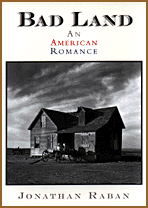
Bad Land: An American Romance

Bad LandRaban, Jonathan. The Bad Land: an American Romance.

In honor of both the month Montana became a state and National Train Month I put Bad Land  on my list. It reads like a river. Some parts read like racing rapids while others slow to languid pools of near stillness. Then there are the waterfalls, where the language is cascading awe-inspiring. It was during these “waterfall” sections that I wanted to pack a bag and head west, just to see it for myself.

Raban helps you look at Montana from the point of view of the immigrant (emigrant), the artist, the ancestor, the traveler, the naturalist. Like standing back from a canvas to discover hidden colors. It’s a historical story, lyrically descriptive and informative. It’s a biography of the landscape as well as the people settled there at the turn of the century.
Favorite lines:”…mouth like a mailbox” (p 67).
“Mrs. Nemitz, scenting sarcasm, put his face on trial for a split second, but found it not guilty” (p 104).
“It’s exhilarating and scary, to lighten ship every so often, to kiss goodbye to the accumulated tonnage of ones life so far” (p 114)
“now the book is full of brittle ghosts” (p 136).

BookLust Twist: Mentioned twice in Book Lust. Once in the chapter called “Montana: In Big Sky Country” (p 156)…in which Pearl calls Bad Land  “the best book about Montana by a non-Montanan” (p 157); and “Riding the Rails: Railroad History” (p 201).

1968: The Year That Rocked the World

1968Kurlansky, Mark. 1968: The Year That Rocked the World. New York: Ballentine Books, 2004.

The year before I came into being. What an amazingly troubled yet vibrant time. There is very little that Kurlansky doesn’t cover. Everything you want to know about what changed world views is here. My favorite chapters were about the civil rights movement and the protesting that went on. From sit-ins and the feminist movement to Freedom Rides and every raised sign in between. Talk about voicing your opinion! Here are my favorite quote on the subject: “The protesters can be nonviolent, but they must evoke a violent reaction. If both sides are nonviolent, there is no story” (p. 38). For this very reason women had a hard time getting their January protest march on Washington documented. They weren’t violent enough.
The harder chapters to read were about politics and the Vietnam war, two very unavoidable subjects for 1968. Both carried the weight of violence and unbridled hatred. The Chicago convention in August…”miraculously, the clubbings in Chicago killed no one…At the same time, Vietnam had its worst week of the summer, with 308 Americans killed, 1,134 wounded, and an estimated 4,755 enemy soldiers killed” (p286).

BookLust Twist: In the chapter “The 1960s in Fact & Fiction” (p 179) from More Book Lust.