Blackbird, Farewell

Greer, Robert. Blackbird, Farewell. Berkley: Frog Books, 2008.

I took a chance requesting Blackbird, Farewell for the Early Review program. For one thing, I don’t know that much about basketball (the little I do know I learned this season from watching the Celtics win the championship this year). For another, I have never read a CJ Floyd novel. I didn’t want to make comparisons or see how it stacked up against to other CJ Floyd books. None of that really mattered when I got down to the serious reading.

Blackbird, Farewell starts out a little rough. It begins with Shandell “Blackbird” Bird going to make a deposit at a bank. Within 27 pages he is dead. Leading up to his murder Bird is described as “having a problem”, jittery, frustrated, sad, mechanical, dismissive and blank. It seems excessive considering the reader already knows he is to die. The cliches did little to pique my interest as to what was really wrong with Bird or care when he was killed.

When Bird’s best friend and college teammate, Damion “Blood” Madrid decides he needs to solve the murder the plot of Blackbird, Farewell  picks up. Madrid is the godson of famed CJ Floyd, a Denver, Colorado bail bondsman. While rough around the edges Madrid does a good job tracking down key players in the mystery. Of course he has his beautiful girlfriend, Niki, for a sidekick as well as the mafia, a hitman, and a Persian Gulf war vet (flora Jean Benson, CJ’s partner). Blackbird has enough drama (violence & sex) to make it interesting but not overly stereotypical of murder mysteries. The streets of Denver, as well as surrounding towns of Fort Collins and Boulder serve as an accurate and appealing backdrop for Greer’s mystery to play itself out.

Final thought: If Greer is trying to sell Blackbird, Farewell on the popularity of other CJ Floyd mysteries he shouldn’t. CJ Floyd doesn’t even enter the picture until the final 20 pages of the book. It is misleading to lure readers in by saying CJ Floyd is there to watch Madrid’s back (back cover) when he isn’t even in the book until the very end. Floyd fans are sure to be disappointed. Blackbird, Farewell stands alone a fun read apart from the CJ Floyd series.

Edited to add: If I were Greer’s editor I would have asked him to change Flora Jean’s “gasket popping” comment to something else, especially since not even five pages later a completely differently character is using a very similar gasket phrase.

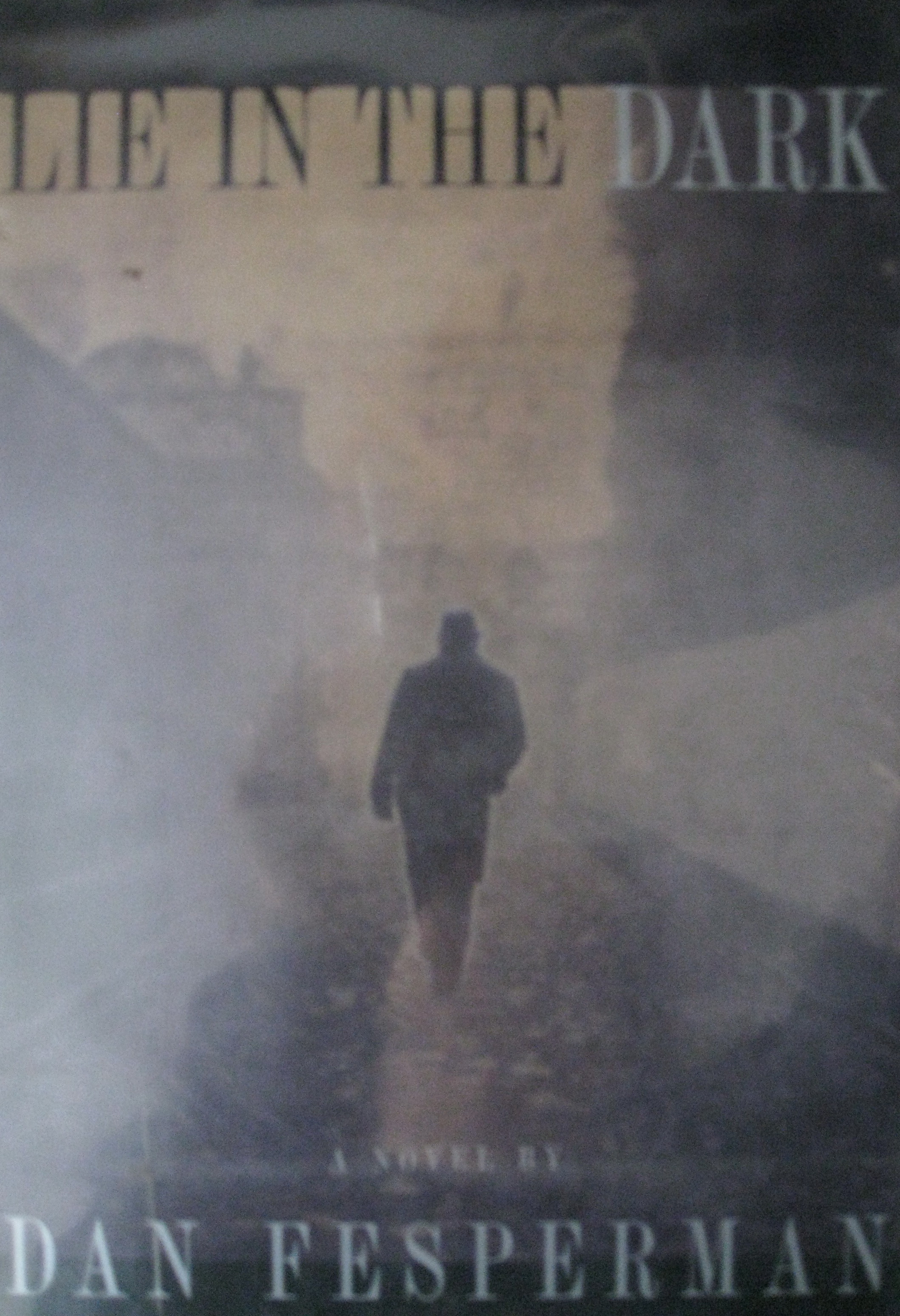
Lie in the Dark


Fesperman, Dan. Lie in the Dark. New York: Soho Press, 1999.

 I can remember this intense sadness when the civil war in Sarajevo broke out…the second time. It seemed like yesterday the Olympics were held there & it was a city of promise, of dreams come true.

Lie in the Dark is an interesting tale about life in war-torn Sarajevo and one police inspector’s fight to win his own private war. In the beginning of the conflict Vlado Petrics’s wife and infant daughter were allowed to escape to Germany. Vlado, as with all men of military serving age, stayed behind. He escaped being drafted into the military because of his employment as a policeman.
While investigating a murder Vlado is confronted with a much bigger scandal than he bargained for. Not knowing who to trust he works alone, unraveling the mystery while the civil war continues all around him. Woven into the plot are the harsh realities of what war can do to economics, politics, families, the landscape and the human spirit.

Right away I knew I would like this book. Fesperman does a great job describing the absurdity of investigating a murder in the middle of a war. As Fesperman says (p 2) “Vlado’s task was that of a plumber fixing leaky toilets in the middle of a flood.” It makes you realize that people will grasp and struggle for normalcy even if it doesn’t make sense.

Favorite lines: ” They never stopped retreating, ending up at the bottom of either a bottle or a grave” (p 5).
I found this next line profoundly sad: “It had taken the first few weeks of separation to rediscover her as lover, as something more than the wife and mother she’d become” (p 83).
“He felt himself beginning to deaden, to go numb and cold and dreary as he left the truth behind” (p 86).

BookLust Twist: From More Book Lust in the chapter “Crime is a Globetrotter” (p 59).

Jackson’s Dilemma

Murdoch, Iris. Jackson’s Dilemma. New York: Viking, 1995.

I hate it when I read a review that influences my way of thinking, my way of reading a book. This happened innocently enough. I was looking for more information about Jackson’s Dilemma. Was it ever made into a movie? Adapted for the stage? A musical? As a result of my searching I discovered Jackson’s Dilemma was Murdock’s last book. Not only that, but she was diagnosed with Alzheimer’s right around the time of publication. Inadvertently, I read two reviews that seemed to blame the disease for the demise of Murdoch’s craft. In other words, Jackson’s Dilemma bombed. Because of the reviews I found myself wondering about the words. I will admit, the beginning was slow and the characters, curious, but in the end I didn’t think it was all that bad.

It starts off on the eve of Edward and Marian’s wedding. Edward is enjoying dinner with friends when he discovers a note under the door: an “I can’t marry you” letter from Marian. There is no explanation but the following day there is much hoopla about making sure people are “barred” from the church and from attending a wedding that won’t happen. All of Edward’s friends are absurdly devastated by this turn of events, so much so that I started to really question their sanity. Meanwhile, both Edward and Marian disappear (separately, of course). Enter Jackson (Just Jackson, no last name). Even his arrival is peculiar.

In the end the plot becomes a garbled mess. Everyone is trying to be in love with someone else, exclaiming undying devotion left and right. Even Owen (male) and Tuan (also male) have some kind of odd, unexplained relationship going on. Despite all this, I did have two favorite lines: “The moon was not present, being elsewhere” (p 22). Who actually knows where the moon was, but I thought that was funny. The other line: “After all, as Randall said, it’s the sea that matters” (p 100). Too bad Randall would lose his life to the very thing that mattered.

BookLust Twist: Book Lust in the chapter “Iris Murdoch: Too Good To Miss”. Leave it to me to read her last book (sorta) first.

Chasing Vermeer

Balliett, Blue. Chasing Vermeer. New York: Scholastic Press, 2004.

I love it when a book takes me somewhere new. It’s even better when it opens doors to other interests that stick. It’s best when it’s completely unexpected. Such is the case with Chasing Vermeer. When I first realized it was a young adult book I thought I would get through it in a day, get through it and move onto something more my speed. Who knew this book would be just my speed? For starters there is a play-along game involving pentominoes. If you can’t get the hidden message there is an interacted website (still active) to help you out, complete with other games to get you sidetracked. Then, there is the discovery of something completely unexpected I mentioned before. Chasing Vermeer mentions a lot of Vermeer’s work in detail so I started doing a little more research and found a fantastic website dedicated to Vermeer. It’s really great. I lost my lunch break playing with it! I love learning something new everyday in the most unexpected ways. But back to Chasing Vermeer, the book.

It’s a great mystery for kids and adults alike. Petra Andalee and her new found friend Calder Pillay find themselves in the middle of a mystery complete with codes and the crime of stolen art. It starts off with Petra and Calder as classmates with a weird assignment: find letters in art. Both Petra and Calder call the other “weird” and can’t imagine ever being friends, but soon weird coincidences bring them together to solve a mystery involving an old woman, the FBI and an international art scandal.

Here are some quotes that nabbed me: “Good letters were no longer written. He was sure of it” (p 23). Glad I’m not the only one who feels this way!
“What was art, anyway? The more she thought about it, the stranger it seemed” (p 40). My thoughts exactly!

BookLust Twist: From More Book Lust in the chapter “Best For Boys and Girls” (p 21).

Murder on the Leviathan

Murder on the LeviathanAkunin, Boris. Murder on the Leviathan. New York: Random House, 2004.

Oddly enough, I chose this book because it was written by an author who spent a great deal of time in Moscow and a guide book advised me that now was the best time to visit Russia. There was no other reason to read this at this particular time. But, having said that, I’m glad that I did. It was fun.
Murder on the Leviathan starts out violently, a record of an examination of a crime scene set in 1878. I think the murders of ten people ranging from ages 6 to 54 in one Parisian house would cause a stir even in the 21st century. Oddly enough, this is not the murder the title of the book refers to. Commissioner Gauche discovers a clue that leads him to the Leviathan, a giant steamship headed for Calcutta. As he sets sail with a host of interesting passengers (in first class) he soons discovers each and every one of them is a potential suspect. It gets interesting when people start dying on the ship. A Russian detective soon joins Gauche on the hunt for the killer.

I didn’t find any quotes to include, but I did have to look up “gutta-percha” shoes. Depending on who you ask, gutta percha is described as tree gum, rubber, or plastic.

BookLust Twist: In More Book Lust in the chapter “Crime is a Globetrotter”, subsection, “Russia” (p 59).

Case for Three Detectives

Case for Three Detectives
Bruce, Leo. Case For Three Detectives. Chicago: Academy Chicago, 1936.

First things first: Leo Bruce is actually a pseudonym for Rupert Croft-Cooke. Just had to get that out there. Second, I have to say how disappointed I am to not be up on my mysteries – or at least the detectives of pop culture! Nancy Pearl compares the three detectives in Case for Three Detectives with Peter Wimsley, Father Brown, and Hercule Peirot. I have only vaguely heard of Peirot so I had no idea what she was talking about! My loss, I guess.
Maybe it’s a generational thing (because this book was written over 70 years ago). Maybe it’s a cultural thing (because this book is decidedly British). Either way, I wasn’t able to get over the fact that, despite a murder (a woman’s throat was slashed), not only were people capable of carrying on as if nothing happened (washing cars and entertaining), but the guests were included to help solve the mystery. Now, I have to keep in mind in those days guests stayed overnight and became “house guests” and dinner parties consisted of four or five house guests, each with his or her own room. 
Pearl included this in her “humor” section but warned I probably wouldn’t laugh outloud, and she’s right. I didn’t. It’s the mystery of three off the wall detectives trying to solve a murder. Each comes up with a completely different yet plausible scenerio for what could have happened. You find yourself saying, “but, of course!” until you hear the final Who Really Did It story. 
A line that made me smile: “‘If you mean spiders,’ he said, ‘I know only two things about them. And those are the things which everyone knows. They kill flies. And they hang on threads.'” (p53).

BookLust Twist: From More Book Lust in the chapter “Tickle Your Funny Bone” (p 218).

Fer-De-Lance


Stout, Rex. Fer-De-Lance. Pennsylvania: Franklin Library, 1934.When I saw this book arrive in the library van box for me I got very excited about the cover alone. It’s beautiful! I didn’t even know it was my requested book, just that it had a gorgeous cover. How’s that for judging a book by its cover? I have heard so much about Rex Stout and his Nero Wolfe mysteries but had never read one before now. I have to admit, I didn’t really care for the character of Mr. Wolfe. He seems to spend a lot of time bossing other people around while being very, very particular about his own activities. The story is actually told from the point of view of his assistant, Archie Goodwin, who seems to do all the legwork work solving mysteries since Wolfe never leaves home.

So, the plot to Fer-De-Lance is this: a man is found murdered. Clues in his room lead to the death of someone else. Ultimately, it’s the solving of the second death that leads to the truth of the first death. It’s a fun story. Here are some of my favorite quotes:
“I made some sort of conversation so O’Grady’s ears wouldn’t be disappointed” (p 39).
“Maybe your salary is the only rope that holds Saturday and Sunday together for you” (p 48).
“It is always wiser, where there is a choice, to trust inertia. It is the greatest force in the world” (p 190).
“A genius may discover the hidden secrets and display them, only a god could create new ones” (p 246).

BookLust Twist: From Book Lust and the chapter “Rex Stout: Too Good To Miss”

24 hours

Iles, Greg. 24 Hours. New York: G.P. Putnam’s Sons, 2000.

A kidnapping mystery set in Mississippi…sort of an odd read for the holiday season, but December is the month Mississippi became a state.
Here’s the storyline: Basically, this guy, Joe, has set up the perfect kidnapping scheme. He targets a doctor who has a spouse and child, learns all he can about the doctor’s family and then while the doc is at an annual convention he kidnaps his/her child. His cousin (a hulking man with the IQ of a chipmunk) holds the child in a remote location while his “wife” entertains the male parent and Joe entertains the female parent for 24 hours. They call each other every 30 minutes and if a call is missed Cousin Chipmunk kills the kid. In the AM one parent wires the ransom to the other parent so the kidnapper doesn’t have any connection to the withdrawal. The money is always an amount the doctor can afford and the kidnapping always works because the child is worth more than getting the money back or calling the police. The detail that makes the whole thing work are the every 30 minutes phone calls. Everything hinges on those calls and the convention – because the convention is the guarantee the doctor will be separated from the rest of the family for at least 24 hours.
Despite the brilliant plot I have two problems with detail. In the beginning both parents are told their family has been scrutinized and studied in great detail. The kidnappers claim to know everything about the family. If that is true then why did they not know their latest kidnapping victim was diabetic? If they knew everything how did they miss such a large piece of a child’s life? The second problem with detail is on page 164 – one of the kidnappers says “You have to chill, Will!” and is delighted by the rhyme of the doctor’s name, yet two pages later Iles writes, “Why don’t you at least face the truth about something, Will.” It was the first time she [the kidnapper] had used his Christian name” (p 166). No, actually it wasn’t. She told Will to chill two pages earlier. Ugh.
All in all, this moved fast and was a constant page turner. Every time I had to put it down I was at “the good part” and hated to stop reading. The end is a little over-the-top dramatic and there are loose ends, but well worth the read.

BookLust Twist: In More Book Lust in the “Southern Fried Fiction (Mississippi)” chapter (p 208).

Above Suspicion

Above SuspicionMacInnes, Helen. Above Suspicion. New York: Harcourt Brace Jovanovitch, Inc., 1969.

This book smells of stale cigarette smoke when it got to me, like it had been hanging out in a 1980’s bar until closing time. The library issued plastic cover is falling off, the tape is yellowing, too. This is not a book that feels good to hold and that really matters to me. I don’t know how many other readers feel this way, but a book has to look a certain way, feel a certain way… in addition to read a certain way.
Nevertheless, the story was intriguing. It’s the story of a young couple recruited to check out a chain of spies (suspected nazi sympathizers) during World War II. The plan is elaborate and dashing. As the story picked up pace I could barely turn the pages fast enough to keep up with my growing interest. Here are some of my favorite quotes (as usual):

“The party in Frame’s rooms had just reached the right temperature when Frances and Richard Myles arrived” (p 17).

“It was strange how her mind, as well as her stomach, rebelled when the choice was sausage or sausage or sausage” (p. 86).

“At first, Richard would only take her on a short ten-mile walk” (p.111). Yikes! I’m lucky if I get in five miles a day!

One of the things I loved about this novel was the interaction between Frances and Richard as man and wife (only married four years). They took cues from each other, nonverbal signs, and acted accordingly. Their intimate knowledge of one another bordered on parapsychology.

BookLust Twist: Nancy Pearl has some great things to say about Above Suspicion in her second Book Lust book, More Book Lust. She calls it “pure fun” something she “rereads regularly” (p 162). For a person who reads a lot that’s a pretty big compliment.

A is for Alibi

Grafton, Sue. A is for Alibi. New York: Henry Holt & Co., Inc. 1982.

My mother-in-law was surprised to see me reading a Sue Grafton mystery. Mysteries have never been my thing. I don’t think she was convinced even when I explained that it was a Book Lust recommendation. I kept saying things like “I have to…” and “it’s on my list…” and still I got the skeptical stare. I’ve decided to loan her my “lists” in other words, my Lust books because I also have to read the F & Q books from Grafton.

I was struck by how much I have in common with Kinsey Millhone, Grafton’s main character. She dedicates Sundays to herself. I used to dedicate Friday with the same to do list: “laundry, housecleaning, grocery shopping. I even shaved my legs to show that I still had some class.” (p82) Kinsey runs even though she’s not good at it. She has conversations with her body when she runs. Me, too – although I could call mine arguments and not conversations. She’s big on breakfast. She drives fast. She even feels the same way I do about dogs if not plants. “I don’t know a lot about houseplants, but when all the green things turn brown, I’d take that as a hint.” (p. 33) Me, I’m a plant person. I may kill one or two along the way but if one dies I consider it suicide, taking one for the team.

Seriously, similarities aside I liked Sue Grafton’s first “alphabet” mystery. Kinsey is cool, as she should be. The mystery she was trying to solve had all the important gun on the table elements: murders, clues, infidelities, suspicions, low lifes, and more sex. My only disappointment? I had the culprit picked out before the end. Why? He was too good to be true.

BookLust Twist: Pearl has a huge mystery list in Book Lust. A is for Alibi comes from the chapter called, I Love a Mystery” (p 117).

An Unofficial Rose

Murdoch, Iris. An Unofficial Rose. New York: Viking Press, 1962.

I read this book in practically one night. I have mixed feelings about Murdoch’s Unofficial Rose. For starters, I never felt like I got to know the characters well enough to care about what happened to them. To be honest I was disgusted by them, all of them. The relationships could be broken at a whim. Marriages meant nothing. It reminded me of a throw of the dice. Partnerships came and went, were formed and were broken again. Nothing was permanent or sacred.
The thing I liked the most was the suspense. No one knew who was really being honest with anyone else. I didn’t know where anyone’s true heart was laid. Okay – here’s a spoiler: son wants to run off with his young mistress. He demands money from his father in the form of the sale of a beloved painting just so he can run away with said mistress. Father sells painting, even though it was his prized possession (and the very item he thinks he married his wife for). Son’s wife has a chance at divorce and a new relationship with someone who might love her and she admits loving back. She declines just in case cheating hubby changes his mind and comes back to her. I was irritated with her but I did not know the character enough to care.

Booklust Twist: Nancy Pearl recommends anything and everything by Iris Murdoch (Book Lust, p.162).