Fine and Private Place

Beagle, Peter. A Fine and Private Place. New York: Viking, 1960.

For starters I have to say I love first novels. It’s that “dammit, im gonna do it” book. That leaping off point of either ‘no return and so I write’, or ‘that failed so I go back to whatever it was I had been doing before I put pen to paper’ (or whatever method they use these days). In Peter Beagle’s case I think A Fine and Private Place was a huge success.

A Fine and Private Place is haunted yet humorous. It takes place in a cemetery with a talking black bird (a sarcastic one at that) and a homeless man as its residents. The dead have issues with remembering yet have no problem complaining to the living man lurking in their midst. That man would be Mr. Rebeck, the one time druggist who now spends his days (and nights) in the New York cemetery. In fact, he hasn’t left the grounds in nearly twenty years. A Fine and Private Place delves into what it means to have a soul, even if it gets lost from time to time. It’s the story of different relationships struggling to make it despite the differences. Throughout the story there are minor mysteries. Why, for example, is Mr. Rebeck living in the cemetery? Did Michael Malone’s wife really murder him? And, what’s with the talking bird? Don’t expect a lot of action from A Fine and Private Place. The majority of the story is filled with introspective musings and the plot is centered on character development and how those characters interact with one another.

Two of my favorite lines, “He had begun to tell her about the raven when he realized that Mrs. Kapper’s credulity had been stretched as far as it would go and would snap back at the slightest mention of a profane black bird bringing him food” (p 145), and “He hastily subpoenaed a sleepy smile” (p 158).

BookLust Twist: Perfect for Halloween, although it wasn’t scary – from More Book Lust in the chapter called, “Gallivanting in the Graveyard” (p 96).

Queen’s Gambit

Tevis, Walter. The Queen’s Gambit. New York: Random House, 1983.

This was speed reading at its best. I read this in one day. Elizabeth “Beth” Harmon started as an orphan after her mother is killed in a car accident. Having lived a sheltered life she is scared of everything. Having no friends and no security she finds comfort in institution-issued tranquilizers and learning to play chess with the janitor in the basement. As a 12-year-old she is adopted by a strangely distant couple, Mr. & Mrs. Wheatley. I was disappointed by the lack of character development for Beth’s adoptive parents. Their actions throughout the story are confusing and I found myself second-guessing their intentions, especially Mr. Wheatley. But, The Queen’s Gambit is not about Mr. or Mrs. Wheatley. It’s about Beth’s rise to fame as a top notch chess player in a male dominated world. With Mrs. Wheatley’s support Beth gets involved in the tournament scene and starts her catapult to the top, beating out the best of them. Only the Russians stand in her way of claiming world champion and the only thing holding her back is her troubled past. She never loses the addictions she found at the orphanage. As she struggles to keep sober she learns valuable lessons about what it means to need people.

The lines that sums up Beth the best: “She was alone, and she liked it. It was the way she had learned everything important in her life” (p 113).

BookLust Twist: From More Book Lust in the chapter called, “Child Prodigies” (p 43). contrary to what I said before, I read this in honor of October being “Special Child Month.”

As an aside ~ this weekend I went home for a family reunion. We all stayed at this gorgeous, huge house right on the bay. In one corner of the living room there was a chess board set up, ready for a game. After reading The Queen’s Gambit I was curious about the pieces; because there is a scene where Beth is describing the “cheapness” of someone’s set – plastic pieces on a warped board.

House on the Strand

du Maurier, Daphne. The House on the Strand. New York: Doubleday Company, 1969.

I chose this book for October because somewhere out there someone deemed October National Starman month…whatever that means. When I think of Starmen, I think of David Bowie and Starman and Moonage Daydream. Don’t ask me why. I just do. That leads me to think of Natalie singing his version of  “keep your mouth shut, you’re squawking like a pink monkey bird” and that’s when things get really weird. And weird to me is, and will always be, October. Halloween and all that.

Dick Young and his old college chum (and biophysicist), Magnus Lane, are working on a potion that can send a person back in time. Their potion is in the planning stages and when we first meet Dick he has just tried to time-travel for the first time. His trip is successful and he finds himself in the 14th century. The travel itself is more a mental trip than a physical one. While Dick’s physical body stays in the 20th century it’s his mind that is actively in the 14th century. This explains why Dick can walk as if he is a ghost, undetected, through the past. Unhappy with his 20th century life, married to a woman with two boys from a previous relationship, Dick finds himself traveling back to the 14th century more frequently and  recklessly. It becomes an addiction to stay “connected” to the people of the time, particularly an attractive woman named Isolda. The story ends in tragedy, as it only could. Because it hasn’t been researched properly, the drug gets the best of Dick and Magnus in the startling conclusion of House on the Strand.

Oddly rational question: “The point is this: Does the drug reverse some chemical change in the memory systems of the brain, throwing it back to a particular thermodynamic situation which existed in the past, so that the sensations elsewhere in the brain are repeated?” (p 14). Hmmm…
My favorite line: “I realised at that moment, more strongly than hitherto, how fantastic, even macabre, was my presence amongst them, unseen, unborn, a freak in time, witness to events that had happened centuries past, unremembered, unrecorded; and I wondered how it was that standing here on the steps, watching yet invisible, I could so feel myself involved, troubled, by these loves and deaths” (p 68).

BookLust Twist: From More Book Lust in the chapter called, “Time Travel” (p 221).

Out of the Silent Planet

Lewis, C. S. Out of the Silent Planet. New York: Macmillan, (no date).

Maybe I am not used to reading science fiction, but this was one of the more unusual stories I have read. Then again, isn’t science fiction supposed to be strange?

Dr. Ransom is a Cambridge philologist who inadvertently runs into two old classmates from his school days. He never really liked them and with good reason. He likes them even less when they drug and kidnap him and take him for a cruise across the universe in a spaceship. They end up on the planet of Malacandra (traditionally known as Mars) where Ransom is to be sacrificed to one of the alien creatures. Lewis tells this story as though the reader is sitting across from him beside a roaring fire. He describes Ransom’s journey and reactions to this foreign new world as oddly detached and strangely calm. Probably the most interesting part to the whole story is how Ransom relates to his new world. He almost takes to it better than his own. He is quick to determine different species and tribes.

And yet, there is humor, too: “Ther period spent in the space-ship ought to gave been one of terror and anxiety for Ransom. He was spearated by an astronomical distance from every member of the human race except two whom he had an excellent reason for distrusting” (p 27).

Another quote I liked, “The love of knowledge is a kind of madness” (p 56).

Side notes: Oddly enough, my copy of Out of the Silent Planet [ISBN 0025707906] did not have a copyright date anywhere on it and Iron Maiden has song called “Out of the Silent Planet.” Wonder if they read C.S. Lewis. Probably.

BookLust Twist: From Book Lust in the chapter called, “Science Fiction, Fantasy and Horror” (p 213). This, of course, was science fiction.

October Was…

October was dinner with a few good friends, a trip homehomehome, a walkathon, the decision to not care about you anymore, the Pumpkin Fest, a trip to the sugar shack, a Rock Band party, a Sex in the City night, a car accident, a dislocated arm, a marathon phone call which I needed desperately, the birth of Manorabug Spuke, a few anniversaries, cleaning house, setting up shop.


Here is October’s list of books:

  • Carry on, Jeeves by P.G. Wodehouse ~ delightfully English and silly
  • Accidental Tourist by Anne Tyler ~ characters so real you could bump into them on the street.
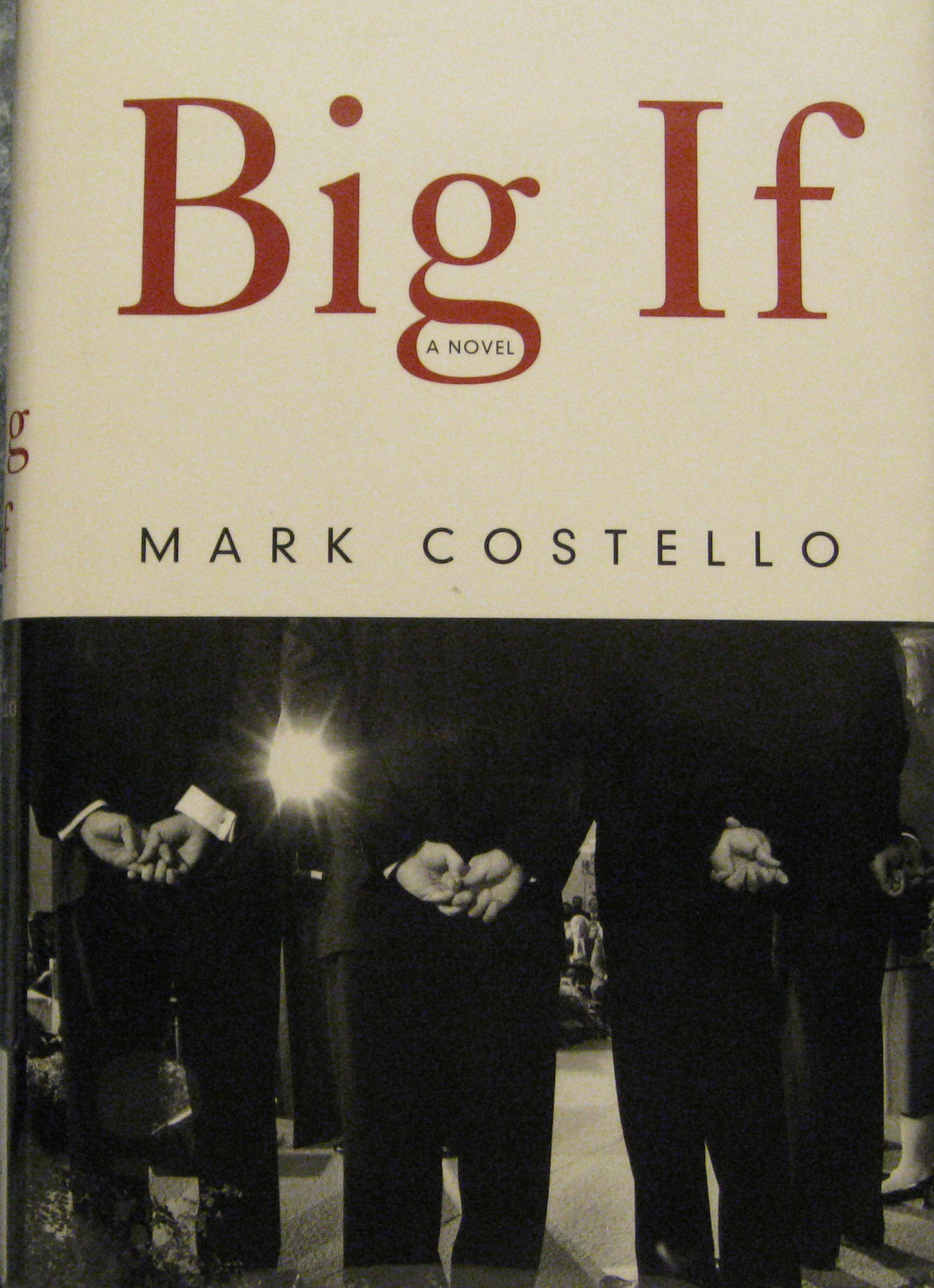
  • Big If  by Mark Costello ~ probably the best book of the month, considering we are in an election year.
  • Artemis Fowl by Eoin Colfer ~ a book for kids but delightfully wicked for adults as well.
  • Dubliners by James Joyce ~ celebrating the best time to visit Ireland.
  • The Cask of Amontillado by Edgar Allan Poe ~ perfect for Halloween!
  • Crime Novels: American Noir of the 1930s & 40s (Contents selected and notes written by Robert Polito) ~ Reading this knocked three other Challenge books off my list!
  1. The Postman Always Rings Twice by James M. Cain
  2. They Shoot Horses Don’t They by Horace McCoy
  3. The big Clock by Kenneth Fearing

For the first time in a long time I didn’t get a Early Review book from LibraryThing. Odd thing is, I’m not disappointed. It was nice to not have to worry about how to squeeze it into an already packed reading schedule. It was nice not having to stress about writing the review “on time.” True, one could argue that there isn’t really strict deadline but I always feel obligated to get something written before the book goes on sale. Isn’t that the point? Having said all that, I will be requesting for October because well, the wait is half the fun!

Dubliners

Joyce, James. Dubliners. New York: Signet, 1991.

When I was in high school I fell in love with James Joyce’s style of writing. We share the same birthday. The Dead, a short story from Dubliners was my all time favorite. Gabriel became my favorite name; a long lost child.

Dubliners is comprised of 15 short  and simple stories all centered around the people of Dublin. To sum up the collection it is a portrait of a city as seen from the eyes of the people living there. The very first story, The Sisters, is nothing more than a family’s reaction to a priest’s death. While the characters are not connected, their stories are. Life and death, love and loss, youth and aging, poverty and wealth. Joyce does a remarkable job capturing the spirit of the Irish while revealing universal truths about mankind as a whole. It is as if we, as readers, get to peek into the character’s lives and are witness to moments of our own circumstances.

What I find so remarkable about Dubliners is that Joyce originally had great trouble getting it published. And even after he finally did it didn’t sell that well.

BookLust Twist: From Book Lust in the chapter “Irish Fiction” (p 125). Where else? Edited to add: I’ll tell you where else…Book Lust To Go in the chapter called “Ireland: Beyond Joyce, Behan, Beckett, and Synge” (p 110). I guess you could say Dubliners shouldn’t be included in this chapter because it’s supposed to be about “beyond Joyce.” Something to think about.

Cask of Amontillado

Poe, Edgar Allan. The Cask of Amontillado. Mahwah: Troll Publications, 1982.

Okay, okay. I admit it. The version I read of Edgar Allan Poe’s Cask of Amontillado was from my library’s Education Curriculum Library – a kids version. Only 32 pages long and brightly illustrated, it was a pleasure to read… in about five minutes. But, that’s not to say I haven’t read it before in it’s original text. And…I reread it online again thanks to the Gutenberg project.

The Cask of Amontillado is a psychological, creepy thriller. Perfect for October. Montressor has had his ego wounded badly by Fortunato. Looking for revenge Montressor waits until Fortunato is well in the drink and can be lured away to his death. The entire story is a study in human failings.
Montressor is able to convince Fortunato to come with him because Fortunato cannot bear the idea of another man playing the expert in identifying Montressor’s Amontillado wine. Montressor uses this jealousy to spur Fortunato deeper into the catacombs. At the same time Montressor showers Fortunato with concerns for his health in an effort to steer Fortunato away from suspicion. For Fortunato cannot suspect a trap if he is the one insistent on continuing deeper into Montressor’s underground chambers.
The reader never does find out what insults Montressor has suffered at the hands of Fortunato. The wrong doing is certainly not as important as the revenge.

Favorite scene: Fortunato questions Montressor’s membership as a brother, a mason. Montressor unveils his trowel as a sign but Fortunato never questions why he would have such a thing with him at that moment.

BookLust Twist: From More Book Lust in the chapter, “Horror for Sissies” (p 119).

Crime Novels

Polito, Robert. Crime Novels: American Noir of the 1930s & 40s. New York: Library of America, 1997.

Something scary for Halloween. Six different stories about crime. Three of them are novels already on my list. Go figure.

  1. The Postman Always Rings Twice by James M. Cain
  2. They Shoot Horses Don’t They? by Horace McCoy
  3. The Big Clock by Kenneth Fearing

and three others:

  • Thieves Like Us by Edward Anderson
  • Nightmare Alley by William Lindsay Gresham
  • I Married a Dead Man by Cornell Woolrich

From The Postman Always Rings Twice~ I have always wanted to know what this story was all about. Written in 1934 it tells the sexy, gritty tale of Frank Chambers, a drifter who finds himself grounded by Cora Papadakis, a married woman. Cora’s beauty and instant mutual attraction leads to Frank’s uncharacteristic staying put. Soon the adulterous couple is contemplating murder. The plot is timeless. Desire has led them to the devil’s doorstep.
Favorite lines: “I kissed her. Her eyes were shining up at me like two blue stars. It was like being in church” (p13).
“Then the devil went to bed with us, and believe you me, kid, he sleeps pretty good” (p 70).
What Nancy had to say about : “…filled with desperate, scheming men and women…” (Pearl, Nancy. Book Lust, p66).

From They Shoot Horses Don’t They?: This was a bizarre, psychological tale about two kids with very different dreams. Robert is looking to be a film producer and Gloria wants to be an actress. They pair up and enter a Hollywood dance contest knowing Hollywood bigwigs would be in attendance. The contest is all about making money, working the contestants like racehorses, making bigger and better stunts to attract sponsors and a bigger audience. Analogies to horse racing are abundant. From the title of the book it is obvious what happens in the end, but it’s a fascinating read just the same.
What Nancy had to say, “…wonderfully grungy dance-marathon nightmare novel” (Book Lust p 67).

From Thieves Like Us ~ : I found this to be a very slow moving, almost methodical story. Written in 1937 it tells the tale of three bank robbers: Elmo Mobley, T.W. Masefeld and Bowie A. Bowers. While the story of these thieves as fugitives on the run is interesting, what makes the entire piece come alive is the vivid imagery used to describe the landscape these men hide in. Across Texas and Oklahoma’s back country there are many farmhouses and hideaways to keep the story moving. Favorite lines: Oddly enough, the dedication caught my eye: “To my cousin and my wife, because there I was with an empty gun and you, Roy, supplied the ammunition and you, Anne, directed my aim” (p 216). Here’s where my sick mind went with this: Roy (the cousin) had an affair with Anne (the wife). Don’t mind me.
Second favorite line: “The moon hung in the heavens like a shred of fingernail” (p 224). There have been a lot of interesting moon descriptions, but I liked this one a lot.

The Big Clock by Kenneth Fearing started out slow. George Stroud works for a conglomerate of magazines in their Crimeways department. He is a simple family man with a wife and daughter, but his dreams and ambitious are big. When he has an affair with his boss’s girlfriend and she winds up bludgeoned to death things get a little tricky. It’s a story of conspiracy and cat and mouse. George must prove his innocence when everything points to the contrary. Once it gets going it’s fascinating!
From The Big Clock: “The eye saw nothing but innocence, to the instincts she was undiluted sex, the brain said here was a perfect hell” (p 383), “He said how nice Georgette was looking which was true, how she always reminded him of carnivals and Hallowe’en” (p 385) and “I could feel the laborious steps her reasoning took before she reached a tentative, spoken conclusion” (p 393).
What Nancy Pearl had to say, “…edgy corporate-as-hell thriller” (Book Lust p 66).

Nightmare Alley was intriguing on many different levels. It was the ultimate “what goes around comes around” story. The lives of carnival entertainers serves as the backdrop for Stanton Carlise’s rise and fall. He joins the carnival and soon picks of the tricks of Zeena, the Seer. Once Stan the Great learns the craft (an inadvertently commits murder) he leaves the carny and sets out on his own as a Mentalist, becoming greedier and greedier for taking the sucker’s buck. Soon he passes himself off as a priest with the capability of bringing loved ones back from the dead. Constantly running from troubles in his own life Stan gets himself deeper and deeper until no one is trustworthy.

I Married a Dead Man by Cornell Woolrich was probably my favorite. You don’t know much about Helen Georgesson before she assumes the identity of Patrice Hazzard. The facts are Helen is a pregnant girl, riding the rails with 17 cents to her name. A chance encounter and a terrible accident leave Helen with a case of mistaken identity. For the opportunity to start life anew and give her baby a better life Helen accepts Patrice’s identity as her own. Living the life of luxury doesn’t come easy when Helen’s past comes to town and threatens to unveil her true self.

BookLust Twist: Crime Novels: American Noir of the 1930s & 40s can be found in Book Lust in the chapter, “Les Crimes Noir” (p 65).


Artemis Fowl

IMG_3757
Colfer, Eion. Artemis Fowl. New York: Talk Miramax Books, 2001.

Another book that I finished in a day. I suppose it helped that it’s a book for young adults so it was a breeze to read. The real reason was it was a fun read.

Meet Artemis Fowl. Only 12 years old but already a millionaire – a criminally brilliant millionaire. When we first meet Artemis we learn he is out to kidnap a fairy. Let the games begin! From the very beginning Artemis Fowl is full of folklore. Besides fairies there are goblins, dwarfs, gnomes, a centaur, trolls and the ever tantalizing hoard of gold. Artemis, though only 12, has devised a plan to rid the fairies of their riches by using their own powers against them. For being a childrens’ book it is pretty fast paced and violent.

Favorite lines: “…A ragged apron does not a waiter make” (p 4), and “Holly unhooked a set of wings from their bracket. They were double ovals, with a clunky motor. She moaned. Dragonflies. She hated that model….now the Hummingbird Z&, that was transport” (p50). Can you just see it? Fairies don’t have wings! They have strap-ons! The idea that Holly was “stuck” with Dragonflies rather than her preferred Hummingbirds cracked me up.

BookLust Twist: From Book Lust in the chapter, ”

ps~ From what I understand Artemis Fowl was made into a movie. This is one to put on the NetFlix list!

Special thank youuuuu to Kisa Too Cool for posting…

Big If

Costello, Mark. Big If: a Novel. New York: W. W. Norton, 2002.

I love it when everything about a book comes together. Meaning, when the plot is exciting and moves along like a river after a good hard rain and characters are detailed and dynamic and even the small stuff is interesting. When all these things come together I can’t put a book down. I read this over the weekend. that should tell you something.

Jens and Vi Asplund are adult siblings with very different lives. Jens lives in New Hampshire with his real estate wife and toddler son. He spends his days as a computer programmer writing programs for violent video games his patriotic father never approved of. His sister, Violet is Secret Service bodyguard sworn to protect the life of the Vice President of the United States during an election campaign. She has nothing that resembles a social life, a love life, or even a home life. If she is lonely she would never admit it.

Big If  takes you inside the creative and neurotic genius of software programmers. Simultaneously, you are drawn into every potential threat made to high powered public officials, as well as reliving old threats-come-true like the assassination attempt on President Reagan. Jens and Vi couldn’t have different lives and seem worlds apart…until they collide.

Favorite line: “This was another Rocky trick, fukc this legalistic sh!t, talk to crazy people in the crazy people language” (p36).

BookLust Twist: From More Book Lust in the chapter “New England Novels” (p 177).

Special thanks to the Hot One for posting…

Accidental Tourist ~with spoiler

Tyler, Anne. The Accidental Tourist. New York: Berkley, 1985.

This was a reread. I couldn’t remember anything about it and rules are rules: if I don’t remember the plot, I don’t remember the main characters or, I don’t remember how it ended I read it again. This one was a cinch. I reread it in a day.

Macon Leary is a man stuck in his ways. He’s so eccentric I almost disliked him in the beginning…until I met his family. They’re all the same way. Macon is the author of unique travel books centered around business travel. The problem is Macon doesn’t like to travel, doesn’t like meeting new people, doesn’t like being in unfamiliar places. Upon separating from his wife Macon’s whole life turns upside down. He learns how to feel emotions, to see the world as if through the eyes of a completely different person. The Accidental Tourist takes you on a journey of awakening and growth.

Lines that hooked me: “Could you really drive a car without reversing?” (p 18). Okay, not the most poetic of lines, but here’s the story: Kisa has a coworker who consistently parks in the turn around instead of using the lot – the huge lot. We used to complain about it until we found out his car couldn’t reverse!
“”She always seemed about to fall over the brink of something” (p 63). Love the imagery!
“Macon got out Miss MacIntosh just for something to pin his mind to” (318). It was at this moment that I knew Macon loved Muriel and would return to her. Don’t ask me why.

BookLust Twist: From Book Lust in the chapter, “Real Characters” (p 197). Incidentally, The Accidental Tourist was made into a movie. I’m thinking if Nancy Pearl ever writes another Lust book she should include books made into movies (worth seeing). I’m betting she would include this one.

Carry On, Jeeves

IMG_3756
Wodehouse, P.G. Carry On, Jeeves. New York: A.L. Burt, 1927.

This book just feels good in my hands. Published 10 years before my father was even born, it even looks its age. I guess I just like old books.

Carry on, Jeeves is a series of stories about how Jeeves acts as man-servant while repeatedly saving the day for Bertram Wooster. Each chapter sets up a different dilemma “Bertie” and/or his friends face and how Jeeves cleverly resolves every one of those dilemmas. There is a formula to these moments of crisis: someone is usually misleading a family member (usually an aunt) to think he is wealthy, in another part of the country, worth marrying, not worth marrying, etc. Jeeves’s solution is to mislead the “aunt” with a lie or two.  The lie is the smallest of gestures and usually something humorous happens – like the plan backfiring. While the general plot seems repetitious, Wodehouse’s style of writing is very funny. Side note: Bertie and Jeeves always seem to get into curious arguments about fashion.

Lines I liked: “I strained the old bean to meet this emergency” (p 47).
“I’m never much of a lad till I’ve engulfed an egg or two and a beaker of coffee (p 89).
“If this was going to be a fish-story, I needed stimulants” (p 167).

BookLust Twist: From More Book Lust in the chapter “P.G. Wodehouse: Too Good To Miss” (p 235). What I find hysterical about Pearl’s entry is her first sentence: “If you can ignore his somewhat rummy behavior…” (p 235). “Rummy” is a word Wodehouse uses over and over and over in Carry On, Jeeves.

Pushing September Out


I decided to push September out the door a little earlier than any calendar would suggest. Yeah, yeah. I have three more days, but who’s counting? Certainly not me. It’s been a hard month.

Truth be known I am always itching for October 1st. My Halloween has 31 days. My thrill time lasts all month. Better than Christmas. Don’t ask me why. I think it started when I was a kid. Mom would make these outrageous costumes (extremely elaborate, creative, funky…but on a frayed shoestring budget – we’re talking tinfoil and spray paint). My all-time favorite was a gigantic pumpkin made out of coat hangers, a bed sheet and lots of paint. I barely fit through doors, couldn’t sit down all that well and my face itched for days on end, but man! it was a cool costume. Another time sis and I were Miss Piggy and Kermit the frog. I remember being embarrassed by the ginormous breasts and blue eye shadow. We were a sight to see! Us kids would pile into the back of a pickup truck and bounce all over the island looking for treats while the older boys played tricks. Scary all the time they were worse on Halloween. Dusk brought eerie shadows to our faces as we tried to peer into plastic bags for goodies. Whoopie pies spilled from my mother’s kitchen as big as your fist. Apple cider simmering on the wood stove.

These days I don’t run around wearing orange and green paint pretending to be a vegetable from the patch. If I’m lucky I will get my kisa to take a walk among the trick or treaters so I can count the goblins. Every year someone on my block plays Nightmare Before Christmas on the side of his house. Candles glow from jack-o-lanterns on every stoop. Leaves crunch beneath our feet. There is some sort of magic in the air. I can’t really explain it. The sugar shacks start up their boils and put on breakfast feasts.
What I need to do now is find my way to the basement, locate the big box marked “Halloween”, drag it up to the living room, and unpack my spooky friends. Who cares if it’s still September? Who cares if I’m in the wrong month. It’s time to get back to the right state of mind.

The Way Men Act

Way Men ActLipman, Elinor. The Way Men Act. New York: Washington Square Press, 1992.
 I had to laugh when I wrote out the title of this blog. Yet another one that could be misconstrued as something juicy and personal. I guess I could write a whole dissertation on the way men act towards me, but that wouldn’t be the book review that this is intended to be.

Elinor Lipman celebrates a birthday in October so it was only appropriate that I try to squeeze in a novel of hers in the last days of the dying month. I have met Lipman before (at a local conference) so it was no surprise to discover The Way Men Act takes place in “my” town. While thinly veiled as somewhere else it was easy to recognize the landmarks and quirks that make up where I live. I have to admit that made reading The Way Men Act a little difficult. The entire time I pictured real store fronts, real schools, real people.
All in all I breezed through this book because it was a simple read. The kind of chick lit you crawl in the bath with and can read in one soak. The plot isn’t complicated, only fun fun fun, the way chick lit is supposed to read. Lipman’s heroine, Melinda LeBlanc returns home to Harrow. She has mixed feelings about being back where she grew up as if being home implies she didn’t make it in the real world. She comes back (single at 30) to work in her cousin’s flower shop. Her job is sandwiched between two other come-home-again classmates from high school: Libby, a fashion designer with her own shop, and Dennis, a wiz at tying flies for fishing for his own shop. In addition to being hung up on being home, Melinda has issues with educational status (Harrow is a snobby college town and she only has a high school degree) and of course, men. The ending was predictable. Melinda is too talented to be working for someone else, and yes, she’s gets the guy.

Favorite line: “Could a man hate me that strenuously that the weight of it would flip itself over and come up again as love?” (p 49)
I flagged other lines only to realize it wasn’t the wording I admired so much. It was Melinda’s relationship with her mother. Every scene had me envious of their obvious closeness.

BookLust Twist: Mentioned twice in Book Lust once in the chapter “Elinor Lipman: Too Good To Miss (p 146), and “My Own Private Dui” (p 165).  The latter chapter begs an explanation: Pearl has her own classification system for her books and The Way Men Act falls under the category of “books I reread when I’m feeling blue” (p 166).

Bean Trees

Bean TreesKingsolver, Barbara. The Bean Trees.New York: HarperPerennial, 1989. 

Barbara Kingsolver is my favorite author. I’ve said it before and I’ll say it again. I love the way she writes. The Bean Trees is on my Book Lust list and I’ve already read it hundreds of time. It’s the book I grab when I am in between other reads. It’s the book I reach for when I have a few minutes to kill while the rice bubbles on the stove. Given the chance to read it again just for Book Lust I am more than happy to jump at the chance.

Taylor Greer isn’t Taylor until she takes to the highway. Leaving her hometown of Kentucky to see something other than small town rumors and ruts she finds herself on the road, “adopting” a three year old American Indian girl on the way then finally landing in Tucson, Arizona.  Taylor is smart, witty and, for lack of a better word, feisty. She tells us her story with great observance to the spirit of humanity.

One of the things I love about Kingsolver’s work is the reoccurring themes: respect for nature described in gorgeous, vibrant detail, immigration and the political implications, the joys and struggles of motherhood (especially the single mother), the value of both belonging to a community and having independence. The Bean Trees is no different. All of these themes are carefully woven into the framework of the novel.

My favorite lines (okay some of them): “Whatever you want the most, it’s going to be the worst thing for you” (p 62).
“There were two things about Mama. One is she always expected the best out of me. And the other is that then no matter what I did, whatever I came home with, she acted like it was the moon I had just hung up in the sky and plugged in all the stars. Like I was that good” (p 10).

BookLust Twist: From More Book Lust’s first chapter called”Adapting to Adoption” (p 1). I have to admit I don’t agree with Pearl’s description of how Taylor “acquires” the American Indian child. Pearl says “When Taylor Greer leaves Kentucky for points west in order to escape the confines of small-town life, she finds an abandoned and abused Cherokee child left in her car…” (p 2). It actually went more like this: “Then she set this bundle down on the seat of my car. “Take this baby,” she said….”where do you want me to take it?” She looked back at the bar, and then looked at me. “Just take it.” I waited a minute, thinking that soon my mind would clear and I would understand what she was saying. It didn’t.” (The Bean Trees p 17). This is a poignant scene to me and it makes a big difference (to me) whether the child was left or handed over.

ps~ November is National Adoption month. I reread this just a tad early.