Bonobo: the Forgotten Ape

De Waal, Frans. Bonobo: the Forgotten Ape. Berkley: University of California Press, 1997.

Not to be snide or anything but how can you forget the ape when you didn’t know the ape? Everyone lumped Bonobo apes with Chimpanzees because they seemed more similar than different. They weren’t forgotten, just misunderstood. de Waal goes to great lengths to compare and contrast the distinctions between the two primates.

From the very beginning you learn that Bonobo apes are different from any other kind of primate with the description, “female-centered, egalitarian primate species that substitutes sex for aggression” (p 4). The sexuality of this species is very much celebrated and discussed. So much so that the sexuality of Bonobos is argued to be a window to the aspects of human sexuality. But sex is not the only discussion worth having about Bonobos. There is social life, a political life, a family life worth exploring. But, what makes Bonobo: the Forgotten Ape so appealing is its photography. Big, glossy “coffee-table book” pages illustrate the allure of these primates. Their facial expressions, family values and even their sexuality is on display in eight different photo essays.

Favorite quote: isn’t really a quote at all. It’s an illustration of the hands and feet of primates and man (p 27).

BookLust Twist: From Book Lust in the chapter called, “Our Primates, Ourselves” (p 180). Bonobo was forgotten in the index yet de Waal’s name wasn’t. Interesting.
Off the Tourist Trail

Off the Tourist Trail: 1, 000 Unexpected Travel Alternatives. New York: Dorsling Kindersley, 2009.

What a gorgeous, gorgeous book! The photography alone makes this book amazing. From the moment it arrived on my doorstep I couldn’t wait to start turning pages and ogle all the great pictures. The concept of Off the Tourist Trail is brilliant. A team of experts searched cheaper alternatives to the well-known, sometimes more expensive travel destinations around the world. The chapters are broken up by interest: historical, beaches, sports, and cultural to name a few. Every destination has a paragraph dedicated to practical information such as how to get there, places to stay and budget. The “Need to Know” paragraphs are filled with location, maximum height and average daytime temperatures. Probably the most interesting spin to all the information is the “Forget” section. Each comparison adds a build-up and letdown component for the better known destination. For example, in the “Architectural Marvels” chapter the ever-popular New York City is compared with with the lesser-traveled Chicago. New York’s letdown (architecturally) is the fact that its architecture is spread out over several miles and at times, difficult to view.  

An added bonus is the forward by Bill Bryson. I love the way he writes. The only drawback to Off the Tourist Trail is that it isn’t portable. Oversized and heavy, this is a book you can’t take in your carry-on. Do your research at home and save room in your bags for souvenirs.

Tracks Across America

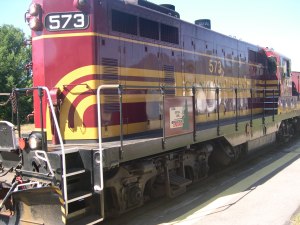
dscn0495Fisher, Leonard Everett. Tracks Across America: The Story of the American Railroad 1825-1900 with photographs, maps, and drawings. New York: Holiday House, 1992.

My father-in-law has a love affair with trains. He can’t wait for me to move out of his house so he can set up his ultimate railroad village complete with snow covered trees and a ski loving community. I can’t say I blame him. There is a romance associated with the railroad whether it’s the real deal or in miniature.

I think Fisher’s title would have been only slightly more accurate if he had added the word quotations to “with photographs, maps, and drawings” because that’s all that was missing. In addition to an informative narrative and the before mentioned photos, maps, and drawings Fisher includes fitting quotes from Charles Dickens, Ralph Waldo Emerson, and Woodrow Wilson as well as song lyrics and poetry fitting of the railroad era. While Tracks Across America is a condensed version of the story of the American railroad Fisher makes an effort to include all aspects of the history including life before the railroads, the building period, the Civil War, Native American “resistance” (really hard to read), famous robberies and disasters, and progress with bigger and faster engines.

One of the best discoveries was learning the origin of the phrase “wrong side of the tracks.” You were on the wrong side if the wind blew the soot and dirt from the trains in your direction. It was considered in poor taste to have a church or home “on the wrong side” but my question is this, what happened when the wind changed direction?

Favorite quote: “…that rails were to a train what water was to a boat; and that if a bridge was necessary to take a train over a river, then that bridge had a perfect right to be there” (p 47). This was Abraham Lincoln’s argument during his 1856 trial defending the railroad against a steamboat’s claim of damage.

BookLust Twist: From Book Lust in the chapter called, “Riding the Rails: Railroad History” (p 200).

Scavenger Hunt Antics

If you attended my wedding you know two things about me. I have never been one for tradition (what? no cake?) and I like to play a game called Photo Scavenger Hunt. It’s simple. One camera. One list of things to take pictures of within a certain time frame. At the wedding every table got a camera and a challenge to take pics of various people and things (like the head chef in the kitchen). That way I didn’t get a bunch of butt pictures! This time the time frame was simply “while on vacation” and I cheated. I had two cameras.
But, that’s beside the point. Here’s the list:

From the Plane:

  • puffy white clouds (piece of cake)
  • the desert
  • a mountain, any mountain

Las Vegas:

  • View from the hotel
  • A live flamingo
  • some sign or plaque of Benjamin Siegel
  • an outdoor slot machine
  • a living statue
  • “money”

Long Beach:

  • view from the hotel
  • a brown pelican
  • the Pacific ocean/ some seaweed
  • Kisa’s great aunt
  • a cactus

San Diego:

  • view from the hotel
  • a palm tree
  • a gorilla
  • my cousin’s flowers
  • proof for Ruby I wore “the dress”
  • someone’s feet
  • a bow tie

Ontario:

  • View from hotel room
  • something related to the Closer
  • a sunset
  • someone in the pool
  • the elusive cousins

I got nearly all the pictures I wanted. Here’s the set. I didn’t find the outdoor slot machine (big surprise) and the gorillas at the San Diego zoo had gone in for the day. I forgot all about a bow tie. I found something Closer related on the first day which was huge because I never made it to L.A. Also, I found three different Chipotles so that was a nice bonus. I even got everyone together for the dreaded cousin picture. Grand total: 859 pics on one camera; 362 pictures on another… 87 on a seperate memory card. 1,308 pictures.

American Century

IMG_0397

Evans, Harold. The American Century. New York: Alfred A. Knopf, 1998.

Weighing in at over 700 pages, American Century is nothing short of gorgeous. Bold black and white photos stand out on nearly every page, while satiric comics adorn the others. I have always loved the Brown Brothers photo of the construction workers on the Woolworth Building and was pleasantly surprised to see its inclusion on page xvii. 

I liked learning that President Cleveland bought the “dirt” on an opponent and upon receiving the envelope burned it, unopened, on the spot. He also suffered from cancer of the mouth and had an entire artificial jaw.

“You feel small in the presence of dead men, and you don’t ask silly questions” (p 332).
Here’s the LibraryThing version of my review:
“Any history buff should have this sitting on his or her shelf (and have a shelf sturdy enough to support this 700+ book). Chock full of intriguing cartoons and mesmerizing photographs, American Century covers every aspect of U.S. history from 1889 to the mid 1990s. Well written with commentaries and first hand accounts, history comes alive. The people, the politics, the power, the pitiful downfalls. The 20th century is laid out and every historical moment of worth is described and detailed.”

BookLust Twist: From Book Lust and the chapter “American History: Fiction” (p 21). I have to explain that this isn’t fiction. Pearl referenced The American Century while talking about Ken Baker’s novels. Ken Baker helped Harold Evans with The American Century.