Dec 09 is…

December 2009 is promising to be an interesting month. I’m taking Kisa to the island for Christmas (his first winter visit ever – we’ve already consulted L.L. Bean twice). Doctors are weighing in on serious subjects (yours and mine) and I await every word with caught breath. It’s not always about me, but the waiting is just the same.
For books it is a simple month:

  • Tiepolo’s Hound by Derek Walcott in honor of December being the best time to visit the Caribbean.
  • Tortilla Curtain by T. Coraghessan Boyle in honor of Iowa becoming a state (Boyle was part of the Iowa Writers Workshop. He was also born on December 2nd).
  • Perma Red by Debra Magpie Earling in honor of Native American literature month.
  • Wonderboys by Michael Chabon in honor of Pennsylvania becoming a state.
  • Walls Came Tumbling Down by Babs Deal in honor of Alabama becoming a state.

I don’t think I have any nonfiction for the month. Strictly imaginary but oddly enough, nothing about Christmas this year. For LibraryThing’s Early Review program I found out I am supposed to receive Then Came the Evening a first book by Brian Hart. I snuck a peek at some Library Journal / Amazon reviews and this promises to be a heartbreaking story.

When Found Make a Verse Of

Bevington, Helen Smith. When Found, Make a Verse of. New York: Simon and Schuster, 1961.

This book has a fascinating concept. Using a phrase from Dickens’ Dombey and Son (“when found, make a note of”), Bevington changes it to “when found, make a verse of.” Throughout literature Bevington’s reaction to it is to write a poem. When Found Make a Verse Of is her way of responding to what she has read. A conversation between writer and page. Oddly enough, the poetry was my least favorite part of When Found, Make a Verse Of. I enjoyed the pieces of literature from Yeats, Cummings, Frost, Russell (to name a few) and found them just as fascinating as Bevington did. I was more thankful for the compilation of  great authors in one place than the poetry that accompanied it.

Favorite lines: In reaction to John Ruskin’s attempt to separate intellect and feeling in his diary, “Poor young man, his head was never to know what happened in the heart” (p 23).
“I am, then, a fraud as teacher, a mere slave of time in this world of morality, circling to decay? I am” (p 45). 

BookLust Twist: In More Book Lust in the chapter “Commonplace Books” (p 52).

Colette

Hirsch, Edward. “Colette.” On Love. New York: Alfred A. Knopf, 1998.

 Probably the thing that grabbed me first about “Colette” is the fact it’s a mother talking to her daughter about marriage. The dos and don’ts on love. For a man writing from the female perspective it’s pretty cynical. There is a hint of humor when the mother mentions “one of her husbands” implying she hasn’t been all that expert on relationships either.

Favorite line: “Never underestimate the mysteries of love” (p 84)

BookLust Twist: From More Book Lust in the chapter, “Poetry Pleasers” (p 189).

Apple That Astonished Paris

Collins, Billy. The Apple That Astonished Paris. Fayetteville: University of Arkansas Press, 1988.

Such a slim, unassuming little book of poetry! Who knew it would pack a punch of powerful words neatly disguised in short and sweet poems? I have decided Billy Collins is one of my favorite poets. His poetry is not pretentious. It’s within reach; a drinking buddy; a lovable troublemaker disguised in a string of words. There is wild imagination (walking across water and thinking of what the fish below see), seriousness (a former teacher looks back on the “community” of students he has taught), nostalgic (remembering a Tuscany vacation), clever (questioning Basque language), humorous (Smokey the Bear is fed up with warning tourists about forest fires) and moving (how cancer is a bad word). Each poem is about a page long or less. Short enough to read again and again. Let the words soak in and open your mind to fun poetry.

Favorite lines:
“…a jaded traveler with an invisible passport” (p 6).
“The evening hangs in the air like lace” (p 13).
“My sentiments are tangled like kites in the branches of her incomprehension” (p 21).

BookLust Twist: From Book Lust  in the chapter called, “Kitchen-Sink Poetry” (p 139).

I Remember Church Going

Larkin, Philip. “Church Going.” The Less Deceived. New York: St. Martin’s Press, 1965,

Larkin, Philip. “I Remember, I Remember.” The Less Deceived. New York: St. Martin’s Press, 1965.

The beginning of “Church Going” is the most fascinating. The author visits a church (not his first, nor his last) and describes what he sees and does in this latest church. There is a sense he doesn’t quite believe in the place or his unspoken reason for being there. There is a skepticism in his tone that suggests a deeper disbelief. It begins with the very first line, “Once I’m sure there’s nothing going on” [in the church] (p 28).

“I Remember, I Remember” is a little more straightforward but as equally honest. The speaker is traveling with a friend and discovers a forgotten place from childhood. Immediately, the remembering begins. My favorite line is delivered by the friend, “You look as if you wish the place in hell” (p 38). I can think of a few places in my life where I would have that look!

BookLust Twist: From More Book Lust in the chapter, “Poetry Pleasers” (p 189).

Why so Few Blacks Study Creative Writing

Eady, Cornelius. “Why So Few Blacks Study Creative Writing.” The Gathering of My Name. New York: Carnegie Mellon University Press, 1991.

Such a long title for such a short poem! Here are the tags words I used for this poem: teacher, education, writing, students, culture, and faith. To me this was all about a growing frustration of a teacher; frustration with his students and their lack of interest in writing. I could almost see the blank stares, the “I don’t get it attitude.” I don’t think this is a cultural problem, but a culture-less epidemic that spans illiteracy and disinterest.

BookLust Twist: From More Book Lust in the chapter called, “Poetry Pleasers” (p 189).

Cancer Come Get Me

Carver, Raymond. “What the Doctor Said.” All of Us, New York: Vintage Contemporaries, 2000.

“What the Doctor Said” is about a patient receiving word from his (?) doctor that he has cancer, a cancer so lethal the doctor “stopped counting” the tumors on one lung. You can’t pray but it won’t make a difference. It’s heart breaking and stark. The message is beyond clear. You. Are. Going. To. Die. No bones about it. No hope. No cure. No way out. Imagine that. You are D-E-A-D.

This poem is perfect timing for me. I have mentioned before I have signed up for a cancer walk. 60 miles in three days. The attitude is yeah-yeah another charity. I’ve even gotten an eye roll. I hear the words: So what? Big freakin’ deal. I shouldn’t take it personally, but it still amazes me. No one has asked how they can help. No one has asked ‘how can we donate to the cause?’ They can’t wrap their brains around the fact that this walk could save a life. This walk, this dollar donated might make a difference. It’s amazing. It’s as if the world has become cynical enough to say “you won’t make a difference so I won’t throw my money away.”

What happens when you get a life threatening illness? What happens when you are told you will die? How does it make you feel to have someone say it won’t help you? The attitude is “so why don’t you go ahead and die? It will be painful but just die because I can’t make a difference. I won’t make a difference.”

Drives me nuts.

Tract

Williams, William Carlos. “Tract.” The Collected Earlier Poems of William Carlos Williams. New York: New Directions, 1951.

This is an ashes to ashes, dust to dust kind of poem. Williams is pleading with his community to spare the glitz and glamour when it comes to burying the dead. He believes in sending a body back to the earth in the simplest way possible. A gentle return, if you will. He asks that his townspeople remember the person for who they were and not who they wanted to be. Do not remember them by the status they kept in society, but rather by the things the departed held dear. Share emotions like grief for they are the true gifts of mourning.

BookLust Twist: In More Book Lust in the chapter, “Poetry Pleasers” (p 189).

Table Talk

table talk
Stevens, Wallace. “Table Talk.” Opus Posthumous. New York: Alfred A. Knopf, 1957.

I like the first line best, “Granted, we die for good.” I can just imagine two people sitting around a kitchen table talking about why they like certain things and how it all matters only when you are alive. While all poetry can be manipulated to suit the reader, I believe that Wallace’s philosophical nature comes through in “Table Talk.” There is an awareness to the good things in life; the joys of being alive. It’s almost as if this poem is more than good timing.

BookLust Twist: From More Book Lust in the chapter “Poetry Pleasers” (p 189).

I Go Back

Olds, Sharon. “I Go Back to May 1937.” The Gold Cell. New York: Alfred A. Knopf, 1987.

I must have read “I Go back to May 1937” a dozen times. It’s so personal, so haunting, so intriguing. The narrator (presumably Olds) wishes she could go back to the time just before her parents got married just so she could stop them from getting that together. She wants to warn them of the hurt they will cause each other and their child. Instinctively you want to know more – hurt each other how? Physically? Mentally? Is she talking about divorce? She does say “he is the wrong man.” But!But.But, to stop her parents from falling in love and getting married is to undo her very existence. It’s a dilemma of curious proportions.

BookLust Twist: From More Book Lust in the chapter, “Poetry Pleasers” (p 189).

Love Song of J. Alfred Prufrock

Black Cat Red House

Eliot, T.S. “The Love Song of J. Alfred Prufrock.” The Oxford Book of American Poetry. Ed. David Lehman. Oxford: Oxford University Press, 2006. 343.

Who hasn’t read this in high school or at least college at least once? I can remember combing through line after line like primates looking for bugs. We scrutinized each word asking ourselves and each other what it all meant. Half the time we wanted to make stuff up because we just didn’t get it. Even today, there is so much to this poem that I have a hard time sorting it all out. Here are some of the ideas I have (and I would love it if someone could tell me how far off (or on) I really am). Okay, so the first idea is a comparison to Dante’s Inferno, and the whole idea of deciding who you really are. The second idea is a rant about aging, or society, or time, or relationships…or all of the above. I do know that it’s a monologue; someone talking to his or her “me, myself and moi”; or in my world, someone just having a good rant. Any takers on this theory?

Here is my favorite imagery: the cat. Of course. I love, love, love T.S. Eliot’s imagery when he decribes the yellow smoke as a cat, “…rubs its back upon the window-panes…licked its tongue into the corners of the evening…curled once about the house, and fell asleep.” It’s brilliant.

BookLust Twist: From More Book Lust  in the chapter “Poetry Pleasers” (p 188). Are you sick of me saying that yet?

Celestial Music

IMG_1223
Gluck, Louise. “Celestial Music.” The Oxford Book of American Poetry. Ed. by David Lehman. Oxford: Oxford University Press, 2006. 991.

I want to call this ‘Friends Argue then Agree to Disagree.’ For it is about (I think), two people seeing life differently. While they focus on the subject of religion (one believes in God, the other doesn’t), it is a metaphor for how each of them sees life as a whole – living, dying, coping with everything in between. It’s poignant. As the two friends walk they come across a dying catapillar. One friend can hardly stand to watch it fall victim to a swarm of ants while the other can. In the end, they know they are both right. As they should be.

My favorite line, “The love of form is a love of endings.”

BookLust Twist: From More Book Lustin the chapter “Poetry Pleasers” (p 189).

Dulce Et Decorum Est

Owen, Wilfred. “Dulce Et Decorum Est.” The Collected Poems of Wilfred Owen. London: Chatto & Windus, 1964. 55.

I think this has to be one of the most famous poems of all times. It is certainly the most famous poem about World War I that I can think of. It’s imagery is so vivid I often recoil from the words as I try to read them. I only think I can imagine the horror of what the soldiers experienced on the battlefields. I can only pretend to feel the pain of their mental and physical traumas. Wilfred Owen has you standing in the trenches with stench of blood and mud in your nose. He has you hearing the bombs whistle and explode in your ears. He has your eyes tearing as they burn from the green gasses and the death of friends.

Lines that killed me:
“As under a green sea, I saw him drowning”
“His hanging face, like a devil’s sick of sin…”

BookLust Twist: From More Book Lust in the chapter “Poetry Pleasers” (p 188).

Edited to add: Some people prefer their poetry in a more lyrical manner. Check out “The Latin One” (10,000 Maniacs, Hope Chest – 1990) for their interpretation.

Search for Baby Combover

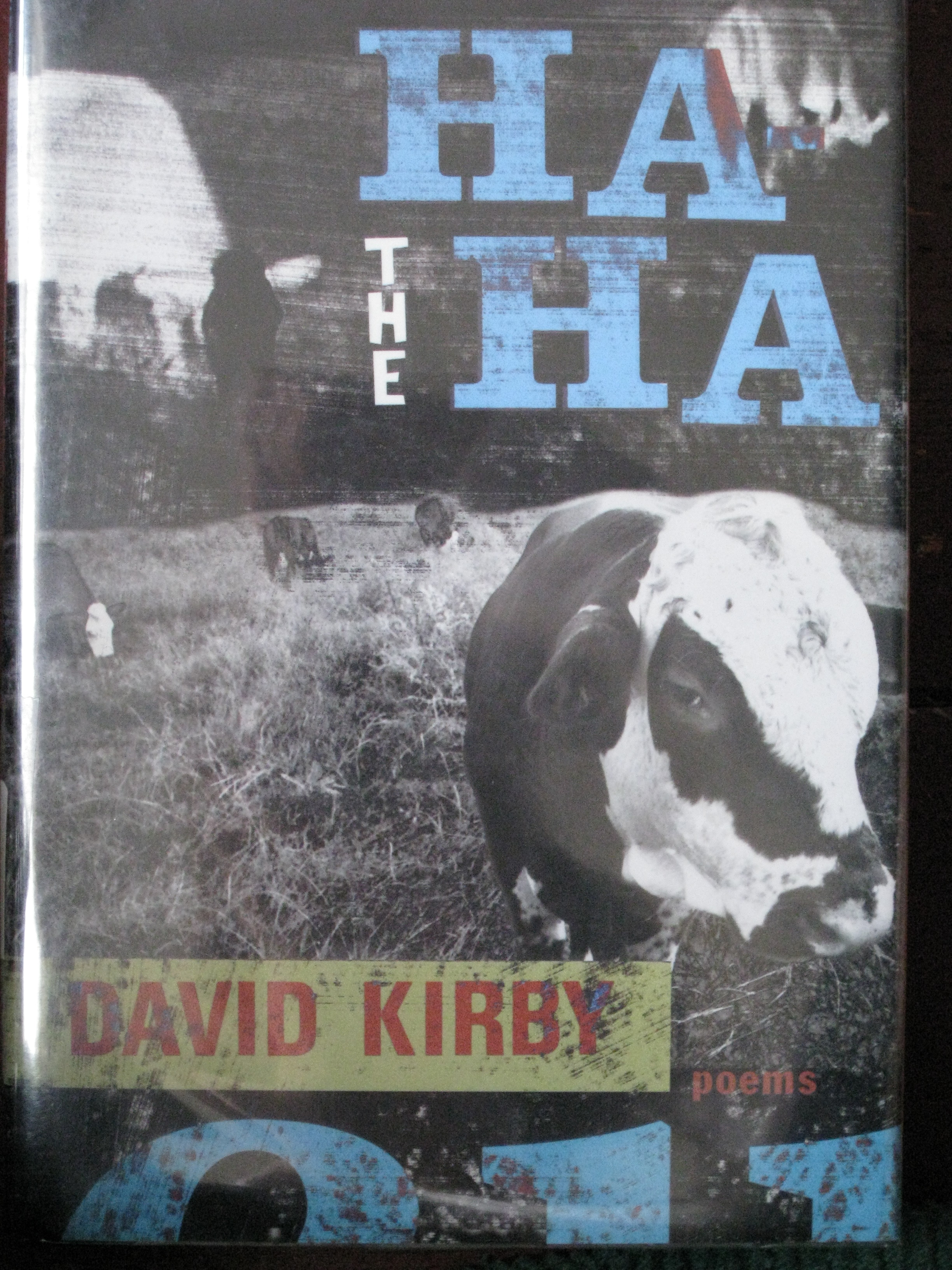
Kirby, David. “The Search for Baby Combover.” The Ha-Ha. Baton Rouge: Louisiana Univeristy Press, 2003. 41.

This is my third (and final) poem from The Ha-Ha that I had to read for the BookLust challenge. Later on, I will read a different book of poetry from David Kirby. But, for now “The Search for Baby Combover” is it. (see yesterday’s post for another Kirby.)
I couldn’t have asked to end Kirby’s collection on a better poem. “Baby Combover” is beyond delightful. It’s not a flowery prosey-prissy kind of thing. Instead, it’s inventive, sarcastic and wildly funny. It’s the story of a man who gets a knock on his door one night. His downstairs neighbor stands before him and proceeds to ask him to please refrain from (whoops wrong story) not move furniture around so late at night…because it wakes the baby. What baby? As far as our man is concerned he’s never seen a baby. Never heard a baby. So, he goes on to think the guy has invented a baby…It’s hysterical.

Here are a few of the best lines (and there are more so you might as well read the whole thing):
“…and I see he’s got something on his head, like strands of oily seaweed, something you’d expect to find on a rock after one of those big tanker spills in the Channel…”
“Baby Combover: the world’s first silent baby.”

BookLust Twist: From More Book Lust in the chapter “Poetry Pleasers” (p 189).

Ha-Ha Part II

David Kirby poetry
Kirby, David. “The Ha-Ha, Part II: I Cry My Heart, Antonio” The Ha-Ha Baton Rouge: Louisiana State University, 2003. 53.

Clever. This poem is so very clever. I like the story within a story concept. Like Shakespeare only a play on words. Here’s the quick and dirty premise: a man is having dinner with a companion. He is loving the meal and makes a comment about it. The comment reminds him of something horrible, so horrible that when his companion asks about his tragic face, he makes up another sad story to compensate for something too horrible to be discuss. The story he makes up becomes his ha-ha, his “structure against chaos”, as Kirby says.

BookLust Twist: From More Book Lust in the chapter “Poetry Pleasers” (p 188).