Black Alibi

Woolrich, Cornell. Black Alibi. New York: Collier Books, 1942.

Reason read: Woolrich was born in December. This book didn’t come in time to read it during the month of December, but I’m breaking a rule and reading it in January because it is so short. Read over one weekend.

In the South American city of Cuidad Real a glamorous woman enters a trendy, high-profile restaurant with a black panther tenuously tethered to the end of a thin gold leash. For Kiki Walker, an up and coming singer, no publicity stunt is too outrageous even though the big cat and Kiki are equally on edge. It isn’t long before disaster strikes and the panther is sprung free. Of course he is! That’s when the grisly murders begin. Young women in different parts of Cuidad Real are found torn to bits but is the panther to blame? One man doesn’t think so. How does an out of work booking agent clear his panther’s reputation when all evidence points to the cat?
Black Alibi is set in an era when establishments hired people to dust off your shoes or straighten your errant hair and the end is a little hokey but, overall, a very entertaining read.

Lines I liked, “One’s sense can identify one’s aura of sounds at all time” (p 41) and “Pain was a thing between oneself and one’s God” (p 52).

Author fact: Woolrich died in 1965 and according to a bio on the IMDB website, his funeral went unattended. So sad!

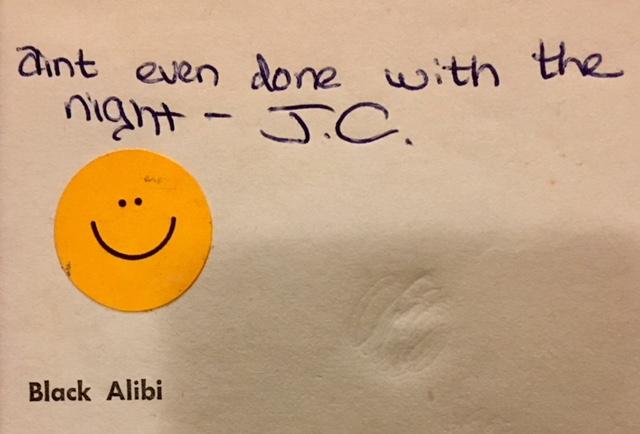
Book trivia: this piece of trivia is unique to my book alone. This is my handwriting from when I was in high school and this is definitely something I would do. I am constantly thinking of lyrics and I loved smiley faces back in the day. However, I don’t remember writing this at all. Nor do I ever remember reading this book before. Odd.

thumbnail

Nancy said: “Woolrich’s [people] are anxious and afraid, stuck in a world that is full of shocking and dangerous surprises” (p 66).

BookLust Twist: from Book Lust in the chapter called “Les Crimes Noir” (p 65).

Nero Wolfe of West Thirty-fifth Street

Baring-Gould, William S. Nero Wolfe of West Thirty-Fifth Street: the Life and Times of America’s Largest Detective. New York: Viking Press, 1969.

Reason read: Rex Stout was born in December. Read in his honor.

Right off the bat I need to tell you Nero Wolfe of West Thirty-Fifth Street is better read after you have consumed every Rex Stout mystery starring the portly private detective. I guarantee you will have many more ah-ha moments if you already know the cases. Baring-Gould fills his book with a mountain of facts but they are oddly assembled; a veritable mishmash of all things Nero Wolfe (and Archie Goodwin).  Everything from fashion, and facial tics to food and every case in between is scrutinized. It’s as if Baring-Gould combed the pages of every mystery, never missing a single detail, to build a character profile and biography of Nero Wolfe and Archie Goodwin.
Baring-Gould also has some interesting theories. I don’t think it is a spoiler to say that Baring-Gould thinks Sherlock Holmes fathered Nero Wolfe. He draws thought-provoking connections between Holmes and Wolfe, including the similar phrases they utter.

Author fact: Baring-Gould’s first claim to fame was his analysis of Sherlock Holmes. He was the editor of the Annotated Sherlock Holmes among other publications.

Book trivia: in addition to the floor plan to Wolfe’s ground floor apartment, Baring-Gould also lays out an impressive chronology of Nero Wolfe’s movements from his birth in 1892 or 1893 to The Father Hunt case in August – September of 1967.

Nancy said: Nancy recommends reading Nero Wolfe of West Thirty-Fifth Street… if “the Nero Wolfe bug bites you” (p 226).

BookLust Twist: from Book Lust in the chapter called “Rex Stout’s Nero Wolfe: Too Good to Miss” (p 226).

Doomsday Book

Willis, Connie. Doomsday Book. New York: Bantam Books, 1992.
Willis, Connie. Doomsday Book. Read by Jenny Sterlin.

Reason read: Connie Willis was born in the month of December. Read in her honor. Confessional: this book is nearly 600 pages long so I decided to start it early.

I don’t know why I get so nervous about reading science fiction. I really shouldn’t when it comes to Connie Willis. I have enjoyed everything I had read from her so far and Doomsday Book is no different. In a word Doomsday Book is brilliant. Young and ambitious student historian Kivrin has been eagerly preparing to leave her 21st century world for that of fourteenth century Oxford. Wearing a costume proper for women of the era? Check. Middle English language lessons completed? Check. Customs training for her alibi for a woman traveling alone? Check. Proper inoculations for illnesses of the day? Check. Or it is check with a question mark? Her instructors back in 2054 had made painstaking calculation to ensure she would arrive decades before the Black Death, but is it possible she slipped twenty eight years passed the targeted date? Did she arrive at ground zero at the exact wrong time? Strangely enough, the 21st century is suffering an epidemic of its own. Modern day Oxford is quarantined and fear bordering on panic runs rampant.
This is a story of parallel tragedies and the human nature that transcends all time…despite being “sci-fi.”

Author fact: at the time of publication Willis lived in Greeley, Colorado. Such a beautiful place!

Book trivia: Doomsday Book won both the Hugo and Nebula award for science fiction.

Nancy said: in Book Lust, “many people believe Doomsday Book Willis’s most accomplished novel (p 246). In More Book Lust, nothing other than to list it as a time travel book.

BookLust Twist: from Book Lust in the chapter called “Connie Willis: Too Good To Miss” (p 246). Also from More Book Lust in the chapter called “Time Travel” (p 221).

Fay

Brown, Larry. Fay. Chapel Hill: Algonquin Books, 2000.

Reason reading: December is Southern Literature Month. Fay takes place in Mississippi.

You can’t help but fall in love with Fay…in the beginning. Despite being abused by animals and humans alike beautiful seventeen year old Fay Jones holds out hope she can be friends with either of them. Preferably both at some point in her young life. But for now she is eager to find Biloxi after running away from a potentially dangerous and definitely drunk father. With only the clothes on her back and two dollars hidden in her bra, she is uneducated and generous; thoughtful in a complicated and naive way. She’ll trust anyone who can steer her in the right direction. You’ll find yourself holding your breath as she hitches a ride with three drunk boys back to their trailer deep in the woods. You again become breathless when a cop picks her up and takes her home. Fay’s ignorance makes people want to help her and hurt her all at the same time. I must admit, over time Fay’s willingness (eagerness?) to fall in with some really bad people grew wearisome. She’s either intensely shallow or so stupid she can’t help herself. She doesn’t recognize when someone is taking advantage of her. When she goes from being a blushing virgin to an easy lay in one week’s time I felt myself losing interest in her fate and willing the character I did care about to stay away from her.
Because Brown will make you care about some people. Even Fay.

My biggest pet peeve? Brown is almost too coy, too cute and dare I say, cheesy? about creating reader suspense at times. His first mention of Alesandra elicited an eye roll from me. One inappropriate remark that spoke volumes in a sea of other details and then nothing for pages and pages. It’s the proverbial gun on a table. Sooner or later it has to go off.

The only line I liked, “Then he was standing there with his neatly pressed gray trousers, a blue stripe down each leg, a gun on his hip and a crisp shirt, his nameplate and his shiny brass and all the authority she feared” (p 34).

Author fact: Brown also wrote Joe and Dirty Work. I’m reading both. Here is the crazy thing. For the first time I have started tracking the approximate time certain books will come up on the schedule. According to the master calendar I will be reading Joe in December of 2037 and Dirty Work in October of 2040.

Book trivia: This should be a movie. It has everything. Sex, drugs and rock and roll. Strippers, prostitutes and drug dealers. Explosions and violence. And don’t forget beautiful scenery of the Mississippi gulf coast.

Nancy said: Nancy said “any list of grit-lit practitioners worth its whiskey would also include Larry Brown” (p 106). She also said Fay drifts through life “serenely” and “almost untouched” by the violence around her. I don’t know if I would agree. Fay’s traumas haunt her constantly. I would see her more as resilient; trying to push on despite the abuses. She has a steely determination to survive.

BookLust Twist: from Book Lust in the very appropriate chapter called “Grit Lit” (p 106).

Edge of the Crazies

Harrison, Jamie. The Edge of the Crazies. New York: Hyperion, 1995.

Reason read: November is the month Montana became a state.

As an aside, I love it when a book introduces me to new music. “If Love was a Train” by Michelle Shocked is an example.

Be prepared to meet a lot of people. Jamie Harrison likes to introduce her readers to a bunch of people (kind of reminded me of Batya Gur). Jules Clement (sheriff) of Blue Deer is the main character but you’ll meet his family (sister and father). You’ll even meet an old girlfriend and her family. Don’t forget current girlfriends and arch enemies. Then there’s attempted murder victim George Blackwater and his entire entourage of family and friends (brother, wife, son, housekeeper, assistant – past and present. Don’t forget his love life, too). The introductions continue with a bunch of reporters, police officers, lawyers, doctors, coroners, personal assistants, paramedics, even the principal, a librarian, a caterer, and a banker.
But, back to the plot. Someone has tried to kill George. He has plenty of enemies but it’s up to Jules Clement to figure out who hates him the most. Is it his wife? His girlfriend? His brother? His agent? But, there is a bigger mystery at play. Who hates Jules Clement even more?

Confessional: I had a hard time pinning down in what decade Edge of the Crazies was supposed to happen. Even though it was published in 1995 the story seems to take place much earlier. An hourly wage was $4.50, you could buy a truck for $700 and a house for $30,000 and yet a couch was $1,000 “back in the eighties.” Harrison quotes a Lucinda Williams tune from 1992….
Another observation: I was surprised Jules wasn’t used to seeing his father’s name in print, especially since he is sheriff of the same town as his father. As sheriff of Blue Deer in 1972, wouldn’t Jules’s father’s signature be on a lot of things at the station?

Lines worth mentioning, “they both mulled over the educational properties of cheap fiction in silence” (p 104),

Author fact: Harrison definitely puts a little of herself in a few of her characters. In her former life she was a caterer and script reader. In Edge of the Crazies there is a caterer and script writer.

Book trivia: There was a section of timeline that didn’t sit well with me at all. Around pages 279-281 Jules goes to the Baird Hotel for lunch. The meal lasts two hours. When he returns to the station Grace fills him in on what happened while he was at lunch. After the conversation he “grabbed his coat and eyed the clock. It was 11, and he had plenty of time” (p 281). 11 in the morning? That would make lunch sometime between 8:30 and 8:45am depending on how long it took him to have his conversation with Grace. Further muddying the waters is that when Jules goes back to the hotel he sees the waitress who served him “an hour earlier.” Obviously, Harrison meant to say Jules had breakfast that lasted two hours. Although I still found it odd that the meal took two hours but he was only served his meal an hour earlier. Does that mean he sat around for an hour before the waitress served him?

Nancy said: Nancy called Edge of the Crazies a “good police procedural” (p 121).

BookLust Twist: from Book Lust twice. First, in the easy chapter called “I Love a Mystery” (p 117) and again the chapter called “Montana: In Big Sky Country” (p 156).

Gastronomical Me

Fisher, M.F.K. The Gastronomical Me. New York: North Point Press, 1989.

Reason read: November is Hunger and Homelessness Awareness month.

This is a series of essays written about Fisher’s life between 1912 and 1941. She covers a wide range of topics; from the first time food became significant to her as a teenager in boarding school to her adventures as a newly married wife living in France. When she said goodbye to her Californian-American palate and encountered French cuisine it was like having an epiphany for Fisher. Her ears (and taste buds) were open to a whole new way of experiencing food and drink. Sprinkled throughout the stories are glimpses of Fisher’s personal history. Her relationship with sister Norah and brother David, the demise of her first marriage with Al, the slow death of her second love, Chexbres, and her awakening to a different culture in Mexico. At times I found Fisher’s language to be overly dramatic. I wondered if she spoke like that in real life.

Confessional: I found Fisher to be a bit snobbish. Every time she called someone stupid or simple for whatever reason, I cringed.

Quote I cared for, “Everyone knows, from books or experience, that living out of sight of any shore does rich and powerful things to humans (p 40).

Author fact: Fisher has written over thirty books. I have already read A Considerable Town for the Challenge and have two more to go. Another more basic piece of trivia is that M.F.K. stands for Mary Frances Kennedy.

Book trivia: Gastronomical Me has been called Fisher’s most autobiographical work and has been considered her best.

Nancy said: M.F.K. Fisher “expresses her love of good food and its importance in the lives of families and communities” (p 91).

BookLust Twist: from Book Lust in the chapter called “Food for Thought” (p 91).

A Fine Balance

Mistry, Rohinton. A Fine Balance.New York: Alfred A. Knopf, 2001.
Mistry, Rohinton. A Fine Balance. Read by John Lee. Santa Ana, CA: Books on Tape, Inc., 2001.

Reason read: in honor of India celebrating Pandit Jawaharlal Nehru’s birth month as Children’s Day in November. Okay, that’s not entirely true. Originally, I chose this book to read in November because supposedly November is a good month to visit India. Since I have never been to India in November or at any time, I couldn’t really say when is the best time to visit.

I could tell I was going to like A Fine Balance when I got to this line early in the the novel, “How much gratitude for a little sherbet…how starved they seemed for ordinary kindness” (p 8). The writing is so graceful and honest. This is the story of the daily lives of four people in an unnamed seaside town in India, thrown together by a housing shortage after the government has declared a state of emergency. At the center is Dina Dalal, a widowed seamstress. As a matter of pride she will not remarry just to be supported by a man. In order to stay self sufficient she takes in borders. One such border is Manek Kohlah, a student attending college in the city. He is studying refrigeration. Ishvar Darji and Omprakash, two other borders, are tailors fleeing caste-centric brutalities in their village. There is no doubt in my mind most people find this story incredibly tragic, considering its ending. I found it sad but with a thin thread of optimism. When a once bitter character can laugh by the end of it, you know the human spirit has not been broken.

The word that comes up time and time again when describing Mistry’s work is depth. Depth of characters, depth of plot, and of human emotion. That being said, pay attention to Dina. Her transformation is the best part of the book.

Author fact: Mistry also wrote Such a Long Journey in 1991. It’s also on my list.

Favorite line, “If there was an abundance of misery in the world, there was also sufficient joy, yes – as long as one knew where to look for it” (p 588.)

Book trivia: On November 30th, 2001 A Fine Balance was chosen as an “Oprah book” for her book club. As an aside, I went to her website to see how such a book is talked about, promoted, marketed, and so on. I was surprised to see her website would have such a crappy cover shot. The image is super blurry so my guess is the file is too big. I guess I expected Oprah’s website to be just like her magazine, big and glossy.

Nancy said: not much. Just described the plot, which is surprising considering Mistry’s masterful writing. I would have thought Pearl would want to say more.

BookLust Twist: from Book Lust twice. First, in the chapter called “100 Good Reads, Decade By Decade (1990)s” (p 179) and again in “Passage to India” (p 181).

Discarded Duke

Butler, Nancy. The Discarded Duke. New York: Signet Book, 2002.

Reason read: In the spirit of romance novels, I am reading The Discarded Duke in recognition of Jane Eyre being published in October. I know, it’s a stretch…

Confessional: I am not a fan of romance novels.

Like any good romance, there has to be a love triangle. Here’s Discarded Duke‘s triangle of love: point A. = Beautiful widow Ursula Roarke, looking for a new husband, point B. = pretty Damien Danover (the Duke of Ardsley), looking to finally settle down with a suitable mate and, point C. = the ruggedly handsome shepherd, William Ridd, who just wants to take care of wool producing sheep in peace and quiet. As you can guess, Beautiful widow wants to seduce rich duke but can’t help the animal attraction she feels towards poor rough-around-the-edges shepherd. Can you see where this is going? Like any good romance the characters are stereotypical in attractiveness and sex appeal. The Widow Ursula, despite being a widow, is still a young and voluptuous, willful and fiery redhead determined to get her way. The dainty Duke is powerful, attractive, wealthy, slightly persnickety and described as a man who can look like he’s smelled a week old fish or behave like a dry old stick. William the innocent, minding-his-own-business sheepherder is bronzed by the sun, doesn’t own the beloved sheep he tends (one guess who does!), has a wry sense of sunny humor but has a dark and stormy past. Of course he does. What decent hero does not? Except Ridd has the scars to prove the violence. Of course Will and Ursula exchange barbs like two elementary school kids on the playground. But, like any good romance, there are secrets galore and assumptions to be made on all sides of the isosceles.
But wait! There’s a fourth point to the triangle. Huh? Now, technically, it’s a rectangle of love. Judith Coltrane, former friend and potentially past love interest of Ardsley’s from back in the day. She has waited in vain for the Duke to return after he ran after from a tragedy on the home front twelves years ago. See, everyone has a secret. So when the Duke rolls back into town with Lady Ursula all this time later…

Probably the best element of Butler’s story is the character development. Yes, they are all slightly stereotypical in their socioeconomic positions (everyone looks down on poor, come-from-nothing William Ridd, obviously. Insert eye roll here.). But every single character has a dark and vulnerable side. And. And! And, they are all likeable characters.

Okay, okay! Having said all that, I admit it! As far as romances go, this one wasn’t that bad.

Probably the best cringe-worthy quote, “It was difficult to have a proper argument when one was naked” (p 209).

Author fact: Nancy Butler’s real name is Nancy Hajeski.

Book trivia: this is the kind of book I would hide at the bottom of my bag and would never, ever be seen reading in public. The cover is of a passionate couple in a lovers’ embrace. It could be worse. Neither individual is in a state of partial undress. Not even in the least. No glistening chest, no bared shoulder. No exposed thigh…Adding to my good fortune is the fact I had to request this book from outside my network so it arrived with a book strap and a warning, “do not remove!” Wouldn’t think of it!

Nancy said: The Discarded Duke is “a good example of well-developed characters and a gripping plot” (p 207). I would agree completely.

BookLust Twist: from Book Lust in the chapter called “Romance Novels: Our Love Is Here To Stay” (p 203).

Breakfast on Pluto

McCabe, Patrick. Breakfast on Pluto. New York: HarperFlamingo, 1998.

Reason read: October is the best time to visit Ireland and this time, I have it from a reliable source. According to a born and raised Dubliner, October is the best month and Breakfast on Pluto was written by an Irishman.

Confessional: I had to read the Prelude a second time to make sure I wasn’t confusing Patrick Braden with Patrick McCabe.

This story will unhinge you a little. Patrick Braden starts his life as a babe left on the doorsteps of a church where he is taken in by Father Bernard McIvor, who just so happens to be Patrick’s real father. Not knowing what else to do with the child, the pastor takes Patrick to an abusive and alcoholic foster home. It is around this time that Patrick decides he is a transvestite and starts calling himself “Pussy”. While Pussy shares his life story in lighthearted, sometimes amusing, sometimes matter of fact anecdotes, there is always a dark and violent undercurrent. That can’t be helped when the protagonist’s boyfriend is murdered, Pussy becomes a prostitute and gets involved in terrorism. Need I say more?

A cool thing about Breakfast on Pluto: it references a lot of music. It prompted me to take a journey to YouTube to look up the song “Breakfast on Pluto” by Don Partridge as well as the music of Vic Damone and the theme song to A Summer Place.

Author fact: McCabe has written thirteen books but I am only reading this one for the Challenge.

Book trivia: Breakfast on Pluto was made into a movie starring Cillian Murphy in 2005. Patrick McCabe was one of the writers on the project. I, of course, have not seen it.
Another piece of trivia: Breakfast on Pluto was short listed for the Booker Prize in 1998.

Nancy said: Breakfast on Pluto was a “good novel” set in Ireland.

BookLust Twist: from Book Lust in the chapter called “Irish Fiction” (p 126).

Aristotle Detective

Doody, Margaret Anne. Aristotle Detective. Great Britain: The Bodley Head, Ltd., 1978.

Reason read: October in Greece; in honor of Ochi (Ochi/Ohi = no, it’s not okay!) Day. It is Greece’s response to Mussolini’s demand to occupy Greece during WWII. Their refusal to give in to Axis power is celebrated every October 28th. Very cool.

Picture this. The year is 332 B.C. and Athens is under the thumb of Alexander the Great. Closer to home, an Athenian citizen is found with an arrow clean through his jugular. A clear case of murder for no one stabs themselves to death with an arrow, so deduces the citizen public. What is not so clear is how Philemon, a young man already in exile for an accidental death in a barroom brawl, is fingered for the crime. Just how can an absent man commit such a heinous act? The task to prove his innocence falls to Philemon’s cousin, Stephanos. Under Athenian law, inexperienced and naive Stephanos must defend the family name in Philemon’s absence. Here’s where Aristotle comes in. Once Stephanos’s mentor, Stephanos knows he can trust Aristotle to guide him to the truth. Like all gripping suspense stories, all evidence points to Philemon’s guilt and clearing his name becomes a Herculean task. It’s the proverbial David and Goliath story with Stephanos the clear underdog. Stephanos is impetuous, emotional and faced with never-ending bad luck. Like the unrelenting surf, he is pounded with one set back after another. Of course this makes for a great mystery! How will Stephanos clear his family name?

Confessional: can I just say how much I loved seeing Pheidippides as a character in Aristotle Detective? And how is this for tongue-in-cheek? “Pheidippides must have been something of a runner” (p 278). I’ll say!

Quote I could relate to very well, “I turned over clothes in the press, and looked into jars and under furniture – into well-swept and barren corners, in the stupid manner of all personal looking for a lost object” (p 83). Been there!

Author fact: It is rare to not see an “about the author” blurb somewhere on a book: back cover, inside flap, somewhere usually with a smiling photograph to accompany it. Aristotle Detective does not give any clues as to Doody’s personal life except for the dedication. She has a sister named Mary Elizabeth Howell-Jones whom Doody considers a “real” classicist.

Book trivia: Aristotle Detective is the first in a series and is Doody’s first fiction. It’s the only Doody book I am reading.

Nancy said: Nancy called Doody a “classicist” and described the Aristotle plot.

BookLust Twist: from Book Lust in the chapter called “The Classical World” (p 59).

All Hallows’ Eve

Williams, Charles. All Hallows’ Eve. New York: Pellegrini & Cudahy, 1948.

Reason read: This is a spooky story so I’m reading this for Halloween, of course.

This is a love story that thrives beyond the grave. Lester and Richard were married only the day before when Lester is killed by a falling airplane. What are the chances? Now Lester is caught between two very different worlds – the living world where Richard still walks about grieving and Lester’s dead and silent world in limbo. She hasn’t made it into either heaven nor hell. Some people can sense her and some can even see her outright. Still others, she can walk clean through and they wouldn’t feel even the slightest whisper. Lester feels alone but she is not. Not really. Also killed in the bizarre crash was her living best friend, Evelyn. Both seek the afterlife forgiveness of a third girl, Betty, who Lester and Evelyn were cruel to in school. Betty is under the spell of evil in the form of her mother, Lady Wallingford, and religious and biological Father Simon Leclerc. Father Simon, better known as The Clerk, is seen as a prophet, a religious leader, a powerful orator able to sway large masses with his preaching…a devil in disguise who practices magic. He has Evelyn under his power as well. She turns out to be the evil one.

Williams is a strange author. His storytelling is dense and sometimes confusing. I likened it to hacking through a thick and oppressive jungle with a dull machete. You spend a lot of time slogging through the narrative and sometimes miss the finer nuances of the story. I found myself frequently rereading passages if only to orient myself to time and place.

Quotes (or imagery) I liked, “The two dead girls went together slowly out of the park” (p 22), and “She did not dichotomize; mechanics were not separate from spirit, nor from imagination, nor that from passion” (p 225).

Confessional: I had to look up two words from this book: sacerdotalism and susurration. Learn something new everyday.

Author fact: Williams wrote All Hallows’ Eve as part of a series called “The Aspects of Power.” It is #7 in the series and is the only one I’m reading for the challenge. for once, I am glad to be missing out.
Second author fact: Williams died following an operation.

Book trivia: All Hallows’ Eve has been compared to James’s Turn of the Screw. Second piece of trivia: T.S. Eliot wrote the introduction to All Hallows’ Eve.

Nancy said: Nancy called All Hallows’ Eve a “lost classic” (p 99); “Williams’s own spiritual beliefs lend a spellbinding conviction to the ensuing struggle between good and evil, magic and art” (p 100).

BookLust: from Book Lust in the chapter called “Ghost Stories” (p 99). True enough.

Everybody Was So Young

Vaill, Amanda. Everybody Was So Young: Gerald and Sara Murphy – a Lost Generation Love Story. New York: Houghton Mifflin Company, 1998.

Reason read: F. Scott Fitzgerald was born in September. His novel Tender is the Night is based on Gerald and Sara Murphy.

I am trying to wrap my brain around just how special Sara and Gerald Murphy’s reputation was between post World War I and pre World War II. Just the who’s who name dropping when describing their inner circle alone is spectacular. Even at an early age, both Sara and Gerald hobnobbed with notables (Sara was warned not to wear a long scarf while flying with the Wright brothers and Gerald was schoolmates with Dorothy (Rothschild) Parker). The Murphys vacation spot of choice was a rocky beach in the south of France. It was easy to rub elbows with the big names for Paris was a hotbed for creativity during the 1920s. Artists, photographers, writers, poets and fashionistas alike flocked to the city center and soon made their way to the French Riviera. Gerald and Sara knew how to entertain all ages. Their children were treated to elaborate parties including a scavenger hunt that took them by sailboat across the Mediterranean. It was a charmed life…until it wasn’t. Interspersed with the good times are episodes of tragedy – illnesses, death, Fitzgerald’s drinking and subsequent estrangements from longtime friends. But, it was probably the tragic deaths of their two sons, Baoth and Patrick that were the most devastating and marked the end of an era for Sara and Gerald.

Pet peeve about Vaill’s book: many of the photographs Vaill refers to are not included in her book. The Fitzgeralds frolicking in the ocean; Sara with pearl looping down her bare back. Even the Pamploma photograph, which Vaill describes in great detail is not the same one included in the book. Hadley does not look at Gerald and Pauline does not look at her lap. Instead, all are looking straight into the camera. This might be why Pearl recommends reading Everybody was so Young with Living Well is the Best Revenge because Living Well includes more photographs and a section on Gerald’s art.

As an aside, I cannot help but think of my paternal grandparents while reading Everybody Was So Young. Their wealth and society was a mirror image of Gerald and Sara’s. To top it off, Sara’s family was well rooted on Long Island, just a short distance from where my Grandmother lived for many, many years in Quogue.

Favorite trivia: Gerald named his boat after a Louis Armstrong album, “The Weatherbird.” When having the boat built he had a copy of the record sealed in its hull. How cool is that?

Author fact: Everybody Was So Young is Amanda Vaill’s first book.

Book trivia: Everybody Was So Young includes two sections of 84 interesting photographs.

Nancy said: Nancy suggested reading Everybody Was So Young at the same time as Tender is the Night by F. Scott Fitzgerald and Living Well is the Best Revenge. by Calvin Tomkins.

BookLust Twist: from Book Lust in the interesting chapter called “Companion Reads” (p 62).

My Dream of You

O’Faolain, Nuala. My Dream of You. Read by Dearbhla Molloy. Hampton, NH: BBC Audiobooks America, 2002.

Reason read: September is supposedly the best month to visit Ireland.

Irish born Kathleen De Burca has arrived at a crossroads in her life. Nearing fifty she loses her best friend and coworker to a heart attack. As a travel writer, Kathleen has lived in London for nearly thirty years and has never married or had children. Jimmy was the closest person she could call family. But, when she is presented with the lifetime achievement award she was supposed to share with her best friend she realizes there is more to life than travel miles and exotic venues. Why not go home to Ireland? Why not research a century old crime that has long fascinated her?
So begins Kathleen’s story. Her past is as complicated as her future is a blank slate. Giving up everything, she lays herself bare to the tragedies of the past; remembrances of long ago transgressions; all the cringe-worthy scars of yesterday. But, as she says on page 408, “Tragedies end.” And so they do. Kathleen learns to pick up the pieces and face the black slate of tomorrow with a different kind of courage than it took in order to come home.
As an aside, I felt the ending gave O’Faolain room for a sequel. Just saying.

Quotes I fell in love with, “I envied her both the Alzheimer’s and the caring husband until I realized that if she had the one she didn’t know she had the other” (p 410), “Happiness keeps you poised, and you do the right thing without effort, whereas you get things wrong when you’re struggling with lack of life” (p 438), and “Either take account of other people from now on, or go back to the bad old days” (p 484). On a personal note, I took a lot from Kathleen’s words. I, too, am a woman who has repeatedly shunned the thrum of humanity, preferring my own seclusions. I, too, need to embrace and take stock of others around me.

Author fact: O’Faolain also wrote a best selling memoir about her life as an Irish woman.

Book trivia: My Dream of You is O’Faolain’s first novel.

Narrator fact: Dearbhla Molloy won an Audio Award for the abridged narration of My Dream of You.

Nancy said: My Dream of You is “a good novel set in Ireland” (p 126). She also said it is a first novel she was “delighted to have read” (p 89).

BookLust Twist: from Book Lust twice. First, in the chapter called “First Novels” (p 88) and again in “Irish Fiction” (p 125). Also, in Book Lust To Go in the chapter appropriately called “Ireland: Beyond Joyce, Behan, Beckett and Synge” (p 111).

Tender is the Night

Fitzgerald, F. Scott. Tender is the Night. Read by George Guidall. Prince Frederick, MD: Recorded Books, 1996.

Reason read: F. Scott Fitzgerald was born in September…

How many people remember this from their English lit days? Tender is the Night is a study in the push-pull of relationships at their strongest and weakest. Dick Diver is a wealthy psychiatrist who falls for the mentally unstable Nicole Warren. A doctor marrying a patient begins as a dance between crazy and sane. Both are wealthy, society driven people with magnetic, charming personalities. The French Riviera serves as the backdrop and Mr. and Mrs. Gerald Murphy serve as the inspiration for the the first half of Tender is the Night. Zurich, Switzerland and Fitzgerald’s relationship with his mentally ill wife, Zelda, help finish the rest of the story. Overall, it is a tragic display of how mental illness infects like a contagion, bringing down even the most solid of minds.

Lines I liked, “He had long been outside the world of simple desires and their fulfillments, and he was inept and uncertain” (p 206) and “Well, you never knew exactly how much space you occupied in people’s lives” (p 211).

Author fact: Fitzgerald was a Princeton graduate.

Book trivia: Tender is the Night bombed commercially. Just goes to show you, you can’t judge a book by its sales. It’s now considered Fitzgerald’s masterpiece. Another piece of trivia: Tender is the Night was made into a 1962 film starring Jason Robards (who played Heidi’s grandfather in a much later movie).

Nancy said: Tender is the Night needs to be read with Everybody Was So Young by Amanda Vaill and Living well is the Best Revenge by Calvin Tomkins.

BookLust Twist: from Book Lust in the previously mentioned chapter called “Companion Reads” (p 45).

Living Well is the Best Revenge

Tomkins, Calvin. Living Well is the Best Revenge. New York: Viking Press, 1962.

Reason read: F. Scott Fitzgerald’s birth month is September. Tender is the Night is (sort of) based on real life characters, Sara and Gerald Murphy. Living Well is the Best Revenge was also written about Sara and Gerald Murphy.

What is it about Sara and Gerald Murphy? Was it their personalities that made them so attractive? Or was it just the era they were living in at the time? This was back in the day when people gave houses as wedding gifts and didn’t worry about the red tape and mountains of paperwork that went with it. Maybe it was the people they associated with that made their light glow a little brighter. For Sara and Gerald Murphy could call Cole Porter, Ernest Hemingway, Pablo Picasso, Jean Cocteau, Igor Stravinsky, John Dos Passos, and, of course, F. Scott Fitzgerald as their friends. Maybe it was their talents. Gerald, encouraged and inspired by Picasso among others, spent nine years as an artist, creating breathtaking paintings. Sadly, he only produced ten works of art and many are either missing or have been destroyed. Together, Sara and Gerald knew how to throw an intimate, yet memorable party. They had personality and flair. Although this is a tiny book, Tomkins gives a succinct portrait of the captivating couple.

Quote I liked to describe Gerald, “Organizer of private gaiety, curator of a richly encrusted happiness” (p 86).

As an aside, I found it interesting to compare Tomkins and Vaill in what details they both considered worthy of inclusion in their books. For example, they both thought the story of Gerald falling through the ice and being made to finish a walk with his father in frozen clothes a telling detail of Gerald’s character.

Author fact: Tomkins has written a bunch of other works but I’m only reading Living Well is the Best Revenge.

Book trivia: Living Well is the Best Revenge is an incredibly short book, less than 150 pages. It is made even shorter by 44 pages of 74 fabulous photographs.

Nancy said: Living Well is the Best Revenge should be read together with Everybody Was So Young and Tender is the Night. They belong together.

BookLust Twist: from Book Lust in the obvious chapter called “Companion Reads” (p 62).