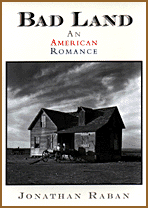
Bad Land: An American Romance

Bad LandRaban, Jonathan. The Bad Land: an American Romance.

In honor of both the month Montana became a state and National Train Month I put Bad Land  on my list. It reads like a river. Some parts read like racing rapids while others slow to languid pools of near stillness. Then there are the waterfalls, where the language is cascading awe-inspiring. It was during these “waterfall” sections that I wanted to pack a bag and head west, just to see it for myself.

Raban helps you look at Montana from the point of view of the immigrant (emigrant), the artist, the ancestor, the traveler, the naturalist. Like standing back from a canvas to discover hidden colors. It’s a historical story, lyrically descriptive and informative. It’s a biography of the landscape as well as the people settled there at the turn of the century.
Favorite lines:”…mouth like a mailbox” (p 67).
“Mrs. Nemitz, scenting sarcasm, put his face on trial for a split second, but found it not guilty” (p 104).
“It’s exhilarating and scary, to lighten ship every so often, to kiss goodbye to the accumulated tonnage of ones life so far” (p 114)
“now the book is full of brittle ghosts” (p 136).

BookLust Twist: Mentioned twice in Book Lust. Once in the chapter called “Montana: In Big Sky Country” (p 156)…in which Pearl calls Bad Land  “the best book about Montana by a non-Montanan” (p 157); and “Riding the Rails: Railroad History” (p 201).

The Way Men Act

Way Men ActLipman, Elinor. The Way Men Act. New York: Washington Square Press, 1992.

 I had to laugh when I wrote out the title of this blog. Yet another one that could be misconstrued as something juicy and personal. I guess I could write a whole dissertation on the way men act towards me, but that wouldn’t be the book review that this is intended to be.

Elinor Lipman celebrates a birthday in October so it was only appropriate that I try to squeeze in a novel of hers in the last days of the dying month. I have met Lipman before (at a local conference) so it was no surprise to discover The Way Men Act takes place in “my” town. While thinly veiled as somewhere else it was easy to recognize the landmarks and quirks that make up where I live. I have to admit that made reading The Way Men Act a little difficult. The entire time I pictured real store fronts, real schools, real people.
All in all I breezed through this book because it was a simple read. The kind of chick lit you crawl in the bath with and can read in one soak. The plot isn’t complicated, only fun fun fun, the way chick lit is supposed to read. Lipman’s heroine, Melinda LeBlanc returns home to Harrow. She has mixed feelings about being back where she grew up as if being home implies she didn’t make it in the real world. She comes back (single at 30) to work in her cousin’s flower shop. Her job is sandwiched between two other come-home-again classmates from high school: Libby, a fashion designer with her own shop, and Dennis, a wiz at tying flies for fishing for his own shop. In addition to being hung up on being home, Melinda has issues with educational status (Harrow is a snobby college town and she only has a high school degree) and of course, men. The ending was predictable. Melinda is too talented to be working for someone else, and yes, she’s gets the guy.

Favorite line: “Could a man hate me that strenuously that the weight of it would flip itself over and come up again as love?” (p 49)
I flagged other lines only to realize it wasn’t the wording I admired so much. It was Melinda’s relationship with her mother. Every scene had me envious of their obvious closeness.

BookLust Twist: Mentioned twice in Book Lust once in the chapter “Elinor Lipman: Too Good To Miss (p 146), and “My Own Private Dui” (p 165).  The latter chapter begs an explanation: Pearl has her own classification system for her books and The Way Men Act falls under the category of “books I reread when I’m feeling blue” (p 166).

Update on the Lust

I’m approaching 100 books in the Book Lust challenge. I’m proud of this because 1) I have been reading Random House books at the same time (I’ve read four so far with another one the way). 2) I started a new job so I’m not only reading “How to be a director” bullsh!t but I’m reading up on how to get my library ready for NEASC. In other words, I don’t read what I want to all the time.

I’ve amended my “rules” too. I had to with all the book reviews I’ve been asked to do. It just seemed like the right thing to do.
And I’ve come up with a strategy for how to decide when to read certain books. It will take me some time to compile the data but since I have four days of alone time coming up and I’m not going anywhere for Thanksgiving (have to work) I’ll make the time.

What I’m reading now:
Bean Trees by Barbara Kingsolver

Song of Solomon

Song of SolomonMorrison, Toni. Song of Solomon. New York: Plume, 1987.

Another must-read from the days in Maine. Although, I don’t remember reading it then. I don’t remember reading it, ever. Is that sad or what? This is a classic. Something everyone should read.

I don’t think I could summarize the plot adequately. Basically, it’s the story of Macon “Milkman” Dead III. He got the nickname Milkman from being breastfed by his mother way past infancy. But, this story goes beyond coming-of-age; it transcends stereotypical stories of racial strife and strained family relations. Yes, there is all of that. This is a story that has been described as tragic and magic in the same line. It may be a story about one man’s rise to adulthood, but it is told from many different points of view. We learn about Milkman’s ancestry and the culture of his time. Morrison weaves imagery and symbolism together so that everything important means something different. Family names are not just names. They come from religion, mistaken identity and social injustice. Family ties are tethered and severed through love and hate, peace and violence, poverty and wealth. One man’s perception is another man’s reality.

Quotes I liked: “I’m on the thin side of evil and trying not to break through” (p 21).
“He wouldn’t know what to feel until he knew what to think” (p 75).
“She was the third beer” (p 91).

BookLust Twist: Toni Morrison is mentioned twice in Book Lust. Song of Solomon is in the chapter “100 Good Reads, Decade by Decade” (p 175) under the section 1970s. 

Turn of the Screw

James, Henry. The Turn of the Screw. New York: Dutton, 1963.Turn of the Screw

Even though October is more than half over I decided to read something scary for the rest of the month…in honor of Halloween and all that. Turn of the Screw seemed like the most obvious choice. A novella only 160 pages long, I knew it wouldn’t take too long to get through.
Written in 1898 and republished numerous times Turn of the Screw has also been  adapted for the stage, television and the big screen. Someone told me it was even mentioned in an episode of “Lost” (I wouldn’t know).  James’s technique is to tell the story within a frame – one story within another. We are first introduced to a man at a Christmas party telling a tale of a governess. From there we are in the story, told from the point of view of the governess. She has been hired to look after two small children after their parents are killed and they are sent to live on an uncle’s estate. Soon after the governess’s arrival she starts to notice strange occurrences, shadowy figures stalking the grounds. She learns they are former lovers and hired hands, back to supposedly recreate their relationship through the children.
While James uses words like “hideous”, “sinister”, “detestable”, and “dangerous”, there is great debate as to exactly what he is describing as so terrible. He refers to evil again and again, but his ghosts are not the usual specters. They only hint at danger rather than taking action and “attacking”. The other great debate is whether the governess is insane (or goes insane while at Bly). Because no one else really backs up her ghost sightings you have to wonder.

BookLust Twist: Mentioned several times in Book Lust. Once in the chapter called “Science Fiction, Fantasy, and Horror” (p 113) and “Ghost Stories” (p 99). I would agree that The Turn of the Screw deserves ghost story status, but horror? Maybe I’m stuck in slasher movie mode where everything horrible has to end up in blood and gore.

Black Dog of Fate: a memoir

Black Dog of FateBalakian, Peter. Black Dog of Fate: a memoir. New York: Random House, 1998.

I must have started this book four or five times. I don’t know what it was about the beginning. I’d pick it up, read for a few pages and put it down again, never getting beyond the first chapter. By the time I’d return to pick it back up I had forgotten what I had read and needed to start all over again. Page one. Finally, I took Black Dog of Fate home with me Columbus Day weekend and read it from start to finish. When I was finally able to devote the time and attention to it I couldn’t put it down.
There are very few books I try to push on other people. Very rarely do I try to tell people what I have read and how I feel about it, urging them to see for themselves. This story was different. From the moment I put it down I found myself struggling to put into words what had moved me so yet I needed to say something.

Here’s what I wrote within seconds of finishing it on Monhegan:
It’s the history you don’t commonly read about. It has the facts everyone would like to wish away; a genocide too horrible to imagine as real. The Armenian Massacre wasn’t a standard topic in my history class. As a rule I think we, as a society, want to sweep all and every horrific moment under our subconscious. This is a memoir about a boy’s growing knowledge and deeper understand of his heritage. True to adolescent ambivilance Balakian doesn’t understand the importance of his ancestry. In his youth all the stories his grandmother wanted to tell him were lost on him. It’s only after he is ready does his grandmother’s words mean anything to him. “I came to find out more about the arid Turkish plain when I picked up a book at a time when I was prepared to read it” (p 147).  

Other lines that struck me:
“…she would pass me the salty green nuts so we could celebrate with our teeth” (p 13). I think food is always the most appropriate way to celebrate.
“Hokee, soul. Hankids, rest. The soul’s rest: a memorial” (p 140).

BookLust Twist: From Book Lust in the chapter “A Geography of Family and Place” (p 97).

Yellow Raft in Blue Water

Yellow raft in blue waterDorris, Michael. A Yellow Raft in Blue Water. New York: Warner Books, 1987.

This is high school to me. I remember being holed up somewhere reading this nonstop. Hot off the press, freshly published and oh so new I couldn’t put it down. I reread it and reread it until finally I could move on to other Michael Dorris creations, which somehow were never quite as good. Nothing compared to A Yellow Raft in Blue Water back then and it is still a faovrite to this day.

Someone described this book as an onion, reading it was like peeling back the layers of a story, and while that imagery is accurate enough, I like to think of Yellow Raft as a game of telephone. First, there is Rayona. She tells the story from her perspective. She is all of fifteen years old…at that difficult age where rebellion against your mother is the easiest thing to do. As she says, “when mom and I have conversations, they mostly involve subjects not personal to our lives” (p 26). She tells her story like it’s the honest truth. Then, there is Christine, her alcoholic mother, and her story. In the beginning you want to hate her for how seemingly unfair she had been to Rayona. But, learning about Christine’s heartbreak you realize Rayona’s reality is only her perception. The wires of communication have been crossed and in some cases, completely disconnected. Christine had her reasons for everything she did (and didn’t do). “I never had been good company for myself” says Christine (p 185). Finally, there is Ida, Christine’s mother. Her story is, by far, the most revealing and tragic. Everything you heard whispered from Rayona through Christina is trapped in the warped truth of Ida. All three women are stubborn, flawed by fate, and determined to make the best of life as they know it even if it means coming off as cruel to others. Being on the inside, privy to their hearts, makes you want to shake each one screaming, “talk to your daughter!”

Favorite lines:
“Ghosts were more lonesome than anything else. They watched the living through a thick plate of glass, a one-way mirror” (p176).
“A bath brought me peace, made me float free” (p340).

BookLust Twist: In both Book Lust and More Book Lust. In Book Lust Pearl mentions A Yellow Raft in Blue Water early; on page 23 in the chapter “American Indian Literature.” In the chapter “Men Chanelling Women” (p 166) in More Book Lust Pearl adds A Yellow Raft in Blue Water because Michael Dorris does an amazing job setting the voices of three very different women free.

Divine Secrets of The Ya-Ya Sisterhood

Wells, Rebecca. The Divine Secrets of the Ya-Ya Sisterhood. New York: Penguin, 1996.Divine Secrets

This is Rebecca Well’s second novel, a follow up to Little Alters Everywhere. Divine Secrets of the Ya-Ya Sisterhood continues the story of Vivi Abbott Walker and her friends (known as the Ya-yas), this time through the eyes of her adult, engaged-to-be-married, daughter, Siddalee Walker. Siddalee is a flourishing theater director who falls victim to the ever-famous, word-twisting interview. A reporter from the New York Times gets Siddalee to open up her childhood box of memories and reveal dark secrets about her upbringing. Ultimately, her mother’s alcoholism and abuse are exposed and Siddalee must spend the rest of the book apologizing to her mother for the scandal. When Siddalee calls off her engagement the Ya-Yas brazenly step in. In an effort to make her daughter understand who she is, Vivi mails her daughter a scrapbook and we are taken into the wonderous, playful yet dark world of the Ya-Ya Sisterhood.
Ultimately, I identified with this story. It’s the classic yet complex struggle between mother and daughter. Secrets revealed, hearts broken, lives changed. In the end, happiness and love prevail. I know you’ve seen the movie.

BookLust Twist: Divine Secrets comes up a couple of times in Book Lust. First, on page 83 in the chapter “Family Trouble” then in the chapter called “Women’s Friendships” (p 248).

Amsterdam

AmsterdamMcEwan, Ian. Amsterdam. New York: Anchor Books, 1999.

Another book that starts with a funeral. Of course, I’m thinking of Charming Billy. But, the comparisons stop there. How to describe Amsterdam? It is a short (193 page) novel that takes place in London, England. Two men share a bond of friendship as well as a romantic past with the same woman. Vernon is an editor of a newspaper and Clive is a modern composer. While they are friends they are not above rivalies and each, through his friendship tests the bounds of morality.

I see this story as a movie. There is one particular scene where Vernon feels dead. He is about to hit himself upside the head in order to feel pain when his secretary interrupts him, “He had raised the ruler several inches above his right ear when there was a knock on his open door and Jean, his secretary, entered and he was obliged to convert the blow into pensive scratching” (p 34). Can’t you just see it?

BookLust Twist: From Book Lust. Ian McEwan has his own chapter called, “Ian McEwan: Too Good To Miss” (p 149).

Disgrace

I’ll call this book my “spur of the moment, read in one day, can’t put it down” book. I’ll also call it Weather Front. It started out sunny and seemingly harmless and carefree. Then the clouds roll in, the rain comes in sheets. The poison seeps in. When the winds pick up to the point of hurricane force it is nothing short of violent and tragic, destructive and disgraceful. After the storm people pick up the pieces, healing yet hurting and more storm clouds can be seen, rumbling in the distance.
In the beginning everything seems fine. Professor Lurie is happy teaching literature in South Africa. But, almost immediately Professor Lurie makes a mistake in seducing a young student. His fall from grace is swift and absolute. Having lost all his social and professional connections he reconnects with the one person who can’t turn her back on him – his flesh and blood daughter. The rest of the story is how Lurie and his daughter deal with their already strained relationship. How Lurie tries to redeems himself is baffling. I found myself asking if he was really worth redemption at all. Maybe it was the name Lurie – too close to the word lurid.

My favorite line, “Affection may not be love, but at least its cousin” (p 2).

BooklustTwist: From Book Lust and the chapter called ” Families in Trouble” (p 82).

Warning: If you are an animal lover you may not want to read this book. What happens to humans is tragic enough, but what happens to the dogs is even worse. I know it’s a fact of life but the end of this book was hard to take. Nobel prize or not.

Ordinary People

ordinary peopleGuest, Judith. Ordinary People. New York: Penguin, 1976.

This book has floated in and out of my life for decades. My roommate had in front of her face when I tried to talk to her about always-there boyfriend. My mother had it on her side of the bed, dog-earred and stained. It was on the summer reading list for my high school. I think my sister has a copy…Despite all these different encounters I never bothered to read it. I don’t know why. Maybe I likened it to Danielle Steel’s genre of pen? Maybe because someone made a movie out of it? I don’t know. No matter. I never wanted to read it. I’m glad it was on “the list.” I’m glad I didn’t miss out.

Ordinary People is exactly that. A story about ordinary people. Reading this book was like stumbling across Mr. & Mrs. Jarret’s home movies. I began watching their lives a year after they had lost their oldest son to a drowning accident and soon after their surviving son comes home after trying to commit suicide. I bounce back and forth between watching Cal, the father’s, videos and peeking in on Con, the son. Beth, wife and mother is detached & disconnected. I haven’t seen the movie so I have had fun trying to picture the actors playing the parts. When Con starts seeing a therapist, I envision Robin Williams (because of Good Will Hunting?)…There is so much psychology in this short (262 pages) book.

My favorite lines:
“Drifting into sleep, he lost his balance, tipping backward again into memory”  (p 144).
“And another turth. That there are no secret passages to strength, no magic words. It is something you know about yourself (p 210).

BookLust Twist: From Book Lust, Pearl actually mentions Ordinary People twice. First in the chapter “100 Good Reads, Decade By Decade” (p 175) and “Shrinks and Shrinkees” (p 221).

Spectator Bird

Stegner, Wallace. Spectator Bird. New York: Penguin, 1976.Spectator Bird

I think this book embodies one of my worst fears – being a spectator bird. The main character, Joe, is a literary agent who is slowing slipping out of the limelight of the living. He goes through life as though he’s on the sidelines, barely even watching the game. Instead of living in busy, exciting, beautiful San Francisco he lives out in the country, away from the daily rub with people. Everything about his current life is gray until he receives a postcard from a friend. Suddenly, he is thrust back into his past. He is forced to remember a time when life was more than a spectator sport. It has some interesting twists, things I didn’t see coming. Joe’s voice is witty and humorous. Here are a few of my favorite lines:
“It is hard to be relaxed around a man who at any moment might examine your prostate” (p 12).
“During the day he will go out seven or eight times. In the U.S. this would be called drinking on the job” (p 76).
“Her wicked brother will not be home – a shame, I’d like to see what real wickedness looks like” (p 98).
“She was so old she would have had to be dated by carbon 14” (p 128).

BookLust Twist: From Book Lust and the chapter called “Companion Reads” (p 65). Pearl suggests reading Spectator Bird with The Moviegoer by Walker Percy, The Remains of the Day by Kazuo Ishiguro, and A Gesture Life by Chang-rae Lee.

Charming Billy

Charming BillyMcDermott, Alice. Charming Billy. New York: Delta Trade, 1998.

I wonder how many people clicked on this blog and thought it would be something a little different? There is more than enough I could say about charming anyone named Billy! Dare I laugh out loud?

Charming Billy is a National Book Award winner. A New York Times bestseller. A movie (again, one I’ve never seen). So it’s no wonder I could say I tore through this book, devoured it in three day’s time. Standing in line, waiting for a sandwich, I read. Stuck in traffice and stalled at super long red lights, I read. Riding shotgun while Kisa was the commuter King, I read. On hold during a tedius teleconference, I read. You get the point. Every chance I got, this book was raised in front of my face. I even walked on the treadmill, barefoot and still in a skirt, book held high in front of my bobbing eyes. That’s not to say it’s a quick read. It’s not a simple book. In all actuality the language is so beautiful it should be read slowly, a few times over. Take the opening chapter, for example. It’s an entire gossipy conversation about a dead man after his funeral. The mourners who have gathered for a restaurant luncheon begin to discuss the drink that killed our Charming Billy. The vitality and truth of that conversation put me at the table. I was there in the restaurant, listening in, passing the bread, leaning back to let the waiter fill my water glass.
It is at this luncheon that the narrator hears a debate about Billy’s heartbreak and the reason for the drink. Losing the love of his life causes Billy to “tilt that bottle in the air, tossing back more than [his] share.” Okay, I couldn’t resist quoting Natalie! The narrator is Billy’s cousin’s daughter. A clever choice for narrator because she is able to weave in her memories and recollections of stories passed around.

“If you loved him, then you told him at some point that he was killing himself and felt the way his indifference ripped through your affection” (p 4).
“…an alcoholic can always find a reason but never needs one” (p 35).
“I suppose there’ not much sense in trying to measure breadth and depth of your own parents’ romance, the course and tenacity of their love” (p 44). These are my favorite lines.

BookLust Twist: From Book Lust, the very first page. In the chapter, “A…My Name is Alice” Pearl lists all the “Alice” authors she adores. Alice McDermott is on the list.

Athenian Murders

Athenian MurdersSomoza, Jose Carlos. The Athenian Murders: a Novel. New York: Fahar, Straus & Giroux, 2002.

I read a review where a critic described this book as Russian dolls, one larger stacked upon another. It is the most accurate description I can think of. The Athenian Murders is indeed a story within a story within a story. The largest doll story takes place in Greece in the time of Plato. In fact, Plato’s Academy is center stage. Athens is plagued by the mysterious murders of several men and before the city can erupt in terror Hercules, the Decipherer of Enigmas, must solve the who-dunnit. Footnoted within the story is the second story – the nameless translator who has his own story to tell as he translates The Athenian Murders. Of course, there is a twist at the end with another story.
It took me a little while to really “get into” this story. I have to admit, I get annoyed by repetition and the word eidetic – let’s put it this way – eidetic or eidesis is used 50 times in the first 100 pages. Talk about repetition!

I have to ask. Is the scar on the right cheek (as mentioned on page 210), or on the left (p 217)?

BookLust Twist: From Book Lust and the chapter titled “The Classical World” (p 60).

Absent Friends

Absent FriendsBusch, Frederick. Absent Friends: Stories. New York: Alfred A. Knopf, 1989.

“From the New World”
Norman is a man returning to his childhood home after his father’s passing to divy up belongings with his sister, his last surviving family member. I found myself yawning through this short story as it’s a well-known plot. Son is disowned for marrying outside his color (although they blame it on something else). His father leaves him $2,000 while his sister, Anna, gets everything else. Norman feels disconnected from Anna. The clever parts: Norman is a film producer so the story is told in script language, from Norman’s p.o.v. One particular scene is played out like a poker game, with conversation acting as the card values – bluffing and backstabbing. My favorite line: from page 61, Tess (Norman’s wife) is talking about love, “that shows you…how chewed up and spat out and stepped on on the sidewalk that word can be.” 

“Ralph the Duck”
You never learn his name. He’s some security / maintenance guy at a college taking classes on the side. He calls himself “the world’s oldest college student” even though he knows he’s not. When he gets a ‘D’ on an assignment (called Ralph the Duck) he lets the disappointment leak out.

“Comrades”
I pictured a tightrope walker when reading this story. The walker carries a pole called “Relationship” and when he waivers to the right he is feeling loving towards his wife. When he teeters to the left, he has animosity. The couple decides to divorce as amicably as possible but the tension and anger is always just below the surface.

“Orbits”
A commentary on getting old. On parenting. On life slipping away, unstoppable. My favorite line, “Her mother limped into the house and they sat in the memory of her tension” (p 100).

“Greetings From a Far-Flung Place”
I could relate to this story. She is a singer in a second rate band. She travels around with a group of men and no one in her family can understand her life. Her sister is married, has a kid, lives the suburban life, and is lonely. Mom is widowed and can understand sis better than singer.

“Naked”
Seen through the eyes of a 13 year old boy. He witnesses adult relationships and experiences changing loyalties. My favorite line, “And I still don’t know if he meant wait for seconds or for years” (p 125).

“In Foreign Tongues”
A group of people in therapy talk their way through their problems outside of sessions. Lonely in the middle of Manhattan.

“Gravity”
The gravity of growing old, getting older. The gravity of weight, of life. The gravity of death. Seriousness and weight.

“Dog Song”
What’s that Harrison Ford movie where he’s a lawyer, gets shot, and has to relearn his life (only to discover he’d been leading the double life of infidelity)? “Dog Song” is like that. Richard is a judge who gets into a horrible car accident (on purpose?). As he slowly remembers the accident, details start to surface. He was in the car with his mistress…

“One More Wave of Fear”
Family life in Brooklyn. One kid’s memory of growing up – from catching squirrels in the attic to going on nature walks with the fam. My favorite line sums up that age, “I didn’t want to be mistaken for someone who cared about birds” (p 201).

“North”
I could mistake “North” for so many things. Kelly divorces her husband because he won’t look North of her female features, She wants to head North – two hours to the Adirondaks – but she doesn’t. “North” is the story of a woman who needs an internal compass.

“Reruns”
“Reruns” was tricky. A doctor’s estranged wife is kidnapped by terrorists in the Middle East. The doctor could care less if she is released but for the sake of his children he plays the part of concerned father. In the end the reader is left wondering how much does he not care?

“Name the Name”
This was actually one of my favorite stories. Told from a traveling teacher’s point of view, he travels to children who can’t be in school for whatever reason. A 12 year old is 7 months pregnant, a girl tries to commit suicide and is on a ventilator, his own son is in jail for nearly two weeks. It’s about commitment and responsibility – owing up to the name.

“To the Hoop”
After his wife commits suicide a father and son struggle to get back on track. Using basketball as for “getting back into the game” both literally and figuratively, both father and son learn to try again. I think this passage sums it up,”He was on the stairs, and something like “good night” trailed his slow and heavy-footed climb. So I was alone, with ham and good intentions, and the usual fears that ranged from drugs to teenage schizophrenia. Jackie had died alone, and in silence. She had left us no word” (p 267).

BookLust Twist: From Book Lust and the chapter “Frederick Busch: Too Good To Miss” (p 48). This is the second collection of short stories I have read from Busch so far.