Defiant Hero

IMG_0573
Brockman, Suzanne. The Defiant Hero. New York, Ivy Books, 2001.

I am not a big fan of romance novels. I’m just not into the language they all seem to require. While the plot of The Defiant Hero is riveting, I am more than a little bored by how good looking the three pivotal couples are. The women are all drop dead gorgeous, “impossibly beautiful” with amazing legs, eyes, breasts, you name it… while the men are chiseled, rugged, handsome, can cry on command, etc, etc. These people are so achingly beautiful and yet…there is something keeping every couple apart. They either hate one another, or are suspicious of each other, or something.
Okay, first the plot (The LibraryThing version): Meg is a translator for a European embassy. Her daughter and grandmother get kidnapped by an “Extremist” group. Meg’s love interest is Navy SEAL Lieutenant John. He’s called in by the FBI to help Meg. She specifically asks for him. Alyssa and Sam are the second couple – Alyssa is FBI and Sam is Navy SEAL – both involved with getting Meg because she has become a kidnapper herself. The third couple is Meg’s grandmother and her past. She reminisces about her first husband while being held captive by the “Extremists.” Got all that? In between the macho FBI/kidnapping violence there is a good amount of romance novel sex – the pantie ripping, throbbing kind.
My favorite quotes:
“Unfortunately, though, penises came attached to men. And therein lay one of her biggest problems” (p 9).
“He was gazing at her as if she were a gourmet delicacy the chef had just presented” (p 218).
“He was supposed to spend the night cuffed to a woman he craved more than oxygen” (p 260).

BookLust Twist: From Book Lust and the chapter ” Romance Novels: Our Love is Here to Stay” (p 203). Obviously chosen in honor of Valentine’s Day. Wanna know something else that’s cheesy? I waited until 2/14 to crack it open, too. It was a fast and fun read!

Bridget Jones

IMG_0570Fielding, Helen. Bridget Jones’ Diary. New York: Penguin, 1996.

When I first learned this chick-lit was on my list I didn’t know whether to groan or grin. But, after pages and pages of stuffy political biographies I knew I’d need a fluffy change. I just didn’t expect it to be so funny! Luckily, my good friend let me borrow it…Here’s the LibraryThing Review:
Bridget Jones is a likable 30-something Londoner. A little on the plump side (so she thinks) and more than a little single (so everyone keeps pointing out), her year long diary takes the reader on a journey through her attempts at weight loss and dating. While her weight gain is more that her ultimate loss and her initial love interest cheats on her, Bridget triumphs with humor and a naivete that is undeniably charming. Obsessive and narcisstist characteristics aside, Bridget could be any woman’s best friend. A delightful (quick) read.

My favorite lines:
“I know what her secret is: she’s discovered power” (p 58).
“Love the friends, better than extended Turkish family in weird headscarves any day” (p 74).
“There’s nothing worse than people telling you you look tired. They might as well have done with it and say you look like five kinds of shit” (p 92).
“By 11:30 Sharon was in full and splendid auto-rant” (p 108).

The only disappointment was a discrepancy with dates. On Wednesday, March 15 Bridget writes “only two weeks to go until birthday” yet, on Tuesday, March 21 she claims it’s her birthday. Two weeks from the 15th is the 29th or at least the 28th. Even if she is counting work weeks it would have been the 25th. Not sure what to think of that. Then there is the time she spends doing something. How is it possible to spend 230 minutes inspecting your face for wrinkles? I’ve done the math. That’s nearly 4 hours – unless London has more minutes to an hour than we do…(ps~ I’m being a snob here. Of course I know Bridget isn’t spending that much time on one activity…)
Another weirdness is that Bridget makes reference to Goldie Hawn and Susan Sarandon a lot. I couldn’t figure out what the reference was all about considering The Banger Sisters didn’t come out until 2002. I’m thinking she meant Thelma and Louise but in that case she didn’t mean Goldie Hawn, but rather Geena Davis. Whatever.

BookLust Twist: From Nancy Pearl’s Book Lust in the chapter called, you guessed it, “Chick-Lit” (p 53).

Dancing to “Almendra”

image0001
Montero, Mayra; translated by Edith Grossman. Dancing to “Almendra” : A Novel. New York: Picador, 2005.

Can I say the cover alone got me? I’m not a big fan of hippos and there, on the cover is a dead hippo. Brilliant. Or, as someone else told me recently, “hippos are jerks.” But, that is either here nor there as far as the plot of Dancing to “Almendra” is concerned.

Here is the benign review I put on LibraryThing:This is a convoluted tale about a young reporter looking to make it big in pre-Castro Cuba’s world of journalism. Characters are drawn as tragic, eccentric, needy and sometimes self-absorbed.
At the center is Joaquin Porrata, the weak-willed entertainment reporter, sent to cover the death of a hippo at the zoo. He finds himself entangled in a much darker plot. There is the mafia (to which the death of the hippo is directly related), eccentric circus performers with leprosy and amputations, a zoo keeper with too many nicknames who chops up horses as food for the zoo carnivores, prostitution, violence, and even a murder that hits closer to home than Joaquin bargained for.
On the other side of the story is Yolanda (she also has other names). As the one-armed, former assistant to a magician with leprosy, her story is just as tragic. While Joaquin and Yolanda’s stories do not mesh well with the plot, the telling of both sides enhances the story of their romance.
Because I read a translation of Dancing to Almendra I cannot be sure Mayra Montero’s language is all her own. While the voice moves masterfully between Joaquin and Yolanda, direct translations could be lost in description.

Not too exciting but I’m paranoid I’m not a team player. More on that later.

Favorite (weird) line: “with a voice like hysterical glass” (p 4). What, exactly, does that mean?

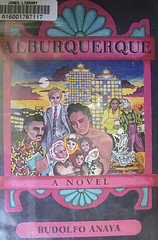
Alburqueque

alburquerque1.jpg

Anaya, Rudolfo. Alburquerque. Alburquerque: University of New Mexico Press, 1992.

My final book of January – chosen to celebrate the month New Mexico became a state. Anaya’s Alburquerque is rich with the culture of New Mexico’s Mexican population. In the center is Abran Gonzalez, a young ex-boxer from Barelas. Upon discovering he is adopted he sets out to learn as much as he can about his birth parents. It is crucial to his understanding of who he really is. Swirling around Abran there is magical realism, cutthroat politics, deep rooted culture, rich history, and tragic romance.
My one complaint – I don’t know why Anaya has Abran have a chance meeting with his birth father in the very first chapter. It seemed a little too coincidental and more than a little cheesy. He is able to come full circle with the same characters at the end. Like I said, a little cheesy.

BookLust Twist: From Book Lust in the chapter simply called, “New Mexico” (p 167).

The Dollmaker

Arnow, Harriette. The Dollmaker. New York: Avon, 1972.

Weighing in at 599 pages this book truly can be called a saga. It’s the story of Gertie Nevens, a simple country woman from Kentucky during World War II. After her husband moves to Detroit, Michigan to find work in the factories, Gertie follows with her five children. Life in the city is cold, dirty, and unkind. Gertie learns of prejudices against “hillbillies” and the importance of the word “adjust”. There is tragedy and triumph with human frailty constantly hanging in the balance. At times I couldn’t believe the hard times Gertie and her family faced. It almost seemed too much to bear. Gertie’s strongest moments are in the very beginning of the book when she has to save her baby from a life threatening illness. After moving from Kentucky it’s as if the city steals Gertie’s strength and spirit.

“…for after the bright whiteness of the hot little room, the cold rain and dark were like old friends” (p 38).
The government owed them at least one man who could fix anything and never got drunk” (p 108).
“‘Are you busy?…Yes and no…I’m in the worst kind of business – tryen to make up my mind'” (p 260).
“She stood, her mind, as always, stumbling around, picking up words, laying them down” (p 538).

BookLust Twist: From More Book Lust and the chapter “Big Ten Country: The Literary Midwest” & the section ‘Michigan’ (p 26).

Funnies (with spoiler)

funniesLennon, J. Robert. The Funnies. New York: Riverhead, 1999.

Tim Mix’s father wrote a comic strip based on his family. Growing up, this comic strip was a source of embarrassment to Tim. Yet, when his father passes away and Tim’s only inheritance is the very comic strip he hated, he decides to try his hand at taking over the strip. Tim is a sarcastic, barely ambitious man who is terrible at conversation, worse at relationships both personal and with his family. This is a formula that always works – the unlikable, unlikely hero goes through a metamorphosis and comes out a pretty decent guy. In the end he doesn’t succeed with the funnies, but he gets the girl.

“This time the pause was longer, a nice slack length of rose to hang the conversation with” (p 52).
“I pushed gently at the sore spot in me and it hurt enough for me to turn away as I talked” (p 132).”
“Susan offered me a bite of her corn dog. I refused, still queasy from the Centrifuge of Death, but didn’t tell her this, and I feared that this rebuff without explanation would give offense. Then I came to my senses and simply let it go. It was a wonderful feeling, like dropping off a box at the Goodwill” (p 155).
And my favorite quote, “I let happiness run its course through me, knowing that it wouldn’t last, but also knowing it would always be there somewhere waiting for me, if I made the effort to find it. This understanding seemed an almost criminally excessive piece of good fortune, but for the time being I accepted it without question” (p 274). For some reason this reminded me of me.

BookLust Twist: From Book Lust twice. Once in the chapter called “Brothers and Sisters” (p 46), and “Families in Trouble” (p83).

Thousand Acres

acres.jpg

Smiley, Jane. A Thousand Acres. New York: Fawcett Columbine, 1991.

I’ll admit it. It took me forever to even want to read this book even though it has been sitting on my book shelf for months, right within easy reach. I tried picking up Moo a few times and something made me keep putting it down. I have no clue why. I assumed A Thousand Acres would be the same difficult to pick up experience. I was wrong. Once I got into it, Thousand Acres was fascinating, troubling and oh so true to family life. I’ve never lived on a farm. I’ve never set foot in Iowa, but thanks to Smiley I knew exactly what both would be like.
One thing I didn’t understand, nor will I ever, is how a family can so completely and utterly fall apart. By the end of the book not one family is intact and it’s all because of a thousand acres.

“You shouldn’t think somethings changed just because you haven’t seen it in thirteen years” (p 11).
“It was exhausting just to hold ourselves at the table… You felt a palpable sense of relief when you gave up and let yourself fall away from the table and wound up in the kitchen getting something, or in the bathroom running the water and splashing it on your face” (p 101).

BookLust Twist: From More Book Lust and the chapter called “Big Ten Country: The Literary Midwest (Iowa)” (p 27) and Book Lust in the chapter “Growing Writers” (p 107). Personally, I think Pearl also could have put this in her “Families in Trouble” chapter. Not to give anything away but…who tries to poison her own sister? Who does that?

Beyond the Black Stump

Shute, Nevil. Beyond the Black Stump. New York: William Morrow, 1956.

Nancy Pearl likes Nevil Shute. There is a whole chapter on him in More Book Lust. This being my first “Shute book” I was enchanted. Beyond the Black Stump is about an American geologist, Stanton Laird, who is assigned to dig for oil in Australia. Stanton is a stand-up guy with a secret in his past, but when he meets and falls in love with Mollie Regan in the Australian outback, he realizes can’t compete with her past. This is the story of two people too different to make it work. It goes beyond race or religion. Prejudices and historical resentments run deep for both families. Despite the plot being predictable I enjoyed getting to the conclusion no matter how obvious it would be.

“It’s the greed for the gold, the curse of the modern age. Avarice kills more men than any physical disease, I am afraid. These men will not make old bones” (p 136).

BookLust Twist: From More Book Lust and the chapter “Nevil Shute: Too Good To Miss” (p 199).

Always Outnumbered


Mosley, Walter. Always Outnumbered, Always Outgunned. New York: W.W. Norton, 1998.

Always Outnumbered, Always Outgunned is like looking at snapshots of one man’s existence. Each chapter is a different time in Socrates Fortlow’s life, a different picture. His past, his friends, and his skewed sense of morality are the common threads in each scene. Socrates is a man, free after 28 years in prison, trying to make his way in Los Angeles, California. The violent streak that landed him in the penitentiary is still prominent in his personality. He is an angel and a devil all in one. A saint with a dark side. A demon with a halo. My favorite example of this split personality is when a friend’s wife comes looking for her husband at Socrates’s door. While telling Corrine she should leave her no-good husband (and be with Socrates) that same no-good husband is hiding out in Socrates’s back room.

Some of my favorite quotes describing Socrates:
“Back then he enjoyed the company of fear” (p 19).
“He wasn’t a thief. Or, if he was, the only thing he ever took was life” (p 64).

BookLust Twist: from More Book Lust and the chapter “Walter Mosley: Too Good To miss” (p 169). Happy Birthday Mr. Mosley!

December Was

I was looking back on the books I supposed to read from the December list and suddenly I found myself lamenting about how I’ll have to wait a whole year to get to the ones I didn’t even start. I decided to recap the month and after I made a list of what I did read I felt much, much better. I can honestly say all in all I am happy about what was and what wasn’t.
Here’s what I said I would read and what actually happened:

  1. Bill Bryson’s African Diary by Bill Bryson done.
  2. Bellweather by Connie Willis – I read Miracle and Other Christmas Stories  instead. I don’t know…it just seemed more appropriate for December.
  3. Fer-De-Lance by Rex Stout – done.
  4. Basque History of the World by Mark Kurlansky – I never to this one because the library system was slow in loaning it.
  5. Body is Water by Julie Schumacher Done.
  6. 24 Hours by Greg Iles – Done.
  7. Last Supper by Charles McCarry- I simply ran out of December and never got to it.
  8. Age of Grief by Jane Smiley – Done. 
  9. Father Christmas Letters by J.R.R. Tolkien – Done.

And the Christmas books not included in the list that I got to read were:

  • Polar Express by Chris Allsburg, and
  • Little Porcupine’s Christmas by Joseph Slate, and
  • Hilary Knight’s 12 Days of Christmas by Hilary Knight.

As an extra bonus I received a RandomHouseRead, Have You Found Her, and was able to squeeze that into the list during the last week of December.

The Book Lover’s Cookbook


Wenger, Shaundra Kennedy and Janet Kay Jensen. The Book Lover’s Cookbook: Recipes Inspired by Celebrated Works of Literature, and the Passages That Feature Them. New York: Ballantine Books, 2003.

I grazed on this book a while ago. The hardcover (borrowed) version sat on my desk for a few days and every so often I would pick it up, skim the pages, eye the recipes, until it was time to send it back. I couldn’t get into it because I was truly afraid I would mark up a book that wasn’t mine. I have that habit with cookbooks – writing in them. So, I sent it back, barely digested.
Fast forward to last year. Book Lover’s Cookbook was on The List. I was thinking I could call it accomplished until I remembered how I didn’t devour it.
Skip to this Christmas. My sister and brother-in-law gave me the softcover version and suddenly, I’m not only devouring the book I’m dedicated to cooking every recipe, reading every book mentioned. This version is mine, mine, mine and I can write in it all I want.

What is so special about this book is that it includes a variety of books and are not all standard Oprah favorites. There are classics, stories for children, chick lit, murder mysteries, nonfiction, and even poetry. Same goes for the dishes – they aren’t all typical recipes. There is something for everyone.

BookLust Twist: From More Book Lust in the chapter “Dewey Deconstructed” (in the 600s, p72).

Fer-De-Lance


Stout, Rex. Fer-De-Lance. Pennsylvania: Franklin Library, 1934.When I saw this book arrive in the library van box for me I got very excited about the cover alone. It’s beautiful! I didn’t even know it was my requested book, just that it had a gorgeous cover. How’s that for judging a book by its cover? I have heard so much about Rex Stout and his Nero Wolfe mysteries but had never read one before now. I have to admit, I didn’t really care for the character of Mr. Wolfe. He seems to spend a lot of time bossing other people around while being very, very particular about his own activities. The story is actually told from the point of view of his assistant, Archie Goodwin, who seems to do all the legwork work solving mysteries since Wolfe never leaves home.

So, the plot to Fer-De-Lance is this: a man is found murdered. Clues in his room lead to the death of someone else. Ultimately, it’s the solving of the second death that leads to the truth of the first death. It’s a fun story. Here are some of my favorite quotes:
“I made some sort of conversation so O’Grady’s ears wouldn’t be disappointed” (p 39).
“Maybe your salary is the only rope that holds Saturday and Sunday together for you” (p 48).
“It is always wiser, where there is a choice, to trust inertia. It is the greatest force in the world” (p 190).
“A genius may discover the hidden secrets and display them, only a god could create new ones” (p 246).

BookLust Twist: From Book Lust and the chapter “Rex Stout: Too Good To Miss”

24 hours

Iles, Greg. 24 Hours. New York: G.P. Putnam’s Sons, 2000.

A kidnapping mystery set in Mississippi…sort of an odd read for the holiday season, but December is the month Mississippi became a state.
Here’s the storyline: Basically, this guy, Joe, has set up the perfect kidnapping scheme. He targets a doctor who has a spouse and child, learns all he can about the doctor’s family and then while the doc is at an annual convention he kidnaps his/her child. His cousin (a hulking man with the IQ of a chipmunk) holds the child in a remote location while his “wife” entertains the male parent and Joe entertains the female parent for 24 hours. They call each other every 30 minutes and if a call is missed Cousin Chipmunk kills the kid. In the AM one parent wires the ransom to the other parent so the kidnapper doesn’t have any connection to the withdrawal. The money is always an amount the doctor can afford and the kidnapping always works because the child is worth more than getting the money back or calling the police. The detail that makes the whole thing work are the every 30 minutes phone calls. Everything hinges on those calls and the convention – because the convention is the guarantee the doctor will be separated from the rest of the family for at least 24 hours.
Despite the brilliant plot I have two problems with detail. In the beginning both parents are told their family has been scrutinized and studied in great detail. The kidnappers claim to know everything about the family. If that is true then why did they not know their latest kidnapping victim was diabetic? If they knew everything how did they miss such a large piece of a child’s life? The second problem with detail is on page 164 – one of the kidnappers says “You have to chill, Will!” and is delighted by the rhyme of the doctor’s name, yet two pages later Iles writes, “Why don’t you at least face the truth about something, Will.” It was the first time she [the kidnapper] had used his Christian name” (p 166). No, actually it wasn’t. She told Will to chill two pages earlier. Ugh.
All in all, this moved fast and was a constant page turner. Every time I had to put it down I was at “the good part” and hated to stop reading. The end is a little over-the-top dramatic and there are loose ends, but well worth the read.

BookLust Twist: In More Book Lust in the “Southern Fried Fiction (Mississippi)” chapter (p 208).

Age of Grief

Smiley, Jane. The Age of Grief. New York: Fawcett Columbine, 1987.

A collection of short stories. Instead of summarizing them I have decided to quote my favorite lines instead because there was one from every story.

  • Pleasure of her company~ “I felt like your child or your sister or something”    (p 25).
  • Lily~ “Love was like an activity, you had to put in the hours” (p 33).
  • Jeffrey, Believe Me~ “Who can tell the lifelong effect of a cacophonous conception” (p 60), and “you would indeed be spending the night but in a near coma” (p 64).
  • Long Distance~ “Can a melancholy sound have a quality of desperation?” (p 71)
  • Dynamite~ “When they would ask me, I was fine, too, but I had the excuse of making bombs, something, I told myself, they didn’t want to know (p 96).
  • And finally, the novella, The Age of Grief~ I couldn’t find one or two quotesI liked best -too many to mention so I won’t mention at all; and I can’t tell you what I think of this final story. A dentist and his wife (also a dentist) go through the ups and downs of marriage & parenting. It’s haunting because I can’t imagine this kind of grief.

BookLust Twist: From More Book Lust in the chapter “Big Ten Country: The Literary Midwest (Iowa)” (p 26).

The Body is Water

Schumacher, Julie. The Body is Water. New York: SoHo, 1995.

I love it when reading fits the day. I don’t know how to describe it other than the perfect marriage between a book and time. It was snowing, sleeting, windy and freezing cold. Every so often a gust of wind would send pellets of freezing rain drumming against the windows, yet the Christmas tree glowed softly, the cat purred at my feet, a balsam candle burned bright, a fleece blanket was thrown over my lap, a cup of tea at my elbow and I was content. If I could ignore the wind, all was quiet, all was still; the perfect time to lose myself in The Body is Water.
I’m still reading December picks and The Body is Water celebrates the month New Jersey became a state, oddly enough. It’s also the story of single and pregnant Jane, and her return to her New Jersey shore childhood home. In one sitting I read 184 of the 262 pages.

“All my life I’ve never been certain of where I should be” (p 20).
“In a crisis, other families probably rush to hold the ailing person’s hand; our family rushes to the general vicinity of the crisis and putters around, hoping the patient will spontaneously recover on her own” (p 61).
“No matter where I lived, I never knew my way around; there was no ocean, no rushing noise of a heartbeat from the east” (p 230).
“I start to cry, remembering the days before my mother died, before Bee slept in another room. That was when we loved each other best and didn’t know it” (p 262).

I ended this book sobbing. I connected with Jane even though she was the younger sister (Bee was four years older); even though Jane lost a mother and I lost a father; even though she became a mother and I remain sans motherhood. I connected through the simple loss of a parent, the soothing sound of the ocean, and the complex closeness of sisters.

BookLust Twist: From More Book Lustin the chapter called “Jersey Guys and Gals” (p 129). This also could have been mentioned in chapter called “Maiden Voyages” (p 158) because this was Schmacher’s first novel.