Franklin And Lucy

Persico, Joseph E. Franklin and Lucy: President Roosevelt, Mrs. Rutherfurd, and the Other Remarkable Women in His Life. New York: Random House, 2008.

Here’s what went on LibraryThing:
When I finally finished the last page of Franklin and Lucy I had two very different thoughts. The first was this was a well written, very thorough biography of the social side of the Roosevelts. It was written in an easy, conversational style that, at times, was hard to put down. The detail given to who, what, where, when, and why made you feel as though you were experiencing every aspect of the era. My second thought was it was an unfortunate title for a work comprised of so much more than just the relationships of Franklin D. Roosevelt. A more accurate title would have included Eleanor. A possible option could have been Franklin and Eleanor: Mrs Rutherfurd, and the Other Remarkable Women in their lives. Another option would be to remove any section dealing with Eleanor that didn’t include her husband’s involvement and focus solely on Franklin.
The other detraction from the book was Perisco’s almost obsessive need to repeatedly include Lucy Rutherfurd’s physical description in such flowery detail. While Franklin’s oft repeated “barrel chested” description was needed to stress his need to hide his disability (and to emphasize his physical decline before his death), and Eleanor’s lack of beauty was important in context to her character as being tragic and unlovable, they were not mentioned nearly as often as Lucy’s exquisiteness.

As an aside (something that didn’t go on LibraryThing), how awful is this? I kept comparing myself to Eleanor! Before you think I’ve gone crazy, hear me out: Perisco described Eleanor as:

  • when stressed Eleanor’s voice grew shrill
  • was insecure
  • was earnest instead of vivacious
  • “schoolmarm air about her”
  • Eleanor failed to recognize humor
  • oblivious to fashion, often choosing sensible over stylish
  • overwhelmed by children
  • suspicious about kindness
  • fought for the underdog

OKay, so I will never go onto greatness and my marriage is a thousand million trillion times better, but the other stuff fits. Kinda sorta maybe.

Elephant of the Sea

elephant of the seaKirby, David. “Elephant of the Sea,” The Ha-Ha.Baton Rouge: Louisiana State University Press, 2003. 46.

Crack me up. This poem is really funny. It’s one of those comments on culture and keeping up with what’s cool. It’s also about language. Words and meanings. A French man wants to buy an automobile just like his American friend’s. Right down to the manatee on the license plate – the “elephant of the sea.” The friend doesn’t get it. He’s imagining what the clerk at the DMV are going to say and how the whole incident will shape her future.
And this is just one poem. Everything David Kirby writes is great. He is like geek rock of poetry. He’s smart and too funny for words.

Favorite line: “‘I can have zuh elephant of the zuh sea on my matriculation?’ to a clerk who’s got this grin on her face like she’s either seeing God or having an aneurysm” (p 46). 

BookLust Twist: From More Book Lustin the chapter “Poetry Pleasers” (p 188). He’s also mentioned in Book Lust in the chapter “Kitchen-Sink Poetry” (p 138).

Musee des Beaux Arts

Auden, W.H. “Musee des Beaux Arts.” The Oxford Book of American Poetry. Oxford: Oxford University Press, 2006. 501.

What do you see when you look at art? Does a painting create question in your mind? W.H. Auden wrote “Musee des Beaux Arts” in response to seeing the painter Brueghel’s Icarus. A ploughman calmly going about his business as a boy falls from the sky. While he had clues to the tragedy (a splash or cry) he does nothing. Auden’s larger observation is about how human response to an event or tragedy can vary; how life goes on beyond that event or tragedy. “Human position” as Auden puts it.

BookLust Twist: From More Book Lust in the chapter “Poetry Pleasers” (p 188).

What He Thought

McHugh, Heather. “What He Thought.” Hinge & Sign: Poems 1968-1993. Middletown: Wesleyan University Press, 1994.

I loved the conversational tone of this poem. I can see them perfectly. Intellects sitting around after dinner discussing what makes poetry poetry. In the beginning there is a snobbishness to the language, an air of I Know Better. Yet at the end there is a hint of mistaken identity which peeks through – an apology, mea culpa, my bad. It’s almost like a weak joke with a killer punchline.
Not to spoil the poem, but here’s the line that got me: “poetry is what he thought, but did not say.” How crazy is that? While this poem is in Hinge & Sign you can also read “What He Thought” on Heather’s humorous site.

BookLust Twist: From More Book Lust in the chapter called “Poetry Pleasers” (p187).

Case for Three Detectives

Case for Three Detectives
Bruce, Leo. Case For Three Detectives. Chicago: Academy Chicago, 1936.

First things first: Leo Bruce is actually a pseudonym for Rupert Croft-Cooke. Just had to get that out there. Second, I have to say how disappointed I am to not be up on my mysteries – or at least the detectives of pop culture! Nancy Pearl compares the three detectives in Case for Three Detectives with Peter Wimsley, Father Brown, and Hercule Peirot. I have only vaguely heard of Peirot so I had no idea what she was talking about! My loss, I guess.
Maybe it’s a generational thing (because this book was written over 70 years ago). Maybe it’s a cultural thing (because this book is decidedly British). Either way, I wasn’t able to get over the fact that, despite a murder (a woman’s throat was slashed), not only were people capable of carrying on as if nothing happened (washing cars and entertaining), but the guests were included to help solve the mystery. Now, I have to keep in mind in those days guests stayed overnight and became “house guests” and dinner parties consisted of four or five house guests, each with his or her own room. 
Pearl included this in her “humor” section but warned I probably wouldn’t laugh outloud, and she’s right. I didn’t. It’s the mystery of three off the wall detectives trying to solve a murder. Each comes up with a completely different yet plausible scenerio for what could have happened. You find yourself saying, “but, of course!” until you hear the final Who Really Did It story. 
A line that made me smile: “‘If you mean spiders,’ he said, ‘I know only two things about them. And those are the things which everyone knows. They kill flies. And they hang on threads.'” (p53).

BookLust Twist: From More Book Lust in the chapter “Tickle Your Funny Bone” (p 218).

Gain

GainPowers, Richard. Gain.New York: Farrar, Straus & Giroux, 1998.
LibraryThing review (with a few edits): Gain reminds me of a fictional A Civil Action. Big company being implicated in a cancer case. Except it’s more complicated than that. In trying to describe Gain to my husband, here’s what I said, “There are two stories being told. In the here and now is Laura, real estate agent, mother of two, divorced, just found out she has cancer. Simultaneously, there is the historical story of these soap making brothers who create a chemical conglomerate. The historical story is like a train from the past rushing towards the future, each chapter brings the giant closer to Laura’s story until they collide disastrously. You switch back and forth between Laura (now) and the brothers (from the past)” My husband just cocked his head and replied, “huh.” Okay, so he didn’t get it. In truth, the historical side is more complicated, scientifically written; the voice more impersonal & dry. It should be because it’s recounting the rise of a company from its roots including the advances in science and the strategies of marketing, whereas Laura’s part of the story is more intimate, emotional, warm and telling.

Favorite lines: “They throw silence back and forth at each other until the gyny surgeon comes in” (p 74).
“Avoid meat and fat. Don’t smoke or drink. Limit the time you spend in the sun. Don’t expose yourself to toxic chemicals at home or at work. Do not indulge in multiple sexual partners. And send twenty-five dollars” (p 283). This last one cracked me up because Laura has just gotten a solicitation from a cancer charity looking for money. At first she thinks she’s being targeted as someone who would be more sympathetic because she has cancer. The above is her reaction to the mailing.
But, probably my favorite – favorite part isn’t a line I can quote but a whole section. Laura goes to the library and learns the value of research…from a librarian.

BookLust Twist: Gain is actually in More Book Lust twice. Once for the reason why I’m reading it in April: it’s included in the “Ecofiction” chapter (p 78), and again in “Richard Powers: Too Good To Miss” (p 192).

The End and the Beginning

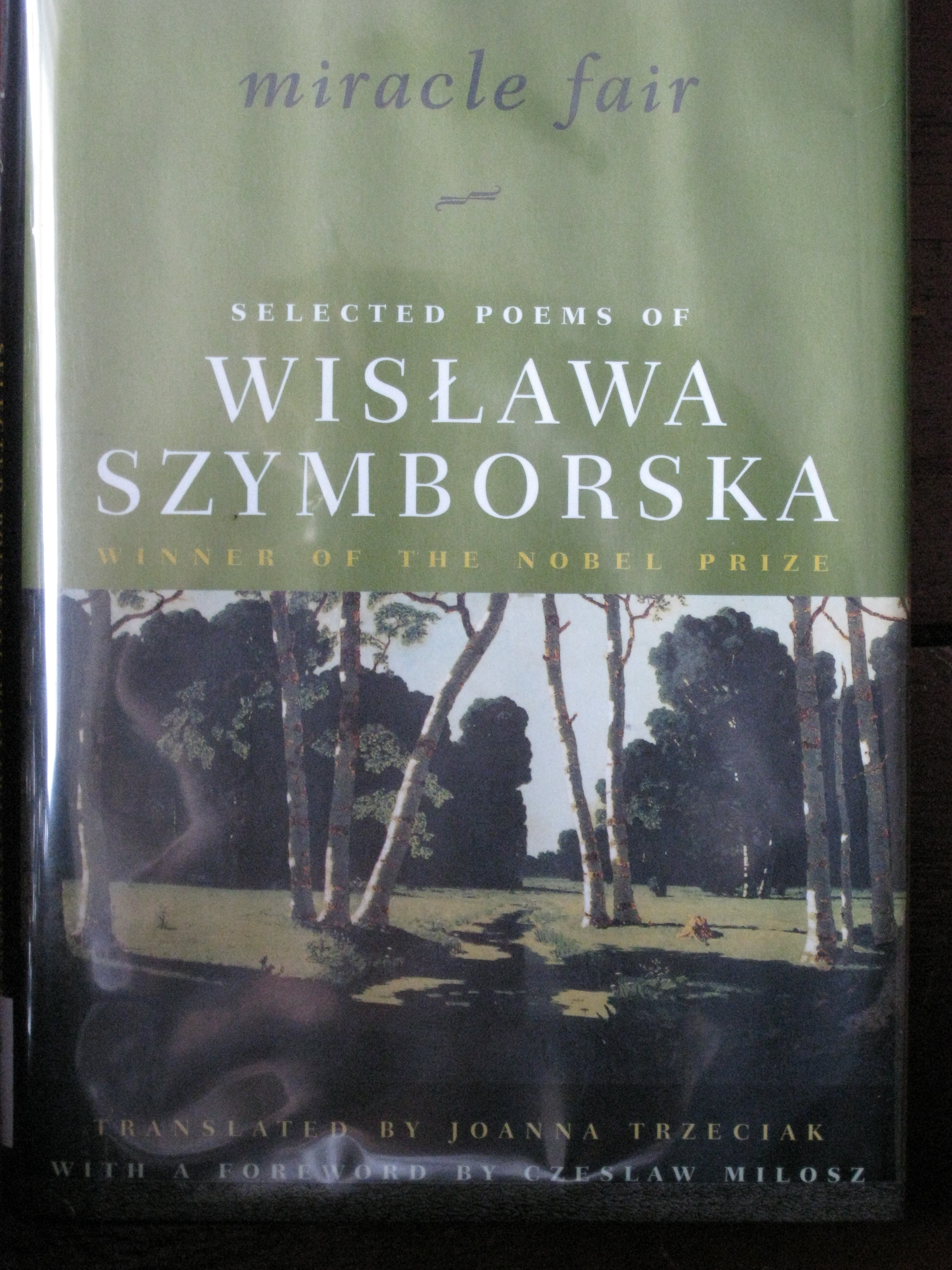
Wislawa Szymborska poetry

Szymborska, Wislawa. “The End and the Beginning.” Miracle Fair: Selected Poems of Wislawa Szymborska. New York: W.W. Norton, 2001.

This poem is so vivid that I pictured it as the scene behind the credits at the end of a war movie. Stay with me. Hear me out. In the poem, Szymborska gently, methodically runs through the list of what must be done at the end of a war: clean up debris, repair houses, rebuild bridges, carry on. Stay strong. So, imagine the credits rolling. The movie has ended, the war is over. Behind the steady stream of names, cast and crew, people survivors are shell shocked and sweeping, weeping and washing, hungry and hammering, biting their lips to continue life as best as they can; as they know how. Somehow, I see this as a stark black and white. More dramatic (or depressing) that way.
My favorite line: “From time to time someone must still dig up a rusted argument from underneath a bush and haul it to the garbage dump.” What does that mean? Maybe two someones can’t decide who really “won” the war. Maybe someone else is adament it rages still…just somewhere else. Arguments that have weathered and rusted from constant exposure.

BookLust Twist: From More Book Lust and the chapter “Poetry Pleasers” (p189).

Forgive Me

Days End

I have been hiding behind book reviews and poetry for days on end. Two poems for every one book. Reading like a fiend seems to suit me. Sorry.
I’ve started to tell you about the weirdest things ~ Kisa murdering the ladybugs in the bathroom, the end of N&ZY, my heartbreak over a breakup, the amazing work I’ve done with MSR, the crap I’ve been handed at AIC, how homesick I am, how little I’ve run, the need to hear my music again (go where we haven’t I don’t dare), Natalie, Germany, Sin City, Taka Tak, being stood up, being letdown, sex in my city, Comic Book Tattoo, Darfur, Boston Celtics, wine, angry black man, gun to my heart, arthritis and friends too far away.

I’ve started to tell you about all these things. Yet, I can’t. Instead I tell you about what I’ve read and read and read.
Forgive me.

Three Roads to the Alamo

Davis, C. William, Three Roads to the Alamo: The Lives and Fortunes of David Crockett, James Bowie, and William Barret Travis. New York: HarperPerennial, 1999.

When I first picked up Three Roads I thought to myself there is no way I want to carry this thing around with me. It’s nearly 800 pages long, and despite the pages being super thin, it’s a heavy book. However, when I quickly calculated that in order to finish Three Roads by the end of March (the month Texas became a state), I would need to read over 40 pages a day I decided carry it around, I would! 
When I read the reviews for Davis’s book one word always seemed to pop up: exhaustive. Exhaustive research, exhaustive detail, exhaustive portraits, exhaustive this, exhaustive that. It’s true. There is so much detail given to not only the personalities and lives of Crockett, Bowie, and Travis, but to the culture and landscape of both politics and era as well. It’s as if the reader is witness to the pioneering growth of Louisiana, Texas and Virginia by default. History, politics and geography all rolled into one book.
Because not much is known about Crockett, Bowie and Travis each has become a legend beyond compare. Using as much information as he was able to research (exhaustively) Davis does a great job trying to dispel rumor and myth surrounding each man, admitting that these are men of folklorish proportions, but not much of it can be substantiated.
Confession: knowing there was no way I was going to finish this in time I skipped to the last chapter of the book. It is, of course, the end of Crockett, Bowie and Travis. Davis paints a tragic picture of what their last days must have been like in Alamo, Texas. The one image that kept playing in my mind was the uncertainty of their fates. When their families did not hear from them they could only speculate and worry. Word travelled slowly in those days. A telegram dispatched two weeks earlier can give loved ones the impression you are still alive despite the fact you died the next day.

BookLust Twist: From Book Lust in the chapter “Texas: Lone Star State of Mind” (p 233).

HUGE woops. This was supposed to be published last month!

Imagine Me & You

Imagine Me And You
Mernit, Billy. Imagine Me & You: A Novel. New York: Shaye Areheart , 2008.

This is March’s LibraryThing early review book but, receiving it late, I just finished it. It’s bright and funny and witty. I loved it. I hated it. Simply put, Imagine Me and You is about a screen writer named Jordan who, because he is in danger of losing his wife Isabella, creates imaginative and sometimes halarious schemes to win her back. It illustrates how communication when confused with emotions (and language barriers) can be misconstrued. Misunderstandings make mountains out of molehills.
While I had issues with shallow character development, one of my biggest problems with Imagine Me and You  was the Dickens-like gimmick of placing a ghostlike “Christmas Carol” character in Jordan’s path. His “muse” Naomi tries to steer Jordan in the right direction beyond writing –  even going so far as to show Jordan what his estranged wife is doing without him. One minute Naomi and Jordan are in California, the next, Italy – watching Isabella moon over a photo she just happens to pull out. Of course Jordan wants to speak to her, but as Naomi warns, “she can’t hear you”…of course she can’t.  
The ending is predicatable. Jordan himself gives it away. It’s no mistake his story mirrors the screenplay he has been writing throughout the story. But, the real saving grace of Imagine Me & You is how the story is written. Setting up each chapter to follow the script of a romantic comedy lends a playful foreshadowing to the plot.

Oven Bird

Robert Frost II
Frost, Robert. “The Oven Bird.” You Come Too: Favorite Poems for Young Readers. New York: Holt, Rinehart & Winston, 1959. 50.

I am definitely unsure of an oven bird. I don’t think I’ve ever seen one, nor heard one. I can’t even imagine one. But, I do know I love Robert Frost’s poetry – whether it be for children (as this one is) or for adults. What I keep coming back to about this particular poem is the circulation of the seasons. The flowers that bloom, and the bird that sings. It’s delightful. No favorite lines. It’s too short.

BookLust Twist: From More Book Lust in the chapter “Poetry Pleasers” (p 188).

Blind Heron

Tate, James. “The Blind Heron.” Shroud of the Gnome. New Jersey: Ecco Press, 1997. 11.

From just the title of Tate’s book I knew I would be in for a treat. I love 20th century poetry, especially when it has a sense of humor, a sense of the playful. Before I even got to “The Blind Heron” I read the table of contents and had a good laugh over some of the other poems: “Where Babies Come From” (made me think of that birds and bees talk – ahem!), “Restless Leg Syndrome”, “Shut Up and Eat Your Toad”, and “Sodomy in Shakespeare’s Sonnets”…I’ll have to blog about those at another time.
But, I will say this – Remember that scene in the movie ‘Tommy Boy’ when Tommy is trying to sleep at a motel. Richard keeps knocking on the door with different suggestive suggestions until finally, Tommy bolts out of bed yelling, “what kind of place is this?”? Well, that’s me with this collection of poetry. After seeing a poem called “In His Hut Sat Baba Jaga, Hag Faced” all I could ask was “what kind of poetry is this?!” The only answer: fun!

“Blind Heron” is clever and impish. Kiki is missing her cockatiel. Kiki is called a liar yet you, as the reader, are not really sure if that’s the truth. It’s more probable that you are only suppose to think of Kiki as a nontruth telling person because the poem concludes rather suddenly. Everything you thought you knew has been changed based on a confession.

BookLust Twist: From More Book Lust in the chapter “Poetry Pleasers” (p 189).

Provide, Provide

Frost, Robert. “Provide, Provide.” The Oxford Book Of American Poetry. Ed. David Lehman. Oxford: Oxford University Press, 2006. 234.

I couldn’t tell if Frost was trying to be funny here, if he was being what they call Tongue in Cheek, or if he really was serious in “Provide, Provide.” The first time I read it I thought it was one of those BeAllYouCanBe poems. Die great if you can help it. Seriously. But, the second time I read it I realized there is a sly sense of humor to this poem, a sort of sarcasm that if you can’t be great, lie about it. Don’t die a nobody. The line “Make the whole stock exchange your own!” sends me smiling every single time. I’m thinking of my Bull Lynch uncle and all his greatness in the arena. 
But, this part cinched it for me & are my favorite lines, at the end (of course):
“Better to go down dignified
With boughten friendship at your side
Than none at all. Provide, Provide!”

BookLust Twist: More Book Lust  in the chapter “Poetry Pleasers” (p 188).

Incident

Cullen, Countee. “Incident.” On These I Stand: An Anthology of the Best Poems of Countee Cullen. New York: Harper & Brothers, 1927.

Don’t let the shortness of this poem fool you. It packs a punch. “Incident” can be defined as one of those defining moments I blogged about earlier – where one instance stays with you, shapes you, defines you. Written in the first person, “Incident” is about an eight year old boy visiting Baltimore. Even though he spends some considerable time there the only thing he can recall is being called “nigger” by another young boy. There is so much below the surface of this poem. The hurt seethes.
Incidentally, this poem comes from an anthology of poems personally picked by Mr. Cullen. He dedicates this particular one to Eric Walrond, a Harlem Renaissance writer. This is the second Countee Cullen poem on my list.

BookLust Twist: From More Book Lust in the chapter “Poetry Pleasers” (p 188).


The Mercy

The Mercy
Levine, Philip. “The Mercy.” The Mercy. New York: Alfred A. Knopf, 1999.

Why is it that I can see some poems as mini movies? “The Mercy” paints a picture of Levine’s mother and her immigration to New York. It’s simple and short, but loaded with imagery. I can see the boat, waiting off-shore (quarantined until all illness had passed), or the sailor who teaches the eight year old girl how to say “orange” as she enjoys the juice-laden fruit.
There is respect and love woven into the words. Levine’s entire book of poetry is dedicated to his mother and the cover of the book depicts immigrants waiting to come ashore. Who knows? Maybe his mother is in the picture? I do not know.

BookLust Twist:From More Book Lust in the chapter, “Poetry Pleasers” (p 189).