Where I Go

Of course I will have to write something a bit more about this (how could I not?), but for now here’s this:

  1. Autumn Lullabye
  2. Man in the Wilderness
  3. The Letter
  4. Sonnet #73
  5. Life is Sweet
  6. Verdi Cries
  7. Butterfly
  8. Spring and Fall: To a young Child
  9. She-Devil
  10. Henry Darger
  11. This House is on Fire
  12. The End

For now, I am stunned into silence. More later.

xoxox

Love Song of J. Alfred Prufrock

Black Cat Red House

Eliot, T.S. “The Love Song of J. Alfred Prufrock.” The Oxford Book of American Poetry. Ed. David Lehman. Oxford: Oxford University Press, 2006. 343.

Who hasn’t read this in high school or at least college at least once? I can remember combing through line after line like primates looking for bugs. We scrutinized each word asking ourselves and each other what it all meant. Half the time we wanted to make stuff up because we just didn’t get it. Even today, there is so much to this poem that I have a hard time sorting it all out. Here are some of the ideas I have (and I would love it if someone could tell me how far off (or on) I really am). Okay, so the first idea is a comparison to Dante’s Inferno, and the whole idea of deciding who you really are. The second idea is a rant about aging, or society, or time, or relationships…or all of the above. I do know that it’s a monologue; someone talking to his or her “me, myself and moi”; or in my world, someone just having a good rant. Any takers on this theory?

Here is my favorite imagery: the cat. Of course. I love, love, love T.S. Eliot’s imagery when he decribes the yellow smoke as a cat, “…rubs its back upon the window-panes…licked its tongue into the corners of the evening…curled once about the house, and fell asleep.” It’s brilliant.

BookLust Twist: From More Book Lust  in the chapter “Poetry Pleasers” (p 188). Are you sick of me saying that yet?

Celestial Music

IMG_1223
Gluck, Louise. “Celestial Music.” The Oxford Book of American Poetry. Ed. by David Lehman. Oxford: Oxford University Press, 2006. 991.

I want to call this ‘Friends Argue then Agree to Disagree.’ For it is about (I think), two people seeing life differently. While they focus on the subject of religion (one believes in God, the other doesn’t), it is a metaphor for how each of them sees life as a whole – living, dying, coping with everything in between. It’s poignant. As the two friends walk they come across a dying catapillar. One friend can hardly stand to watch it fall victim to a swarm of ants while the other can. In the end, they know they are both right. As they should be.

My favorite line, “The love of form is a love of endings.”

BookLust Twist: From More Book Lustin the chapter “Poetry Pleasers” (p 189).

Dulce Et Decorum Est

Owen, Wilfred. “Dulce Et Decorum Est.” The Collected Poems of Wilfred Owen. London: Chatto & Windus, 1964. 55.

I think this has to be one of the most famous poems of all times. It is certainly the most famous poem about World War I that I can think of. It’s imagery is so vivid I often recoil from the words as I try to read them. I only think I can imagine the horror of what the soldiers experienced on the battlefields. I can only pretend to feel the pain of their mental and physical traumas. Wilfred Owen has you standing in the trenches with stench of blood and mud in your nose. He has you hearing the bombs whistle and explode in your ears. He has your eyes tearing as they burn from the green gasses and the death of friends.

Lines that killed me:
“As under a green sea, I saw him drowning”
“His hanging face, like a devil’s sick of sin…”

BookLust Twist: From More Book Lust in the chapter “Poetry Pleasers” (p 188).

Edited to add: Some people prefer their poetry in a more lyrical manner. Check out “The Latin One” (10,000 Maniacs, Hope Chest – 1990) for their interpretation.

Search for Baby Combover

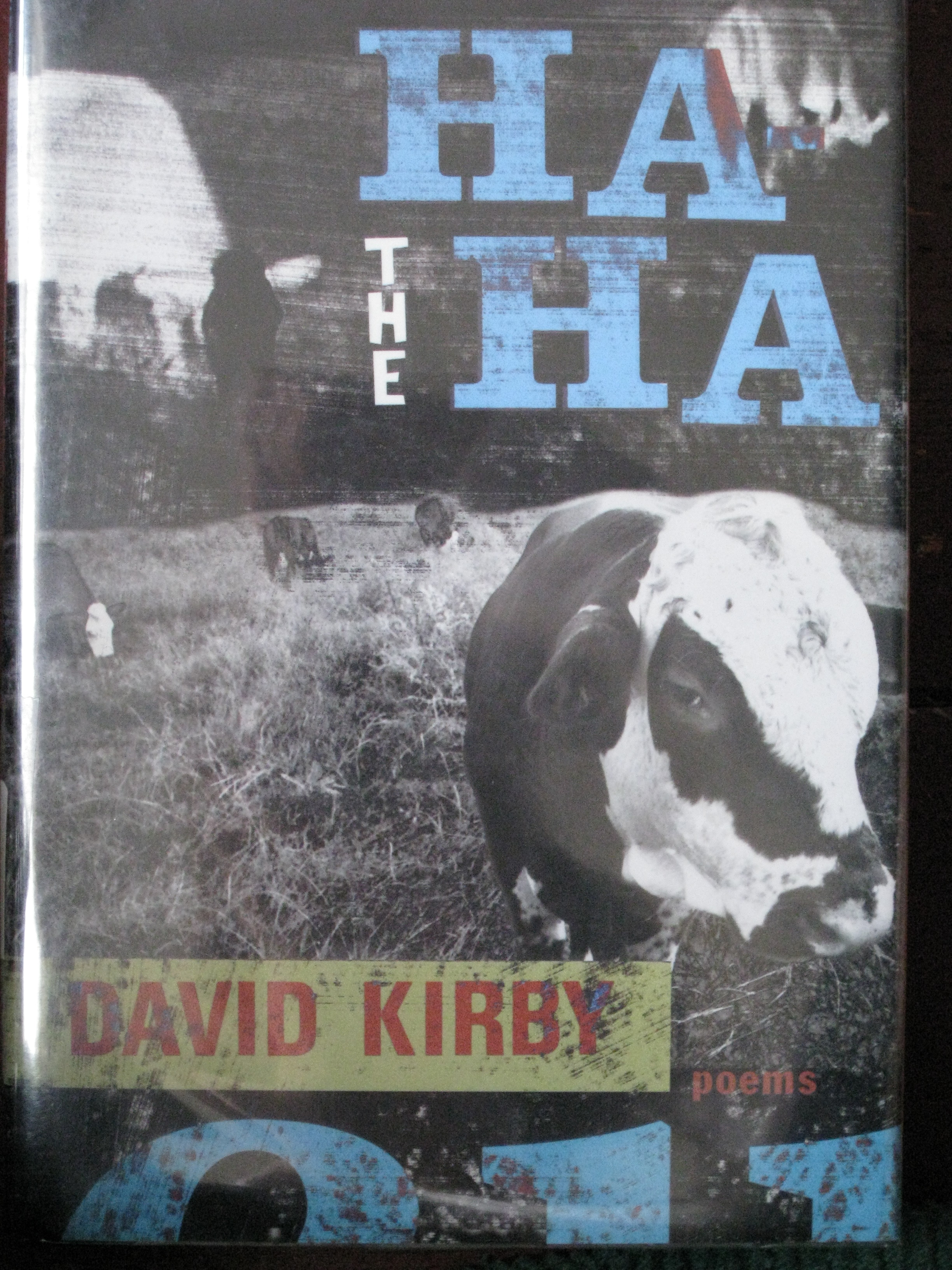
Kirby, David. “The Search for Baby Combover.” The Ha-Ha. Baton Rouge: Louisiana Univeristy Press, 2003. 41.

This is my third (and final) poem from The Ha-Ha that I had to read for the BookLust challenge. Later on, I will read a different book of poetry from David Kirby. But, for now “The Search for Baby Combover” is it. (see yesterday’s post for another Kirby.)
I couldn’t have asked to end Kirby’s collection on a better poem. “Baby Combover” is beyond delightful. It’s not a flowery prosey-prissy kind of thing. Instead, it’s inventive, sarcastic and wildly funny. It’s the story of a man who gets a knock on his door one night. His downstairs neighbor stands before him and proceeds to ask him to please refrain from (whoops wrong story) not move furniture around so late at night…because it wakes the baby. What baby? As far as our man is concerned he’s never seen a baby. Never heard a baby. So, he goes on to think the guy has invented a baby…It’s hysterical.

Here are a few of the best lines (and there are more so you might as well read the whole thing):
“…and I see he’s got something on his head, like strands of oily seaweed, something you’d expect to find on a rock after one of those big tanker spills in the Channel…”
“Baby Combover: the world’s first silent baby.”

BookLust Twist: From More Book Lust in the chapter “Poetry Pleasers” (p 189).

Ha-Ha Part II

David Kirby poetry
Kirby, David. “The Ha-Ha, Part II: I Cry My Heart, Antonio” The Ha-Ha Baton Rouge: Louisiana State University, 2003. 53.

Clever. This poem is so very clever. I like the story within a story concept. Like Shakespeare only a play on words. Here’s the quick and dirty premise: a man is having dinner with a companion. He is loving the meal and makes a comment about it. The comment reminds him of something horrible, so horrible that when his companion asks about his tragic face, he makes up another sad story to compensate for something too horrible to be discuss. The story he makes up becomes his ha-ha, his “structure against chaos”, as Kirby says.

BookLust Twist: From More Book Lust in the chapter “Poetry Pleasers” (p 188).

Elephant of the Sea

elephant of the seaKirby, David. “Elephant of the Sea,” The Ha-Ha.Baton Rouge: Louisiana State University Press, 2003. 46.

Crack me up. This poem is really funny. It’s one of those comments on culture and keeping up with what’s cool. It’s also about language. Words and meanings. A French man wants to buy an automobile just like his American friend’s. Right down to the manatee on the license plate – the “elephant of the sea.” The friend doesn’t get it. He’s imagining what the clerk at the DMV are going to say and how the whole incident will shape her future.
And this is just one poem. Everything David Kirby writes is great. He is like geek rock of poetry. He’s smart and too funny for words.

Favorite line: “‘I can have zuh elephant of the zuh sea on my matriculation?’ to a clerk who’s got this grin on her face like she’s either seeing God or having an aneurysm” (p 46). 

BookLust Twist: From More Book Lustin the chapter “Poetry Pleasers” (p 188). He’s also mentioned in Book Lust in the chapter “Kitchen-Sink Poetry” (p 138).

Musee des Beaux Arts

Auden, W.H. “Musee des Beaux Arts.” The Oxford Book of American Poetry. Oxford: Oxford University Press, 2006. 501.

What do you see when you look at art? Does a painting create question in your mind? W.H. Auden wrote “Musee des Beaux Arts” in response to seeing the painter Brueghel’s Icarus. A ploughman calmly going about his business as a boy falls from the sky. While he had clues to the tragedy (a splash or cry) he does nothing. Auden’s larger observation is about how human response to an event or tragedy can vary; how life goes on beyond that event or tragedy. “Human position” as Auden puts it.

BookLust Twist: From More Book Lust in the chapter “Poetry Pleasers” (p 188).

Forgive Me

Days End

I have been hiding behind book reviews and poetry for days on end. Two poems for every one book. Reading like a fiend seems to suit me. Sorry.
I’ve started to tell you about the weirdest things ~ Kisa murdering the ladybugs in the bathroom, the end of N&ZY, my heartbreak over a breakup, the amazing work I’ve done with MSR, the crap I’ve been handed at AIC, how homesick I am, how little I’ve run, the need to hear my music again (go where we haven’t I don’t dare), Natalie, Germany, Sin City, Taka Tak, being stood up, being letdown, sex in my city, Comic Book Tattoo, Darfur, Boston Celtics, wine, angry black man, gun to my heart, arthritis and friends too far away.

I’ve started to tell you about all these things. Yet, I can’t. Instead I tell you about what I’ve read and read and read.
Forgive me.

Blind Heron

Tate, James. “The Blind Heron.” Shroud of the Gnome. New Jersey: Ecco Press, 1997. 11.

From just the title of Tate’s book I knew I would be in for a treat. I love 20th century poetry, especially when it has a sense of humor, a sense of the playful. Before I even got to “The Blind Heron” I read the table of contents and had a good laugh over some of the other poems: “Where Babies Come From” (made me think of that birds and bees talk – ahem!), “Restless Leg Syndrome”, “Shut Up and Eat Your Toad”, and “Sodomy in Shakespeare’s Sonnets”…I’ll have to blog about those at another time.
But, I will say this – Remember that scene in the movie ‘Tommy Boy’ when Tommy is trying to sleep at a motel. Richard keeps knocking on the door with different suggestive suggestions until finally, Tommy bolts out of bed yelling, “what kind of place is this?”? Well, that’s me with this collection of poetry. After seeing a poem called “In His Hut Sat Baba Jaga, Hag Faced” all I could ask was “what kind of poetry is this?!” The only answer: fun!

“Blind Heron” is clever and impish. Kiki is missing her cockatiel. Kiki is called a liar yet you, as the reader, are not really sure if that’s the truth. It’s more probable that you are only suppose to think of Kiki as a nontruth telling person because the poem concludes rather suddenly. Everything you thought you knew has been changed based on a confession.

BookLust Twist: From More Book Lust in the chapter “Poetry Pleasers” (p 189).

Accidental Recovery ~ for Nick

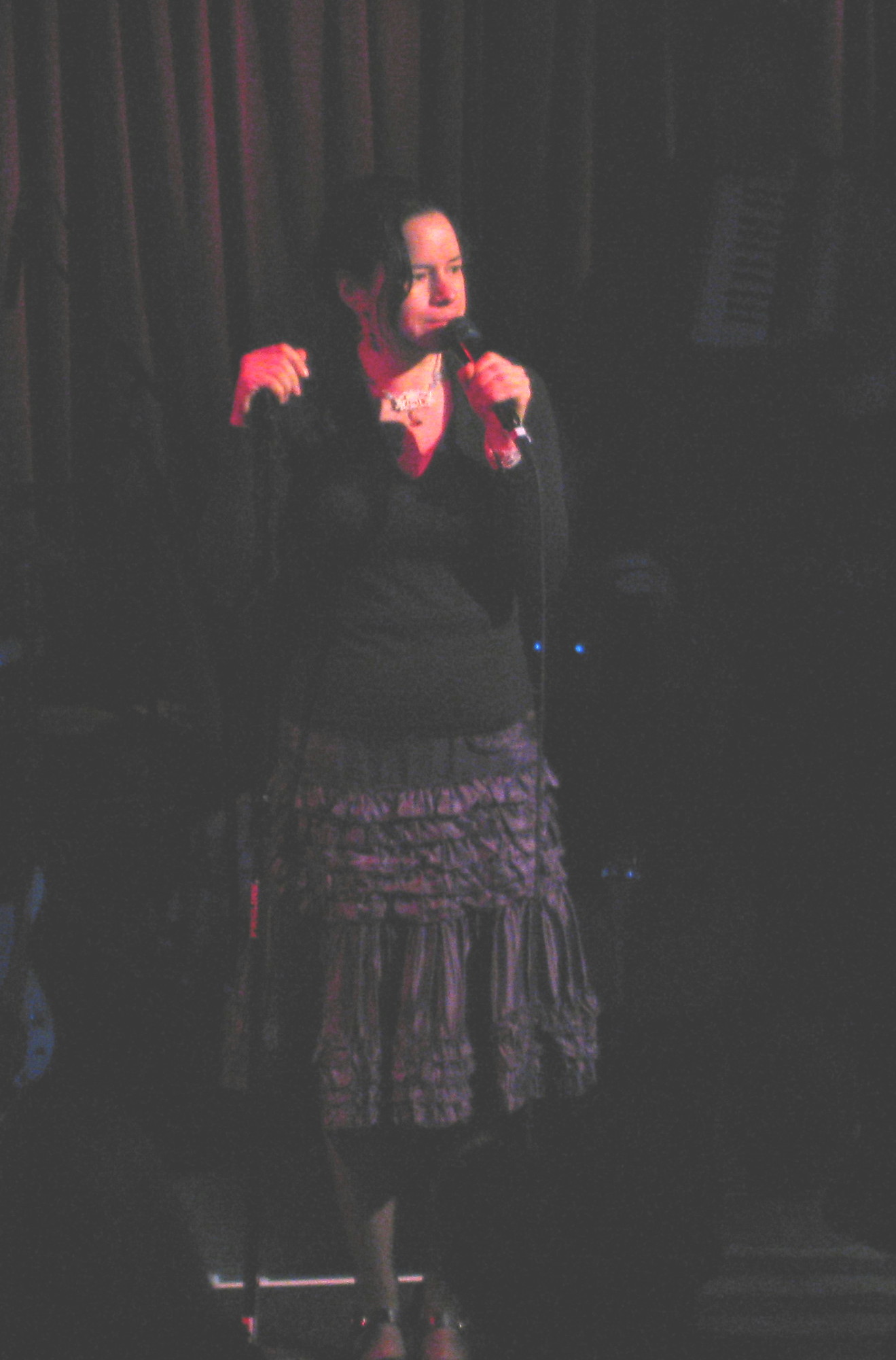
I was researching a poem for April’s poetry month when I came across one I can recite by heart, thanks to Natalie. She sang it during the Hiro shows as one of those ad libs, patter moments: Thought I would share because it’s so darn cute. Imagine a yawn at the end…

The Sleepy Giant

My age is three hundred and seveny-two,
And I think, with the deepest regret.
How I used to pick up and voraciously shew
The dear little boys whom I met.

I’ve eaten them raw, in their holiday suits;
I’ve eaten them curried with rice;
I’ve eaten them baked, in their jackets and boots,
And found them exceedingly nice.

But now that my jaws are too weak for such fare,
I think it exceedingly rude
To do such a thing, when I’m quite well aware
Little boys do not like being chewed. *insert giggle here*
[Little boys do not like being chewed.]

And so I contentedly live upon eels,
And tryto do nothing amiss,
And I pass all the time I can spare from my meals
In innocent slumber  – like this.
[In innocent slumber like this…]

Carryl, Charles E. “The Sleepy Giant.” The New Oxford Book of Children’s Verse. Ed. Neil Philip. Oxford UP, 1996. 95-96. 

Spring and Fall

Hopkins, Gerard Manley. “Spring and Fall: To a Young Child.” The Poems of Gerard Manley Hopkins. London: Oxford University Press, 1967. 88.

Short and sweet, bitter and sad, Hopkins seems to be telling a child (Margaret), “don’t question the death of things too quickly. Life will be over before you know it. Enjoy what you have.” While the child is easily upset by the falling of leaves Hopkins doesn’t belittle the child’s distress, nor does he cater to it. He calmly explains that more disappointments in life will follow and that is the nature of life.

BookLust Twist: More Book Lust in the chapter “Poetry Pleasers” (p 188).

As I Walked Out

AudenAuden, W. H. “As I Walked Out One Evening.” Collected Shorter Poems 1927-1957. New York: Random House, 1966. p85.

I liked this poem. I saw it as questioning time which is something I do all the time. I often wonder what makes time move the way it does. Perceptions of time can differ between two people having the same experience, just by their emotions.
I also saw this poem as pondering life and all that it has to offer. This is yet another thing I ponder as well. Am I living this life the way I’m supposed to? Is there even a blueprint to follow? I got the feeling the voice in “As I Walked Out…” is watching life pass by and speculating on what life really means.

BookLust Twist: From More Book Lust and the chapter on “Poetry Pleasers” (p 188).

“anyone lived in a pretty how town”

Cummings, E.E. “anyone lived in a pretty how town.” Poems 1923-1954. New York: Harcourt, Brace & World, Inc. 1954, 370.ee cummings

I’ve said before that sights and sounds are indicative of times gone by. The smell of freesia will make me think of Ruby even though the sprays we bought together are more than 10 years gone. Words work the same way. Cummings wrote about anyones and noones and someones, giving them voices, feelings, life. When I was in college I wrote a story about a Somebody and a Nobody. My professor called it “slickly professional” implying plagiarism to the point I had to prove myself. (Thanks to Cummings I remember this like it was yesterday.) I dragged my Him into —-‘s office and in a trembling, yet defiant voice, announced “THIS is my Somebody.” Did I remind this professor of Cummings with my somebodys and nobodys? I certainly wasn’t as melodic as Cummings! I didn’t write with the same fluidity and beauty, either.

BookLust Twist: From More Book Lust’s chapter on Poetry Pleasers (p. 188).

Selected Poems 1957-1967

Hughes, Ted. “Wind”. Selected Poems 1957-1967. New York: Harper & Row, 1974. 13.

Ted Hughes

I trembled at the very thought of this poem. I do not like the wind. Never have, never will. I knew the landscape of Hughes’s words would be dark and terrifying. I almost couldn’t read them. I am more than familiar with gulls bent against the wind, life thrown about; and of houses that tremble to the point of coward. I know of the foreboding, the violence. Hughes not only puts me at the scene. He puts me home.

BookLust Twist: Pearl does no more than include Hughes in her list of “Poetry Pleasers” from More Book Lust (p. 188).