Plain Speaking

harry s trumanMiller, Merle. Plain Speaking: An Oral Biography of Harry S. Truman. New York: P.G. Putnam, 1973.

I think I mentioned before that reading this was good timing. For starters, both Truman and Miller share May as their birth month. Secondly, I just finished reading about Roosevelt for the Early Review program. This just seemed appropriate for the next book to read. There was “flow” to the subject material, if you will.

Comprised of interviews in chronological order, Miller talks to Truman (as former President) as well as Mary Jane Truman (Truman’s sister), fellow Battery D veteran Albert Ridge, even a childhood neighbor of Truman’s, Henry Chiles. The interviews (as opposed to Miller’s interpretation) allow for personalities to emerge. Miller spends more time delving into Truman’s political and military careers instead of the more personal subjects such as Truman’s childhood and relationships. There is a definite rapport between Miller and Truman and Miller is careful to avoid disrespect on several occasions.
While the interviews are very candid (I thoroughly enjoyed “hearing” Truman swear) I thought some sections were drawn out and much longer than they needed to be. I also found myself skipping some of the footnotes because they didn’t always relate to the subject. Another small criticism I had is while reading it was sometimes difficult to know the difference between Truman answering a question and Miller telling his reader something. While he used a different font for the questions posed to the respondent he didn’t for generalized comments to the reader.

BookLust Twist: From Book Lust in the chapter “Merle Miller: Too Good To Miss” (p 155).

Red Badge of Courage

Red Badge of CourageCrane, Stephen. Red Badge of Courage. New York: Signet, 1960.

I have heard complaints about Red Badge (language is archaic, plot is meaningless, etc) and while all those points are valid, they don’t take away from the fact that for a person who never saw a day of combat in life Crane does an excellent job portraying a young soldier in battle. I would imagine that anyone facing death would wrestle with the choice to be brave (“heroic” or “patriotic”) or be a coward. To stay and fight or take flight…especially after encountering death up close.
To say that Red Badge of Courage is about a young man in combat during the Civil War sells the story short. Henry is a young man facing many things for the first time in his life and throughout battle he struggles with all of it. It’s a historical snapshot of the psychology of war. It goes beyond whether Henry can be brave or not. Whether he is a true soldier or not.

I haven’t read Red Badge of Courage since high school but the one scene that has always stuck in my mind is when Henry comes across the dead soldier in the woods. I will always picture the blue uniform faded to a shade of green and the ants. The ants crawling on the dead man’s lip. It’s a powerful scene. The other moment I always remember is when Henry longs to be one of the wounded so that he may have his “red badge of courage” too.

BookLust Twist: From Book Lust in the “Civil War Fiction” chapter (p 57).

Educating Esme

Educating EsmeCodell, Esme Raji. Educating Esme:  Diary oi a Teacher’s First Year. Chapel Hill: Algonquin Books, 1999.

Word to the wise: if you want to celebrate education month and you need something really quick to read, grab Educating Esme. Barely 200 pages it’s an entertaining, fast and funny book. This one interested me on so many different levels. For starters, at one time I thought I might be a teacher – even declared Education as my major for a while (until I found out that you never have time to read anything, you just pretend you do). It also interested me because I know two different people who have gone through that “first year” of teaching. They had completely different experiences and I wanted to compare notes.

What went on LibraryThing:
Educating Esme: Diary of a Teacher’s First Year  is smart and funny. It’s a journey inside the mind of a young, fresh-minded educator hell bent on doing things her way. Her lessons and style of teaching are engaging. They allow students to be themselves and in the process learn something.  The students are not bribed or cajoled into lesson plans. Codell disguises education in a safe, fun environment. This is not to say she doesn’t have her share of problems. Chicago has it’s gang culture, it’s broken homes, it’s drug addled families; not to mention a difficult hierarchy within the school system. Codell encounters it all with grace and strength.

Funny quotes: “The way they sassed patrons they didn’t like. The way they seemed to know too much. A little like librarians” (p 62). You would think this quote would somehow offend me on some level…especially considering the fact Esme is describing prostitutes! LOL
“What sort of Jedi would I be if I don’t really face the Dark Side? Mr. Turner may be Vader, but is there an enemy that remains to be revealed , like that bossy old wrinkled guy who told Vader what to do?” (p 112).

BookLust Twist: From Book Lust in the chapter “Teachers and Teaching Tales” (p 230). I love how Pearl calls Codell “relatively” hip (p 231).

May is…

May is one of my favorite months. I love the one month of lilacs. I love the urgency of spring in the air. Days are warm but nights stay cool. Plus, there is Mother’s Day for all those mums out there.
Here is how I am going to celebrate May (besides trying to quell the homesickness):

  • Mother’s Day: Reading: True Confessions by Mary Bringle. Personally: Taking my two favorite mothers to see Natalie Merchant at the end of the month.
  • Merle Miller’s birthday: Plain Speaking by Merle Miller – which is really funny because this is about Truman and his birthday is in May, too…a-n-d…I just finished reading about Roosevelt.
  • National Education Month: Reading: Educating Esme by Esme Raji Codell (nonfiction). Personally: taking my staff out for a Middle Eastern lunch.
  • National Music Month:Reading: Ground Beneath Her Feet by Salman Rushdie (The big question is will I be able to get it out of my head that he did a little acting in that “Bridget Jones” movie?). Personally: I’d like to see Sean Rowe this month. Sirsy would be on the list but their closest show is on a Monday night. Boston Symphony Orchestra is probably the classiest way to celebrate National Music Month, don’t you think?
  • IMG_0163

And if there is time:

  • Best time to visit Russia: Murder on the Leviathan by Boris Akunin
  • National History month: Dreamland by Kevin Baker

I have one Librarything early review book: TBA (which means they told me I’m getting one but I haven’t got it yet…if that makes sense.)


April Was…

IMG_1207
April was…April was definitely not one of my better months. Car crashes that stuck in the crevices of my psyche, accusations of disloyalty, heart breaking breakups. More ends than beginnings. For everyone, me included. It was a month of surviving. Here are just a few things that kept my head above water: amazing pictures from Arizona, amazingly great friends, amazingly crazy good Indian food, the run that gets better and better..and these books.

Finished for BookLust:

  • Road from Coorain by Jill Ker-Conway (in honor of the best time to visit Australia)
  • Ginger Pye by Eleanor Estes (National  Librarian Week & National Dog Month)
  • Deep in the Green: An Exporation of Country Pleasures by Anne Raver (National Gardening Month)
  • Apologizing to Dogs by Joe Coomer (National Dog Month)
  • Gain by Richard Powers (Earth Day)
  • Case for Three Detectives by Leo Bruce (National Humor Month)

Finished for LibraryThing:

  • Imagine Me and You by Billy Mernit
  • Franklin and Lucy: President Roosevelt, Mrs. Rutherfurd, and the Other Remarkable Women in His Life by Joseph E. Persico (Great timing! RE: Cover of “Newsweek”

And a total of 17 poems.
BookLust books NOT on the list:

  • Love, Loss, and What I Wore by Ilene Beckerman (in honor of National Fashion Month !!?)
  • Language of the Land edited by Martha Hopkins & Michael Buscher (Taxes = Government doc.)
  • Red Badge of Courage by Stephen Crane (start of the Civil War)

I knew  I did a lot of reading during that CrAzY month!

Language of the Land

Hopkins, Martha and Michael Buscher. Language of the Land: The Library of Congress Book of Literary Maps. Washington: U.S. Government Printing Office, 1998.

This is a weird choice for the final book of April. I wanted to read something that represented tax time and that dreaded 4/15. Nancy didn’t include a whole lot of books on taxes in either Book Lust or More Book Lust so I decided to lump in government documents and publications as representation…It makes some sense, right?

Anyway, this book is really, really cool. I urge you to take a look at it for yourself. If you have ever seen Manguel’s The Dictionary of Imaginary Places you will get the gist of Language of the Land. I have to admit I’m a sucker for these kinds of things. To say that it is a collection of maps with the basis being about literature doesn’t really explain a whole lot. Here are some better examples (and some of my favorite “maps”): there are several Arthur Conan Doyle maps. One map shows the location of all the fictional places mentioned in the Sherlock Holmes mysteries. Another is the “Sherlock Holmes Mystery Map” (p 207) which allows SH fans to follow the famous detective’s footprints through different stories. Of course, the Odyssey has a few maps depicting the travels of Odysseus. Page 60 has a pictorial map of English literature while on page 70 shows the Beat Generation map. Every state has a map of famous authors. Of course I had to scrutinize Maine to see if they included Monhegan as a place and Stephen King as an author (they did). Then, I had to find the fictional places Robin Hood’s Sherwood Forest and Peter Pan’s Neverland. You would have to be a James Bond fan to know the significance of items in Ian Fleming’s “The Ian Fleming Thriller Map” (p 176) like the centipede in Bond’s glass or the Roman Numeral III tattooed on a blond girl’s arm. Most of the maps are in black and white although a handful are also represented in color. The Literary Map of Latin America (p 162) is beyond cool. So is The Call of The Wild by Jack London map (p 177).

BookLust Twist: From More Book Lust in the chapter “Your Tax Dollars at Work: Good Reading From the Government (Really!)” (p 239). Pearl is serious. Language of the Land is great!

Love Song of J. Alfred Prufrock

Black Cat Red House

Eliot, T.S. “The Love Song of J. Alfred Prufrock.” The Oxford Book of American Poetry. Ed. David Lehman. Oxford: Oxford University Press, 2006. 343.

Who hasn’t read this in high school or at least college at least once? I can remember combing through line after line like primates looking for bugs. We scrutinized each word asking ourselves and each other what it all meant. Half the time we wanted to make stuff up because we just didn’t get it. Even today, there is so much to this poem that I have a hard time sorting it all out. Here are some of the ideas I have (and I would love it if someone could tell me how far off (or on) I really am). Okay, so the first idea is a comparison to Dante’s Inferno, and the whole idea of deciding who you really are. The second idea is a rant about aging, or society, or time, or relationships…or all of the above. I do know that it’s a monologue; someone talking to his or her “me, myself and moi”; or in my world, someone just having a good rant. Any takers on this theory?

Here is my favorite imagery: the cat. Of course. I love, love, love T.S. Eliot’s imagery when he decribes the yellow smoke as a cat, “…rubs its back upon the window-panes…licked its tongue into the corners of the evening…curled once about the house, and fell asleep.” It’s brilliant.

BookLust Twist: From More Book Lust  in the chapter “Poetry Pleasers” (p 188). Are you sick of me saying that yet?

Celestial Music

IMG_1223
Gluck, Louise. “Celestial Music.” The Oxford Book of American Poetry. Ed. by David Lehman. Oxford: Oxford University Press, 2006. 991.

I want to call this ‘Friends Argue then Agree to Disagree.’ For it is about (I think), two people seeing life differently. While they focus on the subject of religion (one believes in God, the other doesn’t), it is a metaphor for how each of them sees life as a whole – living, dying, coping with everything in between. It’s poignant. As the two friends walk they come across a dying catapillar. One friend can hardly stand to watch it fall victim to a swarm of ants while the other can. In the end, they know they are both right. As they should be.

My favorite line, “The love of form is a love of endings.”

BookLust Twist: From More Book Lustin the chapter “Poetry Pleasers” (p 189).

Dulce Et Decorum Est

Owen, Wilfred. “Dulce Et Decorum Est.” The Collected Poems of Wilfred Owen. London: Chatto & Windus, 1964. 55.

I think this has to be one of the most famous poems of all times. It is certainly the most famous poem about World War I that I can think of. It’s imagery is so vivid I often recoil from the words as I try to read them. I only think I can imagine the horror of what the soldiers experienced on the battlefields. I can only pretend to feel the pain of their mental and physical traumas. Wilfred Owen has you standing in the trenches with stench of blood and mud in your nose. He has you hearing the bombs whistle and explode in your ears. He has your eyes tearing as they burn from the green gasses and the death of friends.

Lines that killed me:
“As under a green sea, I saw him drowning”
“His hanging face, like a devil’s sick of sin…”

BookLust Twist: From More Book Lust in the chapter “Poetry Pleasers” (p 188).

Edited to add: Some people prefer their poetry in a more lyrical manner. Check out “The Latin One” (10,000 Maniacs, Hope Chest – 1990) for their interpretation.

Love, Loss, and What I Wore

Mr. StylishBeckerman, Ilene. Love, Loss, and What I Wore. Chapel Hill: Algonquin Books, 1995.

This is on the list in honor of National Fashion Month. Someone told me it really does exists (this fashion month), so I’ve added a bunch of books to the April List. Go Figure.
Anyway, back to Love, Loss, and What I Wore. What a freakin’ cute book. At first I was a cynic and thought, geeze, if this is writing then anyone can do it! Basically Beckerman’s book is small, 139 page, 50% illustrated, all about what she wore throughout major moments of her life. We’re only talking about 65 pages of text which only took me 25 minutes to read (twice). But, in all actuality I loved it. Here are a few reasons why:
I have a lot in common with Beckerman despite the fact she grew up in New York City in the 1940’s and 50’s. For example:

  • Her sister had a significant other who didn’t like her name and insisted on calling her something completely different (ahem)
  • She sometimes wore clothing backwards because it suited her better that way ( 🙂 )
  • She went to Simmon College (yup)
  • She has a fur coat from Bonwit Teller (don’t hate me)
  • She has shopped at the Short Hills Mall (you have too, RT!)
  • She prefers black (duh)

Quotes that caused me to think:
“After I went to love with my grandparents, I never saw my father again” (p 40).
“In another drawer she kept a long, thick, auburn braid of hair that my mother had saved from when she was young and had cut her hair. It was about fourteen inches in length, and sometimes I wore it as a chignon” (p 86). Does anyone else find this a little funky?

BookLust Twist: From Book Lust in the chapter “Do Clothes Make the Man (or Woman)?” (p 75).

Search for Baby Combover

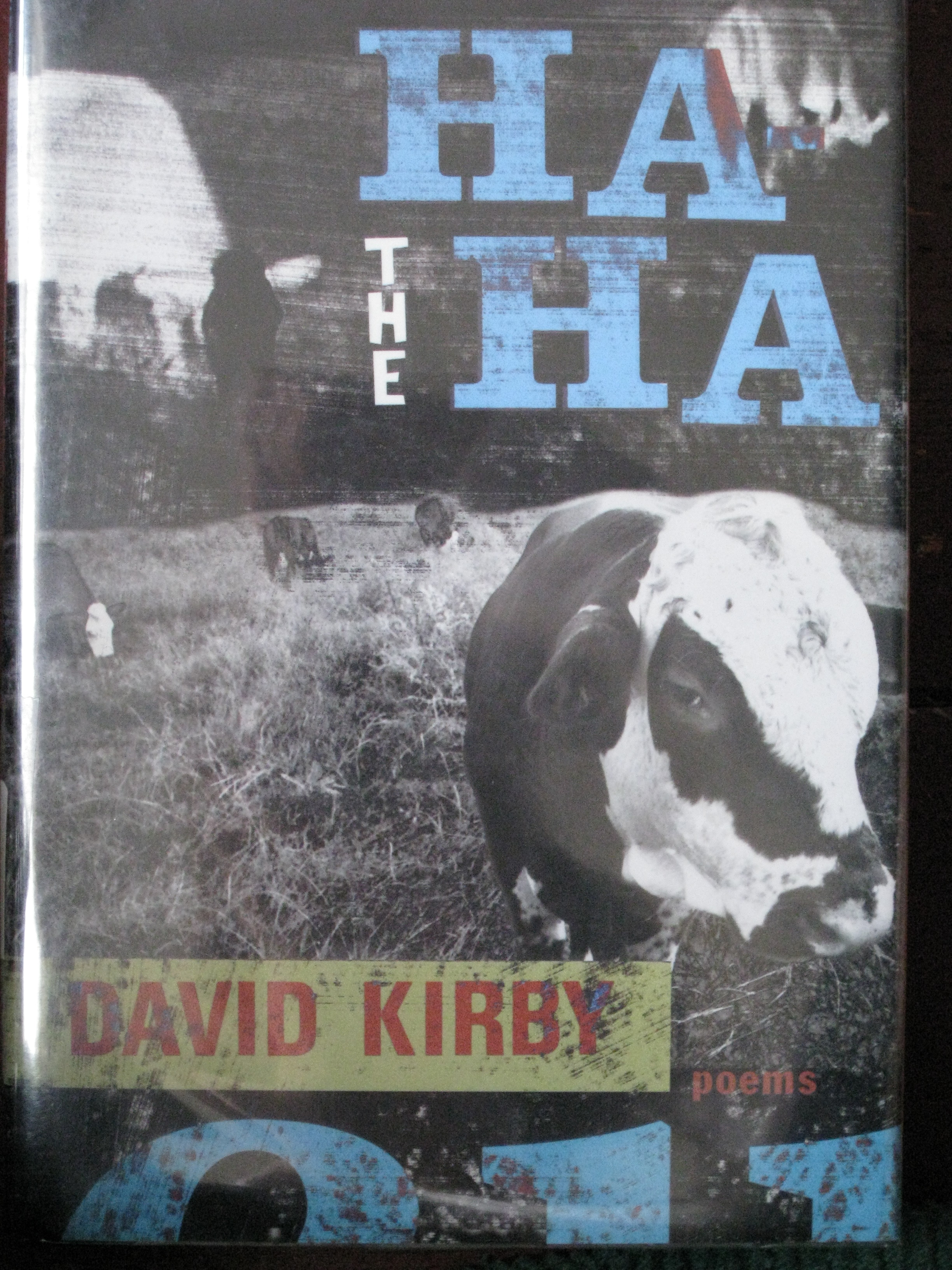
Kirby, David. “The Search for Baby Combover.” The Ha-Ha. Baton Rouge: Louisiana Univeristy Press, 2003. 41.

This is my third (and final) poem from The Ha-Ha that I had to read for the BookLust challenge. Later on, I will read a different book of poetry from David Kirby. But, for now “The Search for Baby Combover” is it. (see yesterday’s post for another Kirby.)
I couldn’t have asked to end Kirby’s collection on a better poem. “Baby Combover” is beyond delightful. It’s not a flowery prosey-prissy kind of thing. Instead, it’s inventive, sarcastic and wildly funny. It’s the story of a man who gets a knock on his door one night. His downstairs neighbor stands before him and proceeds to ask him to please refrain from (whoops wrong story) not move furniture around so late at night…because it wakes the baby. What baby? As far as our man is concerned he’s never seen a baby. Never heard a baby. So, he goes on to think the guy has invented a baby…It’s hysterical.

Here are a few of the best lines (and there are more so you might as well read the whole thing):
“…and I see he’s got something on his head, like strands of oily seaweed, something you’d expect to find on a rock after one of those big tanker spills in the Channel…”
“Baby Combover: the world’s first silent baby.”

BookLust Twist: From More Book Lust in the chapter “Poetry Pleasers” (p 189).

Ha-Ha Part II

David Kirby poetry
Kirby, David. “The Ha-Ha, Part II: I Cry My Heart, Antonio” The Ha-Ha Baton Rouge: Louisiana State University, 2003. 53.

Clever. This poem is so very clever. I like the story within a story concept. Like Shakespeare only a play on words. Here’s the quick and dirty premise: a man is having dinner with a companion. He is loving the meal and makes a comment about it. The comment reminds him of something horrible, so horrible that when his companion asks about his tragic face, he makes up another sad story to compensate for something too horrible to be discuss. The story he makes up becomes his ha-ha, his “structure against chaos”, as Kirby says.

BookLust Twist: From More Book Lust in the chapter “Poetry Pleasers” (p 188).

Franklin And Lucy

Persico, Joseph E. Franklin and Lucy: President Roosevelt, Mrs. Rutherfurd, and the Other Remarkable Women in His Life. New York: Random House, 2008.

Here’s what went on LibraryThing:
When I finally finished the last page of Franklin and Lucy I had two very different thoughts. The first was this was a well written, very thorough biography of the social side of the Roosevelts. It was written in an easy, conversational style that, at times, was hard to put down. The detail given to who, what, where, when, and why made you feel as though you were experiencing every aspect of the era. My second thought was it was an unfortunate title for a work comprised of so much more than just the relationships of Franklin D. Roosevelt. A more accurate title would have included Eleanor. A possible option could have been Franklin and Eleanor: Mrs Rutherfurd, and the Other Remarkable Women in their lives. Another option would be to remove any section dealing with Eleanor that didn’t include her husband’s involvement and focus solely on Franklin.
The other detraction from the book was Perisco’s almost obsessive need to repeatedly include Lucy Rutherfurd’s physical description in such flowery detail. While Franklin’s oft repeated “barrel chested” description was needed to stress his need to hide his disability (and to emphasize his physical decline before his death), and Eleanor’s lack of beauty was important in context to her character as being tragic and unlovable, they were not mentioned nearly as often as Lucy’s exquisiteness.

As an aside (something that didn’t go on LibraryThing), how awful is this? I kept comparing myself to Eleanor! Before you think I’ve gone crazy, hear me out: Perisco described Eleanor as:

  • when stressed Eleanor’s voice grew shrill
  • was insecure
  • was earnest instead of vivacious
  • “schoolmarm air about her”
  • Eleanor failed to recognize humor
  • oblivious to fashion, often choosing sensible over stylish
  • overwhelmed by children
  • suspicious about kindness
  • fought for the underdog

OKay, so I will never go onto greatness and my marriage is a thousand million trillion times better, but the other stuff fits. Kinda sorta maybe.

Elephant of the Sea

elephant of the seaKirby, David. “Elephant of the Sea,” The Ha-Ha.Baton Rouge: Louisiana State University Press, 2003. 46.

Crack me up. This poem is really funny. It’s one of those comments on culture and keeping up with what’s cool. It’s also about language. Words and meanings. A French man wants to buy an automobile just like his American friend’s. Right down to the manatee on the license plate – the “elephant of the sea.” The friend doesn’t get it. He’s imagining what the clerk at the DMV are going to say and how the whole incident will shape her future.
And this is just one poem. Everything David Kirby writes is great. He is like geek rock of poetry. He’s smart and too funny for words.

Favorite line: “‘I can have zuh elephant of the zuh sea on my matriculation?’ to a clerk who’s got this grin on her face like she’s either seeing God or having an aneurysm” (p 46). 

BookLust Twist: From More Book Lustin the chapter “Poetry Pleasers” (p 188). He’s also mentioned in Book Lust in the chapter “Kitchen-Sink Poetry” (p 138).

Musee des Beaux Arts

Auden, W.H. “Musee des Beaux Arts.” The Oxford Book of American Poetry. Oxford: Oxford University Press, 2006. 501.

What do you see when you look at art? Does a painting create question in your mind? W.H. Auden wrote “Musee des Beaux Arts” in response to seeing the painter Brueghel’s Icarus. A ploughman calmly going about his business as a boy falls from the sky. While he had clues to the tragedy (a splash or cry) he does nothing. Auden’s larger observation is about how human response to an event or tragedy can vary; how life goes on beyond that event or tragedy. “Human position” as Auden puts it.

BookLust Twist: From More Book Lust in the chapter “Poetry Pleasers” (p 188).