What He Thought

McHugh, Heather. “What He Thought.” Hinge & Sign: Poems 1968-1993. Middletown: Wesleyan University Press, 1994.

I loved the conversational tone of this poem. I can see them perfectly. Intellects sitting around after dinner discussing what makes poetry poetry. In the beginning there is a snobbishness to the language, an air of I Know Better. Yet at the end there is a hint of mistaken identity which peeks through – an apology, mea culpa, my bad. It’s almost like a weak joke with a killer punchline.
Not to spoil the poem, but here’s the line that got me: “poetry is what he thought, but did not say.” How crazy is that? While this poem is in Hinge & Sign you can also read “What He Thought” on Heather’s humorous site.

BookLust Twist: From More Book Lust in the chapter called “Poetry Pleasers” (p187).

Case for Three Detectives

Case for Three Detectives
Bruce, Leo. Case For Three Detectives. Chicago: Academy Chicago, 1936.

First things first: Leo Bruce is actually a pseudonym for Rupert Croft-Cooke. Just had to get that out there. Second, I have to say how disappointed I am to not be up on my mysteries – or at least the detectives of pop culture! Nancy Pearl compares the three detectives in Case for Three Detectives with Peter Wimsley, Father Brown, and Hercule Peirot. I have only vaguely heard of Peirot so I had no idea what she was talking about! My loss, I guess.
Maybe it’s a generational thing (because this book was written over 70 years ago). Maybe it’s a cultural thing (because this book is decidedly British). Either way, I wasn’t able to get over the fact that, despite a murder (a woman’s throat was slashed), not only were people capable of carrying on as if nothing happened (washing cars and entertaining), but the guests were included to help solve the mystery. Now, I have to keep in mind in those days guests stayed overnight and became “house guests” and dinner parties consisted of four or five house guests, each with his or her own room. 
Pearl included this in her “humor” section but warned I probably wouldn’t laugh outloud, and she’s right. I didn’t. It’s the mystery of three off the wall detectives trying to solve a murder. Each comes up with a completely different yet plausible scenerio for what could have happened. You find yourself saying, “but, of course!” until you hear the final Who Really Did It story. 
A line that made me smile: “‘If you mean spiders,’ he said, ‘I know only two things about them. And those are the things which everyone knows. They kill flies. And they hang on threads.'” (p53).

BookLust Twist: From More Book Lust in the chapter “Tickle Your Funny Bone” (p 218).

Workshop

Collins, Billy. “Workshop.” The Oxford Book of American Poetry. Oxford: Oxford University Press, 2006. 954.

I love poems that make me smile. The ones that seem like someone standing close, elbow to elbow, telling me something special. A conversation between pals. “Workshop” is such a poem. It’s the guy with the great sense of humor taking the time to tell me a joke (Billy was called the class clown of poetry somewhere). Read “Workshop” outloud and you will see what I mean. It’s a poet ranting about his own poem. A poem within a poem Shakespeare style…
Here are the phrases I loved:
“It gets me right away” (only because I identify with something getting me – an awesome drum fill, the right amount of Tabasco on my pizza, my husband’s voice when he’s tired…)
“the ancient mariner grabbing by the sleeve”
“the poem is blowing pipe smoke in my face”
“and maybe this is just me”
“a very powerful sense of something”
Before I quote the entire poem I’ll quit here. But, you see what I mean. It’s a conversational, easy going poem that’s really fun.

BookLust Twist: From where else? Of course it’s from More Book Lustin the chapter (you guessed it) “Poetry Pleasers” (p 188). 

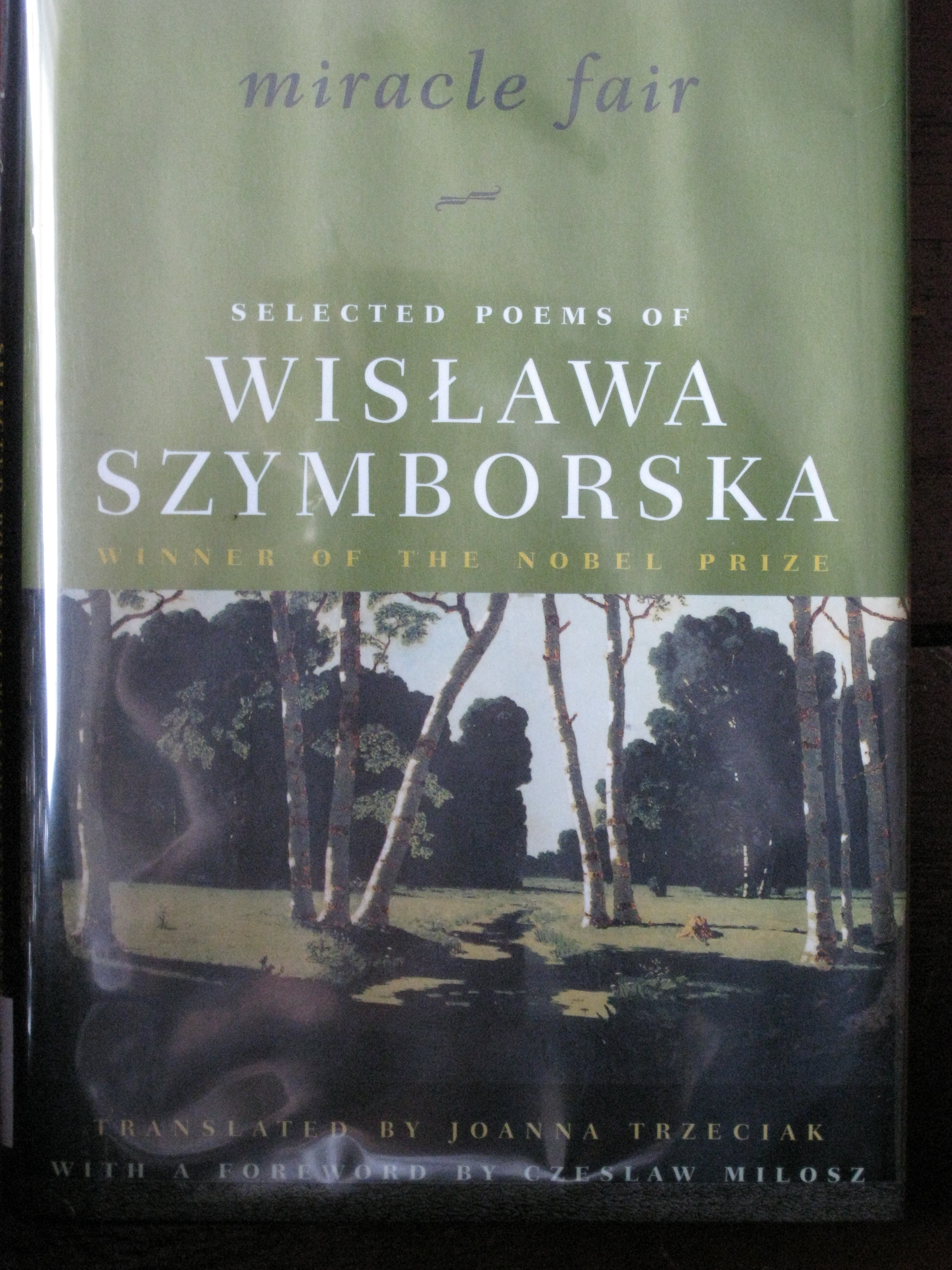
The End and the Beginning

Wislawa Szymborska poetry

Szymborska, Wislawa. “The End and the Beginning.” Miracle Fair: Selected Poems of Wislawa Szymborska. New York: W.W. Norton, 2001.

This poem is so vivid that I pictured it as the scene behind the credits at the end of a war movie. Stay with me. Hear me out. In the poem, Szymborska gently, methodically runs through the list of what must be done at the end of a war: clean up debris, repair houses, rebuild bridges, carry on. Stay strong. So, imagine the credits rolling. The movie has ended, the war is over. Behind the steady stream of names, cast and crew, people survivors are shell shocked and sweeping, weeping and washing, hungry and hammering, biting their lips to continue life as best as they can; as they know how. Somehow, I see this as a stark black and white. More dramatic (or depressing) that way.
My favorite line: “From time to time someone must still dig up a rusted argument from underneath a bush and haul it to the garbage dump.” What does that mean? Maybe two someones can’t decide who really “won” the war. Maybe someone else is adament it rages still…just somewhere else. Arguments that have weathered and rusted from constant exposure.

BookLust Twist: From More Book Lust and the chapter “Poetry Pleasers” (p189).

Oven Bird

Robert Frost II
Frost, Robert. “The Oven Bird.” You Come Too: Favorite Poems for Young Readers. New York: Holt, Rinehart & Winston, 1959. 50.

I am definitely unsure of an oven bird. I don’t think I’ve ever seen one, nor heard one. I can’t even imagine one. But, I do know I love Robert Frost’s poetry – whether it be for children (as this one is) or for adults. What I keep coming back to about this particular poem is the circulation of the seasons. The flowers that bloom, and the bird that sings. It’s delightful. No favorite lines. It’s too short.

BookLust Twist: From More Book Lust in the chapter “Poetry Pleasers” (p 188).

Apologizing to Dogs

Apologizing To Dogs
Coomer, Joe. Apologizing to Dogs. New York: Scribner, 1999.

LibraryThing Review: The first thing I thought when I started to read this book is odd, odd, odd. For one, the first character you meet is a man named “Bone.” He’s not called Bone because he’s super skinny. Nothing obvious like that. He’s called Bone because he sucks on a chicken bone all the time. How bizarre.
The whole story just gets weirder and weirder. Elderly Effie sits out on her porch and spies on the neighborhood. She keeps a journal of everything her paranoid self sees. Her neighbors come and go around her, all of them quirky, too. I found the development of each character too shallow to muster up any real feelings for them. In fact, there are so many characters and their development so shallow I had trouble keeping them straight. In all, there are over 18 different characters and each get barely a paragraph at one time. If anyone, I liked Carl the best. In an effort to impress a woman he builds a boat…from inside his house – using the insides of his house. And. And, I liked Himself, the dog. Himself is the star of the story, but you wouldn’t know right away.

Here are a couple of funny/good quotes:
“‘You know what’s wrong with you, Mrs. Haygood? You’ve got opticum rectitus, a growth connecting the optic nerve to the rectum, producing a continual sh!tty outlook,’ Mr. Haygood said. He was oiling a gear on a blue tin tank” (p 34). 
“10:57 Strong marijuana odor from That Big Indian’s. I think one of his bathtubs is creeping over my property line” (p 37). Obviously, this is from Effie’s journal. She’s the funniest one in the book. Her paranoia is great.

BookLust Twist: From Book Lust in the chapter “Great Dogs in Fiction” (p 105). Himself is a great dog but he was barely in it.

Continental Drift

continental driftBanks, Russell. Continental Drift. New York: HarperPerennial, 2007.

This book was spellbinding.
Thing on LibraryThing: Russell Banks really knows how to tell a good story. On the surface, it’s about Bob Dubois and his downward spiral. Bob is a New Hampshire man who seems to have it all: a wife, two kids, a decent job, a house, a boat to take out on the weekends and even a girlfriend on the side. His problem: greed. He is a man who compares himself too often to the people around him: his brother, his best friend. He doesn’t let go of grudges or jealousies all that easily. Feeling like the man who has nothing to lose, he gives up everything to move to Florida for a “fresh start.” His tale is just the vessel for Banks to describe a society fueled by the overwhelming need for more and more. Excess is not enough. Bob soon learns the meaning of “good enough” when his life spins out of control.
One of my favorite parts is about halfway through the book, the two brothers, Bob and Eddie, are trying to have a conversation. Each one takes a turn to say something then the other responds. Only they aren’t talking about the same thing. Bob is trying to explain to Eddie that he (Eddie) needs to take away a handgun because Bob doesn’t understand himself anymore. He’s afraid of what would happen if the gun stays in his possession. Eddie responds that he has ulcers and his epilepsy has come back. Bob says he doesn’t want to kill anyone and Eddie reponds that he hates fukcing his wife. It’s comical and sad.

My favorite quotes:
“He’s never skied on water before; in fact, he’s never skied on any kind of surface, despite having been raised where people drive from cities hundreds of miles away just so they can spend a few hours careening down mountains on slats strapped to their feet” (p150). Having gone to school in “ski country” yet never skied, I can identify with this!
“She and her father never speak of the event again, not to each other and not to anyone else. There’s nothing to say about it to each other that is not already fully understood, so they remain silent about it, almost as if it never happened” (p 176). Can’t you just see this scene in a movie?
“There’s a mixture of passivity and will that he does not understand. They risk everything, their homes, their families, forsake all they know, and then strike out across the open sea for a place they’ve only heard about” (p 340). What struck me about this quote is where it’s coming from: Bob. Doesn’t he realize he’s just like them?

BookLust Twist: From More Book Lust and the chapter “It Was a Dark and Stormy Novel” (p 129). Pearl isn’t kidding. I’m surprised this hasn’t been made into a movie yet.

Bluest Eye

IMG_0663 Morrison, Toni. The Bluest Eye. New York: Plume, 1970.

The LibraryThing Review:
“Because The Bluest Eye doesn’t have a traditional storyline plot the reader is free to concentrate on the complexities of the characters. The entire work is like a patchwork quilt of human suffering. Each character a different patch of sadness and survival. With each square, the ugly underbelly of society is exposed: poverty, racism, rape, incest, abuse, violence…Toni Morrison is the eye that never blinks in the face of such harsh subjects.”

These are the quotes that stopped me short. “They did not talk, groan or curse during these beatings. There was only the muted sound of falling things, and flesh on unsurprised flesh” (p 43). It’s the word ‘unsurprised’ that speaks volumes.
“He urges his eyes out of his thoughts to encounter her” (p 49). Another way of describing a deep-seeded prejudice.

One aspect of this novel that caught me up was the narrator hearing certain words in colors like light green, black and red. I have done the same thing with my imagination. I see words as certain shades or hues. Aside from the colors, this was a hard book to read and I can’t say anything that hasn’t already been said.

BookLust Twist: From More Book Lust and the chapter called “Big Ten Country: The Literary Midwest (Ohio)” (p 29).

Dalva

Harrison, Jim. Dalva. New York: E.P. Dutton, 1988.Dalva

What I wrote on LibraryThing:
There are two elements that make this story compelling: the characters and the sweeping shadow of history under which they live. Dalva is supposed to be the main character, but her story is told through the richness of the other characters. Michael, the alcoholic professor bumbling his way through Dalva’s history in attempt to reach tenure; Duane, Dalva’s teenage half Sioux love; Dalva’s mother, Naomi; Uncle Paul and the diaries of her great-grandfather, the missionary who first came to Nebraska.

There are more quotes than this, but here are my favorites:
“You are at an age when you are not to yourself as you are to others” (p 51).
“I rehearsed my entire life and heard my heart for the first time” (p 56). Who hasn’t done this at least once?
“It’s not what turns one on, but what turns one on the most strongly” (p 61). Good explanation for the fickle.
“There was a loud noise that turned out to be my yelling, which I managed to do while running backwards” (p 115). Just a really funny image.
“In these semi-angry moods or after she had a few drinks she owned the edge of a predator” (p 122). Aren’t we all?
“Nebraska strikes one as a place where it never occurs to the citizens to leave” (p 126). I think that’s why I don’t know of anyone from Nebraska.
“Some wise soul said that grownups are only deteriorated children” (p 257).
“My mind so clear it shivered inside” (p 296).

The one thing I didn’t care for was the sense of false advertising I got from the description of the book – “this is the story of Dalva’s search for her lost son who was given away for adoption.” Out of a 324 page book it wasn’t until page 221 that Dalva has a serious dialogue about finding her son. Up until then it isn’t mentioned barely at all. That only leaves 103 pages for the story of searching. In truth, I found the first 221 pages were spent explaining Dalva’s past and the important people in her life. They all have stories to tell and fascinating ones at that!
BookLust Twist: From More Book Lust actually twice – once in the chapter “The Great Plains: Nebraska” (p 108) and again in “Men Channeling Women” (p 166).

Carter Clay

IMG_0624
Evans, Elizabeth. Carter Clay: a Novel. New York: HarperFlamingo, 1999.

The LibraryThing review:
The premise of Carter Clay is a guilty conscience. Instantly, I was brought back to Charles Dickens because same could have said for Great Expectations. In Great Expectations, Pip becomes a gentleman through the generosity of a convict Pip was forced to help earlier in his life. When he first finds out, he is disappointed his benefactor isn’t someone more appropriate to society’s standards. In Carter Clay there is a similar parallel. Carter Clay is a homeless drunk who accidentally plows his van into a family, killing the father and seriously wounding the mother and daughter. His guilt and sense of debt drive him to be close to his victims, to care for them as penance. Additional factors, such as the man who wants to kill him, complicate the plot.
While I was impressed by the way Evans tells the story, weaving past and present through the different voices, I didn’t find her writing quotable. Nothing grabbed me in that way. Character development was my favorite. From flashbacks you got a sense of how everyone used to be before the accident. But, those flashbacks are subjective to human emotion and the desire to remember things a certain way which may or may not reflect reality. I found the psychology of what has or hasn’t changed for each character very interesting.

BookLust Twist: From More Book Lust and the chapters “Florida Fiction” (p 90) because most of the plot (and accident) happens in Florida, and “Teenage Times” (p 217) because Jersey, the daughter paralyzed in the accident, is a central character.

Great Expectations

Dickens, Charles. Great Expectations. New York: Oxford University Press, 1998.

Believe it or not, I had never read this before. Not in high school, not in college, not in fun. Go figure. It’s a classic which translated (back in the day) into the assumption of being boring. It was written in 1861 which translated into practically a foreign language (ekerval?). All that translated into me being narrow minded. Great Expectations is wonderful. It opens with Pip (our young main character) encountering an escaped convict in a field. The convict threatens bodily harm if Pip can’t produce some food and, of course, a file. Why was Pip targeted? His brother-in-law is a blacksmith. Of course he is going to have instruments strong enough to tackle something like…leg irons. So, it starts out pretty exciting and not at all unrealizable.

Here are some of my (early) favorite quotes from Pip’s life with his sister and her husband, Joe:
“She concluded by throwing me – I often served as a connubial missle- at Joe, who, glad to get hold of me on any terms, passed me onto the chimney and quietly fenced me up there with his great leg” (p 7).
“My sister having much to do, was going to church vicariously; that is to say, Joe and I were going” (p 20). While Pip’s sister is seen as cruel I cannot help but find humor in both these passages.
After Pip decides to become a gentleman he makes an observation that struck me: “So, throughout life, our worst weaknesses and meannesses are usually committed for the sake of the people whom we most despise” (p 206). Estrella, his love interest, has another observation akin to Pip’s: “I’ll tell you what real love is…It is blind devotion, unquestioning self-humiliation, utter submission, trust and belief against yourself and against the whole world, giving up your whole heart and soul to the smiter…! (p 227).

The LibraryThing review:
A classic from Charles Dickens. All of the characters are so well developed that the reader cannot help but drawn into their individual plots. From Pip, the blacksmith apprentice turned gentleman in the making (and the hero of our story) to Miss Havisham, a wealthy woman locked away in self-induced seclusion. “

BookLust Twist: From Book Lust and the chapter “A Dickens of a Tale” (p 72). It’s funny that Pearl laments about Dickens having to be a high school mandatory read that students had to “choke down” because many of the reviews I have read recently about Great Expectations mention having to read it in this manner.

Baby Sister for Frances

BabySisterForFrancisHoban, Russell. A Baby Sister for Frances. New York: Scholastic, 1992.

Who doesn’t remember this one from their childhood? Originally published in 1964 this was a standard in my young life. I don’t remember if my parents bought this for me in preparation for my sister’s arrival, but I was certainly old enough to be skeptical (and more than a little jealous) of the little bundle everyone kept cooing over. This book would have made sense for that reason alone.

LibraryThing Review:
This is childrens’ book classic. Told from the point of view of a badger, Frances is jealous of her new baby sister, Gloria. Gloria seems to be distracting enough that mama badger is forgetting to do the laundry and shop for groceries. As a result, Frances feels neglected and needs to be noticed. Accepting a new sibling can be hard on anyone, even badgers.

There must be hundreds of self help books out there, all tackling the tricky question of sibling rivalry and what to do when a new baby comes along. All parents need to do is read A Baby Sister for Frances and they’ll be reminded of how the older child often feels diminished, neglected. Hoban hit that one on the head. How Frances “runs away” is hilarious. I know I did the same thing – only I think I didn’t run away long enough to be missed!
My favorite part is when Frances “calls” her parents from under the dining room table then comes “home” singing a rhyme. Very cute.

BookLust Twist: From More Book Lust and the chapter “Russell Hoban: Too Good To Miss” (p 113).

His Excellency

IMG_0571Ellis, Joseph J. His Excellency: George Washington. New York: Afred A Knopf, 2004.

In honor of Presidents’ Day and Washington’s birthday. The LT review: Ellis writes in an easy, flowing style. Almost conversational in tone, Washington’s life comes alive as the pages turn. While not a great deal of evidence of Washington’s personal life has survived, Ellis does a fantastic job filling in the gaps with Washington’s military career and political rise to power. The text is supplemented by a few pages of photographs – mostly portraits Washington had commissioned of himself.

A few of my favorite quotes that make Washington seem less historical and more human. First, a  description of Washington as a 20-something year old man: “He was the epitome of the man’s man: physically strong, mentally enigmatic, emotionally restrained” (p 12).
A commnet on Washington’s unique military order: “…when a ranger…is killed in action, continue his salary for 28 days to pay for his coffin” (p 26).

BookLust Twist: From More Book Lust in the chapter “Founding Fathers” (p 91). Last month I read about Benjamin Franklin from the same chapter. Note to self: Self, don’t read anything from that chapter in March!

Bridget Jones

IMG_0570Fielding, Helen. Bridget Jones’ Diary. New York: Penguin, 1996.

When I first learned this chick-lit was on my list I didn’t know whether to groan or grin. But, after pages and pages of stuffy political biographies I knew I’d need a fluffy change. I just didn’t expect it to be so funny! Luckily, my good friend let me borrow it…Here’s the LibraryThing Review:
Bridget Jones is a likable 30-something Londoner. A little on the plump side (so she thinks) and more than a little single (so everyone keeps pointing out), her year long diary takes the reader on a journey through her attempts at weight loss and dating. While her weight gain is more that her ultimate loss and her initial love interest cheats on her, Bridget triumphs with humor and a naivete that is undeniably charming. Obsessive and narcisstist characteristics aside, Bridget could be any woman’s best friend. A delightful (quick) read.

My favorite lines:
“I know what her secret is: she’s discovered power” (p 58).
“Love the friends, better than extended Turkish family in weird headscarves any day” (p 74).
“There’s nothing worse than people telling you you look tired. They might as well have done with it and say you look like five kinds of shit” (p 92).
“By 11:30 Sharon was in full and splendid auto-rant” (p 108).

The only disappointment was a discrepancy with dates. On Wednesday, March 15 Bridget writes “only two weeks to go until birthday” yet, on Tuesday, March 21 she claims it’s her birthday. Two weeks from the 15th is the 29th or at least the 28th. Even if she is counting work weeks it would have been the 25th. Not sure what to think of that. Then there is the time she spends doing something. How is it possible to spend 230 minutes inspecting your face for wrinkles? I’ve done the math. That’s nearly 4 hours – unless London has more minutes to an hour than we do…(ps~ I’m being a snob here. Of course I know Bridget isn’t spending that much time on one activity…)
Another weirdness is that Bridget makes reference to Goldie Hawn and Susan Sarandon a lot. I couldn’t figure out what the reference was all about considering The Banger Sisters didn’t come out until 2002. I’m thinking she meant Thelma and Louise but in that case she didn’t mean Goldie Hawn, but rather Geena Davis. Whatever.

BookLust Twist: From Nancy Pearl’s Book Lust in the chapter called, you guessed it, “Chick-Lit” (p 53).

American Century

IMG_0397

Evans, Harold. The American Century. New York: Alfred A. Knopf, 1998.

Weighing in at over 700 pages, American Century is nothing short of gorgeous. Bold black and white photos stand out on nearly every page, while satiric comics adorn the others. I have always loved the Brown Brothers photo of the construction workers on the Woolworth Building and was pleasantly surprised to see its inclusion on page xvii. 

I liked learning that President Cleveland bought the “dirt” on an opponent and upon receiving the envelope burned it, unopened, on the spot. He also suffered from cancer of the mouth and had an entire artificial jaw.

“You feel small in the presence of dead men, and you don’t ask silly questions” (p 332).
Here’s the LibraryThing version of my review:
“Any history buff should have this sitting on his or her shelf (and have a shelf sturdy enough to support this 700+ book). Chock full of intriguing cartoons and mesmerizing photographs, American Century covers every aspect of U.S. history from 1889 to the mid 1990s. Well written with commentaries and first hand accounts, history comes alive. The people, the politics, the power, the pitiful downfalls. The 20th century is laid out and every historical moment of worth is described and detailed.”

BookLust Twist: From Book Lust and the chapter “American History: Fiction” (p 21). I have to explain that this isn’t fiction. Pearl referenced The American Century while talking about Ken Baker’s novels. Ken Baker helped Harold Evans with The American Century.