After the Plague

After the plagueBoyle, T. Coraghessan. After the Plague and Other Stories. New York: Viking, 2001.

After finishing A Diary from Dixie, Band Land, and The Crossley Baby I still had time for a couple more “November” reads. The topics already covered for November were: the month the civil war ended, the month Montana became a state, national train month, and national adoption month. I chose After the Plague because I hadn’t recognized National Writers Month yet (and if there is time I’ll also recognize November as the month World War I ended and read Storm in Flanders). The only thing I won’t get around to is honoring Winston Churchill’s birthday (born in November).

So, onto After the Plague. This is a collection of sixteen short stories. Pearl calls them “Boyle’s best.” They hang open, unfinished and unresolved like a to-be-continued drama on television. Each story is like being dropped into the middle of a movie, watching for a scene or two, and then being ushered away before the conclusion. If you like to hang in the balance this collection of short stories is for you. Even stories within stories are left unfinished. Boyle shows off diversity in every story. Some will shock you, some will make you remember something from your own life, but all of them will be a pleasure to read.
Some favorite lines: “I started smoking two or three nights a week, then it was five or six nights a week, then it was everyday, all day, and why not?” (p 48), and “I just watched her, like some sort of tutelary spirit, watched her till she turned over and I could see the dreams invade her eyelids” (p 164).

BookLust Twist: From Book Lust in the chapter called “Growing Writers” (p 107) and “Short Stories” (p 219). I love how Pearl describes Boyle’s work, “…nervy and disconcerting, and often very funny, leaving you uncomfortable with yourself and the world” (p 219). So true!
Diary From Dixie

Diary from DixieChestnut, Mary Boykin. A Diary from Dixie. Boston: Houghton Mifflin, 1949.

From the moment I started reading Mrs. Chestnut’s diary I felt I was in for gossip, gossip, gossip. While this is a great first hand account of life during the Civil War, I couldn’t get over how much of a name-dropping, political hob-nobbing, party-going Southerner she was! Another thing I noticed  was how humorous Mrs. Chestnut was! Here are a few of her more comical entries:

“There Mrs. Hunter told us a joke that made me sorry I had come” (p 8). But, she never does explain the joke was! Too bad!
“At camp meeting he got religion, handed round the hat, took the offering to the Lord down into the swamp to pray over it, untied his horse and fled with it, hat, contribution and all” (p 13).
“I think this journal will be disadvantageous for me, for I spend my time now like a spider, spinning my own entrails, instead of reading as my habit in all my spare moments” (p 22). See, gossip, gossip!
“Every woman in the house is ready to rush into the Florence Nightingale business” (p 70). Good ole fashion jealousy, perhaps?

I think the only quote to get to me showed the attitudes of the time, “Women need maternity to bring out their best and true loveliness” (p 86). We’ve been here before.

All in all, Mary Chestnut’s diary was a delight to read. I fell in love with some of the language: flinders, rataplan, brickbat, and best of all, envenom. Love that word! Witty and humorous, it didn’t read like a history textbook. Instead, it gave texture to the sounds and sights and warmth to the personalities from the Civil War. More importantly, it gave a sense of what it was like to be a woman during that time.

BookLust Twist: From Book Lust and the chapter called “Civil War Nonfiction” (p 58).

Bad Land: An American Romance

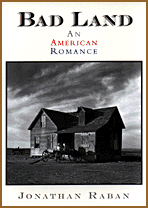
Bad LandRaban, Jonathan. The Bad Land: an American Romance.

In honor of both the month Montana became a state and National Train Month I put Bad Land  on my list. It reads like a river. Some parts read like racing rapids while others slow to languid pools of near stillness. Then there are the waterfalls, where the language is cascading awe-inspiring. It was during these “waterfall” sections that I wanted to pack a bag and head west, just to see it for myself.

Raban helps you look at Montana from the point of view of the immigrant (emigrant), the artist, the ancestor, the traveler, the naturalist. Like standing back from a canvas to discover hidden colors. It’s a historical story, lyrically descriptive and informative. It’s a biography of the landscape as well as the people settled there at the turn of the century.
Favorite lines:”…mouth like a mailbox” (p 67).
“Mrs. Nemitz, scenting sarcasm, put his face on trial for a split second, but found it not guilty” (p 104).
“It’s exhilarating and scary, to lighten ship every so often, to kiss goodbye to the accumulated tonnage of ones life so far” (p 114)
“now the book is full of brittle ghosts” (p 136).

BookLust Twist: Mentioned twice in Book Lust. Once in the chapter called “Montana: In Big Sky Country” (p 156)…in which Pearl calls Bad Land  “the best book about Montana by a non-Montanan” (p 157); and “Riding the Rails: Railroad History” (p 201).

The Way Men Act

Way Men ActLipman, Elinor. The Way Men Act. New York: Washington Square Press, 1992.

 I had to laugh when I wrote out the title of this blog. Yet another one that could be misconstrued as something juicy and personal. I guess I could write a whole dissertation on the way men act towards me, but that wouldn’t be the book review that this is intended to be.

Elinor Lipman celebrates a birthday in October so it was only appropriate that I try to squeeze in a novel of hers in the last days of the dying month. I have met Lipman before (at a local conference) so it was no surprise to discover The Way Men Act takes place in “my” town. While thinly veiled as somewhere else it was easy to recognize the landmarks and quirks that make up where I live. I have to admit that made reading The Way Men Act a little difficult. The entire time I pictured real store fronts, real schools, real people.
All in all I breezed through this book because it was a simple read. The kind of chick lit you crawl in the bath with and can read in one soak. The plot isn’t complicated, only fun fun fun, the way chick lit is supposed to read. Lipman’s heroine, Melinda LeBlanc returns home to Harrow. She has mixed feelings about being back where she grew up as if being home implies she didn’t make it in the real world. She comes back (single at 30) to work in her cousin’s flower shop. Her job is sandwiched between two other come-home-again classmates from high school: Libby, a fashion designer with her own shop, and Dennis, a wiz at tying flies for fishing for his own shop. In addition to being hung up on being home, Melinda has issues with educational status (Harrow is a snobby college town and she only has a high school degree) and of course, men. The ending was predictable. Melinda is too talented to be working for someone else, and yes, she’s gets the guy.

Favorite line: “Could a man hate me that strenuously that the weight of it would flip itself over and come up again as love?” (p 49)
I flagged other lines only to realize it wasn’t the wording I admired so much. It was Melinda’s relationship with her mother. Every scene had me envious of their obvious closeness.

BookLust Twist: Mentioned twice in Book Lust once in the chapter “Elinor Lipman: Too Good To Miss (p 146), and “My Own Private Dui” (p 165).  The latter chapter begs an explanation: Pearl has her own classification system for her books and The Way Men Act falls under the category of “books I reread when I’m feeling blue” (p 166).

Song of Solomon

Song of SolomonMorrison, Toni. Song of Solomon. New York: Plume, 1987.

Another must-read from the days in Maine. Although, I don’t remember reading it then. I don’t remember reading it, ever. Is that sad or what? This is a classic. Something everyone should read.

I don’t think I could summarize the plot adequately. Basically, it’s the story of Macon “Milkman” Dead III. He got the nickname Milkman from being breastfed by his mother way past infancy. But, this story goes beyond coming-of-age; it transcends stereotypical stories of racial strife and strained family relations. Yes, there is all of that. This is a story that has been described as tragic and magic in the same line. It may be a story about one man’s rise to adulthood, but it is told from many different points of view. We learn about Milkman’s ancestry and the culture of his time. Morrison weaves imagery and symbolism together so that everything important means something different. Family names are not just names. They come from religion, mistaken identity and social injustice. Family ties are tethered and severed through love and hate, peace and violence, poverty and wealth. One man’s perception is another man’s reality.

Quotes I liked: “I’m on the thin side of evil and trying not to break through” (p 21).
“He wouldn’t know what to feel until he knew what to think” (p 75).
“She was the third beer” (p 91).

BookLust Twist: Toni Morrison is mentioned twice in Book Lust. Song of Solomon is in the chapter “100 Good Reads, Decade by Decade” (p 175) under the section 1970s. 

Turn of the Screw

James, Henry. The Turn of the Screw. New York: Dutton, 1963.Turn of the Screw

Even though October is more than half over I decided to read something scary for the rest of the month…in honor of Halloween and all that. Turn of the Screw seemed like the most obvious choice. A novella only 160 pages long, I knew it wouldn’t take too long to get through.
Written in 1898 and republished numerous times Turn of the Screw has also been  adapted for the stage, television and the big screen. Someone told me it was even mentioned in an episode of “Lost” (I wouldn’t know).  James’s technique is to tell the story within a frame – one story within another. We are first introduced to a man at a Christmas party telling a tale of a governess. From there we are in the story, told from the point of view of the governess. She has been hired to look after two small children after their parents are killed and they are sent to live on an uncle’s estate. Soon after the governess’s arrival she starts to notice strange occurrences, shadowy figures stalking the grounds. She learns they are former lovers and hired hands, back to supposedly recreate their relationship through the children.
While James uses words like “hideous”, “sinister”, “detestable”, and “dangerous”, there is great debate as to exactly what he is describing as so terrible. He refers to evil again and again, but his ghosts are not the usual specters. They only hint at danger rather than taking action and “attacking”. The other great debate is whether the governess is insane (or goes insane while at Bly). Because no one else really backs up her ghost sightings you have to wonder.

BookLust Twist: Mentioned several times in Book Lust. Once in the chapter called “Science Fiction, Fantasy, and Horror” (p 113) and “Ghost Stories” (p 99). I would agree that The Turn of the Screw deserves ghost story status, but horror? Maybe I’m stuck in slasher movie mode where everything horrible has to end up in blood and gore.

Black Dog of Fate: a memoir

Black Dog of FateBalakian, Peter. Black Dog of Fate: a memoir. New York: Random House, 1998.

I must have started this book four or five times. I don’t know what it was about the beginning. I’d pick it up, read for a few pages and put it down again, never getting beyond the first chapter. By the time I’d return to pick it back up I had forgotten what I had read and needed to start all over again. Page one. Finally, I took Black Dog of Fate home with me Columbus Day weekend and read it from start to finish. When I was finally able to devote the time and attention to it I couldn’t put it down.
There are very few books I try to push on other people. Very rarely do I try to tell people what I have read and how I feel about it, urging them to see for themselves. This story was different. From the moment I put it down I found myself struggling to put into words what had moved me so yet I needed to say something.

Here’s what I wrote within seconds of finishing it on Monhegan:
It’s the history you don’t commonly read about. It has the facts everyone would like to wish away; a genocide too horrible to imagine as real. The Armenian Massacre wasn’t a standard topic in my history class. As a rule I think we, as a society, want to sweep all and every horrific moment under our subconscious. This is a memoir about a boy’s growing knowledge and deeper understand of his heritage. True to adolescent ambivilance Balakian doesn’t understand the importance of his ancestry. In his youth all the stories his grandmother wanted to tell him were lost on him. It’s only after he is ready does his grandmother’s words mean anything to him. “I came to find out more about the arid Turkish plain when I picked up a book at a time when I was prepared to read it” (p 147).  

Other lines that struck me:
“…she would pass me the salty green nuts so we could celebrate with our teeth” (p 13). I think food is always the most appropriate way to celebrate.
“Hokee, soul. Hankids, rest. The soul’s rest: a memorial” (p 140).

BookLust Twist: From Book Lust in the chapter “A Geography of Family and Place” (p 97).

Divine Secrets of The Ya-Ya Sisterhood

Wells, Rebecca. The Divine Secrets of the Ya-Ya Sisterhood. New York: Penguin, 1996.Divine Secrets

This is Rebecca Well’s second novel, a follow up to Little Alters Everywhere. Divine Secrets of the Ya-Ya Sisterhood continues the story of Vivi Abbott Walker and her friends (known as the Ya-yas), this time through the eyes of her adult, engaged-to-be-married, daughter, Siddalee Walker. Siddalee is a flourishing theater director who falls victim to the ever-famous, word-twisting interview. A reporter from the New York Times gets Siddalee to open up her childhood box of memories and reveal dark secrets about her upbringing. Ultimately, her mother’s alcoholism and abuse are exposed and Siddalee must spend the rest of the book apologizing to her mother for the scandal. When Siddalee calls off her engagement the Ya-Yas brazenly step in. In an effort to make her daughter understand who she is, Vivi mails her daughter a scrapbook and we are taken into the wonderous, playful yet dark world of the Ya-Ya Sisterhood.
Ultimately, I identified with this story. It’s the classic yet complex struggle between mother and daughter. Secrets revealed, hearts broken, lives changed. In the end, happiness and love prevail. I know you’ve seen the movie.

BookLust Twist: Divine Secrets comes up a couple of times in Book Lust. First, on page 83 in the chapter “Family Trouble” then in the chapter called “Women’s Friendships” (p 248).

Amsterdam

AmsterdamMcEwan, Ian. Amsterdam. New York: Anchor Books, 1999.

Another book that starts with a funeral. Of course, I’m thinking of Charming Billy. But, the comparisons stop there. How to describe Amsterdam? It is a short (193 page) novel that takes place in London, England. Two men share a bond of friendship as well as a romantic past with the same woman. Vernon is an editor of a newspaper and Clive is a modern composer. While they are friends they are not above rivalies and each, through his friendship tests the bounds of morality.

I see this story as a movie. There is one particular scene where Vernon feels dead. He is about to hit himself upside the head in order to feel pain when his secretary interrupts him, “He had raised the ruler several inches above his right ear when there was a knock on his open door and Jean, his secretary, entered and he was obliged to convert the blow into pensive scratching” (p 34). Can’t you just see it?

BookLust Twist: From Book Lust. Ian McEwan has his own chapter called, “Ian McEwan: Too Good To Miss” (p 149).

Disgrace

I’ll call this book my “spur of the moment, read in one day, can’t put it down” book. I’ll also call it Weather Front. It started out sunny and seemingly harmless and carefree. Then the clouds roll in, the rain comes in sheets. The poison seeps in. When the winds pick up to the point of hurricane force it is nothing short of violent and tragic, destructive and disgraceful. After the storm people pick up the pieces, healing yet hurting and more storm clouds can be seen, rumbling in the distance.
In the beginning everything seems fine. Professor Lurie is happy teaching literature in South Africa. But, almost immediately Professor Lurie makes a mistake in seducing a young student. His fall from grace is swift and absolute. Having lost all his social and professional connections he reconnects with the one person who can’t turn her back on him – his flesh and blood daughter. The rest of the story is how Lurie and his daughter deal with their already strained relationship. How Lurie tries to redeems himself is baffling. I found myself asking if he was really worth redemption at all. Maybe it was the name Lurie – too close to the word lurid.

My favorite line, “Affection may not be love, but at least its cousin” (p 2).

BooklustTwist: From Book Lust and the chapter called ” Families in Trouble” (p 82).

Warning: If you are an animal lover you may not want to read this book. What happens to humans is tragic enough, but what happens to the dogs is even worse. I know it’s a fact of life but the end of this book was hard to take. Nobel prize or not.

Athenian Murders

Athenian MurdersSomoza, Jose Carlos. The Athenian Murders: a Novel. New York: Fahar, Straus & Giroux, 2002.

I read a review where a critic described this book as Russian dolls, one larger stacked upon another. It is the most accurate description I can think of. The Athenian Murders is indeed a story within a story within a story. The largest doll story takes place in Greece in the time of Plato. In fact, Plato’s Academy is center stage. Athens is plagued by the mysterious murders of several men and before the city can erupt in terror Hercules, the Decipherer of Enigmas, must solve the who-dunnit. Footnoted within the story is the second story – the nameless translator who has his own story to tell as he translates The Athenian Murders. Of course, there is a twist at the end with another story.
It took me a little while to really “get into” this story. I have to admit, I get annoyed by repetition and the word eidetic – let’s put it this way – eidetic or eidesis is used 50 times in the first 100 pages. Talk about repetition!

I have to ask. Is the scar on the right cheek (as mentioned on page 210), or on the left (p 217)?

BookLust Twist: From Book Lust and the chapter titled “The Classical World” (p 60).

Abandoned Bride

Abandoned BrideLayton, Edith. The Disdainful Marquis and The Abandoned Bride. New York: Signet, 2002.

One of the great things about this BookLust challenge is the fact that I get to read so many different and interesting books in order to complete the challenge. The only bad thing is romance novels are included in the list and they certainly are “different”…in other words, not my cup of tea or coffee. I simply don’t read the “bodice rippers” as I call them. They scare me. I can’t get into all that…heaving.
Luckily, out of this double feature paperback I only had to read the Abandoned Bride story, and I did it on another quick trip to Maine this past weekend. Here’s the kicker – this one wasn’t that bad. Okay, so the heroine of the story is stunningly, absolutely, beautiful (I can’t even tell you how many times her beauty was referred to – especially her “moonlight-spun gold hair.”) and the villain (who, of course, turns out to be Mr. Romance) is dashing and “trim.” But, the story really wasn’t that bad. Here’s the premise: Julia (Miss Moonspun Hair, virginal-too-good-to-be-true-at-17-years-old) is set to elope with Robin, a boyishly handsome rich guy. They run away to some lodge where he abruptly leaves her for unknown reasons. Three years later Robin’s uncle, Nick (the dashing, trim, bad guy) “kidnaps” Julia in an effort to get her and Robin together to right past wrongs. Robin is also supposed to take over his father’s inheritance and he can’t do that while he’s running away from the memory of Julia (so he claims). The immediate problem is Robin doesn’t want to be found so Nick must drag Julia, against her will, of course, across the continent looking for Robin.
As you can probably guess, the falling in love of Nick and Julia is predictable and a little silly, but the reason for Robin’s abandonment was an interesting twist. I only figured it out when Robin is finally confronted by Julia.

Here are a few favorite lines: “…the entire stack of books fell open neatly to the middle to reveal that the book covers were false and what lay within them was not pages, but a cleverly designed box containing two decanters and a set of blown crystal glasses. “Ha!” Sir Sidney said with satisfaction. “now this, I think, is what a library is really for.”” (p 102) and “I am leagues in love with you” (p 217).

My only moment of “huh?” was when Julia used a phrase similar to being buttered up and I’d like to know if someone could be flattered in the sense of being “buttered up” in 1815.

BookLust Twist: From Book Lust in the chapter called, “Romance Novels: Our Love is Here to Stay” (p 203).

Gift from the Sea

GiftsLindbergh, Anne Morrow. Gift From the Sea. New York: Vintage Books, 1991.

I have to say this is something every woman should read annually. The words and their meaning will change every single time and they will be different for every reader. In the simpliest of terms Gift From the Sea uses seashells, (whelk, moon shell, oyster) all gifts from the sea, as metaphors for life, vehicles for deeper thoughts. On vacation (ironically on an island, like me) Anne picks seashells and ponders religion, relationships, growing old, being young, nature, love and marriage…She picks at nagging thoughts like scabs, letting them bleed, revealing raw emotion and a tender heart. Here are a few of my favorite quotes:

“…I think best with a pencil in my hand” (p 9). I agree!
“…I have shed the shell of my life for these few weeks of vacation” (p 22). Since I was on vacation when I read that I had to smile because it happens to me, too.
“…social life is exhausting; one is wearing a mask” (p 32). Very true! Couldn’t have said it better myself.
“And since our communication seems more important to us than our chores, the chores are done without thinking” (p 100).

I read this in an afternoon. Gulls cried overhead, sea air salted my skin, waves crashed in the distance. It was the perfect setting for Gift from the Sea.

BookLust Twist: From the chapter called “Journals and Letters: We Are All Voyeurs at Heart” (p 130). I swear on everything holy I did NOT have More Book Lust with me when I wrote this review. I was still home without any of my Pearl books. So, I was incredibly surprised to read these words from Pearl, “Some of us still reread them yearly to remind ourselves of what’s important in this frantic world” (p 131). Pearl is referring to everything written by Lindbergh, but I had the exact same thought specifically about Gift from the Sea. Gift from the Sea is also in Book Lust in the chapter, “100 Good Reads, Decade by Decade” (p 175).

All-Bright Court

All-Bright CourtPorter, Connie. All-Bright Court. New York: HarperPerennial, 1992.

I adore debut novels. There is something about that leap of faith that a writer must take before anything else can happen. Every writer is a closet published writer. They walk around with the words in their head, barely daring to dreaming of the day those words will be sold in a big bookstore. Opened up for all the world to see.
That’s exactly how I picture Connie Porter, walking around with the words to All-Bright Court in her head, dreaming of the day they’ll be on paper. I can picture the personalities of  the All-Bright Court residents starting to take shape. It’s the story of two decades of african american families trying to make their way in a steel mill town near Buffalo, New York. All-Bright Court is the housing project that ties them all together.

“She found herself saving things to say to her, storing them away in her mind, folding them as neatly as sheets.” (p 82).
“These people lived inches away from one another, and much of what was done did not have to be told. They did not look away because they did not want to know. They looked away because they did know, and looking away was the only way to grant the woman dignity, to go on believing, to let her go on believing she was a woman” (p 85).

BookLust Twist: From Book Lust  and the chapter “African American: She Say” (p 12).

Tuck Everlasting

Tuck EverlastingBabbitt, Natalie. Tuck Everlasting.New York: Farrar, Straus and Giroux, 1985.

Do I dare say this book was delightful? I read it in an hour over a tuna sandwich lunchbreak. It’s a cute story about ten year old Winnie Foster and her discovery of a family that has eternal life. At first it seems impossible, but after befriending the strange family, Winnie realizes it’s true. The one complication of the story? Someone else (aka “bad guy”) knows the secret and wants to market it for himself.

Favorite line: “The first week of August was asserting itself after a good night’s sleep” (p 86). I like the imagery of this, of August saving it’s energy during the night in order to roast the day.

BookLust Twist: From Book Lust.