Lincoln’s Dreams

Willis, Connie. Lincoln’s Dreams. Toronto: Bantam Books, 1987.

Connie Willis typically writes science fiction or fantasy and while Lincoln’s Dreams doesn’t take place in the year 2197 or on the planet Baktakazini, it is equally mind bending and thought provoking. Jeff Johnston is a historical researcher working for a Civil War novelist, Thomas Broun. Broun is obsessed with Abraham Lincoln’s dreams of foreshadowing before his death. Broun goes to great length to analyze them with Jeff’s help. Through his research, Jeff meets Annie, a beautiful Sleep Institute patient who has troubling dreams of her own. Annie has been having dreams not about Robert E. Lee, but AS Robert E. Lee. It’s as if her dreams really are those of Lee’s. Jeff takes it upon himself to not only satisfy the growing obsession Broun has with supporting facts about Lincoln’s dreams but, he also tries to cure Annie of her own Civil War nightmares while falling in love in the process.

Since the bulk of Willis’s storyline centers on Annie having dreams there are a lot of sleep scenes and subsequently the analysis of those dreams. It’s the analysis that I enjoyed the most. The details of the dreams gave life to the Civil War and its participants.

BookLust Twist: From Book Lust in the chapter “Connie Willis: Too Good to Miss” (p 246).

Note:  It is painfully obvious this is a half-assed “review” of sorts. This just goes to show me & myself how out of it we really have been these past few weeks. I have been finished with this book for awhile and never finished this properly. *sigh*

Family Affair

img_4357Stout, Rex. A family Affair. New York: Viking Press, 1975.

When this little book came across my desk I could hardly contain my surprise. First, it’s only 152 pages long. Second, this was the very first time I was seeing Rex Stout’s picture on the dust jacket. I have to admit Jill Krementz took one funky picture of Stout! Incidentally, A Family Affair was Rex Stout’s last book published while he was still alive (he died one month later in October of 1975).

Despite this being a short mystery it certainly had more twists than the usual Rex Stout creation. Told from the point of view of his assistant, Artie, the mystery begins in Wolfe’s own home when his favorite waiter is murdered in his spare room. It’s unheard of for a crime to happen right under his nose. Another strange development is Wolfe’s uncharacteristic emotional outbursts. This is a case he takes very personally – enough to call it “a family affair” and enough for him to spend a night in jail (this coming from a man who never even likes to leave his home)! Because the murder happens in his own home he is more than determined to find the killer before the authorities do, despite not having a client. Typical of other Stout mysteries Wolfe has his beloved orchids and by-the-minute routines and mannerisms. What is different about this particular story is the inclusion of political commentary concerning Nixon and Watergate. Stout displays his displeasure with the political happenings in Washington through Wolfe.

While I didn’t I really didn’t get into the story enough to care how it ended I will say it was nice to read a compact mystery that wasn’t overburdened with subplots and heavy details.

My favorite quotes: “…on the way back there was an open door and I entered. A good detective doesn’t have to be invited” (p 25).
“I am in a rage right now and out of control” (p 30).
“…but I have rules too. No hat before Thanksgiving. Rain or snow is good for hair” (p 49). How odd.

BookLust Twist: From Book Lust in the chapter, “Rex Stout’s Nero Wolfe: Too Good To Miss” (p 228).

I’m a Stranger Here Myself

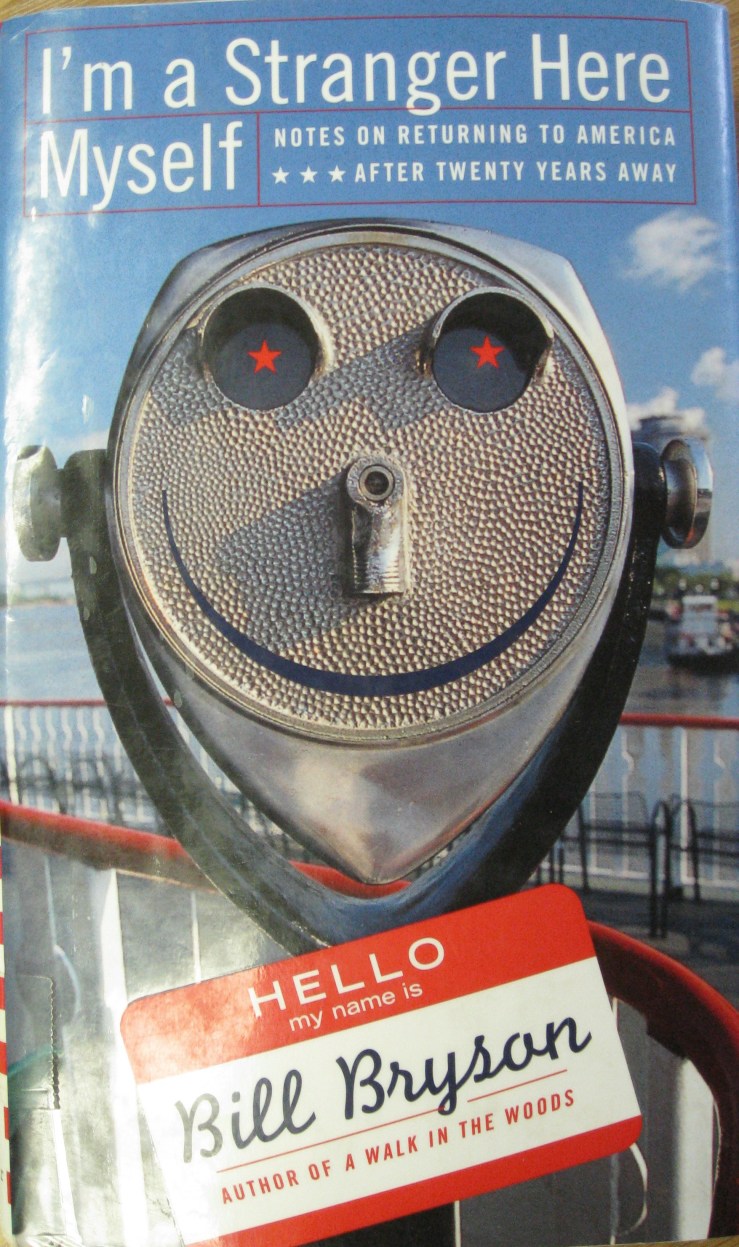
BrysonBryson, Bill. I’m a Stranger Here Myself: Notes on Returning to America After Twenty Years Away. New York: Broadway Books, 1999.

I was skeptical of this book. The premise is Bryson has been away from American soil for twenty years (living in England) and the book is supposedly his running commentary on how different everything has become. Right off the bat I wanted to ask, “What? They didn’t have ATM machines or public pay phones in England? Not even by the time Mr. Bryson left?” I have to admit, it never crossed my mind that England could be twenty years behind the U.S. in such things as technology and invention.
In actuality, Bryson’s book was, in a word, delightful. I thoroughly enjoyed his opening essay about the differences between English and American postal services. However, for the most part the comparisons ended there. It was more about how nonsensical America could be with it’s rules and regulations. It reminded me of Robert Fulghum with his humorous observations.

Favorite funnies:
“Going to a restaurant is generally a discouraging experience for me because I always manage somehow to antagonize the waitress” (p 13).
“It is all immensely complicated, but essentially it means that practically every team in baseball except the Chicago Cubs gets a chance to go to the World Series” (p 25).
“He converses as if he has heard that someday he will be billed  for it” (p 93). Sounds like my father!

BookLust Twist: From More Book Lustin the chapter, “Bill Bryson: Too Good to Miss” (p 36).

Anatomy of a Murder

img_43561Traver, Robert. Anatomy of a Murder. New York: St. Martin’s Press, 1958.

If you want to get technical about it this was my first book of December – considering the first two were read while it was still November. A technicality, I guess.

Anatomy of a Murder was written in the 1950s by Robert Traver. From the moment I started reading it I couldn’t put it down. 439 pages went by in a blur. I read before bed, when I first woke, on the drive into work, on my lunch break, waiting in line at the grocery store…It had me hooked from the very first sentence. It’s no wonder this novel became a movie. For starters, take the author – Robert Traver was the pen name for John D. Voelker who happened to be a lawyer and a judge in addition to being a fantastic writer. Secondly, Voelker used a real life murder than took place in the Upper Peninsula of Michigan. True stories are always fascinating.

So, here’s the story (now that I’ve set the stage, so to speak): Paul (Polly to his friends) Biegler is an ex-D.A. turned public defender set out to prove his client, Frederic Manion, murdered a bartender in a moment of insanity. Proving the insanity isn’t the only challenge of the case. Biegler must also prove Manion’s wife was raped by the bartender (and thus creating the moment of insanity) when all evidence surrounding Mrs. Manion’s attack is not admissible in her husband’s trial. The entire story is so well written you never want it to end.

Some of the many, many lines and phrases I found great:
“gently drunk” (p 13).
“Juries, in common with women drivers, are apt to do the damndest things” (p 39).
“I consider jealousy the most corrosive and destructive of all emotions and I long time ago made up my mind that I refused to be jealous of anyone or anything. Life is simply too goddam short” (p 73).

One last comment. I always thought that lawyers (of any kind) needed to show judges the utmost respect both in the courtroom and in chambers. Right? Well, someone needs to explain the scene on page 244 where Polly is in Judge Weaver’s chambers. Picture this, the Judge has just lit a pipe and Polly sits, “one leg over the arm of [his] chair.” I don’t even sit that way in my mother-in-law’s house!

BookLust Twist: From Book Lust in the chapter, “What a Trial That Was!” (p 243).

Quiet American

Greene, Graham. The Quiet American. New York: Viking Press, 1956.

This has come up twice for my December readings – once because of Ward Just’s birthday (don’t ask), and once because it is a companion read to Ward Just, again don’t ask. I’ll explain all that when I get to Ward Just’s book later this month week.

Like my friend who started decorating for Christmas, I started reading my December picks on 11/23/08. I couldn’t help myself. I had wanted to fit in Just So Stories by Rudyard Kipling but my library’s version was not the complete works. In addition it was missing the two crucial stories Nancy Pearl specifically pointed out. Rather than disrupt the flow of order I moved onto December…a week early!

This was a story of two battles. An English reporter is sent to cover a war-torn Saigon. While there he falls in love with Vietnamese woman. His love is challenged when an American from Boston falls in love with the same woman. There is a real war raging on the periphery, complete with bombings and mass murders, while at the center is a battle over a woman. The interesting twist to this story is how the story makes the reader feel towards the two men and how that changes over time.

Best lines: “I shut my eyes and she was again the same as she used to be: she was the hiss of steam, the clink of a cup; the was a certain hour of the night and the promise of rest” (p 5). That is such an achingly beautiful line!
“You cannot love without intuition” (p 13).
“The possession of a body tonight seemed a very small thing – perhaps that day I had seen too many bodies which belonged to no one, not even to themselves” (p 65-66).
“For a moment I had felt elation as on the instant of waking before one remembers” (p 205).

BookLust Twist: From Book Lust in two different places: in the chapter “Companion Reads” (p 64), and “Ward Just: Too Good To Miss” (p 135).

Bronte Myth

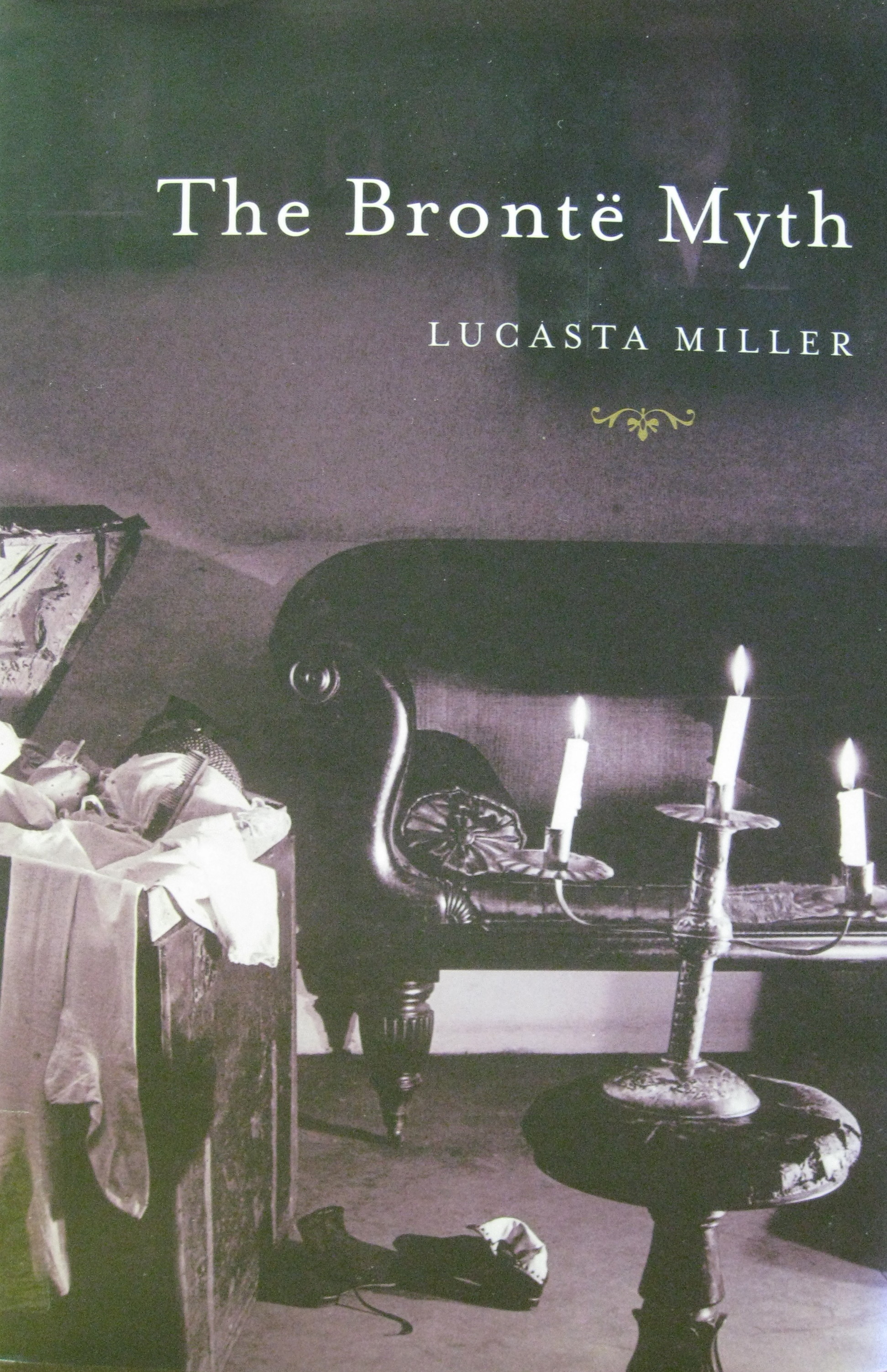
Bronte mythMiller, Lucasta. The Bronte Myth. New York: Alfred A. Knopf, 2004.

In honor of British Literature month I added The Bronte Myth to November’s reading list. From the very beginning I was intrigued about this book; Much like how the Bronte sisters themselves invited an aura of intrigue from the moment they emerged on the literary scene. When they first began writing they, like any other authors out there, wanted desperately to be taken seriously. In an era where women couldn’t so much as travel alone the three sisters took on androgynous pseudonyms to in an attempt to hide their gender. Only these pseudonyms attracted too much attention once the sisters started to publish. The more they tried to hide their identities the more reviewers, critics, and the general public started to speculate on who they really were, not as authors, but as members of their society. Following the speculation came accusations and wild rumors -created to fill in the gaps of each sister’s true personality. Lucasta Miller attempts to unravel the mystery and kill the myths that surrounds the Bronte women. While Miller does an extremely thorough job I found the reading to be both dense and dry as a result.

Passage that made me think: “…Gaskell’s belief that though Currer Bell might be morbid, Miss Bronte was the soul of feminine delicacy” (p 59).

BookLust Twist: From More Book Lust in the chapter, “Literary Lives: the Brits” (p 146).

ps~ sorry about the huge-ness of the pic. It’s just such a beautiful cover that I couldn’t bear to shrink it!

Best American Essays

Oates, Joyce Carol, ed. The Best American Essays of the Century. Boston: Houghton Mifflin, 2000.

As bloggers we cannot help but be reminded that November is National Novel Writing Month. It’s as if there a reminding hope that writing these one-three paragraph diatribes could somehow be transformed into something as concrete, or as interesting, as a full blown novel. I squirm with discomfort every time someone says I should write a book. While my stories are interesting…to a point, I don’t see a need to make them more than what they are: tiny bubbles of thought designed to pop (and ultimately, hopefully) go away when released.

Anyway. This isn’t about me and my nonability to write. This is about the complilation of essays from those who can.
Best American Essays of the Century wraps up the creme de la creme of essay writing from 1901 – 1997. Beginning with Mark Twain (“Corn-pone Opinions”) and ending with Saul Bellow (“Graven Images.”) As part of the Book Lust Challenge I read the following essays:

  • “Stickeen” by John Muir ~ “…for many of Nature’s finest lessons are to be found in her storms” (p 32).
  • “Corn-pone Opinions” by Mark Twain ~ “We are creatures of outside influence; as a rule we do not think, we only imitate” (p 1).
  • “A Law of Acceleration” by Henry Adams
  • “The Devil Baby at Hull-House” by Jane Adams
  • “The Crack-up” by F. Scott Fitzgerald ~ Life was something you dominated if you were any good” (p 139).
  • “The Ethics of Living Jim Crow: an Autobiographical Sketch” by Richard Wright
  • “Sex Ex Machina” by James Thurber ~ “Every person carries in his consciousness the old scar, or the fresh wound of some harrowing misadventure with a contraption of some sort” (p 157).
  • “Letters from a Birmingham Jail” by Martin Luther King, Jr.
  • “The Brown Wasps” by Loren Eisley
  • “A drugstore in Winter” by Cynthia Ozick

BookLust Twist: From Book Lust in the chapter called, “Essaying Essays” (p 80).

The Darling

Banks, Russell. The Darling. New York: Harper Collins, 2004.

I hate using words like “gripping” and “suspense-filled” to describe a book, but this time I can’t help it. The Darling was both of those things and much, much more. Once I started reading it I dropped every other book and concentrated on devouring the words of Russell Banks. While his plots are always over the top I like that hairy edge of reality and suspension of belief.

It’s a political thriller, a sweeping epic spanning the decades of one woman’s life, and a social commentary on Africa, racism and greed. It’s all of these things. Dawn Carrington is Hannah Musgrave who is also “Scout.” Dawn/Hannah/Scout is a woman with a past as complicated as her many names. Brought up by affluent, almost snobby parents as Hannah she is drawn to the underworld of political terrorism as Dawn. On the run after being indicted for a bombing gone bad, Dawn flees to Liberia and, by marrying a government official, becomes Missus Sundiata, her fourth recreation. Told from future to past and back again Dawn/Hannah takes you on her unapologetic journey through deceit, corruption, power and humanity.

Part of the reason why I liked The Darling so well is because it was written by a man. Russell Banks is able to capture the voice of a woman as a wife, mother, and an individual fiercely protective of her independence and individuality. Even if she doesn’t know who she really is. The first person voice is reminiscent of Barbara Kingsolver’s Taylor Greer or Margaret Atwood’s Handmaid.

Favorite lines:
“I was not a natural mother. Was not programmed like most women with a mother’s instincts and abilities…It’s as if I was, and still am, missing the gene” (p 171).
“But how I wished I were invisible. My white skin was a noise, loud and self-proclaiming” (p 177).
“I woke just before dawn with a boulder of rage lodged in the middle of my chest and a desire to break someone’s skull with it” (p 236) – that sounds like something I would say!
“That’s the real American Dream, don’t you think? That you can start over, shape-change, disappear and later reappear as someone else” (p 255).

Another section I had a love-hate relationship with was Hannah/Dawn’s father passing away from a stroke. The detail of his death was almost too painful to read, having watched my father slip away much in the same way.

BookLust Twist: From More Book Lust in the chapter “Men Channeling Women” (p 166).

As I Live & Breathe

img_4234Weisman, Jamie. As I Live and Breathe, notes of a patient-doctor. New York: North Point Press, 2002.

In honor of National Health Month I decided to read As I Live and Breathe. I always find memoirs interesting when the author is more than your average individual. Who doesn’t? Dr. Weisman also has a talent for words which makes her unique story all that more compelling.

Dr. Jamie Weisman is a unique woman. While living within the confines of her illness she chose to do something about it, she joined the medical profession. As she says in her memoir, “”Now that I’ve finished medical school, I know what all those names mean, what diseases they describe, but you cannot know what they are as an illness until you see them in a patient” (p 15). Not only is her condition (congenital autoimmune deficiency disorder) rare and confusing, but her duality of patient and doctor gives her an interesting perspective- from bedside manner of doctor to bedridden patient. Because she is able to really know what the patient is experiencing she can deliver the empathy necessary for individuals really suffering.
My only real disappointment was the organization of the chapters. Dr. Weisman jumps around, remembering patients and her own childhood at random. I would have prefered a more chronological accounting. The last two chapters of the book, “begotten” and “begetting” are warmer and more personal and as a result seem a departure from the more clinical previous chapters.

Favorite blurbs:
“Our diseases overwhelm us at the strangest times” (p 16).
“I knew no happy lawyers” (p 31).

BookLust Twist: From both Book Lust and More Book Lust. In Book Lust in the chapter called, “Physicians Writing More Than Prescriptions” (p 185), and in More Book Lust in the chapter called, “Other People’s Shoes (p 181).

Bridge to Terabithia

Paterson, Katherine. Bridge to Terabithia. New York: Crowell, 1977.

I remember reading this in grade school. No, I take that back. Someone read it to me as “quiet time” in grade school. Then, the movie came out. When Kisa rented it I discovered I had been mispronouncing “terabithia” for years (tera-beeth-ia instead of tera-bith-ia). Not my fault since someone else read it that way.

One of the problems of seeing a movie and then reading the book is the danger of making comparisons to the visuals on the big screen. Because I couldn’t remember the plot from 32 years ago that’s what happened to me. I kept seeing the movie in my mind as I read the words. Either way, it’s a really cute story.

Jesse Aaron is a loner who lives inside his little world of solitude and art. His family is large and boisterous and often times, Jesse doesn’t feel understood by anyone, especially having three sisters. When Leslie Burke moves in next door Jesse is determined to ignore her, too. Soon he discovers they have more in common than he would like to admit. Leslie is creative, smart and a tomboy who can run faster than he can. Eventually they are inseparable friends. Jesse learns more than he bargains for by befriending Leslie.

What I found most compelling is that Paterson wrote this book for her son after he loses a friend to a lightning strike. On the dedication page she indicates her son insisted her name be included.

BookLust Twist: From More Book Lust in the chapter, “Best for Boys and Girls” (p 22). Note: Pearl indicates Bridge to Terabithia would be more suitable for girls, but I think it would be equaling interesting to boys.

Behind the Scenes at the Museum

Atkinson, Kate. Behind the Scenes at the Museum. London: Black Swan, 1996.

November is writing month and to celebrate I decided to read something from Nancy Pearl’s chapter called “First Novels” (Book Lust p 88)…in two days!
Behind the Scenes at the Museum was honored as a Whitbread Book of the Year and received such words of praise as remarkable, impressive, entertaining, quirky, colorful, humorous, ambitious, unusual, lively, provacative, promising, witty, enchanting, sassy, astounding…I could go on (and on). With reviews using words like those how could I not expect to love it, want to love it?

From the very beginning Behind the Scenes draws the reader in. Told from the point of view of young Ruby Lennox…(before she is even born) there is humor and sarcasm. Her voice reminds me of the wise-alec baby on Family Guy (sorry, the name escapes me). Ruby is omnipresent, giving the reader insight on every thought, feeling, dream, nightmare her family has.
The alternate chapters (told in third person) give the backstory of Ruby’s mother’s life during the second Great War. The writing is not as humorous, nor as witty as when Ruby gets to speak. Over all the reading is a rollercoaster of ups and downs, twisting you through life’s crazy moments.
Favorite lines:
“She walks out, saying nothing, but inside, a silent Scarlett rages…” (p 22).
“…but how can time be reversible when it gallops forward, clippity-clop and nobody ever comes back. Do they?” (p 210).

All and all I wasn’t as wowed as I thought I would be. Maybe it’s because Ruby’s story isn’t the main focus after all. While she tells the story it’s more about her mother, Bunty, and the generations of women before her. It’s interesting to note there is always a war going on in some capacity and Ruby seems to always be walking in on her father having sex with someone other than his wife!

BookLust Twist: From Book Lust in the chapter called “First Novels” (p 88). But, I said that already.

Dubliners

Joyce, James. Dubliners. New York: Signet, 1991.

When I was in high school I fell in love with James Joyce’s style of writing. We share the same birthday. The Dead, a short story from Dubliners was my all time favorite. Gabriel became my favorite name; a long lost child.

Dubliners is comprised of 15 short  and simple stories all centered around the people of Dublin. To sum up the collection it is a portrait of a city as seen from the eyes of the people living there. The very first story, The Sisters, is nothing more than a family’s reaction to a priest’s death. While the characters are not connected, their stories are. Life and death, love and loss, youth and aging, poverty and wealth. Joyce does a remarkable job capturing the spirit of the Irish while revealing universal truths about mankind as a whole. It is as if we, as readers, get to peek into the character’s lives and are witness to moments of our own circumstances.

What I find so remarkable about Dubliners is that Joyce originally had great trouble getting it published. And even after he finally did it didn’t sell that well.

BookLust Twist: From Book Lust in the chapter “Irish Fiction” (p 125). Where else? Edited to add: I’ll tell you where else…Book Lust To Go in the chapter called “Ireland: Beyond Joyce, Behan, Beckett, and Synge” (p 110). I guess you could say Dubliners shouldn’t be included in this chapter because it’s supposed to be about “beyond Joyce.” Something to think about.

Cask of Amontillado

Poe, Edgar Allan. The Cask of Amontillado. Mahwah: Troll Publications, 1982.

Okay, okay. I admit it. The version I read of Edgar Allan Poe’s Cask of Amontillado was from my library’s Education Curriculum Library – a kids version. Only 32 pages long and brightly illustrated, it was a pleasure to read… in about five minutes. But, that’s not to say I haven’t read it before in it’s original text. And…I reread it online again thanks to the Gutenberg project.

The Cask of Amontillado is a psychological, creepy thriller. Perfect for October. Montressor has had his ego wounded badly by Fortunato. Looking for revenge Montressor waits until Fortunato is well in the drink and can be lured away to his death. The entire story is a study in human failings.
Montressor is able to convince Fortunato to come with him because Fortunato cannot bear the idea of another man playing the expert in identifying Montressor’s Amontillado wine. Montressor uses this jealousy to spur Fortunato deeper into the catacombs. At the same time Montressor showers Fortunato with concerns for his health in an effort to steer Fortunato away from suspicion. For Fortunato cannot suspect a trap if he is the one insistent on continuing deeper into Montressor’s underground chambers.
The reader never does find out what insults Montressor has suffered at the hands of Fortunato. The wrong doing is certainly not as important as the revenge.

Favorite scene: Fortunato questions Montressor’s membership as a brother, a mason. Montressor unveils his trowel as a sign but Fortunato never questions why he would have such a thing with him at that moment.

BookLust Twist: From More Book Lust in the chapter, “Horror for Sissies” (p 119).

Crime Novels

Polito, Robert. Crime Novels: American Noir of the 1930s & 40s. New York: Library of America, 1997.

Something scary for Halloween. Six different stories about crime. Three of them are novels already on my list. Go figure.

  1. The Postman Always Rings Twice by James M. Cain
  2. They Shoot Horses Don’t They? by Horace McCoy
  3. The Big Clock by Kenneth Fearing

and three others:

  • Thieves Like Us by Edward Anderson
  • Nightmare Alley by William Lindsay Gresham
  • I Married a Dead Man by Cornell Woolrich

From The Postman Always Rings Twice~ I have always wanted to know what this story was all about. Written in 1934 it tells the sexy, gritty tale of Frank Chambers, a drifter who finds himself grounded by Cora Papadakis, a married woman. Cora’s beauty and instant mutual attraction leads to Frank’s uncharacteristic staying put. Soon the adulterous couple is contemplating murder. The plot is timeless. Desire has led them to the devil’s doorstep.
Favorite lines: “I kissed her. Her eyes were shining up at me like two blue stars. It was like being in church” (p13).
“Then the devil went to bed with us, and believe you me, kid, he sleeps pretty good” (p 70).
What Nancy had to say about : “…filled with desperate, scheming men and women…” (Pearl, Nancy. Book Lust, p66).

From They Shoot Horses Don’t They?: This was a bizarre, psychological tale about two kids with very different dreams. Robert is looking to be a film producer and Gloria wants to be an actress. They pair up and enter a Hollywood dance contest knowing Hollywood bigwigs would be in attendance. The contest is all about making money, working the contestants like racehorses, making bigger and better stunts to attract sponsors and a bigger audience. Analogies to horse racing are abundant. From the title of the book it is obvious what happens in the end, but it’s a fascinating read just the same.
What Nancy had to say, “…wonderfully grungy dance-marathon nightmare novel” (Book Lust p 67).

From Thieves Like Us ~ : I found this to be a very slow moving, almost methodical story. Written in 1937 it tells the tale of three bank robbers: Elmo Mobley, T.W. Masefeld and Bowie A. Bowers. While the story of these thieves as fugitives on the run is interesting, what makes the entire piece come alive is the vivid imagery used to describe the landscape these men hide in. Across Texas and Oklahoma’s back country there are many farmhouses and hideaways to keep the story moving. Favorite lines: Oddly enough, the dedication caught my eye: “To my cousin and my wife, because there I was with an empty gun and you, Roy, supplied the ammunition and you, Anne, directed my aim” (p 216). Here’s where my sick mind went with this: Roy (the cousin) had an affair with Anne (the wife). Don’t mind me.
Second favorite line: “The moon hung in the heavens like a shred of fingernail” (p 224). There have been a lot of interesting moon descriptions, but I liked this one a lot.

The Big Clock by Kenneth Fearing started out slow. George Stroud works for a conglomerate of magazines in their Crimeways department. He is a simple family man with a wife and daughter, but his dreams and ambitious are big. When he has an affair with his boss’s girlfriend and she winds up bludgeoned to death things get a little tricky. It’s a story of conspiracy and cat and mouse. George must prove his innocence when everything points to the contrary. Once it gets going it’s fascinating!
From The Big Clock: “The eye saw nothing but innocence, to the instincts she was undiluted sex, the brain said here was a perfect hell” (p 383), “He said how nice Georgette was looking which was true, how she always reminded him of carnivals and Hallowe’en” (p 385) and “I could feel the laborious steps her reasoning took before she reached a tentative, spoken conclusion” (p 393).
What Nancy Pearl had to say, “…edgy corporate-as-hell thriller” (Book Lust p 66).

Nightmare Alley was intriguing on many different levels. It was the ultimate “what goes around comes around” story. The lives of carnival entertainers serves as the backdrop for Stanton Carlise’s rise and fall. He joins the carnival and soon picks of the tricks of Zeena, the Seer. Once Stan the Great learns the craft (an inadvertently commits murder) he leaves the carny and sets out on his own as a Mentalist, becoming greedier and greedier for taking the sucker’s buck. Soon he passes himself off as a priest with the capability of bringing loved ones back from the dead. Constantly running from troubles in his own life Stan gets himself deeper and deeper until no one is trustworthy.

I Married a Dead Man by Cornell Woolrich was probably my favorite. You don’t know much about Helen Georgesson before she assumes the identity of Patrice Hazzard. The facts are Helen is a pregnant girl, riding the rails with 17 cents to her name. A chance encounter and a terrible accident leave Helen with a case of mistaken identity. For the opportunity to start life anew and give her baby a better life Helen accepts Patrice’s identity as her own. Living the life of luxury doesn’t come easy when Helen’s past comes to town and threatens to unveil her true self.

BookLust Twist: Crime Novels: American Noir of the 1930s & 40s can be found in Book Lust in the chapter, “Les Crimes Noir” (p 65).

Artemis Fowl

IMG_3757
Colfer, Eion. Artemis Fowl. New York: Talk Miramax Books, 2001.

Another book that I finished in a day. I suppose it helped that it’s a book for young adults so it was a breeze to read. The real reason was it was a fun read.

Meet Artemis Fowl. Only 12 years old but already a millionaire – a criminally brilliant millionaire. When we first meet Artemis we learn he is out to kidnap a fairy. Let the games begin! From the very beginning Artemis Fowl is full of folklore. Besides fairies there are goblins, dwarfs, gnomes, a centaur, trolls and the ever tantalizing hoard of gold. Artemis, though only 12, has devised a plan to rid the fairies of their riches by using their own powers against them. For being a childrens’ book it is pretty fast paced and violent.

Favorite lines: “…A ragged apron does not a waiter make” (p 4), and “Holly unhooked a set of wings from their bracket. They were double ovals, with a clunky motor. She moaned. Dragonflies. She hated that model….now the Hummingbird Z&, that was transport” (p50). Can you just see it? Fairies don’t have wings! They have strap-ons! The idea that Holly was “stuck” with Dragonflies rather than her preferred Hummingbirds cracked me up.

BookLust Twist: From Book Lust in the chapter, ”

ps~ From what I understand Artemis Fowl was made into a movie. This is one to put on the NetFlix list!

Special thank youuuuu to Kisa Too Cool for posting…