
December Was…

img_0030December started off being my fresh start. New houses, new atttitude. It would have been a return to charity walks (or runs?) had a little thing called house hunting not gotten in the way! December ended up being a really, really difficult month. Lost another house, craziness at work, mental health taking a trip south, a passing of a friend and coworker… Here are the books I read escaped with. It may seem like a lot but, keep in mind, I cheated. I was able to read the first two in November.

  • The Quiet American by Graham Green ~ I read this in three days time…in November. Was really that good!
  • A Dangerous Friend by Ward Just ~ Another book I read in just a few days time, again…in November.
  • Anatomy of a Murder by Robert Traver ~ probably one of the best court-room dramas I have ever read.
  • I’m a Stranger Here Myself: Notes on Returning to America After Twenty Years Away by Bill Bryson ~ funny, but repetitive!
  • A Family Affair by Rex Stout ~ very strange yet entertaining.
  • Lincoln’s Dreams by Connie Willis ~again, strange but entertaining!
  • Shoeless Joe by W.P. Kinsella ~ okay. I’ll admit it. This one made me cry.
  • ‘Sippi by John Oliver Killens ~ powerful – really, really powerful. That’s all I can really say.
  • Snobs by Julian Fellowes ~ silly story about what happens with you combine boredom with good old fashioned English snobbery.
  • Choice Cuts by Mark Kurlansky ~ really interesting, but a bit dry at times (no pun intended).

For LibraryThing it was the fascinating Honeymoon in Tehran by Azadeh Moaveni (really, really good).

Confession: I started Le Mort d’Arthur and couldn’t deal with neither volume one or two. Just not in the mood for the King, no matter how authoritative the version.

So. 11 books. Two being in the month of November and nine as the cure for what ailed me.

Edited to add: someone asked me to post “the count” at the end of each “— Was” blog. What a great idea. I will be starting that next month – something new to start 2009 with. Thanks, A!
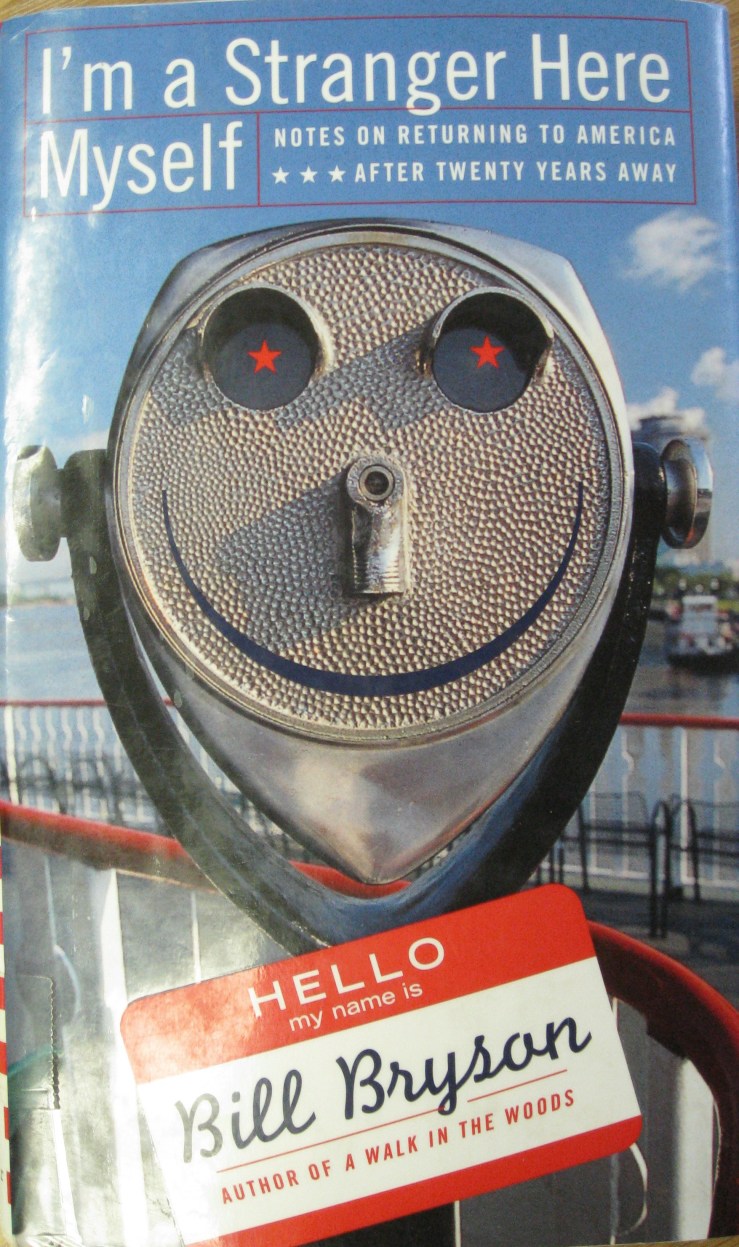
I’m a Stranger Here Myself

BrysonBryson, Bill. I’m a Stranger Here Myself: Notes on Returning to America After Twenty Years Away. New York: Broadway Books, 1999.

I was skeptical of this book. The premise is Bryson has been away from American soil for twenty years (living in England) and the book is supposedly his running commentary on how different everything has become. Right off the bat I wanted to ask, “What? They didn’t have ATM machines or public pay phones in England? Not even by the time Mr. Bryson left?” I have to admit, it never crossed my mind that England could be twenty years behind the U.S. in such things as technology and invention.
In actuality, Bryson’s book was, in a word, delightful. I thoroughly enjoyed his opening essay about the differences between English and American postal services. However, for the most part the comparisons ended there. It was more about how nonsensical America could be with it’s rules and regulations. It reminded me of Robert Fulghum with his humorous observations.

Favorite funnies:
“Going to a restaurant is generally a discouraging experience for me because I always manage somehow to antagonize the waitress” (p 13).
“It is all immensely complicated, but essentially it means that practically every team in baseball except the Chicago Cubs gets a chance to go to the World Series” (p 25).
“He converses as if he has heard that someday he will be billed  for it” (p 93). Sounds like my father!

BookLust Twist: From More Book Lustin the chapter, “Bill Bryson: Too Good to Miss” (p 36).

Behind the Scenes at the Museum

Atkinson, Kate. Behind the Scenes at the Museum. London: Black Swan, 1996.

November is writing month and to celebrate I decided to read something from Nancy Pearl’s chapter called “First Novels” (Book Lust p 88)…in two days!
Behind the Scenes at the Museum was honored as a Whitbread Book of the Year and received such words of praise as remarkable, impressive, entertaining, quirky, colorful, humorous, ambitious, unusual, lively, provacative, promising, witty, enchanting, sassy, astounding…I could go on (and on). With reviews using words like those how could I not expect to love it, want to love it?

From the very beginning Behind the Scenes draws the reader in. Told from the point of view of young Ruby Lennox…(before she is even born) there is humor and sarcasm. Her voice reminds me of the wise-alec baby on Family Guy (sorry, the name escapes me). Ruby is omnipresent, giving the reader insight on every thought, feeling, dream, nightmare her family has.
The alternate chapters (told in third person) give the backstory of Ruby’s mother’s life during the second Great War. The writing is not as humorous, nor as witty as when Ruby gets to speak. Over all the reading is a rollercoaster of ups and downs, twisting you through life’s crazy moments.
Favorite lines:
“She walks out, saying nothing, but inside, a silent Scarlett rages…” (p 22).
“…but how can time be reversible when it gallops forward, clippity-clop and nobody ever comes back. Do they?” (p 210).

All and all I wasn’t as wowed as I thought I would be. Maybe it’s because Ruby’s story isn’t the main focus after all. While she tells the story it’s more about her mother, Bunty, and the generations of women before her. It’s interesting to note there is always a war going on in some capacity and Ruby seems to always be walking in on her father having sex with someone other than his wife!

BookLust Twist: From Book Lust in the chapter called “First Novels” (p 88). But, I said that already.

Carry On, Jeeves

IMG_3756
Wodehouse, P.G. Carry On, Jeeves. New York: A.L. Burt, 1927.

This book just feels good in my hands. Published 10 years before my father was even born, it even looks its age. I guess I just like old books.

Carry on, Jeeves is a series of stories about how Jeeves acts as man-servant while repeatedly saving the day for Bertram Wooster. Each chapter sets up a different dilemma “Bertie” and/or his friends face and how Jeeves cleverly resolves every one of those dilemmas. There is a formula to these moments of crisis: someone is usually misleading a family member (usually an aunt) to think he is wealthy, in another part of the country, worth marrying, not worth marrying, etc. Jeeves’s solution is to mislead the “aunt” with a lie or two.  The lie is the smallest of gestures and usually something humorous happens – like the plan backfiring. While the general plot seems repetitious, Wodehouse’s style of writing is very funny. Side note: Bertie and Jeeves always seem to get into curious arguments about fashion.

Lines I liked: “I strained the old bean to meet this emergency” (p 47).
“I’m never much of a lad till I’ve engulfed an egg or two and a beaker of coffee (p 89).
“If this was going to be a fish-story, I needed stimulants” (p 167).

BookLust Twist: From More Book Lust in the chapter “P.G. Wodehouse: Too Good To Miss” (p 235). What I find hysterical about Pearl’s entry is her first sentence: “If you can ignore his somewhat rummy behavior…” (p 235). “Rummy” is a word Wodehouse uses over and over and over in Carry On, Jeeves.

Last Lecture

Pausch, Randy. The Last Lecture. New York: Hyperion, 2008

This was not on any Book Lust or More Book Lust list. That isn’t to say that it shouldn’t be. Indeed, if Nancy Pearl ever sets up to write a third volume of Lust, I would hope she would include The Last Lecture. When I first heard of it I was reminded of Tuesdays with Morrie by Mitch Albom To crudely sum up Tuesdays, Mitch’s college professor, Morrie Schwartz was dying of Lou Gerhig’s disease. Upon hearing this, Mitch set out to rekindle his Tuesday meetings with Morrie. What came of those meetings was a great book and a heart warming movie.

Imagine Morrie writing his own book. He knows he is dying and is desperate to leave the world with a gift; the gift of inspiration. This is how I think Randy Pausch saw The Last Lecture. Dying of terminal cancer and given only months to live, Randy saw an opportunity to leave his words of wisdom on the minds of former students and colleagues at Carnegie Mellon. His message “Really Achieving Your Childhood Dreams” went beyond academia – it went much deeper than that. It was his meaning of life and he wanted to share these thoughts with family and friends as well. The lecture, delivered in September 2007 was peppered with outrageous stories, touching photographs and a wry sense of humor about his illness. It was a huge success. It led to the book The Last Lecture (which became a national best seller)

Favorite quotes: “There’s a formality on academia that can’t be ignored, even if a man is busy with other things, like trying not to die” (p 4). So, right off the bat you know Randy Pausch views his cancer as something “to deal with” and not get bogged down by. This, to me, set the tone for the entire book.
“Open the encyclopedia. Open the dictionary. Open your mind” (p 22). While the previous quote may have set the tone for the book, this quote summed up who Randy Pausch was from the time he was a child until he last breath. He was a man who never wanted to stop learning. That comes across very clearly throughout The Last Lecture.

I strongly urge you to pick up the book, check out the website, even watch the dvd of the actual lecture. It may change how you view your world around you…it may even change your life.

Search for Baby Combover

Kirby, David. “The Search for Baby Combover.” The Ha-Ha. Baton Rouge: Louisiana Univeristy Press, 2003. 41.

This is my third (and final) poem from The Ha-Ha that I had to read for the BookLust challenge. Later on, I will read a different book of poetry from David Kirby. But, for now “The Search for Baby Combover” is it. (see yesterday’s post for another Kirby.)
I couldn’t have asked to end Kirby’s collection on a better poem. “Baby Combover” is beyond delightful. It’s not a flowery prosey-prissy kind of thing. Instead, it’s inventive, sarcastic and wildly funny. It’s the story of a man who gets a knock on his door one night. His downstairs neighbor stands before him and proceeds to ask him to please refrain from (whoops wrong story) not move furniture around so late at night…because it wakes the baby. What baby? As far as our man is concerned he’s never seen a baby. Never heard a baby. So, he goes on to think the guy has invented a baby…It’s hysterical.

Here are a few of the best lines (and there are more so you might as well read the whole thing):
“…and I see he’s got something on his head, like strands of oily seaweed, something you’d expect to find on a rock after one of those big tanker spills in the Channel…”
“Baby Combover: the world’s first silent baby.”

BookLust Twist: From More Book Lust in the chapter “Poetry Pleasers” (p 189).

Elephant of the Sea

elephant of the seaKirby, David. “Elephant of the Sea,” The Ha-Ha.Baton Rouge: Louisiana State University Press, 2003. 46.

Crack me up. This poem is really funny. It’s one of those comments on culture and keeping up with what’s cool. It’s also about language. Words and meanings. A French man wants to buy an automobile just like his American friend’s. Right down to the manatee on the license plate – the “elephant of the sea.” The friend doesn’t get it. He’s imagining what the clerk at the DMV are going to say and how the whole incident will shape her future.
And this is just one poem. Everything David Kirby writes is great. He is like geek rock of poetry. He’s smart and too funny for words.

Favorite line: “‘I can have zuh elephant of the zuh sea on my matriculation?’ to a clerk who’s got this grin on her face like she’s either seeing God or having an aneurysm” (p 46). 

BookLust Twist: From More Book Lustin the chapter “Poetry Pleasers” (p 188). He’s also mentioned in Book Lust in the chapter “Kitchen-Sink Poetry” (p 138).

Blind Heron

Tate, James. “The Blind Heron.” Shroud of the Gnome. New Jersey: Ecco Press, 1997. 11.

From just the title of Tate’s book I knew I would be in for a treat. I love 20th century poetry, especially when it has a sense of humor, a sense of the playful. Before I even got to “The Blind Heron” I read the table of contents and had a good laugh over some of the other poems: “Where Babies Come From” (made me think of that birds and bees talk – ahem!), “Restless Leg Syndrome”, “Shut Up and Eat Your Toad”, and “Sodomy in Shakespeare’s Sonnets”…I’ll have to blog about those at another time.
But, I will say this – Remember that scene in the movie ‘Tommy Boy’ when Tommy is trying to sleep at a motel. Richard keeps knocking on the door with different suggestive suggestions until finally, Tommy bolts out of bed yelling, “what kind of place is this?”? Well, that’s me with this collection of poetry. After seeing a poem called “In His Hut Sat Baba Jaga, Hag Faced” all I could ask was “what kind of poetry is this?!” The only answer: fun!

“Blind Heron” is clever and impish. Kiki is missing her cockatiel. Kiki is called a liar yet you, as the reader, are not really sure if that’s the truth. It’s more probable that you are only suppose to think of Kiki as a nontruth telling person because the poem concludes rather suddenly. Everything you thought you knew has been changed based on a confession.

BookLust Twist: From More Book Lust in the chapter “Poetry Pleasers” (p 189).