January 2011 Was…

I can’t help but sing ‘Let it snow, let it snow, let it snow” when I think of the month January has been. If you live in any state (besides Hawaii) you know what I am talking about. Even HotTopic-Lanta has gotten some snowfall. They haven’t known what to do with it, but they got it nonetheless! Needless to say the snow has kept me indoors and reading for the month of January! For the record, here are the books:

  • Breath, Eyes Memory by Edwidge Danticat ~ in honor of Danticat’s birth month. This was a movie in my head (or else a true-life story). Really, really good!
  • Cruddy by Lynda Barry ~ in honor of Barry’s birth month. This was one of the most disturbing books I have read so far. the violence and abuse was over the top.
  • King of the World by David Remnick ~ in honor of Muhammad Ali’s birth month. I didn’t know I wanted to know but I’m glad I know.
  • I, Robot by Isaac Asimov ~ in honor of Asimov’s birth month. Science fiction, of course. Interesting, but a little redundant in theme.
  • Two in the Far North by Margaret Murie ~ in honor of Alaska becoming a state in the month of January. Courage and adventure personified. I enjoyed this book a lot.
  • Citizen Soldiers: The U.S. Army From the Normandy Beaches to the Bulge to the Surrender of Germany, June 7, 1944 -May 7, 1945 by Stephen Ambrose ~ in honor of Ambrose’s birth month. It took me a little to get into this book but I’m glad I read it. It is slowly helping me get over my fear of Hitler and all things Nazi.
  • Another Song About the King by Kathryn Stern ~ in honor of Elvis Presley’s birth month being in January. This was a super fast, super fun read.

I was supposed to get an Early Review book but it hasn’t arrived yet. It will go on the February list of books, hopefully.
Another Song About the King

Stern, Kathryn. Another Song About the King. New York: Random House, 2000.

Silvie Page has the kind of mother we all dread having. The kind of mother we probably already have memories of. The kind of mother that loves us to death. Outwardly appearing to have our best interests in mind but really are so caught up in themselves that their intentions are inwardly mean and controlling. Best friends forever as a way to minimize and manipulate. Silvie’s mother, Mimi, is just that woman. When Silvie was a child it was in the way Mimi wanted Silvie to be just like her, only just not as pretty or talented.  It’s in the way she phones an adult Silvie (with a calling code that meant she should pick up no matter what) only to say ‘wear red on your first day on the job.’ All of Silvie’s life her mother has kept her in emotional limbo – one minute loving and sweet, the next competitive and conniving. Silvie tries different tactics to “escape” her mother’s grasp, starting with changing how she addresses her mother from mom to Mimi, as a way to distance herself from a blood relation. Throughout Sylvie’s life there is another shadow that looms just as large. Elvis. Mimi has an ongoing obsession with a date she had with Elvis when she was 16. It is her worst kept secret, one that in times of stress, she hauls out and elaborates on until finally the lie is bigger than the truth. She even has blue suede shoes and a crimson cape to illustrate her never-wavering loyalty to the king.
There is so much more to Another Song About the King than meets the eye. Beyond a complicated mother-daughter relationship there is an element of self-discovery and forgiveness. I couldn’t put it down.

Lines that snagged me: “I was successful in the womb – obedient and nimble, turning somersaults in those jelly seas of color and sleep” (p 9), “I’d come to lose my mother and find myself, to put some distance between her dreams and mine” (p 24), and, “But, I was sure I would lose, and winning, I knew in my bones, would raise the stakes with my mother in a game I didn’t want to play” (p 81). There were many, many more tantalizing lines, but I’ll let you find them.

Author Fact: Another Song About the King is Kathryn Stern’s first novel.

BookLust Twist: From Book Lust in the chapter called “Elvis On My Mind ” (p 78).

What’s a Mother (in-law) To Do?

Angelich, Jane. What’s a Mother (in-law) To Do?: 5 Essential Steps to Building a Loving Relationship with Your Son’s New Wife. New York: Howard Books, 2009.

I have to start off by saying this was a May 2009 Early Review book from LibraryThing. That means roughly a year ago I was supposed to read and review this book. I received it in the mail today. Today. June 26th, 2010. I am assuming this has already hit book stores and doesn’t really need my promotion. However, because I respect the program and the review process I am still going to write about it.

My first impression of What’s a Mother (in-law) To Do? was, “wow, this is short!” Indeed, it’s an odd little book. Hardcover yet the size of a paperback and only 130 pages long. As a librarian I automatically went to the back pages to look for a bibliography of sorts. If this is a book that involved research I expected to see a works cited page. There wasn’t one.

In the end I was disappointed by What’s a Mother (in-law) to Do? because I felt like it was something any old MIL could write: all she would have to do is fill 131 pages with a variety of stories from other in-laws (mothers and daughters), sprinkle in a few personal experiences, and add a layer of common sense advice.  What would have been really interesting (and cater to a larger audience) is if Angelich researched building a relationship with your child’s new spouse. In other words, remove the specificity of the subject and make it work for any in-law relationship.

I honestly couldn’t take What’s a Mother (in-law) To Do? seriously. Angelich talks about conducting research but doesn’t provide real sources. She mentions “research conducted” but there’s no weight behind like what kind of research it was or who conducted it. She talks about taking advice from experts but doesn’t elaborate on how she solicited this advice. In short, I didn’t believe her “research.” This is a book I would have picked up and immediately put back, writing it off as “fluff” or pop psychology. I would recommend it for someone with a fair to mediocre relationship with their new daughter-in-law, but not to someone with a strained or terribly difficult one.

May ’10 was….

Pretty in Pink

May. What to say about May? For obvious reasons it wasn’t the month for reading. I still haven’t mastered walking and reading without doing both at an excruciatingly slow pace!

  • Endless Love by Scott Spencer ~ apparently this was made into a movie. I am curious how they handled the anal sex scene…
  • You Make Me Feel Like an Unnatural Woman: Diary of a New (Old) Mother by Janet Newman ~ funny, funny, funny (although, an odd choice to honor Mother’s Day)
  • Wobegon Boy by Garrison Keillor ~ my first Keillor book. Now I know what all the fuss is about. Another funny one!
  • Zorba the Greek by Nikos Kazantzakis ~I admit it. I gave up on this after 50 pages. I moved onto a Jillian Michaels book. More on that next month….

For LibraryThing & the Early Review Program:

  • Fundamental Weight Training by David Sandler
  • Fall Asleep Forgetting by Georgeann Packard ~ this should be a movie. It was weird but good!

For the hell of it:

  • Homer’s Odyssey by Gwen Cooper

You Make Me Feel…

Newman, Judith. You Make Me Feel Like an Unnatural Woman: Diary of a New (Older) Mother. New York: Miramax Books, 2004.

There are three reoccurring themes in You Make Me Feel Like an Unnatural Woman. Judith likes to portray herself as an over-forty, unhappily married,  yet wealthy woman with a moral on parenting: be careful what you wish for. While she is extremely funny about it, she is constantly criticizing her husband, John, for not being around more to help with twins, born after seven years and & $70,000 worth of IVF procedures. As an over-sixty man living at a different address, what exactly did she expect? He’s not about to change. Judith handles the trials and tribulations of raising twins with more aplomb and name dropping than any new mom I know. Having a $250 a day nanny certainly helps!

Favorite funny lines, “If he’s like most men I’ve known he’ll spend the rest of his life thinking of his dick as a masterpiece anyway. “Yes, honey, that’s art,” I said” (p 215).

My only complaint? Newman tries so freakin’ hard to be funny all the time that the tenderness of what she has (supposedly) longed for for so long gets lost. There were glimpses of caring at times, like, when she describes thinking her babies are beautiful. But, on the whole, it was if Newman was constantly “on” all the time. I never really thought I saw the real mother because she was veiled behind a thousand jokes.

BookLust Twist: From More Book Lust in the chapter called, “Nagging Mothers, Crying children” (p 172). Appropriate for Mother’s Day, don’t you think?

Terms of Endearment

McMurtry, Larry. Terms of Endearment. New York: Signet, 1975.

I really should have a “on a whim” category because this was not on my list to read this month. In fact, this was not on my list to read until May 2010. Here’s what happened. I was home, had no desire to slog through Herzog, saw Terms of Endearment on my mother’s bookshelf (saw it there for years and years), knew it was on The List somewhere, and in a split second decided to read it. I don’t regret the decision. I was able to read it, start to finish, within two days.

Terms of Endearment is the kind of book that makes you feel things. Larry McMurtry has the ability to make you change your mind about the people you meet…several times over. In the beginning I saw Terms as a story about a bunch of miserable people. I was shocked by the hatred these people carried around (see ‘shocking quotes’ below). I didn’t think I would like a single character. I saw Aurora as nasty and Emma as just plain pathetic. By the end of the book I had completely changed my mind about everything and everyone.
The premise for Terms of Endearment is really quite simple. It’s the story of a mother and daughter and the relationships that orbit around them. Aurora is a Boston widow transplanted to Houston, Texas. She has five different “suitors” who tolerate her abrasive tongue and haughty manner and despite all that, continuously vie for her hand in marriage. At first she appears caustic and self-centered. Selfish and conniving, she bends situations to suite her ever-changing needs. Her story takes up the first 324 pages and by the end of it you realize she is a woman of conviction who simply tells it like it is. Emma, her daughter, at first appears to be one of Aurora’s victims – always manipulated and belittled. The strength of their relationship and the depth of their love for one another isn’t readily apparent until life gets complicated for Emma. Emma hasn’t married well. She hasn’t been educated and she has bad hair. On the surface she is poor and pathetic. But, true to McMurtry form, by the end Emma is a strong, defiant woman.
My only disappointment about Terms of Endearment is the inclusion of Book II, Emma’s story. 324 pages are dedicated to Aurora while Emma gets the last 47. I don’t really understand the need for separate “books” when Emma’s story – her bad marriage to Flap, her pregnancy, her lifestyle and relationship with her mother – are all woven seamlessly into Aurora’s story. Emma’s portion of the book seems weak and it’s inclusion, an afterthought.

Shocking quotes: “She was convinced that she could have stood in the driveway dripping blood, both arms amputated at the elbow, and Cecil would still have driven up, said “Hi Toots,” smiled broadly, and squeezed her stump” (p 16).
“She would have liked to have a heavy chain in her hand, and if she had had one she would have hit him with it, right across the lower part of his spine. If it broke his back, so much the better” (p 32).

BookLust Twist: In Book Lust in the chapter called, “Three-Hanky Reads” (p236).

Colette

Hirsch, Edward. “Colette.” On Love. New York: Alfred A. Knopf, 1998.

 Probably the thing that grabbed me first about “Colette” is the fact it’s a mother talking to her daughter about marriage. The dos and don’ts on love. For a man writing from the female perspective it’s pretty cynical. There is a hint of humor when the mother mentions “one of her husbands” implying she hasn’t been all that expert on relationships either.

Favorite line: “Never underestimate the mysteries of love” (p 84)

BookLust Twist: From More Book Lust in the chapter, “Poetry Pleasers” (p 189).

Dalva

Harrison, Jim. Dalva. New York: E.P. Dutton, 1988.Dalva

What I wrote on LibraryThing:
There are two elements that make this story compelling: the characters and the sweeping shadow of history under which they live. Dalva is supposed to be the main character, but her story is told through the richness of the other characters. Michael, the alcoholic professor bumbling his way through Dalva’s history in attempt to reach tenure; Duane, Dalva’s teenage half Sioux love; Dalva’s mother, Naomi; Uncle Paul and the diaries of her great-grandfather, the missionary who first came to Nebraska.

There are more quotes than this, but here are my favorites:
“You are at an age when you are not to yourself as you are to others” (p 51).
“I rehearsed my entire life and heard my heart for the first time” (p 56). Who hasn’t done this at least once?
“It’s not what turns one on, but what turns one on the most strongly” (p 61). Good explanation for the fickle.
“There was a loud noise that turned out to be my yelling, which I managed to do while running backwards” (p 115). Just a really funny image.
“In these semi-angry moods or after she had a few drinks she owned the edge of a predator” (p 122). Aren’t we all?
“Nebraska strikes one as a place where it never occurs to the citizens to leave” (p 126). I think that’s why I don’t know of anyone from Nebraska.
“Some wise soul said that grownups are only deteriorated children” (p 257).
“My mind so clear it shivered inside” (p 296).

The one thing I didn’t care for was the sense of false advertising I got from the description of the book – “this is the story of Dalva’s search for her lost son who was given away for adoption.” Out of a 324 page book it wasn’t until page 221 that Dalva has a serious dialogue about finding her son. Up until then it isn’t mentioned barely at all. That only leaves 103 pages for the story of searching. In truth, I found the first 221 pages were spent explaining Dalva’s past and the important people in her life. They all have stories to tell and fascinating ones at that!
BookLust Twist: From More Book Lust actually twice – once in the chapter “The Great Plains: Nebraska” (p 108) and again in “Men Channeling Women” (p 166).

Bean Trees

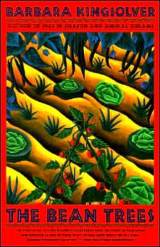
Bean TreesKingsolver, Barbara. The Bean Trees.New York: HarperPerennial, 1989. 

Barbara Kingsolver is my favorite author. I’ve said it before and I’ll say it again. I love the way she writes. The Bean Trees is on my Book Lust list and I’ve already read it hundreds of time. It’s the book I grab when I am in between other reads. It’s the book I reach for when I have a few minutes to kill while the rice bubbles on the stove. Given the chance to read it again just for Book Lust I am more than happy to jump at the chance.

Taylor Greer isn’t Taylor until she takes to the highway. Leaving her hometown of Kentucky to see something other than small town rumors and ruts she finds herself on the road, “adopting” a three year old American Indian girl on the way then finally landing in Tucson, Arizona.  Taylor is smart, witty and, for lack of a better word, feisty. She tells us her story with great observance to the spirit of humanity.

One of the things I love about Kingsolver’s work is the reoccurring themes: respect for nature described in gorgeous, vibrant detail, immigration and the political implications, the joys and struggles of motherhood (especially the single mother), the value of both belonging to a community and having independence. The Bean Trees is no different. All of these themes are carefully woven into the framework of the novel.

My favorite lines (okay some of them): “Whatever you want the most, it’s going to be the worst thing for you” (p 62).
“There were two things about Mama. One is she always expected the best out of me. And the other is that then no matter what I did, whatever I came home with, she acted like it was the moon I had just hung up in the sky and plugged in all the stars. Like I was that good” (p 10).

BookLust Twist: From More Book Lust’s first chapter called”Adapting to Adoption” (p 1). I have to admit I don’t agree with Pearl’s description of how Taylor “acquires” the American Indian child. Pearl says “When Taylor Greer leaves Kentucky for points west in order to escape the confines of small-town life, she finds an abandoned and abused Cherokee child left in her car…” (p 2). It actually went more like this: “Then she set this bundle down on the seat of my car. “Take this baby,” she said….”where do you want me to take it?” She looked back at the bar, and then looked at me. “Just take it.” I waited a minute, thinking that soon my mind would clear and I would understand what she was saying. It didn’t.” (The Bean Trees p 17). This is a poignant scene to me and it makes a big difference (to me) whether the child was left or handed over.

ps~ November is National Adoption month. I reread this just a tad early.

Yellow Raft in Blue Water

Yellow raft in blue waterDorris, Michael. A Yellow Raft in Blue Water. New York: Warner Books, 1987.

This is high school to me. I remember being holed up somewhere reading this nonstop. Hot off the press, freshly published and oh so new I couldn’t put it down. I reread it and reread it until finally I could move on to other Michael Dorris creations, which somehow were never quite as good. Nothing compared to A Yellow Raft in Blue Water back then and it is still a faovrite to this day.

Someone described this book as an onion, reading it was like peeling back the layers of a story, and while that imagery is accurate enough, I like to think of Yellow Raft as a game of telephone. First, there is Rayona. She tells the story from her perspective. She is all of fifteen years old…at that difficult age where rebellion against your mother is the easiest thing to do. As she says, “when mom and I have conversations, they mostly involve subjects not personal to our lives” (p 26). She tells her story like it’s the honest truth. Then, there is Christine, her alcoholic mother, and her story. In the beginning you want to hate her for how seemingly unfair she had been to Rayona. But, learning about Christine’s heartbreak you realize Rayona’s reality is only her perception. The wires of communication have been crossed and in some cases, completely disconnected. Christine had her reasons for everything she did (and didn’t do). “I never had been good company for myself” says Christine (p 185). Finally, there is Ida, Christine’s mother. Her story is, by far, the most revealing and tragic. Everything you heard whispered from Rayona through Christina is trapped in the warped truth of Ida. All three women are stubborn, flawed by fate, and determined to make the best of life as they know it even if it means coming off as cruel to others. Being on the inside, privy to their hearts, makes you want to shake each one screaming, “talk to your daughter!”

Favorite lines:
“Ghosts were more lonesome than anything else. They watched the living through a thick plate of glass, a one-way mirror” (p176).
“A bath brought me peace, made me float free” (p340).

BookLust Twist: In both Book Lust and More Book Lust. In Book Lust Pearl mentions A Yellow Raft in Blue Water early; on page 23 in the chapter “American Indian Literature.” In the chapter “Men Chanelling Women” (p 166) in More Book Lust Pearl adds A Yellow Raft in Blue Water because Michael Dorris does an amazing job setting the voices of three very different women free.

Sex Stories

She came home at five years old and said with a smile “I touched a penis.” This was like lighting a match and there were only two options. The flame dies out, the incident is forgotten on a whisp of smoke, or. Or. The match flares to a flame. Becomes an inferno of hell to come.
TruthDareConsequencesPromiseOrRepeat. I chose Dare. I just like taking dares with Yes. Sent her to her room without explanation. Where did I go wrong? My Fault for years to come. Come on baby, light my fire.

She had her first older man at eight. Fire on the Mountain. Couldn’t understand why he didn’t treat her differently. Wasn’t she special (so special, he would whisper) because of the things she let him do. Let him do to her? “IWLLBGNTLE” spelled out in Scrabble pieces. No wonder she won’t play the game. She wondered if anyone of importance would ever noticed. She was certainly teased enough about it by those who mattered less. Who would say anything? Definitely not her. Where did she go wrong. Her fault for years to come.

Virginity lost at 13. I pretended to be asleep. What’s the sense of interupting when she wants it that way? Expects it that way? A walking, talking, breathing, lying (down) slut. Talk is cheap but actions are rich – they rule the game played out. She walked away. I turned my face away from his pain. Where did he go wrong? His fault to fall in love. His fault for years to come.

They caught up to her in September. Payback’s a bitch and she felt she earned it, deserved it even. Larry, Curly & Moe. Where did you go? The taste of gin, sour on your lips. The lead of Led, heavy in your ears. She’s not here. But I am.

Her fault for years to come.