Jemez Mountains

Swetnam, Thomas W. The Jemez Mountains: a Cultural and Natural History. University of New Mexico Press, 2025.

Reason read: As a member of the Early Review Program for LibraryThing I get to review really cool books. This is one of them. I chose this book because I have long been fascinated with the Southwest. My sister has big dreams of settling in Taos, New Mexico. Me, I am not so sure.

There is a lot of love and respect in the pages of Jemez Mountains. It is abundantly clear that Swetnam cares deeply for the culture, history, and natural beauty of the region. He will take you to the hot springs that rival Saratoga’s. He will describe the first automobile in Jemez Springs. He will spend a lot of time at the Soda Dam. There are stories of bears, hippies, and abusive priests. He will give you a historical and scientific perspective of land use through the ages with photographs to illustrate each point. He has a serious concern about climate change and the damage it has already done to the region. There is a great deal of information packed in each essay so it was a relief when Swetnam explained that the essays of Jemez Mountains need not be read in sequential order.
As an aside, I felt a huge connection to Jemez Mountains not only because of my previously disclosed love of the Southwest, but because I uncovered other commonalities with the narrative. Swetnam matched photographs taken at the turn of the century with current ones. My hometown did something similar to illustrate how little it has changed in the last one hundred or so years. Swetnam refers to this matching of photographs as “then and now.” Inspired by the photography of my hometown, I put together an art show at my college with old photographs overlaid with current photographs and I called the project “Then and Now.”

Disclaimer: I make comments based on the assumption that special features to a book, like the same photographs, maps, or illustrations will be in the final published copy. That being said, the cover to Jemez Mountains is gorgeous. Swetnam has mentioned that there are more than one hundred photographs, maps, and drawings. My favorite photograph was of a Mack truck coming through one of the Guadalupe Box tunnels. It is impressive.

Book trivia: Jemez Mountains is set to be published in April 2025.

Author fact: Swetnam is a retired University of Arizona professor.

Small music: “O Fair New Mexico”
Santa Fe

Cordova, Kimberly Burk. Santa Fe: Read by Hannah Stone. Kimberly Burk Cordova, 2024.

Reason read: As part of the Early Review program for LibraryThing, I specifically requested Santa Fe because I love the Southwest.

Santa Fe is full of practical information, explained almost as if to a foreigner to the United States. Time zone, how to get to New Mexico by airplane, train, or bus, local customs, cultural etiquette, dining etiquette (eat slowly!), emergency contacts, tipping, public transportation, what to pack for each season (comfortable walking shoes), even how to drive (right side of the road, wear a seatbelt, do not use your phone unless you are hand-free, and so on) and how to take photographs. Most of this information is readily available on Google so I found myself speeding up the narrative to get to the stuff I didn’t know…like the margarita trail, the top ten tourist traps, and the popularity of blue doors!
As with other travel guides written by Cordova, there was a plethora of information that was often repeated. Certain excursions for toddlers, teenagers, and young adults were mentioned more than a few times (the Georgia O’Keefe Museum and the Botanical Garden, to name two). The sample itineraries seems to be filler. The plans for if you have three, five and seven days in Santa Fe were the most basic and, while the fourteen day seems to include everything from the other days, it had more detail, like specific restaurant names.
Having an audio travel guide is not practical. At least for me, it is definitely not. Case in point, the restaurant list. Cordova gives the mailing address (complete with zip code) for every single place on her list. While some of the places sound fantastic, I would never remember them without writing them down somewhere. Plus, I need maps.

As an aside, after trying to navigate the Roman public bathrooms for my friend with digestive issues, I now would like every travel guide to talk about public toilets. Banks and hotels wouldn’t hurt, either. Especially when Cordova suggests an overnight in Taos if you have fourteen days to spend in New Mexico.

Author fact: Cordova shares a couple of intimate details of her own life, like where she exchange wedding vows in Santa Fe and her favorite restaurants.

Book trivia: Santa Fe is not limited to Santa Fe. Cordova includes Taos and Albuquerque.

Arizona, New Mexico & the Grand Canyon Trips

Blond, Becca and Aaron Anderson. Arizona, New Mexico & the Grand Canyon Trips: 58 Themed Itineraries, 1005 Local Places to See. Oakland, California: Lonely Planet, 2009.

Reason read: Planning a trip to the Southwest this spring.

This has got to be one of the coolest travel books I have seen in a long time. There are fifty-eight themed itineraries (as the title suggests), but it’s the unique theme of each itinerary that is the real showcase. This guidebook takes into consideration practically every lifestyle imaginable. Do you want to hike the Grand Canyon exclusively? There’s a rim to rim itinerary for such an excursion. Do you want to go on an epic art tour in New Mexico? Maybe you are into beer and wine tastings? There are trips for that and that and that. Maybe you want to specifically look at Arizona architecture or follow its music scene. Like I said, there is a tour for those interests as well.
That being said, as with any tour book you definitely want to double check that the hotels and restaurants mentioned in the book are still operational. Additionally, prices for anything are bound to be different ten years after publication, but the canyons, buttes, deserts, and mesas aren’t going anywhere.
Another nice feature of this tour book is the time it will take to do each tour (providing you stick to the mileage they have laid out and avoid lengthy detours). They also suggest the best time to go, where you start and end up, and if you want to link on trip to another, which ones work the best. It made me want to take a year off and try every itinerary back to back. Of course there are detailed maps to help you plan such a thing.

Final thought: the photography included is spectacular. Then again, I think all desert photography is gorgeous.

March ’11 is…

I consider March to be a month of all things serious. I will be serious about training for the Just Cause 60-mile walk. I will be serious about keeping up with my PT. I will be serious about the goals I set for myself (written and unwritten). Oh so serious! For books the list for March is modest:

  • Jane Eyre by Charlotte Bronte ~ in honor of March being Book Reading Month. Isn’t this just the most classic book with which to start the month?
  • Flint by Paul Eddy ~ in honor of March being Action Hero Month. I forget who told me that. I know I just ran with it! Grace Flint is the hero of the month.
  • Famished Road by Ben Okri ~ in honor of African Writer’s month. Again, I don’t know where I got that info. I’m just going with it!
  • Blind Descent by Nevada Barr ~ in honor of March being Barr’s birth month
  • Cosi Fan Tutti by Michael Dibdin~ in honor of March being Dibdin’s birth month

There is still the LibraryThing Early Review book that is still missing in action AND I just received word I have been chosen for one for March as well. As always, I won’t name them until I see them!

In other news, there is news on the job front. I suppose that should be on the list of serious as well. *sigh*

January Was…

January started off and ended with a head cold (damn you, kisa), a really nice dinner party, a re-commitment to the houses HOUSE (glutton for punishment that I am), a re-commitment to charities with a big one – training for a 20 mile walk for Project Bread, a huge re-commitment to friendships and huge changes at the library. For books it was:

  • Death Comes to the Archbishop by Willa Cather in honor of New Mexico becoming a state in January.
  • Red Death by Walter Mosely in honor of Walter’s birthday being in January
  • Biggest Elvis by P.F. Kluge in honor of both Elvis and P.F. celebrating their birthdays in January.
  • Devices and Desires by P.D. James ~ in honor of mystery month.
  • The Eleven Million Mile High Dancer by Carol Hill
  • Edith Wharton: a Biography by R.W.B. Lewis ~ in honor of Edith’s birthday on January 24th.
  • The Guns of August by Barbara Tuchman ~ in honor of Barbara’s birthday.

For fun:

  • The Letters by Luanne Rice and Joseph Monninger ~ a story that partially takes place on Monhegan. How could I resist? This is the blog that was plagarized by some dumb-azz.
  • 30 pages of Nutritional Wisdom ~ a Christmas gift from my sister.

So I didn’t get a LibraryThing Early Review book in January. That’s not a big deal. I have certainly gotten my fair share over the course of the program so I’m not complaining. I do have to admit, I feel a little guilty. For the first time ever, I am really late publishing the review for the last ER book. Maybe that had something to do with it…who knows?

ps~ I did get one for February, or so I am told! 🙂

Death Comes for the Archbishop

Cather, Willa. Death Comes for the Archbishop. New York: Alfred A. Knopf, 1929.

Father Vaillant and Father LaTour are two friends on a quest. Death Comes for the Archbishop is their story of the attempt to establish a diocese in New Mexico – a landscape fraught with corruption and a complete breakdown of religious morality. On their travels we meet other notable characters such as Padre Martinez and Dona Isabella. They add violence and greed and drama and intrigue to an otherwise seemingly simple story of a religious quest.
While Death Comes for the Archbishop is Cather’s self proclaimed “best written book” I had never heard of it before the Challenge. In the beginning it seemed like an easy, quick read but after I got into it I realized it had amazing depth and powerful symbolism.

Impressionable quotes:
“When they were tramping home, Father Joseph said that, as for him, he would rather combat the superstitions of a whole Indian Pueblo than the vanity of one white woman” (p 219), and “…it was the Indian manner to vanish into the landscape, not to stand out against it” (p 265).

BookLust Twist: From Book Lust in the chapter”New Mexico” (p 167).

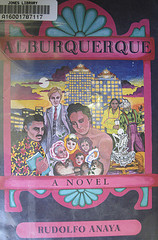
Alburqueque

alburquerque1.jpg

Anaya, Rudolfo. Alburquerque. Alburquerque: University of New Mexico Press, 1992.

My final book of January – chosen to celebrate the month New Mexico became a state. Anaya’s Alburquerque is rich with the culture of New Mexico’s Mexican population. In the center is Abran Gonzalez, a young ex-boxer from Barelas. Upon discovering he is adopted he sets out to learn as much as he can about his birth parents. It is crucial to his understanding of who he really is. Swirling around Abran there is magical realism, cutthroat politics, deep rooted culture, rich history, and tragic romance.
My one complaint – I don’t know why Anaya has Abran have a chance meeting with his birth father in the very first chapter. It seemed a little too coincidental and more than a little cheesy. He is able to come full circle with the same characters at the end. Like I said, a little cheesy.

BookLust Twist: From Book Lust in the chapter simply called, “New Mexico” (p 167).