Elephant of the Sea

elephant of the seaKirby, David. “Elephant of the Sea,” The Ha-Ha.Baton Rouge: Louisiana State University Press, 2003. 46.

Crack me up. This poem is really funny. It’s one of those comments on culture and keeping up with what’s cool. It’s also about language. Words and meanings. A French man wants to buy an automobile just like his American friend’s. Right down to the manatee on the license plate – the “elephant of the sea.” The friend doesn’t get it. He’s imagining what the clerk at the DMV are going to say and how the whole incident will shape her future.
And this is just one poem. Everything David Kirby writes is great. He is like geek rock of poetry. He’s smart and too funny for words.

Favorite line: “‘I can have zuh elephant of the zuh sea on my matriculation?’ to a clerk who’s got this grin on her face like she’s either seeing God or having an aneurysm” (p 46). 

BookLust Twist: From More Book Lustin the chapter “Poetry Pleasers” (p 188). He’s also mentioned in Book Lust in the chapter “Kitchen-Sink Poetry” (p 138).
Musee des Beaux Arts

Auden, W.H. “Musee des Beaux Arts.” The Oxford Book of American Poetry. Oxford: Oxford University Press, 2006. 501.

What do you see when you look at art? Does a painting create question in your mind? W.H. Auden wrote “Musee des Beaux Arts” in response to seeing the painter Brueghel’s Icarus. A ploughman calmly going about his business as a boy falls from the sky. While he had clues to the tragedy (a splash or cry) he does nothing. Auden’s larger observation is about how human response to an event or tragedy can vary; how life goes on beyond that event or tragedy. “Human position” as Auden puts it.

BookLust Twist: From More Book Lust in the chapter “Poetry Pleasers” (p 188).

What He Thought

McHugh, Heather. “What He Thought.” Hinge & Sign: Poems 1968-1993. Middletown: Wesleyan University Press, 1994.

I loved the conversational tone of this poem. I can see them perfectly. Intellects sitting around after dinner discussing what makes poetry poetry. In the beginning there is a snobbishness to the language, an air of I Know Better. Yet at the end there is a hint of mistaken identity which peeks through – an apology, mea culpa, my bad. It’s almost like a weak joke with a killer punchline.
Not to spoil the poem, but here’s the line that got me: “poetry is what he thought, but did not say.” How crazy is that? While this poem is in Hinge & Sign you can also read “What He Thought” on Heather’s humorous site.

BookLust Twist: From More Book Lust in the chapter called “Poetry Pleasers” (p187).

Workshop

Collins, Billy. “Workshop.” The Oxford Book of American Poetry. Oxford: Oxford University Press, 2006. 954.

I love poems that make me smile. The ones that seem like someone standing close, elbow to elbow, telling me something special. A conversation between pals. “Workshop” is such a poem. It’s the guy with the great sense of humor taking the time to tell me a joke (Billy was called the class clown of poetry somewhere). Read “Workshop” outloud and you will see what I mean. It’s a poet ranting about his own poem. A poem within a poem Shakespeare style…
Here are the phrases I loved:
“It gets me right away” (only because I identify with something getting me – an awesome drum fill, the right amount of Tabasco on my pizza, my husband’s voice when he’s tired…)
“the ancient mariner grabbing by the sleeve”
“the poem is blowing pipe smoke in my face”
“and maybe this is just me”
“a very powerful sense of something”
Before I quote the entire poem I’ll quit here. But, you see what I mean. It’s a conversational, easy going poem that’s really fun.

BookLust Twist: From where else? Of course it’s from More Book Lustin the chapter (you guessed it) “Poetry Pleasers” (p 188). 

The End and the Beginning

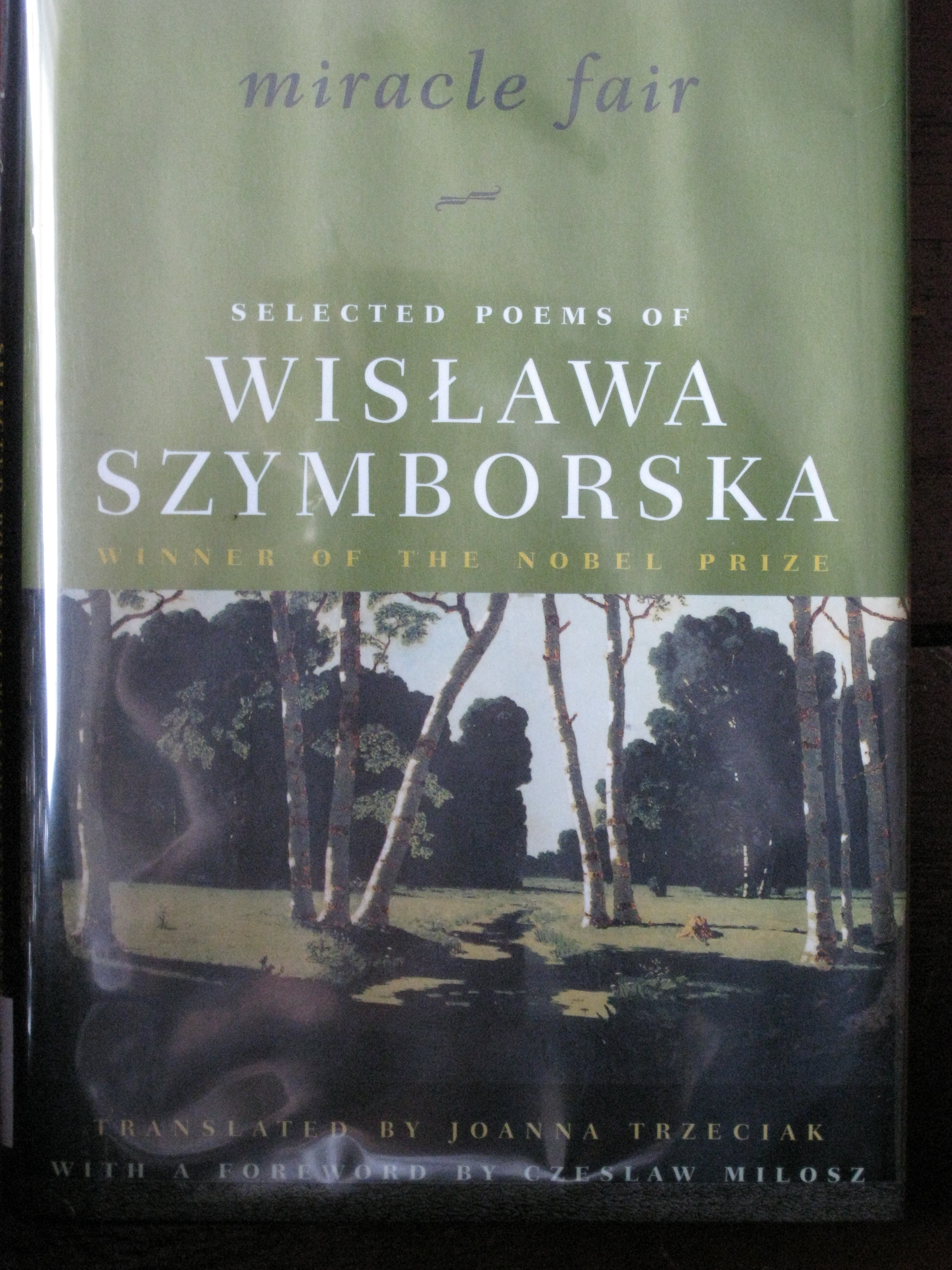
Wislawa Szymborska poetry

Szymborska, Wislawa. “The End and the Beginning.” Miracle Fair: Selected Poems of Wislawa Szymborska. New York: W.W. Norton, 2001.

This poem is so vivid that I pictured it as the scene behind the credits at the end of a war movie. Stay with me. Hear me out. In the poem, Szymborska gently, methodically runs through the list of what must be done at the end of a war: clean up debris, repair houses, rebuild bridges, carry on. Stay strong. So, imagine the credits rolling. The movie has ended, the war is over. Behind the steady stream of names, cast and crew, people survivors are shell shocked and sweeping, weeping and washing, hungry and hammering, biting their lips to continue life as best as they can; as they know how. Somehow, I see this as a stark black and white. More dramatic (or depressing) that way.
My favorite line: “From time to time someone must still dig up a rusted argument from underneath a bush and haul it to the garbage dump.” What does that mean? Maybe two someones can’t decide who really “won” the war. Maybe someone else is adament it rages still…just somewhere else. Arguments that have weathered and rusted from constant exposure.

BookLust Twist: From More Book Lust and the chapter “Poetry Pleasers” (p189).

Oven Bird

Robert Frost II
Frost, Robert. “The Oven Bird.” You Come Too: Favorite Poems for Young Readers. New York: Holt, Rinehart & Winston, 1959. 50.

I am definitely unsure of an oven bird. I don’t think I’ve ever seen one, nor heard one. I can’t even imagine one. But, I do know I love Robert Frost’s poetry – whether it be for children (as this one is) or for adults. What I keep coming back to about this particular poem is the circulation of the seasons. The flowers that bloom, and the bird that sings. It’s delightful. No favorite lines. It’s too short.

BookLust Twist: From More Book Lust in the chapter “Poetry Pleasers” (p 188).

Blind Heron

Tate, James. “The Blind Heron.” Shroud of the Gnome. New Jersey: Ecco Press, 1997. 11.

From just the title of Tate’s book I knew I would be in for a treat. I love 20th century poetry, especially when it has a sense of humor, a sense of the playful. Before I even got to “The Blind Heron” I read the table of contents and had a good laugh over some of the other poems: “Where Babies Come From” (made me think of that birds and bees talk – ahem!), “Restless Leg Syndrome”, “Shut Up and Eat Your Toad”, and “Sodomy in Shakespeare’s Sonnets”…I’ll have to blog about those at another time.
But, I will say this – Remember that scene in the movie ‘Tommy Boy’ when Tommy is trying to sleep at a motel. Richard keeps knocking on the door with different suggestive suggestions until finally, Tommy bolts out of bed yelling, “what kind of place is this?”? Well, that’s me with this collection of poetry. After seeing a poem called “In His Hut Sat Baba Jaga, Hag Faced” all I could ask was “what kind of poetry is this?!” The only answer: fun!

“Blind Heron” is clever and impish. Kiki is missing her cockatiel. Kiki is called a liar yet you, as the reader, are not really sure if that’s the truth. It’s more probable that you are only suppose to think of Kiki as a nontruth telling person because the poem concludes rather suddenly. Everything you thought you knew has been changed based on a confession.

BookLust Twist: From More Book Lust in the chapter “Poetry Pleasers” (p 189).

Provide, Provide

Frost, Robert. “Provide, Provide.” The Oxford Book Of American Poetry. Ed. David Lehman. Oxford: Oxford University Press, 2006. 234.

I couldn’t tell if Frost was trying to be funny here, if he was being what they call Tongue in Cheek, or if he really was serious in “Provide, Provide.” The first time I read it I thought it was one of those BeAllYouCanBe poems. Die great if you can help it. Seriously. But, the second time I read it I realized there is a sly sense of humor to this poem, a sort of sarcasm that if you can’t be great, lie about it. Don’t die a nobody. The line “Make the whole stock exchange your own!” sends me smiling every single time. I’m thinking of my Bull Lynch uncle and all his greatness in the arena. 
But, this part cinched it for me & are my favorite lines, at the end (of course):
“Better to go down dignified
With boughten friendship at your side
Than none at all. Provide, Provide!”

BookLust Twist: More Book Lust  in the chapter “Poetry Pleasers” (p 188).

Incident

Cullen, Countee. “Incident.” On These I Stand: An Anthology of the Best Poems of Countee Cullen. New York: Harper & Brothers, 1927.

Don’t let the shortness of this poem fool you. It packs a punch. “Incident” can be defined as one of those defining moments I blogged about earlier – where one instance stays with you, shapes you, defines you. Written in the first person, “Incident” is about an eight year old boy visiting Baltimore. Even though he spends some considerable time there the only thing he can recall is being called “nigger” by another young boy. There is so much below the surface of this poem. The hurt seethes.
Incidentally, this poem comes from an anthology of poems personally picked by Mr. Cullen. He dedicates this particular one to Eric Walrond, a Harlem Renaissance writer. This is the second Countee Cullen poem on my list.

BookLust Twist: From More Book Lust in the chapter “Poetry Pleasers” (p 188).


The Mercy

The Mercy
Levine, Philip. “The Mercy.” The Mercy. New York: Alfred A. Knopf, 1999.

Why is it that I can see some poems as mini movies? “The Mercy” paints a picture of Levine’s mother and her immigration to New York. It’s simple and short, but loaded with imagery. I can see the boat, waiting off-shore (quarantined until all illness had passed), or the sailor who teaches the eight year old girl how to say “orange” as she enjoys the juice-laden fruit.
There is respect and love woven into the words. Levine’s entire book of poetry is dedicated to his mother and the cover of the book depicts immigrants waiting to come ashore. Who knows? Maybe his mother is in the picture? I do not know.

BookLust Twist:From More Book Lust in the chapter, “Poetry Pleasers” (p 189).

Clouds Above The Sea

Storm II
Levine, Philip. “Clouds Above the Sea.” The Mercy. New York: Random House, 2000.

There is a melancholy air to this poem. Levine is simply describing his parents side by side, watching a storm roll in. He gives more decription to his mother, wanting to give her gifts to compensate for child bearing. She sounds as if she is taken for granted and Levine is just figuring that out. He sounds as if he is imaging the scene long after his parents’ passing. There is a tinge of regret in the language that cannot be ignored.

BookLust Twist: From More Book Lust in the chapter “Poetry Pleasers” (p 189).

Yet Do I Marvel

On These I Stand
Cullen, Countee. “Yet Do I Marvel.” On These I Stand: An Anthology of the Best Poems of Countee Cullen. New York: Harper & Brothers, 1927.

This is Cullen’s first poem of On These I Stand and if order was of important to him, Cullen made a wise decision. The imagery in this first poem is so powerful! How many of us have looked at the atrocities of this world and wondered, if there really is a God, why he would allow such horrible things to happen? Cullen does the same thing – only he takes his “religion” to a whole new level citing the less than savory Greek gods of mythology, evil doer Tantalus & forever doomed Sisyphus. And yet. Yet, Cullen concedes the god he knows must be good to allow him, a black man, to sing with poetry.  

BookLust Twist: From More Book Lust in the chapter “Poetry Pleasers” (p 188).

Accidental Recovery ~ for Nick

I was researching a poem for April’s poetry month when I came across one I can recite by heart, thanks to Natalie. She sang it during the Hiro shows as one of those ad libs, patter moments: Thought I would share because it’s so darn cute. Imagine a yawn at the end…

The Sleepy Giant

My age is three hundred and seveny-two,
And I think, with the deepest regret.
How I used to pick up and voraciously shew
The dear little boys whom I met.

I’ve eaten them raw, in their holiday suits;
I’ve eaten them curried with rice;
I’ve eaten them baked, in their jackets and boots,
And found them exceedingly nice.

But now that my jaws are too weak for such fare,
I think it exceedingly rude
To do such a thing, when I’m quite well aware
Little boys do not like being chewed. *insert giggle here*
[Little boys do not like being chewed.]

And so I contentedly live upon eels,
And tryto do nothing amiss,
And I pass all the time I can spare from my meals
In innocent slumber  – like this.
[In innocent slumber like this…]

Carryl, Charles E. “The Sleepy Giant.” The New Oxford Book of Children’s Verse. Ed. Neil Philip. Oxford UP, 1996. 95-96. 

Just a Song

wonder.jpg

Sometime ago I said that life was too busy for supporting & following & being obsessed by music. I think what I meant was these days I am being far more selective about the music I hear and how far I’ll go to stand before it. Recently, I went on a Natalie binge. Call me crazy, but four years is too long to go without hearing that voice live. Unlike myself I wanted a night upclose and a night far away. Unlike myself I made no attempt to remember the setlist. Unlike myself I made no attempt to get the perfect picture & in fact, refuse to post the ones that actually came out decent. I’ll leave that for some other adoring fan to do. Here is a list of the songs I heard. They are not all from the same night, nor are they in the “correct” order. The time listening to Natalie was too precious to worry about perfection.

  • Carnival~ this is the only one I will fess up to putting in the correct order. Every single time she came out on stage this was the song she performed first. It makes sense. This is her ode to New York; a nod to the city she adores. I have to say I was spellbound when she first appeared. It really had been too long. “Wide eyed misfit prophet, on a traffic island, stopped. And he raged of saving me.”
  • Build a Levee ~ This is a personal fave of mine. “You’ll fall under an evil spell just looking at his beautiful face.”
  • I’m not Gonna Beg ~ Where’s the boa? “I know ‘once upon a time’ and ‘ever after’ is a lie.”
  • At the Fair ~ Introduced as Robert Frost this is a Bonnie Raitt cover…” I swear another night is fallin'”
  • Sonnet #73~ Natalie was asked by the Royal Shakespeare Company to collaborate with Gavin Bryans for his Nothing Like the Sun project & put a sonnet to music. She chose #73 and said a few words about the Black Death and how many people died…typical Nat. “When yellow leaves, or none, or few do hang.”
  • The Equestrienne ~ A story about a circus by Rachel Field. Natalie created a song out of part of the story involving a white horse. “See the girl in pink on a milk white horse.”
  • Janitor’s Boy ~ A song written by Nathalia Crane when she was 10 years old. Natalie put it to music & sang it in a 1920’s vaudville sort of way, very fun and flirty. “He’ll carry me off I know that he will, for his hair is exceedingly red: and the only thing that occurs to me is to dutifully shivers in bed.”
  • If No One Marries Me by Laurence Alma-Tadema~ “And when I’m getting really old, at twenty-eight or nine I’ll buy a little orphan girl and bring her up as mine.”
  • The Man in the Wilderness from Mother Goose~ a strange little poem about a man in the wilderness and asking about strawberries in the sea…
  • Texas ~ a new song of Natalie’s that seemed a warning about having it all. “I don;t mind if I have to kill a little honey bee.”
  • Life is Sweet ~ I have to admit I cried during this song. I think Natalie avoided singing it one night just because someone requested it. The jury is still out on that one…”It’s high time you make up your own sweet little mind.”
  • Wonder ~ the anthem is still strong. The best part was Natalie’s special guest, “How I confound you and astound you.”
  • Golden Boy ~ and to think we have so many more Golden Boys to talk about since Columbine. “Meteor rise from obscurity and all it took was a killing spree.”
  • Go Down Moses ~ this is probably my favorite song. It’s haunting and hurting as only a song about Katrina moving through New Orleans could be. “But it so hard without you…cold shocked and speechless can anyone reach us?”
  • Giving Up ~ another new Natalie song…
  • The End ~ If anyone remembers Natalie’s 2004 tour they will remember the peace banner Natalie held up during Gulf of Araby. It was back for The End. “When we give up the barrel and the blade…”
  • Tell Yourself ~ Natalie tested us with this one. She said “I wrote this for my 13 year old niece…any guesses?” “You’ll never be like the anorexic beauties in the magazines.”
  • Village Green Preservation Society~ Who would have thought The Kinks would show up in a Natalie show.? Erik & Gabe helped Nat make this hysterical.
  • Break Your Heart ~ while I miss the horn section on this song the cello was a good replacement. “See the push and shove for their rewards”
  • From the Time You Say Goodbye~ what a lovely surprise. I never thought I would get to hear this love. “Keep a prayer within your heart that the time will surely fly”
  • Tension ~ although this was just a snippet it was awesome to hear Natalie’s very first song. “A thought mistaken for a memory”
  • Kind & Generous~ The time to give Natalie gifts… “My love and respect for you”
  • Letter ~ I know I have never heard this live before. “but the truth it would reveal knowing you brought me pleasure…”
  • Motherland ~“Where in hell can you go?”

I will never be able to really write about this experience. It was a pleasure. Special thanks to Germany, Scotland and to the great city of New York.

Death of the Ball Turret Gunner

JarrellJarrell, Randall. “The Death of the Ball Turret Gunner.” The Complete Poems.  New York: Farrar, Straus & Giroux, 1969. 144.

Randall Jarrell has a section in his Complete Poems just for gunners. While this poem is only five lines long, it packs a punch. Evoking images of motherhood and innocence, twisting to violence and death. It is a journey. The last line so disturbed me. Read for youself and see. For once I will not spoil it by spelling it out.
I will be honest, having never faced any war of a political nature, I looked up turret just to make sure it matched what my mind was seeing. It did. That didn’t make reading this emotional poem any easier.

BookLust Twist: From More book Lust’s chapter on Poetry Pleasers (p188).