Dangerous Friend

Dangerous FriendJust, Ward. A Dangerous Friend. Boston: Houghton Mifflin, 1999.

This is the companion read to The Quiet American by Graham Greene. I have to say it was interesting to read one man’s book in honor of someone else. But, back to Ward Just. Just was born in December, hence the addition of A Dangerous Friend. If it isn’t clear, I read The Quiet American because it was so similar to A Dangerous Friend. It just made sense to read them together.

A Dangerous Friend takes the reader to Vietnam, 1965. Sydney Parade is a man bored with his Connecticut life. In search of something bigger than himself he leaves his wife and daughter for the jungles of Saigon. While his intention is to be part of a foreign-aid operation building bridges, administering agriculture education, and facilitating supply delivery, Sydney soon discovers war is war no matter which side you are on. The depths of conflict strike his moral heart and leave him struggling to survive any way that he can.

A couple lines that I liked:
“…we were imprisoned in our own language, tone deaf to possibility” (p 4)
“The answer to chaos is repetition” (p 73).

BookLust Twist: From Book Lust in two different chapters: “Companion Reads” (p 64), and “Ward Just: Too Good to Miss” (p 135). Also, mentioned in the introduction (p xi).

Quiet American

Greene, Graham. The Quiet American. New York: Viking Press, 1956.

This has come up twice for my December readings – once because of Ward Just’s birthday (don’t ask), and once because it is a companion read to Ward Just, again don’t ask. I’ll explain all that when I get to Ward Just’s book later this month week.

Like my friend who started decorating for Christmas, I started reading my December picks on 11/23/08. I couldn’t help myself. I had wanted to fit in Just So Stories by Rudyard Kipling but my library’s version was not the complete works. In addition it was missing the two crucial stories Nancy Pearl specifically pointed out. Rather than disrupt the flow of order I moved onto December…a week early!

This was a story of two battles. An English reporter is sent to cover a war-torn Saigon. While there he falls in love with Vietnamese woman. His love is challenged when an American from Boston falls in love with the same woman. There is a real war raging on the periphery, complete with bombings and mass murders, while at the center is a battle over a woman. The interesting twist to this story is how the story makes the reader feel towards the two men and how that changes over time.

Best lines: “I shut my eyes and she was again the same as she used to be: she was the hiss of steam, the clink of a cup; the was a certain hour of the night and the promise of rest” (p 5). That is such an achingly beautiful line!
“You cannot love without intuition” (p 13).
“The possession of a body tonight seemed a very small thing – perhaps that day I had seen too many bodies which belonged to no one, not even to themselves” (p 65-66).
“For a moment I had felt elation as on the instant of waking before one remembers” (p 205).

BookLust Twist: From Book Lust in two different places: in the chapter “Companion Reads” (p 64), and “Ward Just: Too Good To Miss” (p 135).

Best American Essays

Oates, Joyce Carol, ed. The Best American Essays of the Century. Boston: Houghton Mifflin, 2000.

As bloggers we cannot help but be reminded that November is National Novel Writing Month. It’s as if there a reminding hope that writing these one-three paragraph diatribes could somehow be transformed into something as concrete, or as interesting, as a full blown novel. I squirm with discomfort every time someone says I should write a book. While my stories are interesting…to a point, I don’t see a need to make them more than what they are: tiny bubbles of thought designed to pop (and ultimately, hopefully) go away when released.

Anyway. This isn’t about me and my nonability to write. This is about the complilation of essays from those who can.
Best American Essays of the Century wraps up the creme de la creme of essay writing from 1901 – 1997. Beginning with Mark Twain (“Corn-pone Opinions”) and ending with Saul Bellow (“Graven Images.”) As part of the Book Lust Challenge I read the following essays:

  • “Stickeen” by John Muir ~ “…for many of Nature’s finest lessons are to be found in her storms” (p 32).
  • “Corn-pone Opinions” by Mark Twain ~ “We are creatures of outside influence; as a rule we do not think, we only imitate” (p 1).
  • “A Law of Acceleration” by Henry Adams
  • “The Devil Baby at Hull-House” by Jane Adams
  • “The Crack-up” by F. Scott Fitzgerald ~ Life was something you dominated if you were any good” (p 139).
  • “The Ethics of Living Jim Crow: an Autobiographical Sketch” by Richard Wright
  • “Sex Ex Machina” by James Thurber ~ “Every person carries in his consciousness the old scar, or the fresh wound of some harrowing misadventure with a contraption of some sort” (p 157).
  • “Letters from a Birmingham Jail” by Martin Luther King, Jr.
  • “The Brown Wasps” by Loren Eisley
  • “A drugstore in Winter” by Cynthia Ozick

BookLust Twist: From Book Lust in the chapter called, “Essaying Essays” (p 80).

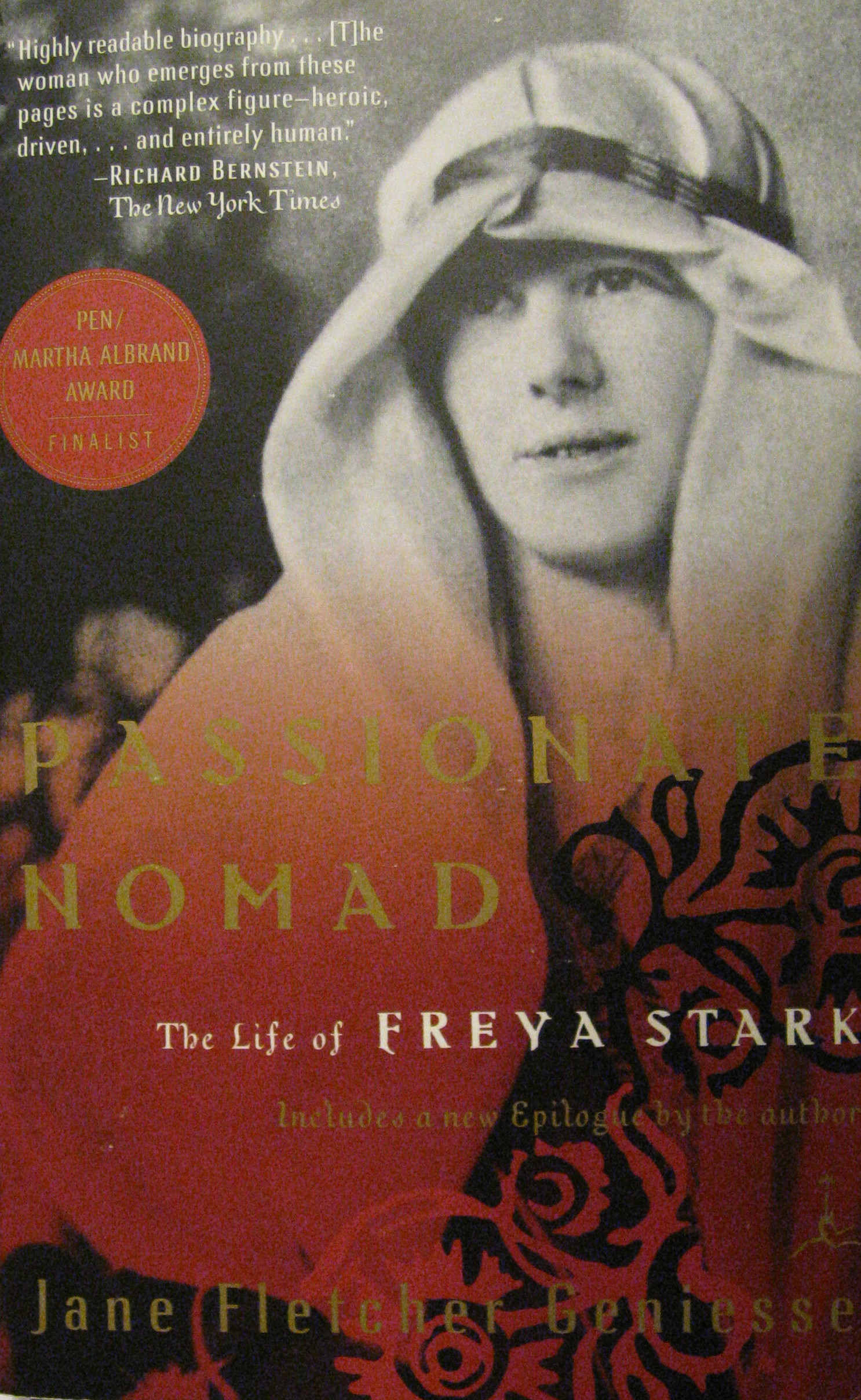
Passionate Nomad

img_4236Geniesse, Jane Fletcher. Passionate Nomad: The Life of Freya Stark. New York: Modern Library, 2001.

This has been hanging around the house for over a year now. I had no idea it was even on “the list” until now. Someone gave me a copy with the recommendation, “read it. It’s good. You’ll like it.” Okay. So, in honor of National Travel Month I put Freya on the list (as soon as I found out it was even on the list).

Freya Stark was an amazing woman. Not because she explored uncharted territories. Not because she dared to go where even the bravest of men hadn’t. Not because she had no regard for her own well being. Not even because she was an expert Arabist. She was an amazing woman because she dared, period. We hear about the glass ceiling and what women even today are tolerating. Freya faced all that and more.
Geniesse weaves a convincing autobiography of Freya Stark using letters to and from Freya, journals, interviews, but mostly from Freya’s own library of books written about her experiences. Freya was a prolific writer and so Geniesse had plenty of material to draw from. The final product is a fascinating account of one woman’s rise to recognition through exploration and encourage, especially during one of the most volatile times of our history – World War II.

A few favorite passages:
“One suspects that all her life Freya carried some degree of rage…” (p 23).
“A telegram from Freya requesting that a tin bath be shipped into the interior of Yemen was not unusual” (p 156). You go girl!
“Wherever she went to find solitude on this great, empty earth, from nowhere emerged some form of life, human or otherwise, to share the loneliness” (p 217).
“in the middle of the night she was awakened by the tinkling of a music box being played close to her ear” (p 250).

BookLust Twist: From Book Lust in the chapter, “Lady Travelers” (p 143). I am excited to think I will be reading some of Freya’s own works (eventually), – from this same chapter. Maybe next year.

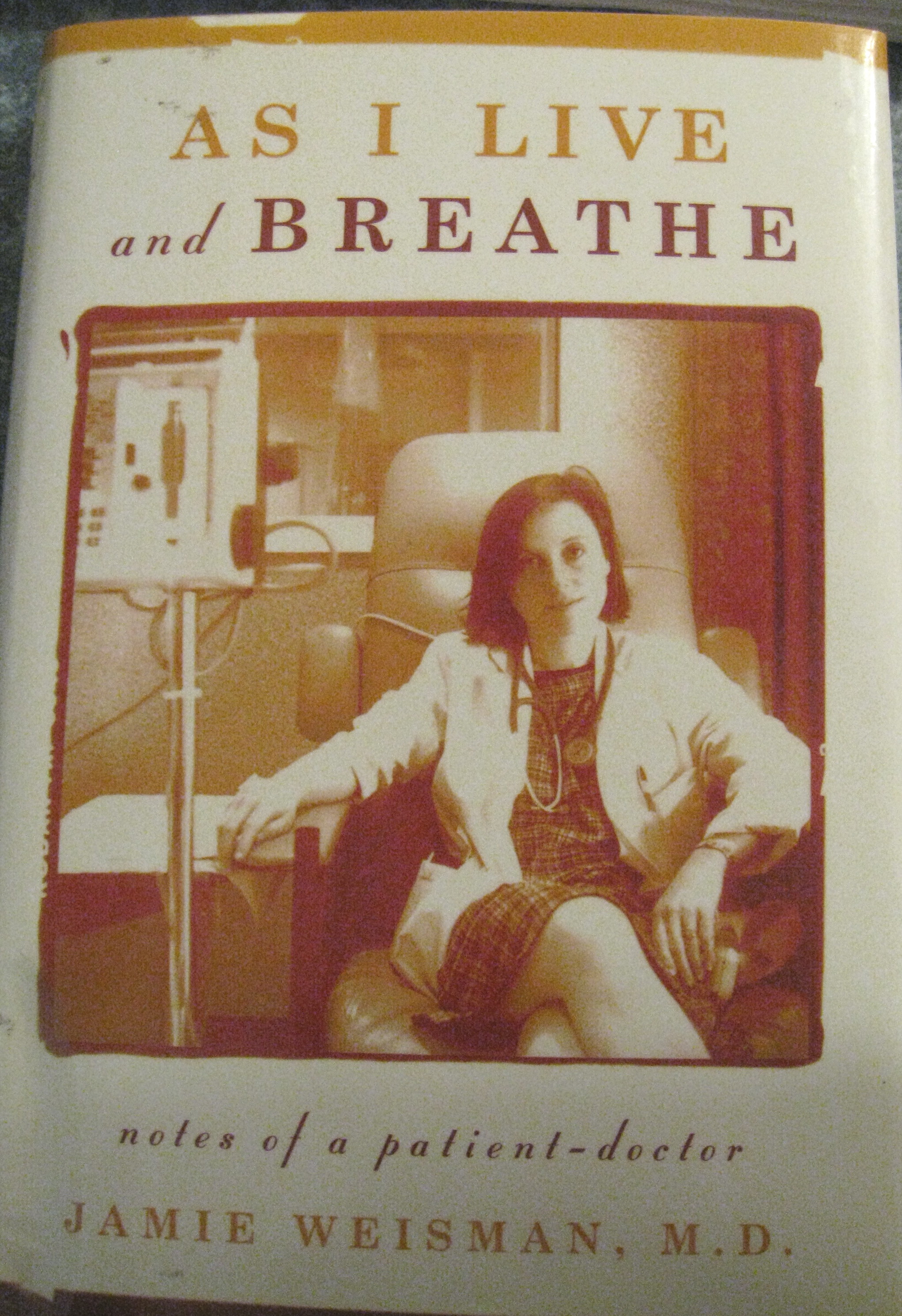
As I Live & Breathe

img_4234Weisman, Jamie. As I Live and Breathe, notes of a patient-doctor. New York: North Point Press, 2002.

In honor of National Health Month I decided to read As I Live and Breathe. I always find memoirs interesting when the author is more than your average individual. Who doesn’t? Dr. Weisman also has a talent for words which makes her unique story all that more compelling.

Dr. Jamie Weisman is a unique woman. While living within the confines of her illness she chose to do something about it, she joined the medical profession. As she says in her memoir, “”Now that I’ve finished medical school, I know what all those names mean, what diseases they describe, but you cannot know what they are as an illness until you see them in a patient” (p 15). Not only is her condition (congenital autoimmune deficiency disorder) rare and confusing, but her duality of patient and doctor gives her an interesting perspective- from bedside manner of doctor to bedridden patient. Because she is able to really know what the patient is experiencing she can deliver the empathy necessary for individuals really suffering.
My only real disappointment was the organization of the chapters. Dr. Weisman jumps around, remembering patients and her own childhood at random. I would have prefered a more chronological accounting. The last two chapters of the book, “begotten” and “begetting” are warmer and more personal and as a result seem a departure from the more clinical previous chapters.

Favorite blurbs:
“Our diseases overwhelm us at the strangest times” (p 16).
“I knew no happy lawyers” (p 31).

BookLust Twist: From both Book Lust and More Book Lust. In Book Lust in the chapter called, “Physicians Writing More Than Prescriptions” (p 185), and in More Book Lust in the chapter called, “Other People’s Shoes (p 181).

November Is…

Giant
November is completely out of whack – already! I posted a review and then realized I hadn’t even listed out everything I plan to read. Woops! Truth be known, I hadn’t really decided what I wanted to read this month (hence the silly delay). But, this is what November is: November is when I wanted to turn on the heat. It actually came on 10/24 (at 56 degrees), but maybe now I’ll turn it up…to 60. This November marks the first time in my life I am not planning anything for the holidays (watch me cave and change my mind in the next two weeks). November is a marriage forever stuck at 22. November is (hopefully) a month of music. November is also the attempt to get a lot of reading done since it is National Novel Writing Month. Here’s the list:

  • Behind the Scenes at the Museum by Kate Atkinson (in honor of first novels) -already finished and reviewed!
  • A Continent for the Taking by Howard W. French (in honor of the best time to visit Africa).
  • The Darling by Russell Banks (in honor of Transgender month*, but, conveniently, also about Africa).
  • Passionate Nomad by Jane Geniesse (in honor of National Travel Month – or one of them, at least!).

and if there is time:

  • As I Live and Breathe: Notes of a Patient Doctor by Jamie Weisman (in honor of National Healing Month).
  • Battle Cry of Freedom: the Civil War Era by James M. McPherson (in honor of November being the month the Civil War ended).

And a few “goals” such as they were: getting my car fixed & getting life as I know it back on track. Period.

*None of the books I will be reading in honor of Transgender Month actually are about people of transgender. Nancy Pearl has a chapter called “Men Channeling Women” in More Book Lust (p 166), but since National Men Channeling Women month doesn’t exist (yet), I thought this would be a good tongue-in-cheek substitute.

Behind the Scenes at the Museum

Atkinson, Kate. Behind the Scenes at the Museum. London: Black Swan, 1996.

November is writing month and to celebrate I decided to read something from Nancy Pearl’s chapter called “First Novels” (Book Lust p 88)…in two days!
Behind the Scenes at the Museum was honored as a Whitbread Book of the Year and received such words of praise as remarkable, impressive, entertaining, quirky, colorful, humorous, ambitious, unusual, lively, provacative, promising, witty, enchanting, sassy, astounding…I could go on (and on). With reviews using words like those how could I not expect to love it, want to love it?

From the very beginning Behind the Scenes draws the reader in. Told from the point of view of young Ruby Lennox…(before she is even born) there is humor and sarcasm. Her voice reminds me of the wise-alec baby on Family Guy (sorry, the name escapes me). Ruby is omnipresent, giving the reader insight on every thought, feeling, dream, nightmare her family has.
The alternate chapters (told in third person) give the backstory of Ruby’s mother’s life during the second Great War. The writing is not as humorous, nor as witty as when Ruby gets to speak. Over all the reading is a rollercoaster of ups and downs, twisting you through life’s crazy moments.
Favorite lines:
“She walks out, saying nothing, but inside, a silent Scarlett rages…” (p 22).
“…but how can time be reversible when it gallops forward, clippity-clop and nobody ever comes back. Do they?” (p 210).

All and all I wasn’t as wowed as I thought I would be. Maybe it’s because Ruby’s story isn’t the main focus after all. While she tells the story it’s more about her mother, Bunty, and the generations of women before her. It’s interesting to note there is always a war going on in some capacity and Ruby seems to always be walking in on her father having sex with someone other than his wife!

BookLust Twist: From Book Lust in the chapter called “First Novels” (p 88). But, I said that already.

Dubliners

Joyce, James. Dubliners. New York: Signet, 1991.

When I was in high school I fell in love with James Joyce’s style of writing. We share the same birthday. The Dead, a short story from Dubliners was my all time favorite. Gabriel became my favorite name; a long lost child.

Dubliners is comprised of 15 short  and simple stories all centered around the people of Dublin. To sum up the collection it is a portrait of a city as seen from the eyes of the people living there. The very first story, The Sisters, is nothing more than a family’s reaction to a priest’s death. While the characters are not connected, their stories are. Life and death, love and loss, youth and aging, poverty and wealth. Joyce does a remarkable job capturing the spirit of the Irish while revealing universal truths about mankind as a whole. It is as if we, as readers, get to peek into the character’s lives and are witness to moments of our own circumstances.

What I find so remarkable about Dubliners is that Joyce originally had great trouble getting it published. And even after he finally did it didn’t sell that well.

BookLust Twist: From Book Lust in the chapter “Irish Fiction” (p 125). Where else? Edited to add: I’ll tell you where else…Book Lust To Go in the chapter called “Ireland: Beyond Joyce, Behan, Beckett, and Synge” (p 110). I guess you could say Dubliners shouldn’t be included in this chapter because it’s supposed to be about “beyond Joyce.” Something to think about.

Crime Novels

Polito, Robert. Crime Novels: American Noir of the 1930s & 40s. New York: Library of America, 1997.

Something scary for Halloween. Six different stories about crime. Three of them are novels already on my list. Go figure.

  1. The Postman Always Rings Twice by James M. Cain
  2. They Shoot Horses Don’t They? by Horace McCoy
  3. The Big Clock by Kenneth Fearing

and three others:

  • Thieves Like Us by Edward Anderson
  • Nightmare Alley by William Lindsay Gresham
  • I Married a Dead Man by Cornell Woolrich

From The Postman Always Rings Twice~ I have always wanted to know what this story was all about. Written in 1934 it tells the sexy, gritty tale of Frank Chambers, a drifter who finds himself grounded by Cora Papadakis, a married woman. Cora’s beauty and instant mutual attraction leads to Frank’s uncharacteristic staying put. Soon the adulterous couple is contemplating murder. The plot is timeless. Desire has led them to the devil’s doorstep.
Favorite lines: “I kissed her. Her eyes were shining up at me like two blue stars. It was like being in church” (p13).
“Then the devil went to bed with us, and believe you me, kid, he sleeps pretty good” (p 70).
What Nancy had to say about : “…filled with desperate, scheming men and women…” (Pearl, Nancy. Book Lust, p66).

From They Shoot Horses Don’t They?: This was a bizarre, psychological tale about two kids with very different dreams. Robert is looking to be a film producer and Gloria wants to be an actress. They pair up and enter a Hollywood dance contest knowing Hollywood bigwigs would be in attendance. The contest is all about making money, working the contestants like racehorses, making bigger and better stunts to attract sponsors and a bigger audience. Analogies to horse racing are abundant. From the title of the book it is obvious what happens in the end, but it’s a fascinating read just the same.
What Nancy had to say, “…wonderfully grungy dance-marathon nightmare novel” (Book Lust p 67).

From Thieves Like Us ~ : I found this to be a very slow moving, almost methodical story. Written in 1937 it tells the tale of three bank robbers: Elmo Mobley, T.W. Masefeld and Bowie A. Bowers. While the story of these thieves as fugitives on the run is interesting, what makes the entire piece come alive is the vivid imagery used to describe the landscape these men hide in. Across Texas and Oklahoma’s back country there are many farmhouses and hideaways to keep the story moving. Favorite lines: Oddly enough, the dedication caught my eye: “To my cousin and my wife, because there I was with an empty gun and you, Roy, supplied the ammunition and you, Anne, directed my aim” (p 216). Here’s where my sick mind went with this: Roy (the cousin) had an affair with Anne (the wife). Don’t mind me.
Second favorite line: “The moon hung in the heavens like a shred of fingernail” (p 224). There have been a lot of interesting moon descriptions, but I liked this one a lot.

The Big Clock by Kenneth Fearing started out slow. George Stroud works for a conglomerate of magazines in their Crimeways department. He is a simple family man with a wife and daughter, but his dreams and ambitious are big. When he has an affair with his boss’s girlfriend and she winds up bludgeoned to death things get a little tricky. It’s a story of conspiracy and cat and mouse. George must prove his innocence when everything points to the contrary. Once it gets going it’s fascinating!
From The Big Clock: “The eye saw nothing but innocence, to the instincts she was undiluted sex, the brain said here was a perfect hell” (p 383), “He said how nice Georgette was looking which was true, how she always reminded him of carnivals and Hallowe’en” (p 385) and “I could feel the laborious steps her reasoning took before she reached a tentative, spoken conclusion” (p 393).
What Nancy Pearl had to say, “…edgy corporate-as-hell thriller” (Book Lust p 66).

Nightmare Alley was intriguing on many different levels. It was the ultimate “what goes around comes around” story. The lives of carnival entertainers serves as the backdrop for Stanton Carlise’s rise and fall. He joins the carnival and soon picks of the tricks of Zeena, the Seer. Once Stan the Great learns the craft (an inadvertently commits murder) he leaves the carny and sets out on his own as a Mentalist, becoming greedier and greedier for taking the sucker’s buck. Soon he passes himself off as a priest with the capability of bringing loved ones back from the dead. Constantly running from troubles in his own life Stan gets himself deeper and deeper until no one is trustworthy.

I Married a Dead Man by Cornell Woolrich was probably my favorite. You don’t know much about Helen Georgesson before she assumes the identity of Patrice Hazzard. The facts are Helen is a pregnant girl, riding the rails with 17 cents to her name. A chance encounter and a terrible accident leave Helen with a case of mistaken identity. For the opportunity to start life anew and give her baby a better life Helen accepts Patrice’s identity as her own. Living the life of luxury doesn’t come easy when Helen’s past comes to town and threatens to unveil her true self.

BookLust Twist: Crime Novels: American Noir of the 1930s & 40s can be found in Book Lust in the chapter, “Les Crimes Noir” (p 65).

Artemis Fowl

IMG_3757
Colfer, Eion. Artemis Fowl. New York: Talk Miramax Books, 2001.

Another book that I finished in a day. I suppose it helped that it’s a book for young adults so it was a breeze to read. The real reason was it was a fun read.

Meet Artemis Fowl. Only 12 years old but already a millionaire – a criminally brilliant millionaire. When we first meet Artemis we learn he is out to kidnap a fairy. Let the games begin! From the very beginning Artemis Fowl is full of folklore. Besides fairies there are goblins, dwarfs, gnomes, a centaur, trolls and the ever tantalizing hoard of gold. Artemis, though only 12, has devised a plan to rid the fairies of their riches by using their own powers against them. For being a childrens’ book it is pretty fast paced and violent.

Favorite lines: “…A ragged apron does not a waiter make” (p 4), and “Holly unhooked a set of wings from their bracket. They were double ovals, with a clunky motor. She moaned. Dragonflies. She hated that model….now the Hummingbird Z&, that was transport” (p50). Can you just see it? Fairies don’t have wings! They have strap-ons! The idea that Holly was “stuck” with Dragonflies rather than her preferred Hummingbirds cracked me up.

BookLust Twist: From Book Lust in the chapter, ”

ps~ From what I understand Artemis Fowl was made into a movie. This is one to put on the NetFlix list!

Special thank youuuuu to Kisa Too Cool for posting…

Accidental Tourist ~with spoiler

Tyler, Anne. The Accidental Tourist. New York: Berkley, 1985.

This was a reread. I couldn’t remember anything about it and rules are rules: if I don’t remember the plot, I don’t remember the main characters or, I don’t remember how it ended I read it again. This one was a cinch. I reread it in a day.

Macon Leary is a man stuck in his ways. He’s so eccentric I almost disliked him in the beginning…until I met his family. They’re all the same way. Macon is the author of unique travel books centered around business travel. The problem is Macon doesn’t like to travel, doesn’t like meeting new people, doesn’t like being in unfamiliar places. Upon separating from his wife Macon’s whole life turns upside down. He learns how to feel emotions, to see the world as if through the eyes of a completely different person. The Accidental Tourist takes you on a journey of awakening and growth.

Lines that hooked me: “Could you really drive a car without reversing?” (p 18). Okay, not the most poetic of lines, but here’s the story: Kisa has a coworker who consistently parks in the turn around instead of using the lot – the huge lot. We used to complain about it until we found out his car couldn’t reverse!
“”She always seemed about to fall over the brink of something” (p 63). Love the imagery!
“Macon got out Miss MacIntosh just for something to pin his mind to” (318). It was at this moment that I knew Macon loved Muriel and would return to her. Don’t ask me why.

BookLust Twist: From Book Lust in the chapter, “Real Characters” (p 197). Incidentally, The Accidental Tourist was made into a movie. I’m thinking if Nancy Pearl ever writes another Lust book she should include books made into movies (worth seeing). I’m betting she would include this one.

Good Enough Parent

Bettelheim, Bruno. A Good Enough Parent. New York: Alfred A. Knopf, 1987.

It’s funny that this was written in the year I graduated from high school and went onto college. I consider 1987 one of the biggest “brink” years – standing on the brink of something bigger. However, reading this 21 years later reminds me of something else: homework!

Maybe it’s because I don’t have kids (and the fact I’ll never have kids) that I didn’t find A Good Enough Parent all that interesting. Instead it was rather dry and psychological. Nancy Pearl says this book is a must for any new parent. I honestly do not know when any new parent would have the time! Pearl also goes on to say, “Be forewarned: Bettelheim’s perspective is very psychoanalytical” (Book Lust p 30). He does make the text a little easier (interesting) by including personal anecdotes and compelling stories to punctuate his point.

Lines I like: “None of this holds true for what happens between a parent and child. Anything that occurs in their relationship is heir to a long and complicated history” (p 5).
“I feel that a parent’s most important task is to get a feeling for what things may mean to his child” (p 14).
“Parental anxiety makes life very difficult for parent and child, since the child responds to the anxiety of the parents with even more severe anxiety” (p 41).

BookLust Twist: From Book Lust in the chapter called “Babies: A Readers Guide” (p 30).

World’s Fair

Doctorow, E.L. World’s Fair. New York: Fawcett Crest, 1985.

This is another challenge book that I read out of order. It was supposed to be on the July list. The only reason for this out-of-orderness was I didn’t plan very well. Technically, I have two Early Review books and four challenge books on the way but…you guessed it, none of them are here yet. I needed something to read over the weekend after finally, finally unpacking from the trip, while waiting for laundry (seven loads) to cycle and while Kisa was at a Patriots game. While this was a chore chocked weekend I needed to do my own thing, too. Nothing beats uninterrupted reading!

World’s Fair is the brilliant story of a boy named Edgar and his life in the 1930’s in New York City. Spanning Manhattan, the Bronx and Brooklyn, all senses come alive with Doctorow’s descriptive narrative. From the bustling, noisy market places to the quieter mom & pop shops; from the silent synagogues to the crowded beaches of Rockaway, New York is on display through the eyes of a child. Edgar is the youngest brother in a musical family. As he grows up, goes to school and becomes more aware of the world around him, politics and economics become less abstract and more of a reality in his day to day life. He sees his parents not getting along, his brother becoming more adult (and less fun), grandparents getting frailer, and finally, his own life becoming more complicated.

I thoroughly enjoyed World’s Fair. It was a clean, straightforward book with lots of vivid description and emotion. Most of the time Edgar tells the story, but intermittently his mother Rose, or brother Donald will step in for a chapter. Even an aunt has a moment in the story.

Favorite lines: “I am roused from sleep in one instant from glutinous sleep to grieving awareness” (p 4), “My mother ran our home and our lives with a kind of tactless administration that often left a child with bruised feelings, though an indelible understanding of right and wrong” (p 13), “this was her way, to express concern from opposite sides of the crisis” (p 27), and “I lived in the weather of my mother’s spirit,  and at these times, after these visits, the sky grew black” (p 96).

BookLust Twist: From Book Lust in the chapter “New York, New York” (p 170).

Heartbreaking Work

Eggers, Dave. A Heartbreaking Work of Staggering Genius. New York: Vintage Books, 2001.

I didn’t even have to touch this book to know it was going to be great. It landed on my desk upside down. the first words I read from the back cover were, “Yes lets and then can we leave and run in shallow warm water.” I was intrigued, to say the least!

It’s the story of Eggers as a young adult faced with having to take care of his younger brother after losing both his parents to cancer. It’s sad and funny. Witty and sarcastic. It took my much longer to read because I had to drink every little word. I read the Rules and Suggestions for Enjoyment of This Book, the Preface to this Edition, the Contents, Achknowledgments, even Mistakes We Knew We Were Making which contains notes, corrections, clarifications, apologies, and addenda. Too funny.

A few of my favorite lines:
“I have visions of my demise: When I know I have only so much time left – for example, if I do in fact have AIDS as I believe I probably do, if anyone does, it’s me, why not – when the time comes, I will just leave, say goodbye and leave, and then throw myself into a volcano” (p xiii)
“Beth and I take turns driving him to and fro, down the hill and up again and otherwise we lose weeks like buttons, like pencils” (p 55).
Then there’s this scene. I don’t know how to describe it other than to say I’ve been there: “I want to put the box somewhere else…The box which is not my mother cannot go in the trunk because she would be livid if I put her in the trunk. She would fucking kill me” (p 383). This is so, so, dare I say it? Heartbreaking.

BookLust Twist: Pearl really liked this book. It’s mentioned four different times between her two books Book Lust and More Book Lust. From Book Lust: in the chapter “Memoirs” (p 152), and “The Postmodern Condition” (p 191) and again in the preface on page xi. Then again in More Book Lust in the chapter “And The Award for Best Title Goes To…” ( p 12).

Dog Handling

Naylor, Clare. Dog Handling. New York: Ballentine Books, 2004.

When it comes to chick lit I think there has to be a trick to reading it. At least for me there are two tricks. Suspension of belief, first and foremost…and the ability to laugh out loud at some of the nonsense.

Dog Handling is the story (cute story!) of Liv Elliot, a soon-to-be married accountant in London’s Notting Hill district. When Liv’s fiance breaks off the engagement she flees to Australia to mend her not so broken heart. Australia brings new friendships, a new career opportunity, new men (of course), and a whole new way of dating them. Liv’s outlook on life changes once she learns the rules of “dog handling.”

Traditionally, I am not a big fan of mind games, overextended cliches and predictable sappy-happy endings and Dog Handling had all of the above. It took me sometime to stop making Bridget Jones comparisons and seeing Liv Elliot in her own bumbling, lovable, all’s well that ends well movie. Once I was able to get past all that I truly enjoyed the story. The characters were delightful and the plot, humorous. It was a great summer read.

Favorite lines: “After all, a foreign city is a foreign city, and until she knew the precise location of the nearest places to buy newspapers, tampons, and beer she wasn’t taking any chances” (p 40).
“Liv had been cutting split ends off her hair with a potato peeler” (p 232). What a great idea!

BookLust Twist: From Book Lust in the chapter “Chick Lit” (p 54). Where else?