Kite Runner

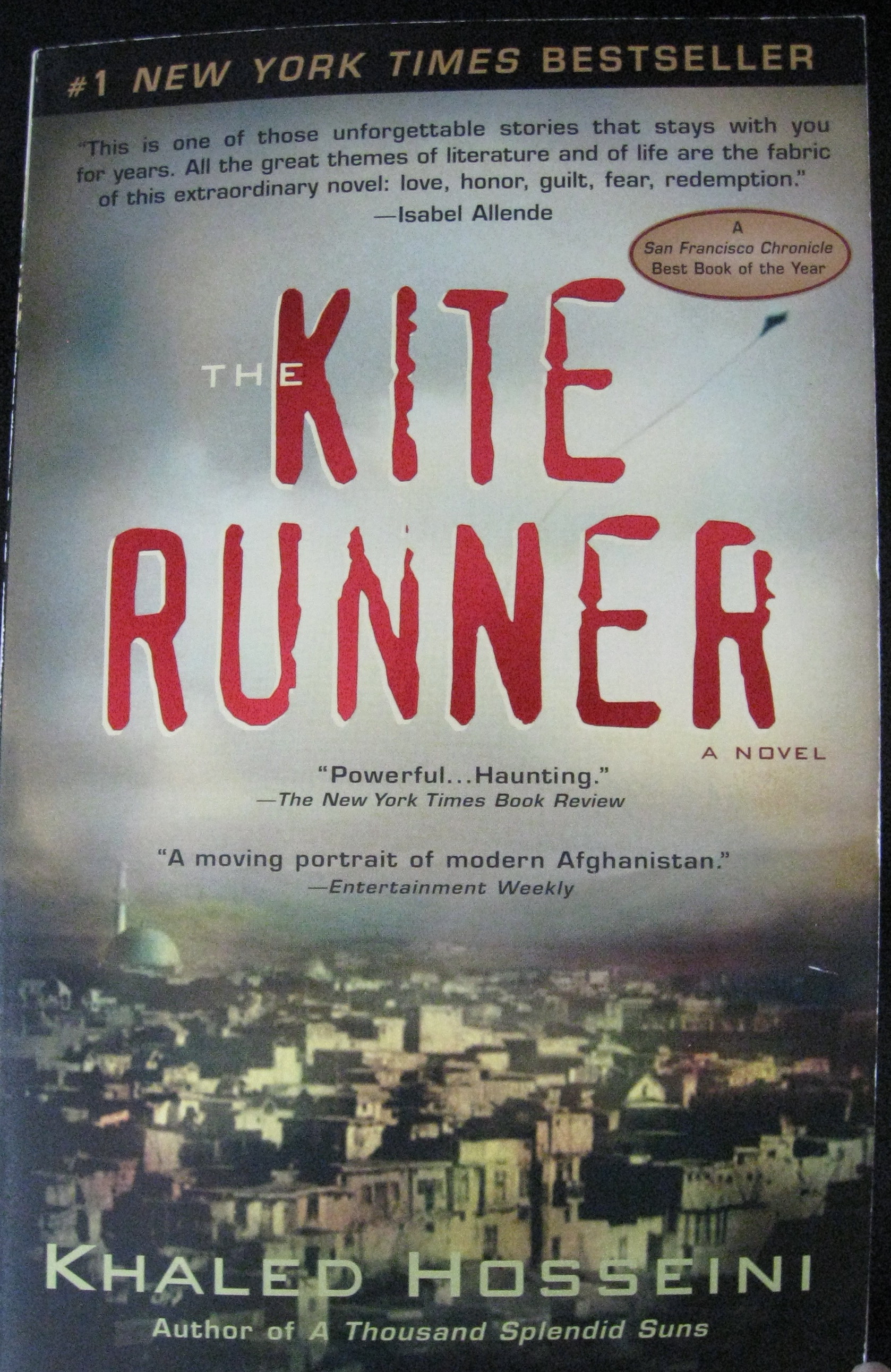
Hosseini, Khaled. The Kite Runner. New York: Riverhead, 2003.

It is hard to believe The Kite Runner is Khaled Hosseini’s first novel. I am reminded of a favored race horse, one that is described as “strong out of the gate.” I couldn’t put it down (read it from start to finish on the flight back from California). The Kite Runner is a powerful story of friendship and family in a time of political and cultural upheaval. Amir tells the story of his childhood in Kabul, Afghanistan. As a privileged son, Amir grows up in the shadow of his Baba, his father’s affection, constantly looking for ways to win his father’s love and admiration. Occasionally Amir finds the sunshine and basks in the approval, but those moments are fleeting, overshadowed by Baba’s obvious and puzzling devotion to Hassan, a servant’s son. Amir spends his childhood balancing a friendship with Hassan while enduring blinding bouts of jealousy. Amir’s personal turmoil forces him to make regrettable choices and soon his life parallels his country’s dramatic revolution. For both boy and country, life as they knew it is over in a dramatic upheaval.

BookLust Twist: In More Book Lust twice:  First in the chapter called, “Central Asia: Crossroads of Empires, Cauldron of War” (p 40), and again in “Maiden Voyages” (p 159), for being Hosseini’s first book. 

Time Traveler’s Wife

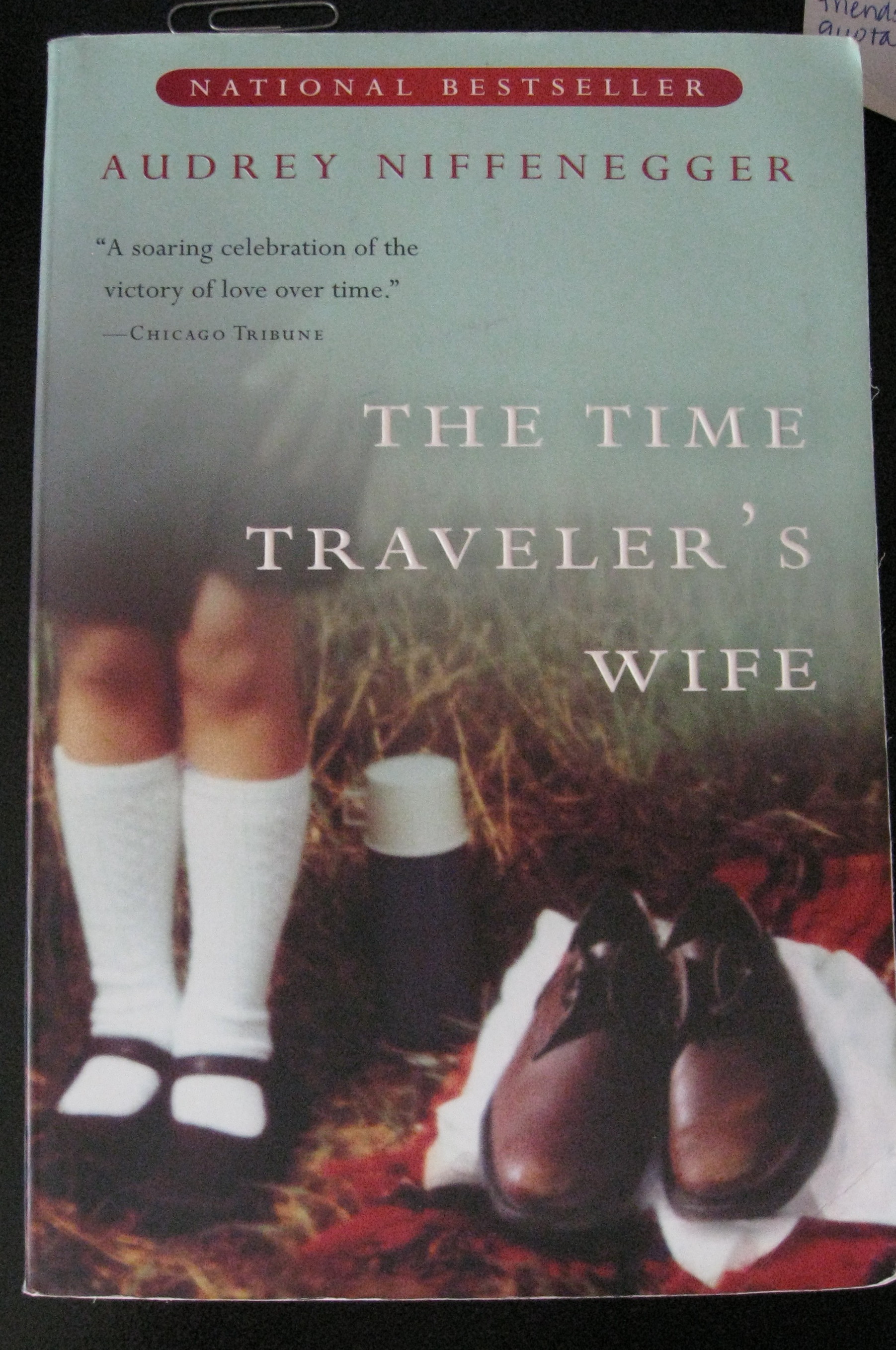
Niffenegger, Audrey. The Time Traveler’s Wife. Orlando: Harcourt: 2003.

This was a reread for me. I first read it on a cruise and it seemed only fitting to reread it on my vacation in California. The first time I read The Time Traveler’s Wife I ached to map out a time line for the story. I wanted to chart Henry’s comings and goings. Reading it a second time was no different.
The Time Traveler’s Wife is the intricate love story of Henry DeTamble and Clare Abshire. Henry is a Chicago librarian who visits the opera, beats people up, and just happens to have a genetic disorder that not only causes him to involuntarily time travel, but gives him the ability to duplicate and visit himself at various stages of his life.
Clare Abshire is an artist and the object of Henry’s affection. Henry’s ability to time travel brings the couple together when young Clare is as young as six years old. As a result, Clare must endure waiting for Henry to time travel back to her. Her wait is made easier by a list of dates of when Henry will return.
While the main story focusses on Henry and Clare’s unusual romance life and world events go on around them. Sex, drugs and rock and roll give way to the aids epidemic and advances in science. Soon doctors are looking for a cure for Henry’s genetic disorder. Because Henry cannot control his time travel he seems to disappear during times of stress or some other great emotion. For example, haunted by the memory of his mother’s tragic death, Henry visits the scene of the accident again and again. Throughout it all, Clare stays by his side as best as she can given the unusual circumstances.

BookLust Twist: In More Book Lust twice. First, in the chapter called “Maiden Voyages” (p 158), and again in the chapter called “Time Travel” (p 221). How appropriate!

Amateur Marriage

Tyler, Anne. The Amateur Marriage: a Novel. New York: Ballantine, 2004.

It’s weird to say I finished this book poolside in Las Vegas, Nevada. Who would have predicted that? Certainly not me.

This is a book I will definitely read again someday. When thinking about this review I wanted to box this story into a corner and call it a sad book, but I couldn’t. It’s such an accurate portrait of how a marriage (and ultimately, a life) can end up that I can’t just call it “sad.” How can I when it’s beautiful, funny, tragic, infuriating, intelligent, frightening and honest all at the same time?
Michael and Pauline are two teenagers whose lives collide at the start of World War II. Their romance is the result of a marriage between a fear of the future and the desire to be someone else at that very instant. Michael wants a girlfriend, any girlfriend. Sensing Pauline’s fascination with the war effort he spontaneously enlists. Pauline wants a soldier for a boyfriend. Any soldier. The culture and uncertainly of the times have thrown these two people together in such a way that neither of them can back out, despite the growing realization they were never meant to be together.
One things leads to another and soon thirty years have gone by. Pauline and Michael divorce and life goes on. And on. While the marriage didn’t survive more than halfway through the novel, Michael and Pauline go on. Their relationship from beginning to end and beyond is captured beautifully.

Favorite quotes: “You know how men are about wearing ties on a Saturday” (p 31).
“I’ve reached the stage where I got so hungry that I’ve gone beyond  hunger” (p 71) …and Kisa didn’t think that was possible!
“Sometimes, Pauline got a feeling like a terrible itch, like a kind of all-over vibration, and she thought that any moment she might jump clear out of her skin” (p 71).

BookLust Twist: From More Book Lust in the chapter “Marriage Blues” (p 161). 

92 in the Shade


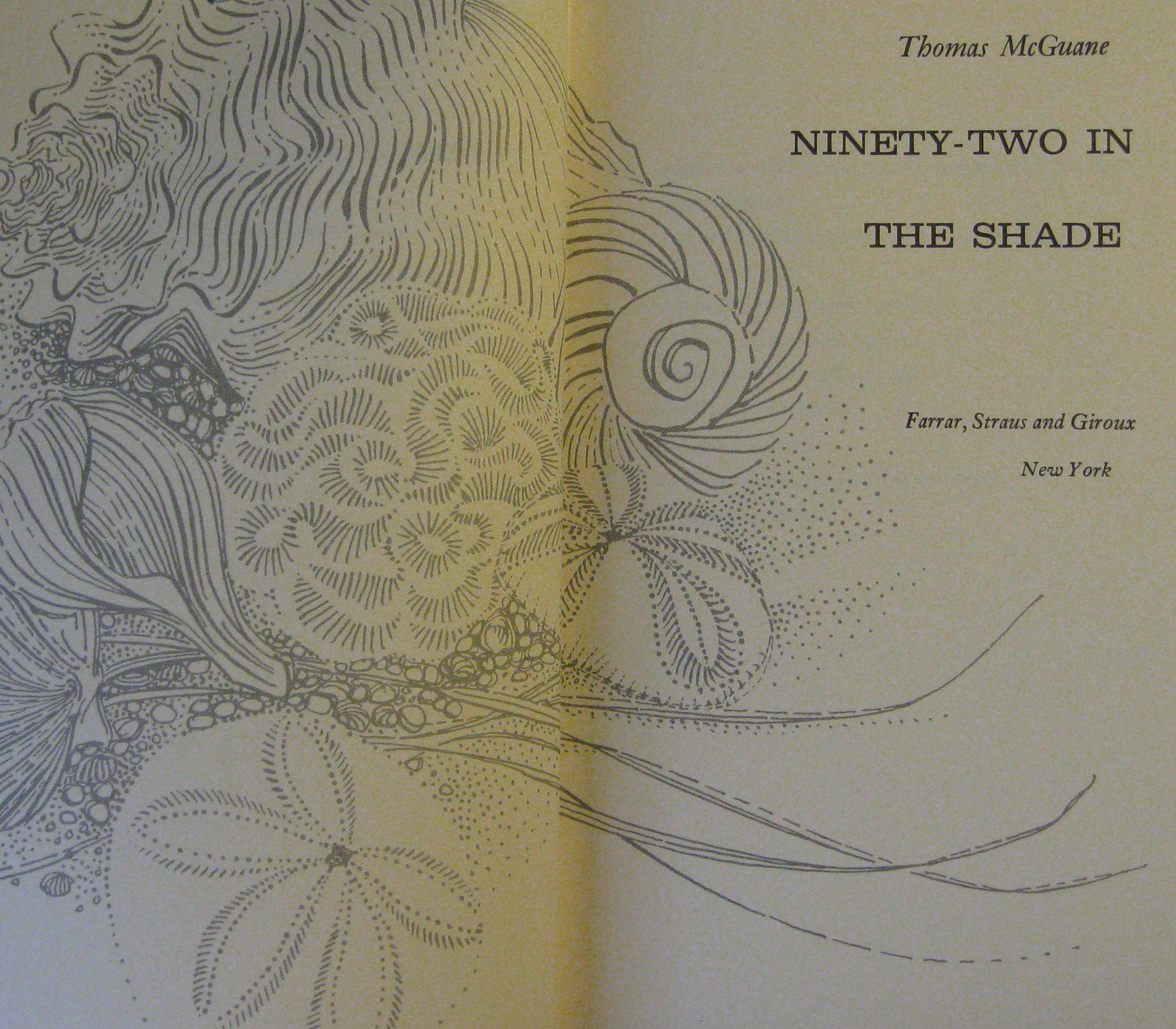
McGuane, Thomas. Ninety-Two in the Shade. New York: Farrar, Straus & Giroux, 1972.

June is fishing month. Go figure. Ninety-Two in the Shade is about a man (Thomas Skelton) who has always wanted to run a guided fishing tour off the Florida Keys. Not the fishing I had pictured for the month of June, but a form of it, I guess. Thomas is new to the business and even newer to competition. He is not without his share of problems. The opening “scene” is Thomas waking up in a hotel and finding four people standing naked in a tub. Right away you know this isn’t your typical River Runs Through It fishing story! Other quirks: violence that does (or doesn’t) happen, relationships that are (or aren’t) good, and the entire book is absent of chapters. I may have come across other books like this but never noticed this chapterlessness before. The only reason why this seems odd is because not having chapters makes it difficult to know where to stop!

I did a little extra research and found out that Ninety-Two in the Shade was made into a movie not long after it was written and while it’s Thomas McGuane’s third work of fiction many critics consider it his best.

I never did get used to McGuane’s “gritty” style of writing, but here are some quotes (and scenes) that caught me: “He walked to Homestead, then right on through town, tripping his brains out in the emptiness of 5 a.m.” (p 4).
A conversation between Skelton and “his girl.” May it confuse you as much as it did me:
Miranda~ “Tom, I had this incredible orgasm.”
Tom~ “Do I have to hear about your organism too?”
M ~ “Just this one. It was like a whole dream of sweet things to eat…Spun sugar, meringue, whipped egg whites…”
T ~ “How about when your chum shot off? Was it a blintz or an omelet?”
M~ “Ask him.”

To say that Ninety-Two in the Shade isn’t without humor would be a lie: “You should never kill somebody if it isn’t funny” ( 34).

BookLust Twist: In both Book Lust and More Book Lust. Book Lust: in the chapter “Montana: In Big Sky Country” (p 156) because Thomas McGuane is from Montana. This, by the way, takes care of a November read because that’s when Montana became a state and Ninety-Two in the Shade was on the November list. More Book Lust: in the chapter “Gone Fishin'” (p 101).

May Was…

A month of allergies. Lilacs. The end of the school year (yay). Dreams coming true. The final Chuck Lelas walk. A new haircut. The serious house hunt. Family time. Natalie Merchant performing with the Boston Pops and ten good books (Nine and a half…).

  • Educating Esme: Diary of a Teacher’s First Year by Esme Raji Codell (National Education Month)
  • Plain Speaking by Merle Miller (Harry Truman’s birthday, Merle Miller’s birthday, on the heels of a book about Roosevelt…it just made sense).
  • True Confessions: a Novel by Mary Bringle (Mothers & Daughters)
  • Dreamland by Kevin Baker (History. I have to admit, tail between my legs, that I didn’t finish this one. Once I found out what the reader doesn’t find out I didn’t want to continue. BooHiss).
  • Ground Beneath Her Feet by Salman Rushdie (Music month)
  • Murder on the Leviathan by Boris Akunin.

Books added to the list because I gave up on Dreamland:

  • Peter Pan by J.M. Barrie (celebrating Barrie’s birthday)
  • The Things They Carried by Tim O’Brien for no ther reason than it was a great book!

For LibraryThing & the Early Review Program~two books!:

  • Best Girlfriends Getaways Worldwide by Marybeth Bond (really, really fun travel guide)
  • Home Girl: Building a Dream House on a Lawless Block by Judith Matloff. Interesting, considering I’m dreaming of houses these days…


Peter Pan

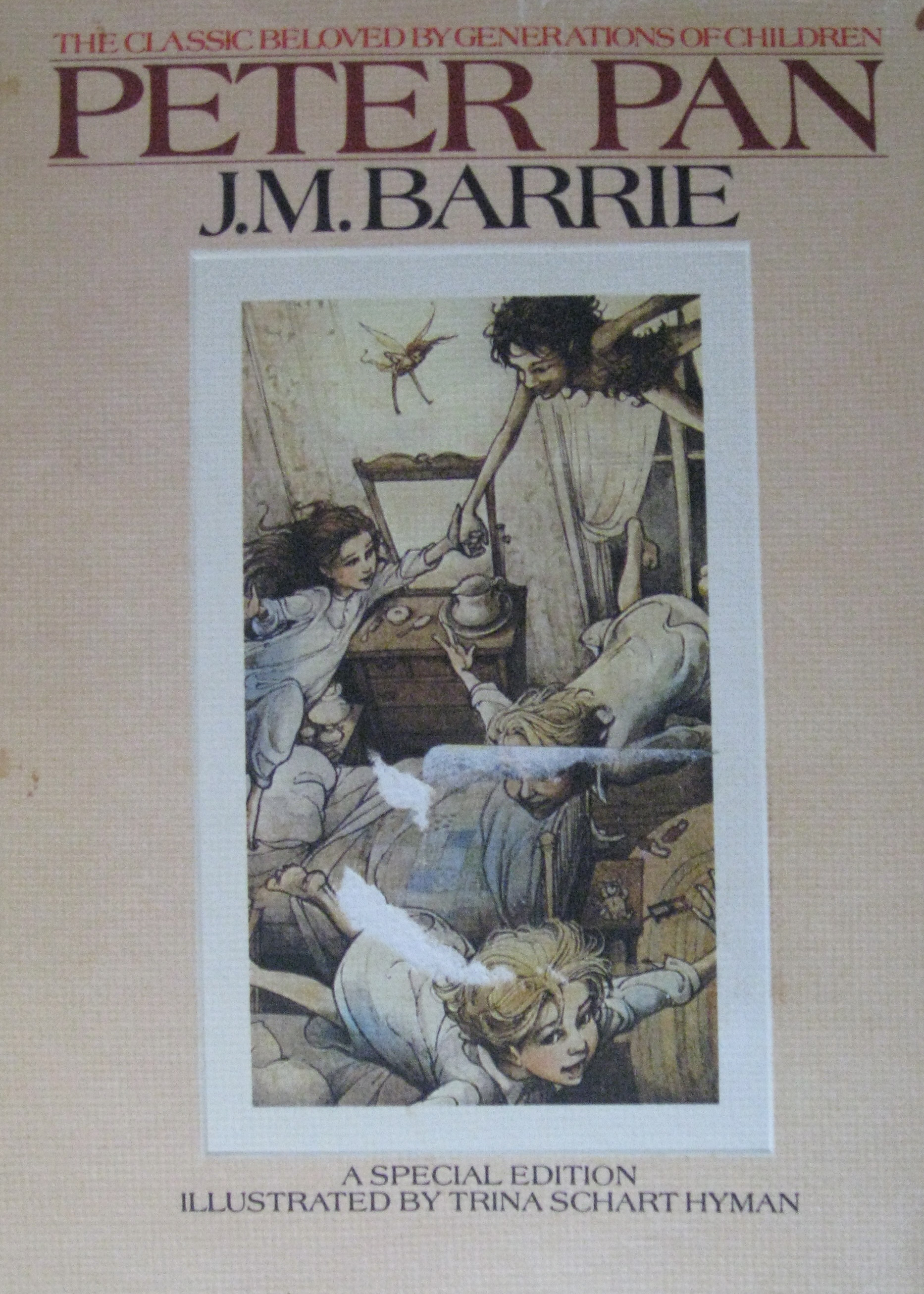
Barrie, J.M. Peter Pan. Toronto: Bantam books, 1980.

Barrie was born in May. I needed a quickie read for the end of the month. Choosing Peter Pan was a no-brainer. The version I chose to read was an illustrated deluxe addition. Full of both color and black and white illustrations: “Special edition illustrated by Trina Schart Hyman.” Really.

Because Peter Pan is such a well loved, well (over?) produced story, everyone knows the basic plot: three kids unhappy with the way their father has treated the family dog run away with an orphan boy to his Neverland (not to be confused with Michael’s Never Land Ranch). Peter and his Lost Boys are looking for a mother and they think they have such a figure in Wendy, one of the Darling children. It’s a magical adventure full of danger in the form of pirates, “redskins” and a ticking crocodile. Even the fairies and mermaids are not to be trusted.

Upon rereading Peter Pan I was surprised by how slow the story moved in certain sections. Because of the glossed-over, dumbed-down, glitzed-up theater/movie/storybook versions that have popped up over the years I had forgotten Barrie’s original 1911 language and long since deleted details. It was hard to picture reading this aloud to a young child. Peter Pan seemed slightly evil (being described as cunning and sly), Tink seemed downright dirty as she responded to her own jealousy over Wendy (gleefully leading Wendy to her death). True to fairy tale form, it does have a happy ending. Sort of.

One of my favorite images from the book that I’ve never forgotten is how Peter describes fairies as being the shattered pieces of a baby’s first laugh, “You see, Wendy, when the first baby laughed for the first time, its laugh broke into a thousand pieces. and they all went skipping about, and that was the beginning of the fairies” (p 29).

BookLust Twist: From More Book Lust in the chapter “Fantasy for Young and Old (p 83). 

Language of the Land

Hopkins, Martha and Michael Buscher. Language of the Land: The Library of Congress Book of Literary Maps. Washington: U.S. Government Printing Office, 1998.

This is a weird choice for the final book of April. I wanted to read something that represented tax time and that dreaded 4/15. Nancy didn’t include a whole lot of books on taxes in either Book Lust or More Book Lust so I decided to lump in government documents and publications as representation…It makes some sense, right?

Anyway, this book is really, really cool. I urge you to take a look at it for yourself. If you have ever seen Manguel’s The Dictionary of Imaginary Places you will get the gist of Language of the Land. I have to admit I’m a sucker for these kinds of things. To say that it is a collection of maps with the basis being about literature doesn’t really explain a whole lot. Here are some better examples (and some of my favorite “maps”): there are several Arthur Conan Doyle maps. One map shows the location of all the fictional places mentioned in the Sherlock Holmes mysteries. Another is the “Sherlock Holmes Mystery Map” (p 207) which allows SH fans to follow the famous detective’s footprints through different stories. Of course, the Odyssey has a few maps depicting the travels of Odysseus. Page 60 has a pictorial map of English literature while on page 70 shows the Beat Generation map. Every state has a map of famous authors. Of course I had to scrutinize Maine to see if they included Monhegan as a place and Stephen King as an author (they did). Then, I had to find the fictional places Robin Hood’s Sherwood Forest and Peter Pan’s Neverland. You would have to be a James Bond fan to know the significance of items in Ian Fleming’s “The Ian Fleming Thriller Map” (p 176) like the centipede in Bond’s glass or the Roman Numeral III tattooed on a blond girl’s arm. Most of the maps are in black and white although a handful are also represented in color. The Literary Map of Latin America (p 162) is beyond cool. So is The Call of The Wild by Jack London map (p 177).

BookLust Twist: From More Book Lust in the chapter “Your Tax Dollars at Work: Good Reading From the Government (Really!)” (p 239). Pearl is serious. Language of the Land is great!

Love Song of J. Alfred Prufrock

Black Cat Red House

Eliot, T.S. “The Love Song of J. Alfred Prufrock.” The Oxford Book of American Poetry. Ed. David Lehman. Oxford: Oxford University Press, 2006. 343.

Who hasn’t read this in high school or at least college at least once? I can remember combing through line after line like primates looking for bugs. We scrutinized each word asking ourselves and each other what it all meant. Half the time we wanted to make stuff up because we just didn’t get it. Even today, there is so much to this poem that I have a hard time sorting it all out. Here are some of the ideas I have (and I would love it if someone could tell me how far off (or on) I really am). Okay, so the first idea is a comparison to Dante’s Inferno, and the whole idea of deciding who you really are. The second idea is a rant about aging, or society, or time, or relationships…or all of the above. I do know that it’s a monologue; someone talking to his or her “me, myself and moi”; or in my world, someone just having a good rant. Any takers on this theory?

Here is my favorite imagery: the cat. Of course. I love, love, love T.S. Eliot’s imagery when he decribes the yellow smoke as a cat, “…rubs its back upon the window-panes…licked its tongue into the corners of the evening…curled once about the house, and fell asleep.” It’s brilliant.

BookLust Twist: From More Book Lust  in the chapter “Poetry Pleasers” (p 188). Are you sick of me saying that yet?

Celestial Music

IMG_1223
Gluck, Louise. “Celestial Music.” The Oxford Book of American Poetry. Ed. by David Lehman. Oxford: Oxford University Press, 2006. 991.

I want to call this ‘Friends Argue then Agree to Disagree.’ For it is about (I think), two people seeing life differently. While they focus on the subject of religion (one believes in God, the other doesn’t), it is a metaphor for how each of them sees life as a whole – living, dying, coping with everything in between. It’s poignant. As the two friends walk they come across a dying catapillar. One friend can hardly stand to watch it fall victim to a swarm of ants while the other can. In the end, they know they are both right. As they should be.

My favorite line, “The love of form is a love of endings.”

BookLust Twist: From More Book Lustin the chapter “Poetry Pleasers” (p 189).

Dulce Et Decorum Est

Owen, Wilfred. “Dulce Et Decorum Est.” The Collected Poems of Wilfred Owen. London: Chatto & Windus, 1964. 55.

I think this has to be one of the most famous poems of all times. It is certainly the most famous poem about World War I that I can think of. It’s imagery is so vivid I often recoil from the words as I try to read them. I only think I can imagine the horror of what the soldiers experienced on the battlefields. I can only pretend to feel the pain of their mental and physical traumas. Wilfred Owen has you standing in the trenches with stench of blood and mud in your nose. He has you hearing the bombs whistle and explode in your ears. He has your eyes tearing as they burn from the green gasses and the death of friends.

Lines that killed me:
“As under a green sea, I saw him drowning”
“His hanging face, like a devil’s sick of sin…”

BookLust Twist: From More Book Lust in the chapter “Poetry Pleasers” (p 188).

Edited to add: Some people prefer their poetry in a more lyrical manner. Check out “The Latin One” (10,000 Maniacs, Hope Chest – 1990) for their interpretation.

Search for Baby Combover

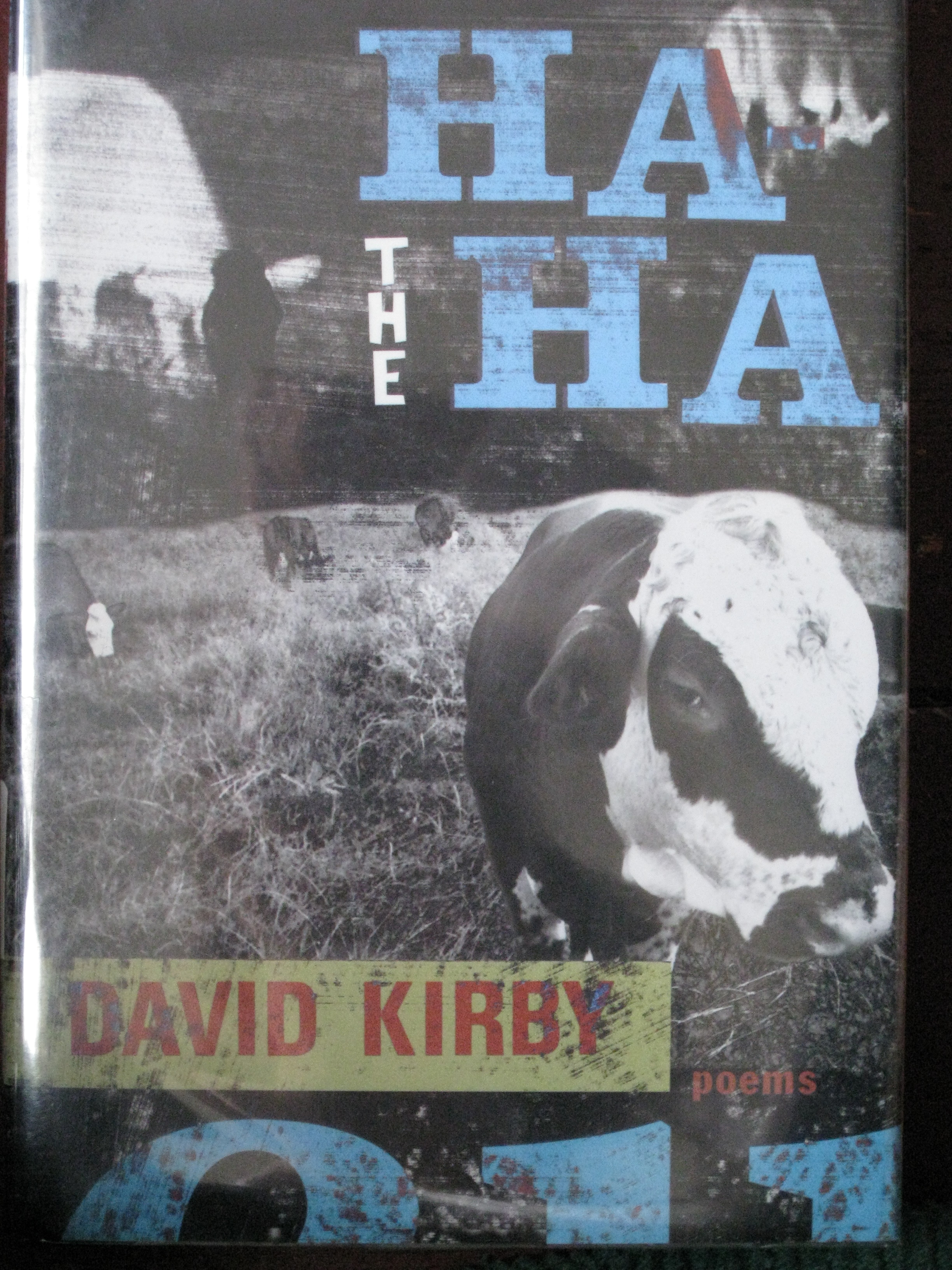
Kirby, David. “The Search for Baby Combover.” The Ha-Ha. Baton Rouge: Louisiana Univeristy Press, 2003. 41.

This is my third (and final) poem from The Ha-Ha that I had to read for the BookLust challenge. Later on, I will read a different book of poetry from David Kirby. But, for now “The Search for Baby Combover” is it. (see yesterday’s post for another Kirby.)
I couldn’t have asked to end Kirby’s collection on a better poem. “Baby Combover” is beyond delightful. It’s not a flowery prosey-prissy kind of thing. Instead, it’s inventive, sarcastic and wildly funny. It’s the story of a man who gets a knock on his door one night. His downstairs neighbor stands before him and proceeds to ask him to please refrain from (whoops wrong story) not move furniture around so late at night…because it wakes the baby. What baby? As far as our man is concerned he’s never seen a baby. Never heard a baby. So, he goes on to think the guy has invented a baby…It’s hysterical.

Here are a few of the best lines (and there are more so you might as well read the whole thing):
“…and I see he’s got something on his head, like strands of oily seaweed, something you’d expect to find on a rock after one of those big tanker spills in the Channel…”
“Baby Combover: the world’s first silent baby.”

BookLust Twist: From More Book Lust in the chapter “Poetry Pleasers” (p 189).

Ha-Ha Part II

David Kirby poetry
Kirby, David. “The Ha-Ha, Part II: I Cry My Heart, Antonio” The Ha-Ha Baton Rouge: Louisiana State University, 2003. 53.

Clever. This poem is so very clever. I like the story within a story concept. Like Shakespeare only a play on words. Here’s the quick and dirty premise: a man is having dinner with a companion. He is loving the meal and makes a comment about it. The comment reminds him of something horrible, so horrible that when his companion asks about his tragic face, he makes up another sad story to compensate for something too horrible to be discuss. The story he makes up becomes his ha-ha, his “structure against chaos”, as Kirby says.

BookLust Twist: From More Book Lust in the chapter “Poetry Pleasers” (p 188).

Elephant of the Sea

elephant of the seaKirby, David. “Elephant of the Sea,” The Ha-Ha.Baton Rouge: Louisiana State University Press, 2003. 46.

Crack me up. This poem is really funny. It’s one of those comments on culture and keeping up with what’s cool. It’s also about language. Words and meanings. A French man wants to buy an automobile just like his American friend’s. Right down to the manatee on the license plate – the “elephant of the sea.” The friend doesn’t get it. He’s imagining what the clerk at the DMV are going to say and how the whole incident will shape her future.
And this is just one poem. Everything David Kirby writes is great. He is like geek rock of poetry. He’s smart and too funny for words.

Favorite line: “‘I can have zuh elephant of the zuh sea on my matriculation?’ to a clerk who’s got this grin on her face like she’s either seeing God or having an aneurysm” (p 46). 

BookLust Twist: From More Book Lustin the chapter “Poetry Pleasers” (p 188). He’s also mentioned in Book Lust in the chapter “Kitchen-Sink Poetry” (p 138).

Musee des Beaux Arts

Auden, W.H. “Musee des Beaux Arts.” The Oxford Book of American Poetry. Oxford: Oxford University Press, 2006. 501.

What do you see when you look at art? Does a painting create question in your mind? W.H. Auden wrote “Musee des Beaux Arts” in response to seeing the painter Brueghel’s Icarus. A ploughman calmly going about his business as a boy falls from the sky. While he had clues to the tragedy (a splash or cry) he does nothing. Auden’s larger observation is about how human response to an event or tragedy can vary; how life goes on beyond that event or tragedy. “Human position” as Auden puts it.

BookLust Twist: From More Book Lust in the chapter “Poetry Pleasers” (p 188).

What He Thought

McHugh, Heather. “What He Thought.” Hinge & Sign: Poems 1968-1993. Middletown: Wesleyan University Press, 1994.

I loved the conversational tone of this poem. I can see them perfectly. Intellects sitting around after dinner discussing what makes poetry poetry. In the beginning there is a snobbishness to the language, an air of I Know Better. Yet at the end there is a hint of mistaken identity which peeks through – an apology, mea culpa, my bad. It’s almost like a weak joke with a killer punchline.
Not to spoil the poem, but here’s the line that got me: “poetry is what he thought, but did not say.” How crazy is that? While this poem is in Hinge & Sign you can also read “What He Thought” on Heather’s humorous site.

BookLust Twist: From More Book Lust in the chapter called “Poetry Pleasers” (p187).