
May Was…

A month of allergies. Lilacs. The end of the school year (yay). Dreams coming true. The final Chuck Lelas walk. A new haircut. The serious house hunt. Family time. Natalie Merchant performing with the Boston Pops and ten good books (Nine and a half…).

  • Educating Esme: Diary of a Teacher’s First Year by Esme Raji Codell (National Education Month)
  • Plain Speaking by Merle Miller (Harry Truman’s birthday, Merle Miller’s birthday, on the heels of a book about Roosevelt…it just made sense).
  • True Confessions: a Novel by Mary Bringle (Mothers & Daughters)
  • Dreamland by Kevin Baker (History. I have to admit, tail between my legs, that I didn’t finish this one. Once I found out what the reader doesn’t find out I didn’t want to continue. BooHiss).
  • Ground Beneath Her Feet by Salman Rushdie (Music month)
  • Murder on the Leviathan by Boris Akunin.

Books added to the list because I gave up on Dreamland:

  • Peter Pan by J.M. Barrie (celebrating Barrie’s birthday)
  • The Things They Carried by Tim O’Brien for no ther reason than it was a great book!

For LibraryThing & the Early Review Program~two books!:

  • Best Girlfriends Getaways Worldwide by Marybeth Bond (really, really fun travel guide)
  • Home Girl: Building a Dream House on a Lawless Block by Judith Matloff. Interesting, considering I’m dreaming of houses these days…
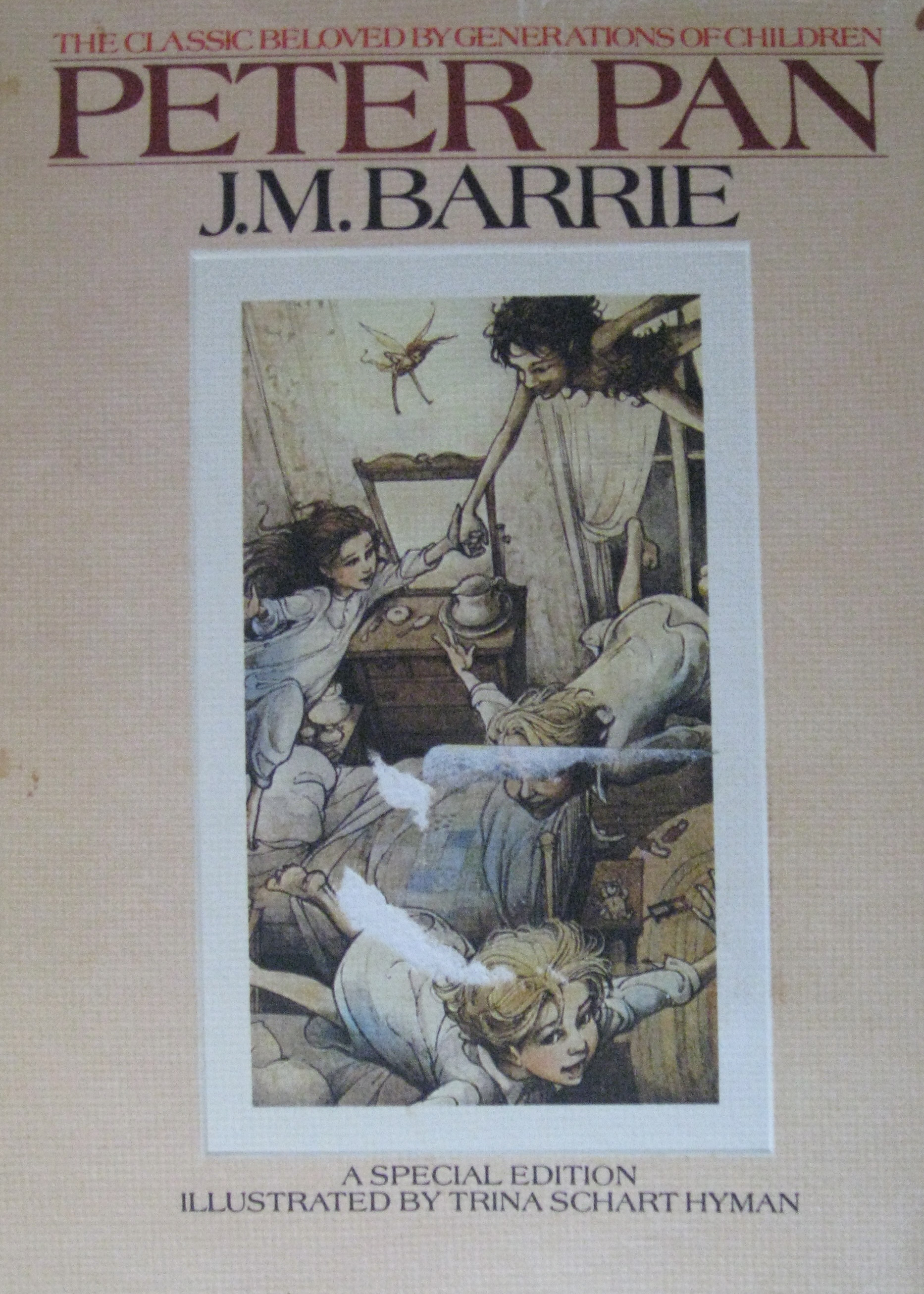


Peter Pan

Barrie, J.M. Peter Pan. Toronto: Bantam books, 1980.

Barrie was born in May. I needed a quickie read for the end of the month. Choosing Peter Pan was a no-brainer. The version I chose to read was an illustrated deluxe addition. Full of both color and black and white illustrations: “Special edition illustrated by Trina Schart Hyman.” Really.

Because Peter Pan is such a well loved, well (over?) produced story, everyone knows the basic plot: three kids unhappy with the way their father has treated the family dog run away with an orphan boy to his Neverland (not to be confused with Michael’s Never Land Ranch). Peter and his Lost Boys are looking for a mother and they think they have such a figure in Wendy, one of the Darling children. It’s a magical adventure full of danger in the form of pirates, “redskins” and a ticking crocodile. Even the fairies and mermaids are not to be trusted.

Upon rereading Peter Pan I was surprised by how slow the story moved in certain sections. Because of the glossed-over, dumbed-down, glitzed-up theater/movie/storybook versions that have popped up over the years I had forgotten Barrie’s original 1911 language and long since deleted details. It was hard to picture reading this aloud to a young child. Peter Pan seemed slightly evil (being described as cunning and sly), Tink seemed downright dirty as she responded to her own jealousy over Wendy (gleefully leading Wendy to her death). True to fairy tale form, it does have a happy ending. Sort of.

One of my favorite images from the book that I’ve never forgotten is how Peter describes fairies as being the shattered pieces of a baby’s first laugh, “You see, Wendy, when the first baby laughed for the first time, its laugh broke into a thousand pieces. and they all went skipping about, and that was the beginning of the fairies” (p 29).

BookLust Twist: From More Book Lust in the chapter “Fantasy for Young and Old (p 83). 

Ground Beneath Her Feet

IMG_1374
Rushdie, Salman. The Ground Beneath Her Feet. New York: Henry Holt & Co., 1999.

May was deemed National Music Month by someone out there so, in honor of that tidbit I chose The Ground Beneath Her Feet as my “music book.” This was my first time reading Salman Rushdie & I have to confess, if all his other books are so lengthy and detail driven, I am going to have a hard time getting through them. This one was a whopping 575 pages long and and and! I knew the ending in the first chapter!

The Ground Beneath Her Feet is an epic rock and roll love story. Spanning several lifetimes Rushdie tells the love story of Ormus and Vina, two musicians from Bombay. Their story is like a gigantic flood, catching up and describing in detail: cultures, mythologies, histories, industries (agriculture (goats!), music and beyond), the landscapes of India, England and America, their societies, religions, ancestries of families, personalities, births, deaths, emotions, tragedies, triumphs, anything and everything from  the mid 1950s until the early 1990s.  This is a sweeping story that cannot be pigeon-holed into a romance, mystery, or comedy. It is all these things and thensome. Suicides and secrets, miscarriages and murders, wealth and poverty, sane and strange, greedy and generous, brothers and sisters, twins and torture, and of course, sex, drugs and rock and roll.

My favorite quotes circled and scrutinized love:
“In love one advances by retreating” (p 15).
“when it comes to love there’s no telling what people will convince themselves of” (p 30).
“But as the years passed we became each other’s bad habit” (215).

And one quote about my fave, the drums: “It is as if the drums have been yearning to speak to him, and he to them. Finally, he thinks: at long last, here are friends” (p 287).

BookLust Twist: From Book Lust in the chapter “Music and Musicians” (p 164).


Murder on the Leviathan

Murder on the LeviathanAkunin, Boris. Murder on the Leviathan. New York: Random House, 2004.

Oddly enough, I chose this book because it was written by an author who spent a great deal of time in Moscow and a guide book advised me that now was the best time to visit Russia. There was no other reason to read this at this particular time. But, having said that, I’m glad that I did. It was fun.
Murder on the Leviathan starts out violently, a record of an examination of a crime scene set in 1878. I think the murders of ten people ranging from ages 6 to 54 in one Parisian house would cause a stir even in the 21st century. Oddly enough, this is not the murder the title of the book refers to. Commissioner Gauche discovers a clue that leads him to the Leviathan, a giant steamship headed for Calcutta. As he sets sail with a host of interesting passengers (in first class) he soons discovers each and every one of them is a potential suspect. It gets interesting when people start dying on the ship. A Russian detective soon joins Gauche on the hunt for the killer.

I didn’t find any quotes to include, but I did have to look up “gutta-percha” shoes. Depending on who you ask, gutta percha is described as tree gum, rubber, or plastic.

BookLust Twist: In More Book Lust in the chapter “Crime is a Globetrotter”, subsection, “Russia” (p 59).

Dreamland

DreamlandBaker, Kevin. Dreamland. New York: Harper Collins, 1999.

It makes sense that a historian like Kevin Baker would write something as epic and sweeping as Dreamland. It is a beautifully blended tale of fiction and reality. Events like the Triangle Shirtwaist fire and people like Sigmund Freud and politics like Tammany Hall exist in harmony with fictional Coney Island gangsters and seedy carnival performers. It’s a world of underground rat fights, prostitution, gambling, and the sheer violent will to survive. It’s dirty and tragic. A love story hidden behind the grime, the colorful lights, the tricks, and the chaotic noise of New York.
Favorite lines that moved me: “That is always the thing with depravity: just when you think you’ve plumbed the very depths, there is always someplece lower to fall” (p 26).
“I sat behind the left ear of Satan, and watched the sun come up over Sheepshead Bay, and dreamed of an empire of little men and little women, ruled by a mad queen” (p 34).

BookLust Twist: From Book Lust in the chapter “American History: Fiction” (p 21). I think Pearl’s description says it all, ” Dreamlandvividly describes the lives of poor immigrants families on the Lower East Side of New York City, circa 1910, who find their lives somewhat more bearable by the promise of excitement of Coney Island” (p 21).

True Confessions

True Confessions
Bringle, Mary. True Confessions. New York: Donald I. Fine, 1996.

This sounds like it would be the title of a very juicy blog. Something I haven’t already spilled in some sordid way or another. Unfortunately, it’s only the latest challenge book for Book Lust. I read this in honor of Mother’s Day and I have to admit it was a strange choice. The inside book cover describes True Confessions (in part) as “…a mother who loves her to death and an ex-mother in-law who doesn’t approve…” So, yes, mothers are part of the story, but you never really meet either mother. As a result I didn’t get that loved to death feeling from mom, nor the disapprovefrom the ex-mother in-law.
But here’s the story in a nutshell: Grace teaches writing in New York, lies to her mother about her location (mom thinks she’s in England), struggles with relationships and fantasizes about being a story in a magazine she is obsessed with called – you guessed it – True Confessions. Grace doesn’t have direction. In the beginning she seems shallow and self-absorbed. Of course there is a period of growth through odd incidents such as her friend’s affair revealed on television, a kidnapping, and even a death. When it is all said and done, Grace emerges a stronger, wiser person.
Critics describe the book as funny, but I have to admit the first laugh-out-loud moment I had was when Grace is in Central Park with her friend Naomi. Naomi has two children, but acts like she wasn’t meant for motherhood: “Grace always felt grateful to Naomi for refusing to submit to the role which it would have been so natural for her to assume” (p 68). On describing her daughter Alice, Naomi says, “Sometimes I think we have her on loan, like a library book…sometimes…it’s not even a book I want to finish” (p 68). There is more. Naomi rants about trying to keep kids away from television. “…unless you want them to be social pariahs they’ll be contaminated sooner or later” (p 69.
Another favorite line: “lunacy is quite impartial. Warps in the genes, screwy endocrines – they don’t count” (p72).

BookLust Twist: From Book Lust in the chapter “Mothers and Daughters” (p 160).

Red Badge of Courage

Red Badge of CourageCrane, Stephen. Red Badge of Courage. New York: Signet, 1960.
I have heard complaints about Red Badge (language is archaic, plot is meaningless, etc) and while all those points are valid, they don’t take away from the fact that for a person who never saw a day of combat in life Crane does an excellent job portraying a young soldier in battle. I would imagine that anyone facing death would wrestle with the choice to be brave (“heroic” or “patriotic”) or be a coward. To stay and fight or take flight…especially after encountering death up close.
To say that Red Badge of Courage is about a young man in combat during the Civil War sells the story short. Henry is a young man facing many things for the first time in his life and throughout battle he struggles with all of it. It’s a historical snapshot of the psychology of war. It goes beyond whether Henry can be brave or not. Whether he is a true soldier or not.

I haven’t read Red Badge of Courage since high school but the one scene that has always stuck in my mind is when Henry comes across the dead soldier in the woods. I will always picture the blue uniform faded to a shade of green and the ants. The ants crawling on the dead man’s lip. It’s a powerful scene. The other moment I always remember is when Henry longs to be one of the wounded so that he may have his “red badge of courage” too.

BookLust Twist: From Book Lust in the “Civil War Fiction” chapter (p 57).

Language of the Land

Hopkins, Martha and Michael Buscher. Language of the Land: The Library of Congress Book of Literary Maps. Washington: U.S. Government Printing Office, 1998.

This is a weird choice for the final book of April. I wanted to read something that represented tax time and that dreaded 4/15. Nancy didn’t include a whole lot of books on taxes in either Book Lust or More Book Lust so I decided to lump in government documents and publications as representation…It makes some sense, right?

Anyway, this book is really, really cool. I urge you to take a look at it for yourself. If you have ever seen Manguel’s The Dictionary of Imaginary Places you will get the gist of Language of the Land. I have to admit I’m a sucker for these kinds of things. To say that it is a collection of maps with the basis being about literature doesn’t really explain a whole lot. Here are some better examples (and some of my favorite “maps”): there are several Arthur Conan Doyle maps. One map shows the location of all the fictional places mentioned in the Sherlock Holmes mysteries. Another is the “Sherlock Holmes Mystery Map” (p 207) which allows SH fans to follow the famous detective’s footprints through different stories. Of course, the Odyssey has a few maps depicting the travels of Odysseus. Page 60 has a pictorial map of English literature while on page 70 shows the Beat Generation map. Every state has a map of famous authors. Of course I had to scrutinize Maine to see if they included Monhegan as a place and Stephen King as an author (they did). Then, I had to find the fictional places Robin Hood’s Sherwood Forest and Peter Pan’s Neverland. You would have to be a James Bond fan to know the significance of items in Ian Fleming’s “The Ian Fleming Thriller Map” (p 176) like the centipede in Bond’s glass or the Roman Numeral III tattooed on a blond girl’s arm. Most of the maps are in black and white although a handful are also represented in color. The Literary Map of Latin America (p 162) is beyond cool. So is The Call of The Wild by Jack London map (p 177).

BookLust Twist: From More Book Lust in the chapter “Your Tax Dollars at Work: Good Reading From the Government (Really!)” (p 239). Pearl is serious. Language of the Land is great!

Love Song of J. Alfred Prufrock

Black Cat Red House

Eliot, T.S. “The Love Song of J. Alfred Prufrock.” The Oxford Book of American Poetry. Ed. David Lehman. Oxford: Oxford University Press, 2006. 343.

Who hasn’t read this in high school or at least college at least once? I can remember combing through line after line like primates looking for bugs. We scrutinized each word asking ourselves and each other what it all meant. Half the time we wanted to make stuff up because we just didn’t get it. Even today, there is so much to this poem that I have a hard time sorting it all out. Here are some of the ideas I have (and I would love it if someone could tell me how far off (or on) I really am). Okay, so the first idea is a comparison to Dante’s Inferno, and the whole idea of deciding who you really are. The second idea is a rant about aging, or society, or time, or relationships…or all of the above. I do know that it’s a monologue; someone talking to his or her “me, myself and moi”; or in my world, someone just having a good rant. Any takers on this theory?

Here is my favorite imagery: the cat. Of course. I love, love, love T.S. Eliot’s imagery when he decribes the yellow smoke as a cat, “…rubs its back upon the window-panes…licked its tongue into the corners of the evening…curled once about the house, and fell asleep.” It’s brilliant.

BookLust Twist: From More Book Lust  in the chapter “Poetry Pleasers” (p 188). Are you sick of me saying that yet?

Search for Baby Combover

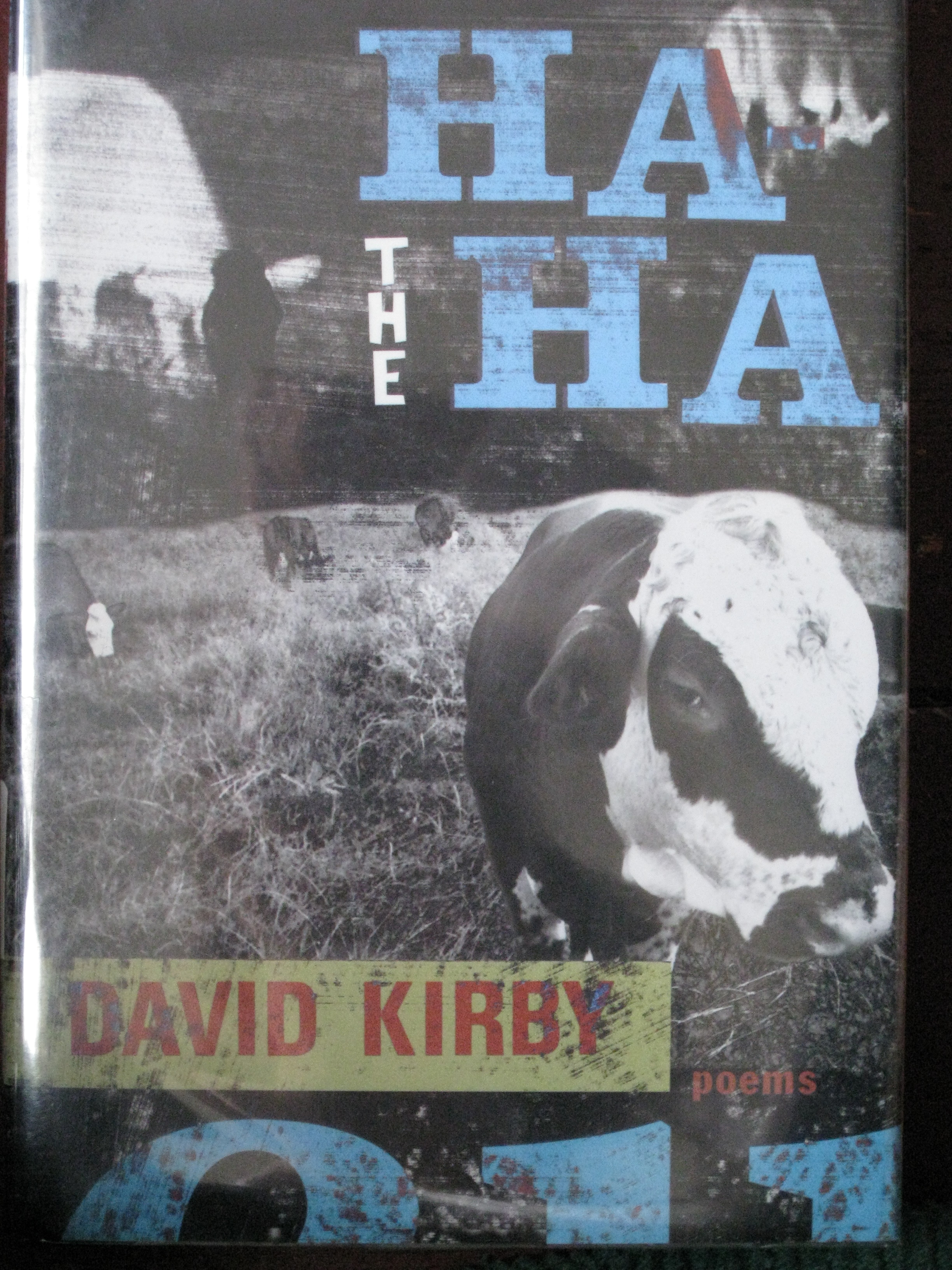
Kirby, David. “The Search for Baby Combover.” The Ha-Ha. Baton Rouge: Louisiana Univeristy Press, 2003. 41.

This is my third (and final) poem from The Ha-Ha that I had to read for the BookLust challenge. Later on, I will read a different book of poetry from David Kirby. But, for now “The Search for Baby Combover” is it. (see yesterday’s post for another Kirby.)
I couldn’t have asked to end Kirby’s collection on a better poem. “Baby Combover” is beyond delightful. It’s not a flowery prosey-prissy kind of thing. Instead, it’s inventive, sarcastic and wildly funny. It’s the story of a man who gets a knock on his door one night. His downstairs neighbor stands before him and proceeds to ask him to please refrain from (whoops wrong story) not move furniture around so late at night…because it wakes the baby. What baby? As far as our man is concerned he’s never seen a baby. Never heard a baby. So, he goes on to think the guy has invented a baby…It’s hysterical.

Here are a few of the best lines (and there are more so you might as well read the whole thing):
“…and I see he’s got something on his head, like strands of oily seaweed, something you’d expect to find on a rock after one of those big tanker spills in the Channel…”
“Baby Combover: the world’s first silent baby.”

BookLust Twist: From More Book Lust in the chapter “Poetry Pleasers” (p 189).

Ha-Ha Part II

David Kirby poetry
Kirby, David. “The Ha-Ha, Part II: I Cry My Heart, Antonio” The Ha-Ha Baton Rouge: Louisiana State University, 2003. 53.

Clever. This poem is so very clever. I like the story within a story concept. Like Shakespeare only a play on words. Here’s the quick and dirty premise: a man is having dinner with a companion. He is loving the meal and makes a comment about it. The comment reminds him of something horrible, so horrible that when his companion asks about his tragic face, he makes up another sad story to compensate for something too horrible to be discuss. The story he makes up becomes his ha-ha, his “structure against chaos”, as Kirby says.

BookLust Twist: From More Book Lust in the chapter “Poetry Pleasers” (p 188).

Musee des Beaux Arts

Auden, W.H. “Musee des Beaux Arts.” The Oxford Book of American Poetry. Oxford: Oxford University Press, 2006. 501.

What do you see when you look at art? Does a painting create question in your mind? W.H. Auden wrote “Musee des Beaux Arts” in response to seeing the painter Brueghel’s Icarus. A ploughman calmly going about his business as a boy falls from the sky. While he had clues to the tragedy (a splash or cry) he does nothing. Auden’s larger observation is about how human response to an event or tragedy can vary; how life goes on beyond that event or tragedy. “Human position” as Auden puts it.

BookLust Twist: From More Book Lust in the chapter “Poetry Pleasers” (p 188).

Case for Three Detectives

Case for Three Detectives
Bruce, Leo. Case For Three Detectives. Chicago: Academy Chicago, 1936.

First things first: Leo Bruce is actually a pseudonym for Rupert Croft-Cooke. Just had to get that out there. Second, I have to say how disappointed I am to not be up on my mysteries – or at least the detectives of pop culture! Nancy Pearl compares the three detectives in Case for Three Detectives with Peter Wimsley, Father Brown, and Hercule Peirot. I have only vaguely heard of Peirot so I had no idea what she was talking about! My loss, I guess.
Maybe it’s a generational thing (because this book was written over 70 years ago). Maybe it’s a cultural thing (because this book is decidedly British). Either way, I wasn’t able to get over the fact that, despite a murder (a woman’s throat was slashed), not only were people capable of carrying on as if nothing happened (washing cars and entertaining), but the guests were included to help solve the mystery. Now, I have to keep in mind in those days guests stayed overnight and became “house guests” and dinner parties consisted of four or five house guests, each with his or her own room. 
Pearl included this in her “humor” section but warned I probably wouldn’t laugh outloud, and she’s right. I didn’t. It’s the mystery of three off the wall detectives trying to solve a murder. Each comes up with a completely different yet plausible scenerio for what could have happened. You find yourself saying, “but, of course!” until you hear the final Who Really Did It story. 
A line that made me smile: “‘If you mean spiders,’ he said, ‘I know only two things about them. And those are the things which everyone knows. They kill flies. And they hang on threads.'” (p53).

BookLust Twist: From More Book Lust in the chapter “Tickle Your Funny Bone” (p 218).

Gain

GainPowers, Richard. Gain.New York: Farrar, Straus & Giroux, 1998.
LibraryThing review (with a few edits): Gain reminds me of a fictional A Civil Action. Big company being implicated in a cancer case. Except it’s more complicated than that. In trying to describe Gain to my husband, here’s what I said, “There are two stories being told. In the here and now is Laura, real estate agent, mother of two, divorced, just found out she has cancer. Simultaneously, there is the historical story of these soap making brothers who create a chemical conglomerate. The historical story is like a train from the past rushing towards the future, each chapter brings the giant closer to Laura’s story until they collide disastrously. You switch back and forth between Laura (now) and the brothers (from the past)” My husband just cocked his head and replied, “huh.” Okay, so he didn’t get it. In truth, the historical side is more complicated, scientifically written; the voice more impersonal & dry. It should be because it’s recounting the rise of a company from its roots including the advances in science and the strategies of marketing, whereas Laura’s part of the story is more intimate, emotional, warm and telling.

Favorite lines: “They throw silence back and forth at each other until the gyny surgeon comes in” (p 74).
“Avoid meat and fat. Don’t smoke or drink. Limit the time you spend in the sun. Don’t expose yourself to toxic chemicals at home or at work. Do not indulge in multiple sexual partners. And send twenty-five dollars” (p 283). This last one cracked me up because Laura has just gotten a solicitation from a cancer charity looking for money. At first she thinks she’s being targeted as someone who would be more sympathetic because she has cancer. The above is her reaction to the mailing.
But, probably my favorite – favorite part isn’t a line I can quote but a whole section. Laura goes to the library and learns the value of research…from a librarian.

BookLust Twist: Gain is actually in More Book Lust twice. Once for the reason why I’m reading it in April: it’s included in the “Ecofiction” chapter (p 78), and again in “Richard Powers: Too Good To Miss” (p 192).

The End and the Beginning

Wislawa Szymborska poetry

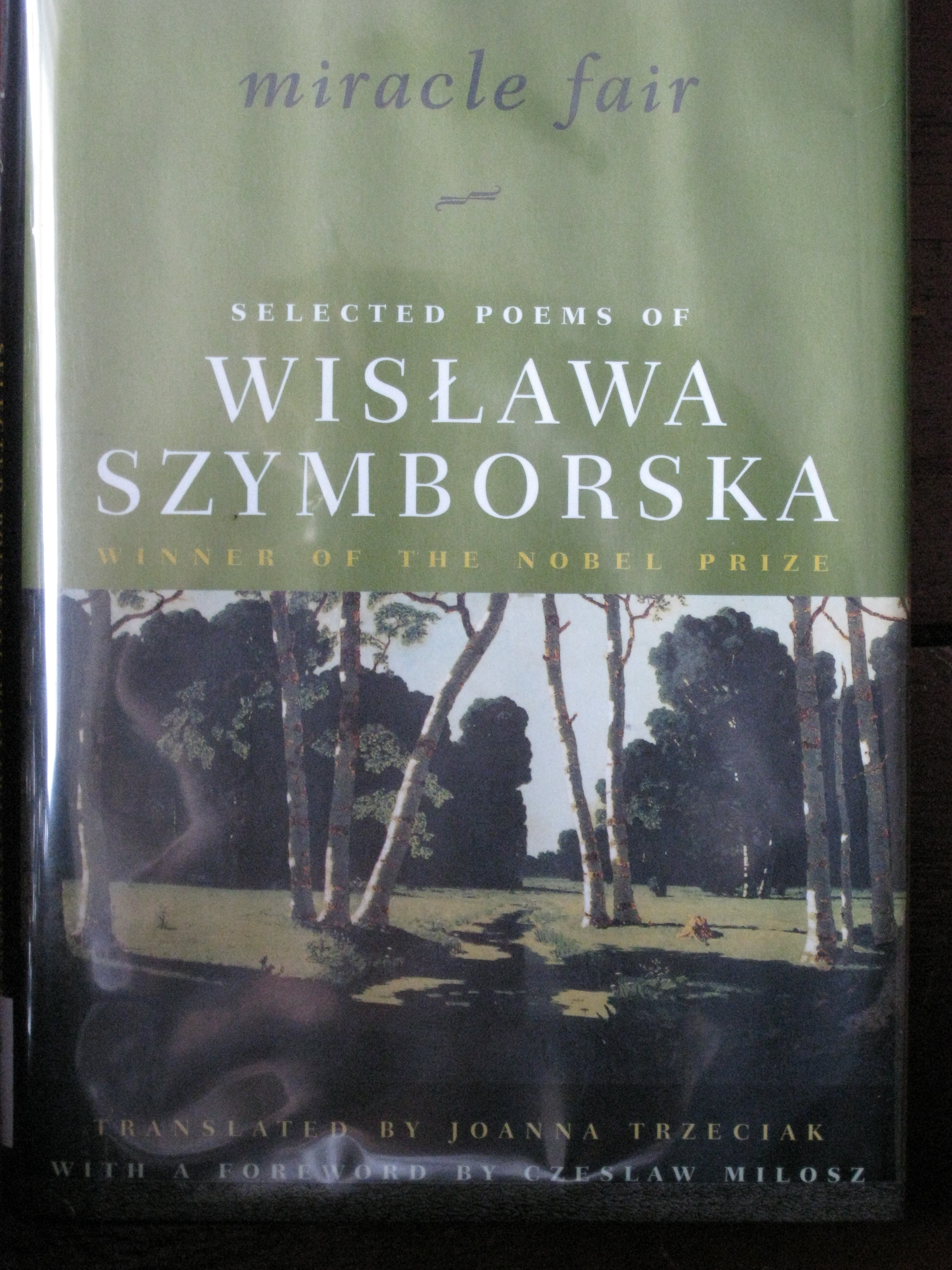
Szymborska, Wislawa. “The End and the Beginning.” Miracle Fair: Selected Poems of Wislawa Szymborska. New York: W.W. Norton, 2001.

This poem is so vivid that I pictured it as the scene behind the credits at the end of a war movie. Stay with me. Hear me out. In the poem, Szymborska gently, methodically runs through the list of what must be done at the end of a war: clean up debris, repair houses, rebuild bridges, carry on. Stay strong. So, imagine the credits rolling. The movie has ended, the war is over. Behind the steady stream of names, cast and crew, people survivors are shell shocked and sweeping, weeping and washing, hungry and hammering, biting their lips to continue life as best as they can; as they know how. Somehow, I see this as a stark black and white. More dramatic (or depressing) that way.
My favorite line: “From time to time someone must still dig up a rusted argument from underneath a bush and haul it to the garbage dump.” What does that mean? Maybe two someones can’t decide who really “won” the war. Maybe someone else is adament it rages still…just somewhere else. Arguments that have weathered and rusted from constant exposure.

BookLust Twist: From More Book Lust and the chapter “Poetry Pleasers” (p189).