Age of Grief

Smiley, Jane. The Age of Grief. New York: Fawcett Columbine, 1987.

A collection of short stories. Instead of summarizing them I have decided to quote my favorite lines instead because there was one from every story.

  • Pleasure of her company~ “I felt like your child or your sister or something”    (p 25).
  • Lily~ “Love was like an activity, you had to put in the hours” (p 33).
  • Jeffrey, Believe Me~ “Who can tell the lifelong effect of a cacophonous conception” (p 60), and “you would indeed be spending the night but in a near coma” (p 64).
  • Long Distance~ “Can a melancholy sound have a quality of desperation?” (p 71)
  • Dynamite~ “When they would ask me, I was fine, too, but I had the excuse of making bombs, something, I told myself, they didn’t want to know (p 96).
  • And finally, the novella, The Age of Grief~ I couldn’t find one or two quotesI liked best -too many to mention so I won’t mention at all; and I can’t tell you what I think of this final story. A dentist and his wife (also a dentist) go through the ups and downs of marriage & parenting. It’s haunting because I can’t imagine this kind of grief.

BookLust Twist: From More Book Lust in the chapter “Big Ten Country: The Literary Midwest (Iowa)” (p 26).

The Body is Water

Schumacher, Julie. The Body is Water. New York: SoHo, 1995.

I love it when reading fits the day. I don’t know how to describe it other than the perfect marriage between a book and time. It was snowing, sleeting, windy and freezing cold. Every so often a gust of wind would send pellets of freezing rain drumming against the windows, yet the Christmas tree glowed softly, the cat purred at my feet, a balsam candle burned bright, a fleece blanket was thrown over my lap, a cup of tea at my elbow and I was content. If I could ignore the wind, all was quiet, all was still; the perfect time to lose myself in The Body is Water.
I’m still reading December picks and The Body is Water celebrates the month New Jersey became a state, oddly enough. It’s also the story of single and pregnant Jane, and her return to her New Jersey shore childhood home. In one sitting I read 184 of the 262 pages.

“All my life I’ve never been certain of where I should be” (p 20).
“In a crisis, other families probably rush to hold the ailing person’s hand; our family rushes to the general vicinity of the crisis and putters around, hoping the patient will spontaneously recover on her own” (p 61).
“No matter where I lived, I never knew my way around; there was no ocean, no rushing noise of a heartbeat from the east” (p 230).
“I start to cry, remembering the days before my mother died, before Bee slept in another room. That was when we loved each other best and didn’t know it” (p 262).

I ended this book sobbing. I connected with Jane even though she was the younger sister (Bee was four years older); even though Jane lost a mother and I lost a father; even though she became a mother and I remain sans motherhood. I connected through the simple loss of a parent, the soothing sound of the ocean, and the complex closeness of sisters.

BookLust Twist: From More Book Lustin the chapter called “Jersey Guys and Gals” (p 129). This also could have been mentioned in chapter called “Maiden Voyages” (p 158) because this was Schmacher’s first novel.

Little Porcupine’s Christmas

Slate, Joseph. Little Porcupine’s Christmas. New York: Harper, 1982.

Cute. Cute. Cute! Felicia Bond illustrates this story and, for those of you who don’t know, Felicia Bond is the illustrator for another favorite of mine, If You Give a Mouse a Cookie. This isn’t about a mouse. This time it’s a porcupine who can’t be in the school play because of his sharp and pointy quills. It’s a typical story about how cruel “kids” can be towards an outsider, But, but, but, in the end Little Pocupine prevails and proves his worth. The adult in me hates stories like this because the other animals are never corrected when they say “you’re too — to participate. You don’t belong,” all because he is different. I worry (too much) that kids reading the story will learn that it’s okay to push someone outside the popular circle because that someone is different. I’ve been there and it isn’t fun. But, that’s the stoic, always serious adult talking. Take the book at face value and it’s a cute story about someone who is unique finding his niche and belonging after all.
Note: This story is also called How Little Porcupine Played Christmas.

BookLust Twist: From Book Lust in the chapter “Christmas Books for the Whole Family to Read” (p 56). Pearl calls Little Porcupine “heartwarming.”

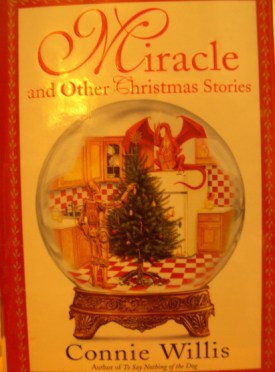
Miracle

Willis, Connie. Miracle and Other Christmas Stories. New York: Bantam, 2000.

A collection of short stories centered around Christmas.
image0001.jpg

  • Miracle ~ Lauren reminds me of me. She’s well-meaning yet corner cutting when it comes to Christmas. Her cards go out on time and she buys gifts for everyone in the office yet something is missing. Enter Spirit of Christmas Present, a environmentally exuberant specter sent to show Lauren the real meaning of Christmas.
  • Inn ~This is an odd little story about a woman who, while in choir practice for her church pageant, discovers a homeless couple who turn out to be Joseph and Mary. That Joseph and Mary, lost on their way to Bethlehem.
  • In Coppelius’s Toyshop ~ This is one of my favorites. It’s so reminiscent of Will from About a Boy lost in a crazy, confusing, chaotic toystore. Throughout the whole thing I could imagine rows and rows and floors and floors of toys, games, puzzles, colors, lights, noises, and the sounds of children everywhere.
  • Pony~ Moral of the story: it is never too late to get the ultimate present of your dreams…even if you no longer want it.
  • Adaptation ~ An interesting twist on A Christmas Carol. A divorced father wants nothing more than to give his daughter the ultimate Christmas but work and his exwife have other plans.
  • Cat’s Paw ~ A famous detective has been sent to solve a mystery on Christmas Eve. A weird tale involving monkeys and murder. “We are all capable of murder. It’s in our genes” (p 208).
  • Newsletter ~ Has the world been taking over by a parasite that causes goodness and peace of earth? How can we take humanity that’s just a little more…well…human? Turns out, we can’t.
  • Epiphany ~ Another twist on a classic tale. Mel is convinced he has had an epiphany about the Second Coming. He gets a friend and a stranger involved in his travels and suddenly they are the three wise “men.” It’s funny.
  • A Final Word~
  • BookLust Twist: From Book Lust  in the chapter “Connie Willis: Too Good To Miss” (p 248).

    Boy’s Life

    McCammon, Robert. Boy’s Life. New York: Pocket Star, 1991.

    I would almost venture to say there is almost too much adventure in this book. More stuff happens to CoreyMackenson in his life, in his boyhood life, than I can begin to explain. There is magic and imagination on nearly every page. Corey is an all-around good kid but that doesn’t mean he doesn’t have his share of trouble at school, confrontations with bullies and disagreements with his parents. All normal stuff until you add the mystery of a dead man, the mob, a dog that won’t die, a eye-blinking bike, a run-in with Nazis, kidnapping, a prostitute, the klu klux klan, several monsters and more mayhem. 

    I love a book that has almost every page flagged for a good line; a line I wish I had written, or one that made me think. Here are a few of my favorite lines from early in Boy’s Life:
    “You realize that every person in the world is a compromise of nature” (p 9).
    “Maybe crazy is what they call anyone who’s got magic inside them after they’re no longer a child” (p 10).
    “Oh, I knew what the word meant and all, but its casual use from a pretty mouth shocked the fool out of me” (p 20).
    “There are horrors that burst the bounds of screen and page, and come home all twisted up and grinning behind the face of somebody you love” (p 50).
    “I had never seen a black Jesus before, and this sight both knocked me for a loop and opened up a space in my mind that I’d never known needed light” (p 120).

    BookLust Twist: From More Book Lust and the section on Alabama in “Southern Fried Fiction” (p 207).

    Polar Express

    polar expressVan Allsburg, Chris. The Polar Express. Boston: Houghton Mifflin, 1985.

    Is it any wonder that The Polar Express won a Caldecott award? Is it any wonder that Hollywood made a movie out of it? This is a gorgeous book for adults as well as children. It’s fantastic to read aloud to a child because not only is are the pictures spectacular, but the storyline is wonderful, too. See, I can’t say enough nice things about this book!
    It’s simply the story of a boy who takes a trip by train to visit Santa at the North Pole. He is given a special gift that proves his belief in all things Christmas – the elves, the gifts, the reindeer, the North Pole, and of course, Santa Claus himself. This book was such a treat that I now want to go see the movie!

    “We climbed mountains so high it seemed as if we would scrape the moon” (p 9) and “Though I’ve grown old, the bell still rings for me as it does for all who truly believe” (p 29) are my favorite lines.

    BookLust Twist: From Book Lust  and the chapter on “Christmas Books for the Whole Family to Read” (p 55).

    Appointment in Samarra

    appointment in samarraO’Hara John. Appointment in Samarra. New York: Vintage, 2003.

    In honor of Pennsylvania becoming a state in the month of December Appointment in Samarra was my first novel pick. I was excited to see the introduction was written by John Updike. He is another author I have enjoyed over the years. Set in the 1930’s with a keen eye on society, O’Hara tells the story of Caroline & Julian English and their how their elite status is washed away with alcohol and attitude. In an instance the English couple go from being the toast of the town to the talk of trash.

    “I love you more than a tongue can tell” (p 63).
    “…their position in Gibbsville was just that certain and insecure…” (p 83).
    “…she was too conscious of looking like the wrath of God to enjoy any of it” (p 121).
    “The worst of that drive was that the sun glare on the snow made you smile before you were ready” (p 200).

    As an aside: I don’t remember where I was when I learned that the Lenape Indians believed the turtle was the center of the universe. To this day, it remains the only thing I know about this particular tribe. It was interesting to see O’Hara mention the tribe in his historical ancestry of the English family.

    BookLust Twist: From More Book Lust in the chapter “Big Ten Country: The Literary Midwest (Pennsylvania)” (p 30). 

    Twelve Days of Christmas

    12 days of ChristmasKnight, Hilary. Hilary Knight’s Twelve Days of Christmas. New York: Simon & Schuster Books for Young Readers, 2001.

    On the surface this book looks like your average kids’ book. Cute pictures and a storyline you can sing. We all know “The Twelve Days of Christmas” – it’s that silly song that involves milking cows, egg producing hens, and ladies dancing among other things. What makes this book special is what is going on behind the scenes. There’s a whole other story unfolding in the illustrations.  On the surface Bedelia the bear is trying to tell you what her true love gave to her during the twelve days of Christmas (Dec 25- Jan 6) and then there is Benjamin, for those twelve days straight, bringing her the goods. In the background there’s Reginald the raccoon. He lives in Bedelia’s basement for some strange reason, and if you are observant, you learn that he pines for the perfect girl. Throughout Benjamin’s trips to Bedelia’s door with various (odd) gifts, you see Reginald struggling with something of his own.
    In the end (and I won’t ruin it for you), you will want to go back and look at all the illustrations just a little closer. Everything has a meaning – beyond Benjamin looking to woo Bedelia with twelve lords a~leaping (my favorite). Seriously. Check out the lords. They’ll crack you up.

    BookLust Twist: From Book Lust and the chapter “Christmas Books for the Whole Family to Read” (p 55).

    Father Christmas Letters

    Father ChristmasTolkien, J.R.R. The Father Christmas Letters. Boston: Houghton Mifflin, 1976.

    Pure magic. I loved every minute of this book! I have always loved J.R.R. Tolkien’s imagination. From The Hobbit to The Two Towers I have always enjoyed submerging myself in his work. This book is something special. I think Nancy Pearl sums it up best in Book Lust “Tolkien wrote these letters for his children, beginning in 1920 and ending in 1939. Whimsical pictures complement the descriptions of Father Christmas’s life at the North Pole” (p 56). But, what Pearl doesn’t tell you is that Tolkien is posing as Father Christmas, and each letter (one for each year) is a continuation a story (involving a polar bear, elves and ) from the year before. The illustrations that accompany the letters are as captivating as the storyline. I can truly imagine being a child, caught up in waiting for the letter from Father Christmas.
    The sobering thing about this book is that it ends the same year that World War II starts. Tolkien even makes mention of it on the last page “Half the world seems in the wrong place.” It seems like everyone needed to put aside childhood in 1939.

    BookLust Twist: From Book Lust  in the chapter “Christmas Books For The Whole Family To Read” (p 55).

    After the Plague

    After the plagueBoyle, T. Coraghessan. After the Plague and Other Stories. New York: Viking, 2001.

    After finishing A Diary from Dixie, Band Land, and The Crossley Baby I still had time for a couple more “November” reads. The topics already covered for November were: the month the civil war ended, the month Montana became a state, national train month, and national adoption month. I chose After the Plague because I hadn’t recognized National Writers Month yet (and if there is time I’ll also recognize November as the month World War I ended and read Storm in Flanders). The only thing I won’t get around to is honoring Winston Churchill’s birthday (born in November).

    So, onto After the Plague. This is a collection of sixteen short stories. Pearl calls them “Boyle’s best.” They hang open, unfinished and unresolved like a to-be-continued drama on television. Each story is like being dropped into the middle of a movie, watching for a scene or two, and then being ushered away before the conclusion. If you like to hang in the balance this collection of short stories is for you. Even stories within stories are left unfinished. Boyle shows off diversity in every story. Some will shock you, some will make you remember something from your own life, but all of them will be a pleasure to read.
    Some favorite lines: “I started smoking two or three nights a week, then it was five or six nights a week, then it was everyday, all day, and why not?” (p 48), and “I just watched her, like some sort of tutelary spirit, watched her till she turned over and I could see the dreams invade her eyelids” (p 164).

    BookLust Twist: From Book Lust in the chapter called “Growing Writers” (p 107) and “Short Stories” (p 219). I love how Pearl describes Boyle’s work, “…nervy and disconcerting, and often very funny, leaving you uncomfortable with yourself and the world” (p 219). So true!

    Crossley Baby (with spoiler)

    Crossley BabyCarey, Jacqueline. The Crossley Baby. New York: Ballantine, 2003.

    November is National Adoption Month. Out of everything I am currently reading, I thought this would be my favorite. I’m sorry to say I was a little disappointed. The Crossley Baby is the story of two sisters (Sunny & Jean) battling for their dead sister (Bridget)’s baby. Well, that’s what it’s supposed to be about. Instead, it’s more of a commentary on wealth (Jean has it, Sunny does not), parenting (Sunny is a mother of two, Jean is not) and manipulation (they both do it, for one reason or another). More time is spent setting up where Jean, Sunny and Bridget came from than the actual adoption process. More time is spent on describing the vast financial differences between Sunny and Jean than on their personalities. By the end of the book I didn’t know Jean or Sunny any better so I didn’t care who got the baby. I was completely indifferent to their struggle for baby Jade. Probably what bothered me most was the lack of real grief shown by either sister over the death of their elder sister. Crossley adds flickers of sadness, glimpses of sorrow, but for the most part Bridget’s death goes mostly unmourned. Possibly that is because they never got along. If there is one thing the three sisters did really well it was avoiding closeness.
    In the end, Sunny wins custody. Everything points in the direction of Jean winning – money, power, people in her corner – while Sunny’s husband is filing for bankruptcy, old favors aren’t worth cashing in, and they have to sell their home. In a last minute surprise ending Jean withdraws her application for adoption and doesn’t contest the award going to Sunny. No one from Bridget’s life is there to put in a word edgewise.
    Ironically enough, it was Bridget who was my favorite character because of this one line, “Bridget tasted her words before she spoke…” (p 112).

    BookLust Twist: From More Book Lust and the very first chapter called “Adapting to Adoption” (p 1).

    The Way Men Act

    Way Men ActLipman, Elinor. The Way Men Act. New York: Washington Square Press, 1992.

     I had to laugh when I wrote out the title of this blog. Yet another one that could be misconstrued as something juicy and personal. I guess I could write a whole dissertation on the way men act towards me, but that wouldn’t be the book review that this is intended to be.

    Elinor Lipman celebrates a birthday in October so it was only appropriate that I try to squeeze in a novel of hers in the last days of the dying month. I have met Lipman before (at a local conference) so it was no surprise to discover The Way Men Act takes place in “my” town. While thinly veiled as somewhere else it was easy to recognize the landmarks and quirks that make up where I live. I have to admit that made reading The Way Men Act a little difficult. The entire time I pictured real store fronts, real schools, real people.
    All in all I breezed through this book because it was a simple read. The kind of chick lit you crawl in the bath with and can read in one soak. The plot isn’t complicated, only fun fun fun, the way chick lit is supposed to read. Lipman’s heroine, Melinda LeBlanc returns home to Harrow. She has mixed feelings about being back where she grew up as if being home implies she didn’t make it in the real world. She comes back (single at 30) to work in her cousin’s flower shop. Her job is sandwiched between two other come-home-again classmates from high school: Libby, a fashion designer with her own shop, and Dennis, a wiz at tying flies for fishing for his own shop. In addition to being hung up on being home, Melinda has issues with educational status (Harrow is a snobby college town and she only has a high school degree) and of course, men. The ending was predictable. Melinda is too talented to be working for someone else, and yes, she’s gets the guy.

    Favorite line: “Could a man hate me that strenuously that the weight of it would flip itself over and come up again as love?” (p 49)
    I flagged other lines only to realize it wasn’t the wording I admired so much. It was Melinda’s relationship with her mother. Every scene had me envious of their obvious closeness.

    BookLust Twist: Mentioned twice in Book Lust once in the chapter “Elinor Lipman: Too Good To Miss (p 146), and “My Own Private Dui” (p 165).  The latter chapter begs an explanation: Pearl has her own classification system for her books and The Way Men Act falls under the category of “books I reread when I’m feeling blue” (p 166).

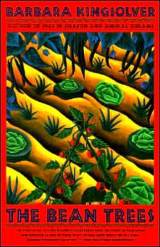
    Bean Trees

    Bean TreesKingsolver, Barbara. The Bean Trees.New York: HarperPerennial, 1989. 

    Barbara Kingsolver is my favorite author. I’ve said it before and I’ll say it again. I love the way she writes. The Bean Trees is on my Book Lust list and I’ve already read it hundreds of time. It’s the book I grab when I am in between other reads. It’s the book I reach for when I have a few minutes to kill while the rice bubbles on the stove. Given the chance to read it again just for Book Lust I am more than happy to jump at the chance.

    Taylor Greer isn’t Taylor until she takes to the highway. Leaving her hometown of Kentucky to see something other than small town rumors and ruts she finds herself on the road, “adopting” a three year old American Indian girl on the way then finally landing in Tucson, Arizona.  Taylor is smart, witty and, for lack of a better word, feisty. She tells us her story with great observance to the spirit of humanity.

    One of the things I love about Kingsolver’s work is the reoccurring themes: respect for nature described in gorgeous, vibrant detail, immigration and the political implications, the joys and struggles of motherhood (especially the single mother), the value of both belonging to a community and having independence. The Bean Trees is no different. All of these themes are carefully woven into the framework of the novel.

    My favorite lines (okay some of them): “Whatever you want the most, it’s going to be the worst thing for you” (p 62).
    “There were two things about Mama. One is she always expected the best out of me. And the other is that then no matter what I did, whatever I came home with, she acted like it was the moon I had just hung up in the sky and plugged in all the stars. Like I was that good” (p 10).

    BookLust Twist: From More Book Lust’s first chapter called”Adapting to Adoption” (p 1). I have to admit I don’t agree with Pearl’s description of how Taylor “acquires” the American Indian child. Pearl says “When Taylor Greer leaves Kentucky for points west in order to escape the confines of small-town life, she finds an abandoned and abused Cherokee child left in her car…” (p 2). It actually went more like this: “Then she set this bundle down on the seat of my car. “Take this baby,” she said….”where do you want me to take it?” She looked back at the bar, and then looked at me. “Just take it.” I waited a minute, thinking that soon my mind would clear and I would understand what she was saying. It didn’t.” (The Bean Trees p 17). This is a poignant scene to me and it makes a big difference (to me) whether the child was left or handed over.

    ps~ November is National Adoption month. I reread this just a tad early.

    Song of Solomon

    Song of SolomonMorrison, Toni. Song of Solomon. New York: Plume, 1987.

    Another must-read from the days in Maine. Although, I don’t remember reading it then. I don’t remember reading it, ever. Is that sad or what? This is a classic. Something everyone should read.

    I don’t think I could summarize the plot adequately. Basically, it’s the story of Macon “Milkman” Dead III. He got the nickname Milkman from being breastfed by his mother way past infancy. But, this story goes beyond coming-of-age; it transcends stereotypical stories of racial strife and strained family relations. Yes, there is all of that. This is a story that has been described as tragic and magic in the same line. It may be a story about one man’s rise to adulthood, but it is told from many different points of view. We learn about Milkman’s ancestry and the culture of his time. Morrison weaves imagery and symbolism together so that everything important means something different. Family names are not just names. They come from religion, mistaken identity and social injustice. Family ties are tethered and severed through love and hate, peace and violence, poverty and wealth. One man’s perception is another man’s reality.

    Quotes I liked: “I’m on the thin side of evil and trying not to break through” (p 21).
    “He wouldn’t know what to feel until he knew what to think” (p 75).
    “She was the third beer” (p 91).

    BookLust Twist: Toni Morrison is mentioned twice in Book Lust. Song of Solomon is in the chapter “100 Good Reads, Decade by Decade” (p 175) under the section 1970s. 

    Turn of the Screw

    James, Henry. The Turn of the Screw. New York: Dutton, 1963.Turn of the Screw

    Even though October is more than half over I decided to read something scary for the rest of the month…in honor of Halloween and all that. Turn of the Screw seemed like the most obvious choice. A novella only 160 pages long, I knew it wouldn’t take too long to get through.
    Written in 1898 and republished numerous times Turn of the Screw has also been  adapted for the stage, television and the big screen. Someone told me it was even mentioned in an episode of “Lost” (I wouldn’t know).  James’s technique is to tell the story within a frame – one story within another. We are first introduced to a man at a Christmas party telling a tale of a governess. From there we are in the story, told from the point of view of the governess. She has been hired to look after two small children after their parents are killed and they are sent to live on an uncle’s estate. Soon after the governess’s arrival she starts to notice strange occurrences, shadowy figures stalking the grounds. She learns they are former lovers and hired hands, back to supposedly recreate their relationship through the children.
    While James uses words like “hideous”, “sinister”, “detestable”, and “dangerous”, there is great debate as to exactly what he is describing as so terrible. He refers to evil again and again, but his ghosts are not the usual specters. They only hint at danger rather than taking action and “attacking”. The other great debate is whether the governess is insane (or goes insane while at Bly). Because no one else really backs up her ghost sightings you have to wonder.

    BookLust Twist: Mentioned several times in Book Lust. Once in the chapter called “Science Fiction, Fantasy, and Horror” (p 113) and “Ghost Stories” (p 99). I would agree that The Turn of the Screw deserves ghost story status, but horror? Maybe I’m stuck in slasher movie mode where everything horrible has to end up in blood and gore.