Abandoned Bride

Abandoned BrideLayton, Edith. The Disdainful Marquis and The Abandoned Bride. New York: Signet, 2002.

One of the great things about this BookLust challenge is the fact that I get to read so many different and interesting books in order to complete the challenge. The only bad thing is romance novels are included in the list and they certainly are “different”…in other words, not my cup of tea or coffee. I simply don’t read the “bodice rippers” as I call them. They scare me. I can’t get into all that…heaving.
Luckily, out of this double feature paperback I only had to read the Abandoned Bride story, and I did it on another quick trip to Maine this past weekend. Here’s the kicker – this one wasn’t that bad. Okay, so the heroine of the story is stunningly, absolutely, beautiful (I can’t even tell you how many times her beauty was referred to – especially her “moonlight-spun gold hair.”) and the villain (who, of course, turns out to be Mr. Romance) is dashing and “trim.” But, the story really wasn’t that bad. Here’s the premise: Julia (Miss Moonspun Hair, virginal-too-good-to-be-true-at-17-years-old) is set to elope with Robin, a boyishly handsome rich guy. They run away to some lodge where he abruptly leaves her for unknown reasons. Three years later Robin’s uncle, Nick (the dashing, trim, bad guy) “kidnaps” Julia in an effort to get her and Robin together to right past wrongs. Robin is also supposed to take over his father’s inheritance and he can’t do that while he’s running away from the memory of Julia (so he claims). The immediate problem is Robin doesn’t want to be found so Nick must drag Julia, against her will, of course, across the continent looking for Robin.
As you can probably guess, the falling in love of Nick and Julia is predictable and a little silly, but the reason for Robin’s abandonment was an interesting twist. I only figured it out when Robin is finally confronted by Julia.

Here are a few favorite lines: “…the entire stack of books fell open neatly to the middle to reveal that the book covers were false and what lay within them was not pages, but a cleverly designed box containing two decanters and a set of blown crystal glasses. “Ha!” Sir Sidney said with satisfaction. “now this, I think, is what a library is really for.”” (p 102) and “I am leagues in love with you” (p 217).

My only moment of “huh?” was when Julia used a phrase similar to being buttered up and I’d like to know if someone could be flattered in the sense of being “buttered up” in 1815.

BookLust Twist: From Book Lust in the chapter called, “Romance Novels: Our Love is Here to Stay” (p 203).

Bastard out of Carolina

Bastard out of CarolinaAllison, Dorothy. Bastard out of Carolina. New York: Penguin, 1993.

The only way I can describe how I felt after finishing Bastard is raw. Raw and used up. Maybe it’s because this is my second time reading it. Maybe it’s because I reread this in two days. I don’t know. There are a thousand different ways to describe the book itself: coming of age, looking for acceptance, southern, white trash poverty, motherhood gone by the wayside. It’s a nightmare of a mother loving a cruel stepfather (Pearl calls him “violent and predatory”) more than her own daughter. I could go on and on but that would only ruin the depression. Oddly enough, I loved it. I loved Bone’s defiant voice as she tried to make her way through life as the oldest daughter of young mother Anney. I loved her keen observance of her surroundings, “It was dangerous, that heat. It wanted to pour out and burn everything up, everything they had that we couldn’t have, everything that made them think they were better than us” (p 103).
The social commentary on men and women, men against women was poignant, too. “A man belongs to the woman who feeds him…the woman belongs to the ones she feeds” (p 157).

BookLust Twist: Bastard out of Carolina is mentioned twice in Nancy Pearl’s Book Lust. First, in the chapter called “Grit Lit” (p 106), and then in the chapter simply called “Southern Fiction” (p 222).

pps~ I was wondering if this was ever made into a movie and it has…back in 1996. Where have I been?

All-Bright Court

All-Bright CourtPorter, Connie. All-Bright Court. New York: HarperPerennial, 1992.
I adore debut novels. There is something about that leap of faith that a writer must take before anything else can happen. Every writer is a closet published writer. They walk around with the words in their head, barely daring to dreaming of the day those words will be sold in a big bookstore. Opened up for all the world to see.
That’s exactly how I picture Connie Porter, walking around with the words to All-Bright Court in her head, dreaming of the day they’ll be on paper. I can picture the personalities of  the All-Bright Court residents starting to take shape. It’s the story of two decades of african american families trying to make their way in a steel mill town near Buffalo, New York. All-Bright Court is the housing project that ties them all together.

“She found herself saving things to say to her, storing them away in her mind, folding them as neatly as sheets.” (p 82).
“These people lived inches away from one another, and much of what was done did not have to be told. They did not look away because they did not want to know. They looked away because they did know, and looking away was the only way to grant the woman dignity, to go on believing, to let her go on believing she was a woman” (p 85).

BookLust Twist: From Book Lust  and the chapter “African American: She Say” (p 12).

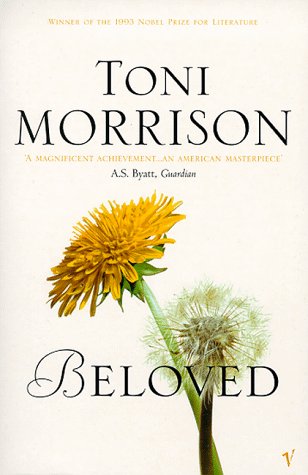
Beloved

BelovedMorrison, Toni. Beloved. New York: Penguin, 1987.

It’s been 21 years since I first read Beloved. The one and only thing I remember is my reaction to it. I remember crying and crying, not understanding why the words moved me so. Every sentence was so beautiful in its heartbreak.
After rereading Beloved I realize why I had such a hard time remembering people and plot. Beloved is the story of running. At the center is Sethe, a former slave who cannot escape her past. Everyday she lives in fear of being brought back to someone’s possession. Her history chases her everywhere. Denver is her surviving daughter who runs from loneliness, constantly trying to catch up to her mother’s attention. Paul D is another former slave who shares Sethe’s past. He, too, is in a devastating cycle of running away from his past, never believing he is capable of staying in one place freely. Beloved is Sethe’s murdered daughter, back from the dead to reclaim her life with Sethe.
After rereading Beloved I remembered English class and how we went round and round about the symbolism. What did the number 124 on the house meant? Why was color such a prominant description for things? What about Baby Suggs? In the end we decided one of the most powerful images of Beloved is Denver’s birth. Denver wouldn’t have made it into the world had it not been for the help of a white woman when Sethe was in labor. It’s almost a commentary on how society should be thinking today – we can’t make it in this world if we do not work together.

“The sky above them was another country. Winter stars, close enough to lick, had come out before sunset” (p 175) is my favorite line.

BookLust Twist: From Book Lust and the chapter called, “African American Fiction: She Say” (p. 12).

Abbreviating Ernie

Abbreviating ErnieLefcourt, Peter. Abbreviating Ernie. New York: Villard, 1997.

At first glance this humorous book is just plain cut and dried funny. Okay, bad pun. Read on and you’ll see why. Here’s the surface premise, the tip of the iceburg, of Abbreviating Ernie. Ernie and his wife are having sex. He drops dead of a heart attack. She’s blamed for his death. Here’s the just under the surface details: Ernie likes to dress in his wife clothes while having sex. He also likes to handcuff his wife and he can’t seem to “do the deed” anywhere normal. Long story cut short (there’s that pun again): Wife is found holding an electric carving knife, chained in the kitchen while hubby lies dead on the floor missing his “tommyhawk” as one character put it. All of this happens within the first twenty pages of the book so I found myself wondering what in the world Lefcourt would have say in the remaining 271.
Here’s the rest of the iceburg. Abbreviating Ernie is a commentary on the legal system, mental illness, women’s rights, the sensationalism the media can create, the Hollywoodization of a tragedy (what famous actor will portray the prosecutor?), and the exposure to human nature, often seen as failings. It’s about how warped our society can be when confronted with the dark secrets of suburbia. Yet, it keeps you laughing.

BookLust Twist: Abbreviating Ernie shows up in Pearl’s More Book Lust in the chapter on “Alabama” (p 207). While Abbreviating Ernie doesn’t take place in Alabama Pearl makes mention of Lefcourt’s book because Crazy in Alabama has an electric carving knife in its plot.

Tuck Everlasting

Tuck EverlastingBabbitt, Natalie. Tuck Everlasting.New York: Farrar, Straus and Giroux, 1985.

Do I dare say this book was delightful? I read it in an hour over a tuna sandwich lunchbreak. It’s a cute story about ten year old Winnie Foster and her discovery of a family that has eternal life. At first it seems impossible, but after befriending the strange family, Winnie realizes it’s true. The one complication of the story? Someone else (aka “bad guy”) knows the secret and wants to market it for himself.

Favorite line: “The first week of August was asserting itself after a good night’s sleep” (p 86). I like the imagery of this, of August saving it’s energy during the night in order to roast the day.

BookLust Twist: From Book Lust.

As I Lay Dying

As I Lay DyingFaulkner, William. Novels 1930 – 1930: As I Lay Dying, Santuary, Light in August, Pylon. New York: The Library of America, 1996.

As I Lay Dying is terribly sad. Through a stream of consciousness every character tells the tale of Addie Bundren’s dying days. Addie’s five children, husband, neighbors and doctor all chime in. Strangely enough, even Addie expressing herself…from her coffin. I’m not exactly sure what Anse (Addie’s husband) did besides being selfish and greedy but Addie’s final revenge on her husband is to have him bury her in her birthtown of Jefferson – a long and difficult journey. Even the kids have something against their father. In one chapter Cash doesn’t look at pa and in another, Dewey doesn’t look at pa. Eveyone has something bad to say about “pa” but, the one thing I find admirable in Anse is that he sticks to his promise saying, “I give my promise. She’s counting on it” (p 92).

One of my favorite lines is from Addie when she says, “I could just remember how my father used to say that the reason for living was to get ready to stay dead a long time” (p 114).

BookLust Twist: From Pearl’s first lust book, Book Lust in the chapter “Southern Fiction” (p 222).

Above The Thunder

Above the ThunderManfredi, Renee. Above the Thunder. San Francisco: MacAdam & Cage, 2004.

Once I started reading Above the Thunder it was like a giant boulder building momentum down a hill. I couldn’t stop turning the pages. I like that it’s all about journeys, big and small. Personal and global. On the surface its four people, on the whole it’s humanity. The plot is simple – it’s about the life of Anna. She starts out being a cynical, bitter widow who “doesn’t want to get involved.”‘ She doesn’t want to get involved in living, period. She has all but disowned her daughter whom she hasn’t seen in 12 years. She has one friend. When her son-in-law and granddaughter return to live with her and she reluctantly agrees to help moderate an aids support group she ends up being the center of a collection of people so diverse and wonderful she can’t help but change and, in the process, grow. Sounds predictable and nice, but it isn’t. There is a harsh reality to this coming-into-the-light story: aids, suicide, divorce, miscarriage and sadness all play an important part in the plot.

The thing I liked best about Above the Thunder are the characters. They are believable. Anna is introduced to us as closed off and inflexible. In time she changes, but when faced with a new tragedy she reverts back her old self and craves solitude where she can grieve in private. In shrugging off the comfort of others she is still the same person we meet in chapter one. Even Jack, a homosexual with problems with fidelity, doesn’t change his desire for sexual freedom once he discovers he is hiv positive. All the characters go through a period of growth and acceptance, but at the core are all still the same unique individuals.
Some favorite lines:

  • “She doubted it was possible to understand someone else’s suffering. Even her beloved husband whose pain had become a private geography on which she couldn’t trespass.” (p 21)
  • “Holy God, man, how long does it take to cook a hot dog? I’ve been in line long enough to break a habit, backslide, and recommit.” (p 183)

And a favorite scene: two homosexual men trying to teach a pubescent girl how to use a tampon for the first time. It’s hysterical and poignant all at once.

BookLust Twist: From More Book Lust in the chapter called, “Maiden Voyages” (p 159). I have always loved discovering someone’s very first novel. Katherine Weber’s maiden voyage is one of my favorite, but Above the Thunder rates right up there, too.

River Wife

I wanted to write reviews as I was reading this. There were passages I wanted to pass on – lines that I truly enjoyed reading. Maybe after the finished book is finally published I will edit them into this review. For now, this is it.

FROM LibraryThing:
The River Wife is a historical novel by Jonis Agee. While it chronicles the lives of four generations of women and the men who loved them, the timeline meanders back and forth between the early 1800s and 1930s up to 1950 without clear motive. Hedie Rails Ducharme opens the tale in 1930 and through the discovery of diaries the reader is taken back to the women of 1812, Annie Lark Ducharme and Dealie Dare Chabot. Omah Ducharme and Laura Burke Shut Ducharme soon follow. Later, after bouncing back from Hedie again, we are introduced to more women who prove vital to the storyline, Little Maddie Ducharme, Vishti and India Gatto. Then back to Hedie to wrap things up. It would be more appropriate to title this story The River Women since it tells the story of many women all with interesting connections to one man, Jacques Ducharme.

When describing the natural elements of location, such as the Mississippi river and Missouri farmland, the writing is lyrical and fluid – reminiscent of Barbara Kingsolver’s Prodigal Summer. Yet, the characters fall a bit flat. Jacques Ducharme is a contradiction full of mystery. At once he is both a ruthless, dangerous, thieving murderer, and a tender, playful, loving husband. This night and day personality makes it difficult for the reader to fully trust Jacques, or in some instances, even like him. The same contradiction applies to his grandson Clement. This example of history repeating itself, of living dangerously yet loving passionately does nothing to arouse sympathy when both characters leave the story. Even the women lack reality. There is something exaggerated in their passions, their desires to be strong.

One interesting element of the River Wife is the mingling of fact and fantasy, for example, using real events (the New Madrid earthquake and the Civil War) and people (naturalist John James Audubon) against evidence of working witchcraft (Jacques inexplicable youth) and the sighting and interaction with Annie’s ghost (Annie’s ghost saves Omah).

Because the timeline jumps around and key elements are either withheld or shrouded in mystery, The River Wife seems mimic one constant in the story, the Mississippi River. Both meander, have twists and turns, both are calm yet powerful, beautiful and dangerous, full of mystery and depth.

PS~ I trust that Ms. Jonis will credit Maud Irving and JP Webster for the poem on page eight. “Wildwood Flower” was actually written in 1860, nearly 40 years after Annie Lark Ducharme’s death and made famous by the Carter Family.

Spring and Fall

Hopkins, Gerard Manley. “Spring and Fall: To a Young Child.” The Poems of Gerard Manley Hopkins. London: Oxford University Press, 1967. 88.

Short and sweet, bitter and sad, Hopkins seems to be telling a child (Margaret), “don’t question the death of things too quickly. Life will be over before you know it. Enjoy what you have.” While the child is easily upset by the falling of leaves Hopkins doesn’t belittle the child’s distress, nor does he cater to it. He calmly explains that more disappointments in life will follow and that is the nature of life.

BookLust Twist: More Book Lust in the chapter “Poetry Pleasers” (p 188).

Sounder

SounderArmstrong, William, H. Sounder. New York: Harper & Row, 1969.

Haunting. I find this story haunting on so many different levels. Haunting and tragic. Where do I begin? Where can I begin? The copy of Sounder I picked up had the words “now a motion picture!” emblazoned across the cover with photographs of scenes from the movie inside. Of course, I studied the photos before I read a single word and saw pictures of an obviously poor black family. One picture showed the mother with three kids as a father, handcuffed, is being led away by white, mean looking “authorities.” Another picture depicts the “criminal” as he is about to be struck by a prison guard…

But, the tragic pictures couldn’t prepare me for the quiet yet strong story. The raw undercurrent of something more ominous buzzed constantly. No one in the story has a name except the family hunting dog, Sounder. The father is accused of stealing a ham and is sent to jail, the mother cracks walnuts and sells the meat in town. There are three children and the story is told from the oldest’s perspective.
During the father’s arrest, Sounder is shot. Everyone in the family thinks Sounder is dead. What amazes me is the oldest son is more worried about the dog than his own father. His father’s guilt is plain, simple and true when his mother returns what was stolen, yet because Sounder’s body cannot be found, it’s all the boy can think about. “If the deputy sherrif had turned around on the seat of the wagon and shot his father, the visiting preacher and somebody would bring him back and bury him behind the meetin’ house, the boy thought. And if Sounder dies, I won’t drag him over the hard earth. I’ll carry him. I know I can carry him if I try hard enough, and I will bury him across the field, near the fencerow, under the big jack oak tree.” (p34)

I can’t do the storyline justice, but the writing is beautiful. Here are a few of my favorite lines:

  • “And Sounder, too, settin’ on his haunches, would speak to the moon in ghost-stirrin’ tones of lonesome dog-talk” (p 38).
  • “Now the cabin was even quieter than it had been before loneliness put its stamp on everything” (p 76).

BookLust Twist: From Book Lust and the chapter called “Three-Hanky Reads.” Sounder is paired with other dog books for children like Beautiful Joe and Goodbye, My Lady (p 237).

Twenty-One Balloons

21 BalloonsDu Bois, William Pene. The Twenty-One Balloons. New York: Viking Press, 1947.

I like coincidences. I was nearly finished with Zelda Fitzgerald’s biography when I picked up Twenty-One Balloons. I’ve gotten into the habit of reading prefaces and author’s notes before diving into a story. In the past I would skip over them but now I like the little tidbits if information before getting to the heart of the plot. It was a huge surprise to read that Du Bois’ publisher noted “a strong resemblance” to F. Scott Fitzgerald’s story called, “The Diamond as Big as the Ritz.” Du Bois states in his note, “The fact that F. Scott Fitzgerald and I apparently would spend our billions in like ways right down to being dumped from bed into a bathtub is altogether, quite frankly, beyond my explanation. William Pene Du Bois January 16th, 1947.” I find this compelling and made it impossible for me to delay reading Twenty-One Balloons!

Twenty-One Balloons is the clever children’s story of Professor William Waterman Sherman. He taught arithmetic for 40 years and decided he was in need of a vacation of solitude. He decided ballooning would be just the thing and masterminded the invention of a balloon that could take him around the world. Except he doesn’t make it and the adventures that follow are more exciting than had he actually made it around the world. This book is delightfully illustrated by William Pene Du Bois as well.

Some of my favorite moments are when first, when Sherman first crashes (on Krakatao) he is told, “you may think that your landing on this island was all by accident…” setting the scene for something little more ominous. It’s followed up by the escape which is equally fun.

BookLust Twist: From More Book Lust  and the chapter on Krakatau. Pearl says, “Du Bois’s book is a glorious fantasy…” (p 183). Indeed!

One Morning in Maine

One Morning in MaineMcCloskey, Robert. One Morning in Maine. New York: Puffin Books, 1989.

Who doesn’t love Robert McCloskey’s books? For starters, all the illustrations are great. For another, I always loved One Morning in Maine because I could compare Sal’s life to my own growing up…She lived on an island in Maine, boat trips were something to get excited about and she had a younger sister…the differences were her family lived close enough to row over to the mainland (when their boat engine died) and her family could go digging for clams right outside their house. Our boat rides took over an hour, full steam ahead and I hunted for periwinkles in tide pools.
Even her parents reminded me of my own – always playing the Big Girl Card. Compared to my sister I was supposed to be more mature, more responsible. They used my elder status to get me to behave, “but you’re growing into a big girl and big girls don’t cry about things like that” (p37).

BookLust Twist: From More Book Lust. Pearl mentions in the intro (p ix) she started her obsession with reading with books like One Morning in Maine. Me too!

Autobiography of an Unknown Indian

AutobiographyChaudhuri, Nirad. The Autobiography of an Unknown Indian. Los Angeles: University of California Press, 1968.

I admitted defeat with Autobiographyby page 92. Maybe I was spoiled by all the easy reading over the vaca. Maybe I just couldn’t wrap my brain around Chaudhuri’s lengthy descriptions. Maybe it was the subject matter. I don’t know. I do know that I literally fell asleep every time I cracked open this book.
From the very beginning I was confused about the nature of this story. Fiction? Nonfiction? It’s the first hand account of an Indian growing up in Kishorganj, India. A memoir of sorts. It sounds nonfiction because he refers to the Chaudhuri family off and on and he goes to great length to describe everything – the huts his family lived in, the landscape, the weather, the townspeople, the politics, the culture, even the animals. Chaudhuri lost me in the chapter about his mother’s ancestral village. It was more of the same. 
But, the reading wasn’t all dry. Littered in between the descriptive are little stories about childhood and memories. Those little pieces were fun and added color to the overall plot. 

BookLust Twist: From More Book Lust in the chapter called “India: A Readers Itinerary.” Nancy puts Autobiography under fiction but it reads as dry as non. What cracked a smile on my face is when Nancy described it as an “exceptionally informative.” She wasn’t kidding.

The Awakening (w/ spoiler)

AwakeningChopin, Kate. The Awakening. New York: New American Library, 1976.

If I had a tag for “feminism” this book would be under it. Actually, it’s more of a long short story than a book. Only 125 pages long Kate Chopin tells the story of discontented, tragic Edna Pontellier. A wife and a mother she is dutiful as both until a younger man awakens her inner rebel and sex goddess. You can see it start slowly when she states, “I feel this summer as if I were walking thrugh the green meadow again; idly, aimlessly, unthinking and unguided” (p. 17). It grows stronger when she disobeys her husband, “Another time she would have gone in at his request” (p. 33). Finally, the ultimate of rebellion reaches its peak when she is seduced by another man, Arobin. “He did not say goodnight until she had become supple to his gentle, seductive entreaties” (p. 100).

BookLust Twist: While Pearl doesn’t think anything really happened with Edna (” …poor Edna Pontellier…who doesn’t actually do anything but suffers the consequences anyway.” More Book Lust, Wayward Wives p 232), I strongly disagree. What Edna doesn’t do is be a good mother to her kids (they’re shipped off while she pretends to be an artist), or a good wife. She moved out of their home while hubby’s away. He’s left making excuses to save face (said the house was being renovated and that’s why his wife took up another residence).

In the end Edna commits suicide. She knows she’s not a good mother. She knows she isn’t a faithful wife. She can’t have the man who truly awakened her sexuality. Trapped in a life she cannot conform to she walks into the sea never to emerge.