Storm in Flanders

Storm in FlandersGroom, Winston. A Storm in Flanders: The Ypres Salient, 1914 – 1918: Tragedy and Triumph on the Western Front. New York: Atlantic Monthly Press, 2001.

I’m thinking I shouldn’t have picked this book up in the middle of my current state of mind. Don’t get me wrong, Groom’s history on World War I is impressive. Between the diary accounts, breathtaking pictures and easy language (he called someone a “military nut” and someone else “butt-headed”), this wasn’t a dry read. I know more about military warfare than ever before. For example, I learned WWI was Hitler’s introduction to war, paved the way for him, so to speak. The Germans were the first to introduce poison-gas (mustard gas) warfare; and I now know the meaning behind the poppy-like flowers veterans sell outside the grocery store. I always bought them and hung them in Gabriel without knowing why.
There is humor to Groom’s language: “While the Germans pondered their next move, there was a four-day lull in the fighting – if you can call taking thousands of casualties a day a “lull” (p 51) and “…Germans binged on a gluttony of pork until they were virtually wursted and brattened to their limits” (p 119).

Since Christmas is fast approaching I am drawn to the story Groom tells of Christmas 1914 when both sides put down their weapons and pretended to be friends for a day, exchanging gifts, singing carols, playing games and even laughing with one another. Yet, when the day was over they went back to killing one another.

BookLust Twist: From Book Lust in the chapter “World War I Nonfiction” (p 251). Pearl points out that Groom writes with compassion for the soldiers and I couldn’t agree more. I think that compassion is what makes this book so interesting.
Diary From Dixie

Diary from DixieChestnut, Mary Boykin. A Diary from Dixie. Boston: Houghton Mifflin, 1949.

From the moment I started reading Mrs. Chestnut’s diary I felt I was in for gossip, gossip, gossip. While this is a great first hand account of life during the Civil War, I couldn’t get over how much of a name-dropping, political hob-nobbing, party-going Southerner she was! Another thing I noticed  was how humorous Mrs. Chestnut was! Here are a few of her more comical entries:

“There Mrs. Hunter told us a joke that made me sorry I had come” (p 8). But, she never does explain the joke was! Too bad!
“At camp meeting he got religion, handed round the hat, took the offering to the Lord down into the swamp to pray over it, untied his horse and fled with it, hat, contribution and all” (p 13).
“I think this journal will be disadvantageous for me, for I spend my time now like a spider, spinning my own entrails, instead of reading as my habit in all my spare moments” (p 22). See, gossip, gossip!
“Every woman in the house is ready to rush into the Florence Nightingale business” (p 70). Good ole fashion jealousy, perhaps?

I think the only quote to get to me showed the attitudes of the time, “Women need maternity to bring out their best and true loveliness” (p 86). We’ve been here before.

All in all, Mary Chestnut’s diary was a delight to read. I fell in love with some of the language: flinders, rataplan, brickbat, and best of all, envenom. Love that word! Witty and humorous, it didn’t read like a history textbook. Instead, it gave texture to the sounds and sights and warmth to the personalities from the Civil War. More importantly, it gave a sense of what it was like to be a woman during that time.

BookLust Twist: From Book Lust and the chapter called “Civil War Nonfiction” (p 58).

Bad Land: An American Romance

Bad LandRaban, Jonathan. The Bad Land: an American Romance.

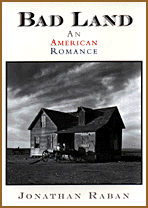
In honor of both the month Montana became a state and National Train Month I put Bad Land  on my list. It reads like a river. Some parts read like racing rapids while others slow to languid pools of near stillness. Then there are the waterfalls, where the language is cascading awe-inspiring. It was during these “waterfall” sections that I wanted to pack a bag and head west, just to see it for myself.

Raban helps you look at Montana from the point of view of the immigrant (emigrant), the artist, the ancestor, the traveler, the naturalist. Like standing back from a canvas to discover hidden colors. It’s a historical story, lyrically descriptive and informative. It’s a biography of the landscape as well as the people settled there at the turn of the century.
Favorite lines:”…mouth like a mailbox” (p 67).
“Mrs. Nemitz, scenting sarcasm, put his face on trial for a split second, but found it not guilty” (p 104).
“It’s exhilarating and scary, to lighten ship every so often, to kiss goodbye to the accumulated tonnage of ones life so far” (p 114)
“now the book is full of brittle ghosts” (p 136).

BookLust Twist: Mentioned twice in Book Lust. Once in the chapter called “Montana: In Big Sky Country” (p 156)…in which Pearl calls Bad Land  “the best book about Montana by a non-Montanan” (p 157); and “Riding the Rails: Railroad History” (p 201).

Red Zone Blues

Escobar, Pepe. Red Zone Blues: A Snapshot of Baghdad During the Surge. Ann Arbor: Nimble Books, L.L.C., 2007.

The following was what I posted on LibraryThing  a while ago. I forgot that it has a place here as well.

Red Zone Blues was like reading something by a politically focused Anthony Bourdain. Escabar’s language was gritty, sarcastic, and colorful. His opinions are not veiled in the least. The prologue seemed to be added just for shock value, something to get the reader revved up for more. Each subsequent chapter was short, like a stand-alone essay, written with sarcasm and thought-provoking observation. While the “essays” seemed disjointed, each was a mere glimpse into a certain time period of Iraq: a refugee’s visa troubles, a road-side arrest, the sniper infested society just to name a few. Each chapter was a quick and dirty peep show of the culture, the people and politics of Iraq. It left you wanting more, squirming all the while.

** This blog has the tag “RandomHouse” even though it is not a Random House publication. When I first started the Early Reviewer program I thought I would be reviewing titles only published through Random House (and thus created the tag). I needed a tag that would differentiate book reviews written for the Book Lust challenge from those written for the Early Reviewer program. **

Black Dog of Fate: a memoir

Black Dog of FateBalakian, Peter. Black Dog of Fate: a memoir. New York: Random House, 1998.

I must have started this book four or five times. I don’t know what it was about the beginning. I’d pick it up, read for a few pages and put it down again, never getting beyond the first chapter. By the time I’d return to pick it back up I had forgotten what I had read and needed to start all over again. Page one. Finally, I took Black Dog of Fate home with me Columbus Day weekend and read it from start to finish. When I was finally able to devote the time and attention to it I couldn’t put it down.
There are very few books I try to push on other people. Very rarely do I try to tell people what I have read and how I feel about it, urging them to see for themselves. This story was different. From the moment I put it down I found myself struggling to put into words what had moved me so yet I needed to say something.

Here’s what I wrote within seconds of finishing it on Monhegan:
It’s the history you don’t commonly read about. It has the facts everyone would like to wish away; a genocide too horrible to imagine as real. The Armenian Massacre wasn’t a standard topic in my history class. As a rule I think we, as a society, want to sweep all and every horrific moment under our subconscious. This is a memoir about a boy’s growing knowledge and deeper understand of his heritage. True to adolescent ambivilance Balakian doesn’t understand the importance of his ancestry. In his youth all the stories his grandmother wanted to tell him were lost on him. It’s only after he is ready does his grandmother’s words mean anything to him. “I came to find out more about the arid Turkish plain when I picked up a book at a time when I was prepared to read it” (p 147).  

Other lines that struck me:
“…she would pass me the salty green nuts so we could celebrate with our teeth” (p 13). I think food is always the most appropriate way to celebrate.
“Hokee, soul. Hankids, rest. The soul’s rest: a memorial” (p 140).

BookLust Twist: From Book Lust in the chapter “A Geography of Family and Place” (p 97).

Reading Lolita in Tehran

Reading lolitaNafisi, Azar. Reading Lolita in Tehran: A Memoir in Books. New York: Random House, 2004.

The first thing I think as I am 13 chapters into Reading Lolita in Tehran is maybe, just maybe I should have read Lolita first. Yet, it is not just about Lolita. It’s also about Gatsby, Daisy Miller and Pride & Prejudice. Those, I have read. But, these four books are not the only ones Nafisi recommends. There is a whole list of them. I am tempted to start another challenge and add them to my “must read” list.

But, back to Reading Lolita in Tehran. Where do I start? Blanketing the entire story (nonfiction) is the outrage I felt. Professor Azar Nafisi must secretly meet with seven students to study Western classics, books that are forbidden in the Islamic Republic of Iran. I don’t know how they dared. Morality squads roamed the streets, raiding homes and shops whenever they wanted, fundamentalists took over the university where Nafisi formally taught, women are arrested for not wearing the veil, being seen in public with men other than their husbands, brothers or fathers, for wearing makeup…It just reminds me I am a spoiled Westerner who can paint my eyes black as night, show the curve of my neck, and most importantly, read any book I want.
Think of a braid. One strand is politics, another literature, the last society. This is Reading Lolita in Tehran. Woven over and under and throughout is Azar Nafisi’s life. Her personal views on relationships, society and of course, the books she loves. Because it’s her point of view and hers alone we have to trust that she is telling us the truth. Her truth. Here are my favorite quotes – some with my commentary after.

Reality has become so intolerable, she said, so bleak, that all can paint now are the colors of my dreams” (p 11).
“I think I somehow felt that as long as I was conscious, nothing bad could happen, that bad things would come in the middle of my dreams” (p 45).
“Some people take up alcohol during periods of stress. I took up Jeff” (106).
“In the midst of gunshots and chants we hugged and chatted about the almost two decades since we had last seen each other” (p 148).
“The administration wanted us to stop working and at the same time pretend that nothing has changed” (p 151). ** I’m reminded of a relationship I once had when the entrapment was the same. **
If I turned towards books, it was because they were the only sanctuary I knew, one I needed in order to survive, to protect some aspect of myself that was now in constant retreat” (p 170).
I became more anxious. Until then I had worried for the safety of my parents, husband, brother and friends, but my anxiety for my children overshadowed all” (170). ** I thought of my sister when I read this line. I think she would agree. **

Random comments~ I want someone to explain these things to me. How someone can be pompous and meek at the same time; how someone can speak precisely and leisurely; and how someone can murmur a defiant no. Just odd descriptors in my opinion.

BookLust Twist: From More Book Lust and the chapter called “Me, Me, Me: Autobiographies and Memoirs” (p 162). I would say Nafisi’s story is a chapter of a memoir; a partial snapshot of a life.

Abyssinian Chronicles

Abyssinian ChroniclesIsegawa, Moses. Abyssinian Chronicles. New York: Alfred A Knopf, 2000.

This took me absolutely forever to read. In the beginning Athenian Murders seemed more interesting. No, I take that back. It seemed a faster read. Honesty is the best policy. Then, I started Autumn Across America. Juggling two “landscapes” as sweeping as Abyssinian and Autumn wasn’t easy. Both are elaborate, even panoramic, if you will. Very descriptive. But, enough excuses – back to Abyssinian Chronicles.
This is story of Mugezi. It is more than a coming-of-age chronicle. It is Mugezi’s life story from childhood to harsh adulthood in the span of twenty years and the necessary means it took to survive each and every day. In addition, it weaves in the landscape of Uganda, the politics of the 1970s, society, religion, violence,  and the family traditions of African clan. It is panoramic and profound. Isegawa’s language is harsh, his subjects, brutal. For example, the children Mugezi looks after are caller “shitters.” A line that made me laugh outloud was Muzegi’s aunt’s warning to a woman who was letting herself go, “If she did not take care, Nakibuka thought, soon birds would be nesting in her hair, baby hippos snorting in her belly and hyenas rubbing their rumps in her armpits” (p 162). If you are anything like me, you read that sentence and said “whaaaat?” I read it twice, said “whaa?” and then laughed out loud. I have no idea what it means (especially the hyena part) but it was funny. Female cattiness. I can relate to that. But, probably the section I can relate to the most is a tie between politics and family. First, politics: “Local politics were also at work: you never bit the hand that fed you… Consequently, there was much turning of the other cheek and much patience in the hope that everything would turn out right in the end” (p 218). Words I should take to heart in my present situation. Now, family: “Grandpa’s old lawyerly dreams boiled inside me. I felt I had stepped onto holy ground” (p 341). I felt that way when I was training for the Leukemia Society…something about fighting the ghosts of cancer, cradled in my grandmother’s name…

BookLust Twist: From More Book Lust and the chapter “Africa: A Reader’s Itinerary” (p 3). While I called Isegawa’s novel panoramic and sweeping Pearl describes it as sprawling and ambitious. Either way it’s 462 pages long. I think you get the point.

Autumn Across America

redsky.jpg

Teale, Edwin Way. Autumn Across America. New York: Dodd, Mead & Co., 1965.

I’m sure hundreds of books about traveling across the country have been written (I’m thinking specifically of Steinbeck’s Travels With Charley among others), but this is one of my favorites. It is a great combination of science and ecology, history and socialism with personal antidotes sprinkled throughout: a story of a deaf, mute man who lost his dog; the antics of sea otters playing in the surf; pages from John Muir’s diary and lines from Emerson’s poetry, to name a few. You can tell that Teale loves the land and everything above, around, on and in it. He has stories about birds and butterflies, deer and dogs, trees and turtles, flowers and faces. He introduces you to wonderful people, interesting facts. My favorite part, which I read outloud to kisa, involved scaring a pond load of birds only to have them all react in precisely the same way. Not one bird reacted more than another. They all did the exact same thing at the exact same time. I found that so fascinating.

My favorite line, by far, “We had, for the space of a whole glorious autumn, been time-rich” (p 356). Wouldn’t that be nice? Where would you go if you had a whole season to travel in?

BookLust Twist: From More Book Lust in the chapter appropriately called “Nature Writing” (p 173). Pearl writes, “…these books beckon us to emulate Teale’s own travels…” (p 174).

Accidental Connoisseur

Accidental ConnoisseurOsborne, Lawrence. The Accidental Connoisseur: An Irreverent Journey Through the Wine World. New York: Fair Point Press, 2004.
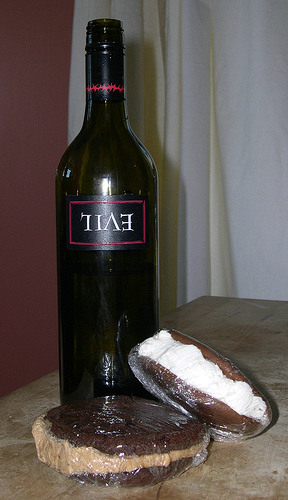
Even though I don’t know much about wine and I probably wouldn’t have picked up this book if it weren’t for the challenge, I had to admit this: ILMAO. Lawrence Osborne has a great deal of fun with the punny, the witty, and the downright funny. Right off the bat, on page four, he had me giggling with “all drinks came under the Arabic word alcohol, essentially reducing them to a level of chemical sin, and none of them could be bought on Sunday.” Especially since we had downed a wine called Evil on vacation, thanks to Stacey. See below for the proof.

Even if you aren’t a wine drinker or even a wine liker, Osborne’s writing will amuse you. He has phrases that are somewhat identifiable as my own, “when the happiness of drinking overwhelms you, you cannot resist it” (p 21) and “Wine is 99% psychological, a creation of where you are and with whom” (p 22). This makes me sound wildly alcoholic, but bear with me a second. Think of any great seduction scene. Who is usually front and center (along with soft music and sexy candlelight)? Partners in  crime – a wine bottle and two wine glasses. I found that a glass of wine is definitely more pleasurable when enjoyed in the presence of good friends and equally good scenery.
Seriously, I learned a lot from this short book. For example, how you space the vines in each row determines the complexity of a wine (according to one grower). The theory is plants with less crowding don’t have to compete for sunlight and growth space. They are more relaxed and get this, less stressed out. You see, the more stressed out a plant is, the more psychotic it is. It’s this aggrivated state that develops the complexity of flavor. Got it? I learned a new wine word, too: terroir. Makes me think of ‘terror’ but whatever.

Other favorite parts: “”what do you taste?” “Grapes,” I said. “Good. That’s what’s in it!”” (p 97)

“If wine is sex, ” I said, “this is like yoga.”
“Yoga? You’re saying it’s like yoga?”… I’m not sure I get you there. You mean athletic?”
“Virtuous. Unsexy.”
“Ah, you mean American!” (p 101)

But, probably my favorite line is an obvious one, “Wine summons ghosts out of the cupboard” (p 228).

BookLust Twist: From More Book Lust in the chapter “A Holiday Shopping List” (p 115). It’s true that I would buy this for the wine lover that I know, only I don’t think he drinks and reads. Is that a problem?
wine.jpg

1968: The Year That Rocked the World

1968Kurlansky, Mark. 1968: The Year That Rocked the World. New York: Ballentine Books, 2004.

The year before I came into being. What an amazingly troubled yet vibrant time. There is very little that Kurlansky doesn’t cover. Everything you want to know about what changed world views is here. My favorite chapters were about the civil rights movement and the protesting that went on. From sit-ins and the feminist movement to Freedom Rides and every raised sign in between. Talk about voicing your opinion! Here are my favorite quote on the subject: “The protesters can be nonviolent, but they must evoke a violent reaction. If both sides are nonviolent, there is no story” (p. 38). For this very reason women had a hard time getting their January protest march on Washington documented. They weren’t violent enough.
The harder chapters to read were about politics and the Vietnam war, two very unavoidable subjects for 1968. Both carried the weight of violence and unbridled hatred. The Chicago convention in August…”miraculously, the clubbings in Chicago killed no one…At the same time, Vietnam had its worst week of the summer, with 308 Americans killed, 1,134 wounded, and an estimated 4,755 enemy soldiers killed” (p286).

BookLust Twist: In the chapter “The 1960s in Fact & Fiction” (p 179) from More Book Lust.

Gift from the Sea

GiftsLindbergh, Anne Morrow. Gift From the Sea. New York: Vintage Books, 1991.
I have to say this is something every woman should read annually. The words and their meaning will change every single time and they will be different for every reader. In the simpliest of terms Gift From the Sea uses seashells, (whelk, moon shell, oyster) all gifts from the sea, as metaphors for life, vehicles for deeper thoughts. On vacation (ironically on an island, like me) Anne picks seashells and ponders religion, relationships, growing old, being young, nature, love and marriage…She picks at nagging thoughts like scabs, letting them bleed, revealing raw emotion and a tender heart. Here are a few of my favorite quotes:

“…I think best with a pencil in my hand” (p 9). I agree!
“…I have shed the shell of my life for these few weeks of vacation” (p 22). Since I was on vacation when I read that I had to smile because it happens to me, too.
“…social life is exhausting; one is wearing a mask” (p 32). Very true! Couldn’t have said it better myself.
“And since our communication seems more important to us than our chores, the chores are done without thinking” (p 100).

I read this in an afternoon. Gulls cried overhead, sea air salted my skin, waves crashed in the distance. It was the perfect setting for Gift from the Sea.

BookLust Twist: From the chapter called “Journals and Letters: We Are All Voyeurs at Heart” (p 130). I swear on everything holy I did NOT have More Book Lust with me when I wrote this review. I was still home without any of my Pearl books. So, I was incredibly surprised to read these words from Pearl, “Some of us still reread them yearly to remind ourselves of what’s important in this frantic world” (p 131). Pearl is referring to everything written by Lindbergh, but I had the exact same thought specifically about Gift from the Sea. Gift from the Sea is also in Book Lust in the chapter, “100 Good Reads, Decade by Decade” (p 175).

Under the Tuscan Sun

Mayes, Frances. Under the Tuscan Sun: At Home in Italy. New York: Broadway Books, 1997.Under the Tuscan Sun

Under the Tuscan Sun was made into a movie I have never seen, nor do I think I ever want to. I don’t see how the richness of Mayes’s Italy comes to life on the silver screen. I can’t picture the blood, sweat and tears of rebuilding a house; the glorious smells of garden fresh cooking; the love and laughter of enjoying one’s surroundings in moving pictures. I don’t see how Mayes’s  lush language is communicated. Really. Tuscan Sun is the journey of a woman (with the help of her second husband) to rebuild a Tuscan farmhouse. While she struggles with culture, language barriers and politics she falls in love with her Italian life. Try as I might I can’t see it as a movie. Okay, so now maybe I’ve convinced myself to see it out of curiosity!
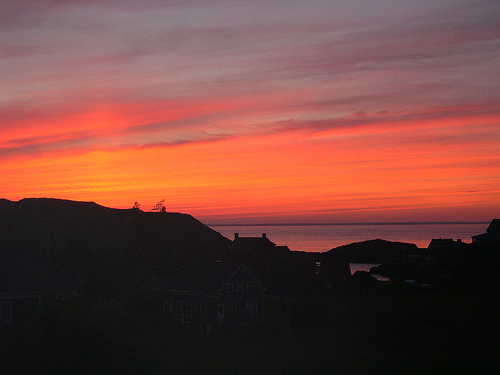
I think I’m having trouble picturing a movie because I read Under the Tuscan Sun in my own personal paradise – by the dying light of fiery sunsets with the cadance of the surf as my only distractions. To say that I devoured Under the Tuscan Sun is an understatement. During the day I read it between hiking, eating, and breathing in my own love affair with a place. Every single time Mayes gushed about her Italian home I wanted to challenge her. I wanted to boast that it was I, not she, who was living the perfect life. On page 86 she says, “Where you are is who you are. The further inside you the place moves, the more your identity is intertwined with it. Never casual the choice of place is the choice of something you crave.” I found that quote so profound to my place I had to choke back tears. It is hard to explain arriving on Monhegan and reading those words on the very first night home. I had arrived to the only place my soul knows intimately. The only place where my whole being breathes a sigh of relief. Home is who I am, for sure. Later, I bought a guestbook for our rental cottage and wrote Mayes’s same words on the inside cover.

BookLust Twist: From More Book Lust in the chapter called “Ciao, Italia” (p 46). I like that Pearl describes Mayes adventure as a “love affair” (p 47). We’re both on the same page with this book.

My love affair:
875069607_94b33dab01.jpg

Autobiography of a Face

AutobiographyGrealy, Lucy. Autobiography of a Face.New York: HarperCollins, 2003.

I had all the right conditions to finish this book in two days – traveling, vacationing, but most of all, fascination. I couldn’t put it down. On the surface Autobiography of a Face is the tragic story of one woman’s struggle with cancer and journey through recovery. Only her struggle isn’t as an adult. She is a child. Confronting Ewing’s sarcoma at age nine Lucy battles through radiation therapy and chemotherapy. Her tone can only be described as matter of fact as she recounts the loneliness and pain after countless surgeries to correct the deformity of losing a third of her jaw. Deeper than that, Autobiography is about rising above the cruelty of others, shaking off the superficial prejudices of what supposedly makes a face beautiful. Lucy is defiant and remarkably stoic in her recollections of childhood taunts, adult avoidance, and across the board lack of social acceptance.
Critics call this book the vehicle with which to free oneself from self loathing and fears of rejection. It is a message to stop wallowing in self pity and live with dignity – no matter what. It’s also a call to be human and have real emotions as Lucy admits, “and as much as I wanted to love everybody in school and waft esoterically into the ether when someone called me ugly, I was plagued with petty desires and secret, evil hates” (p 181).

My favorite quote: “speaking seemed like something one could grow tired of” (p 77).

Lucy’s story ends with her getting published, finding friendships and getting on with her life. Yet, there is a darkness to it all. She is criticized for not telling the whole truth. There is mystery surrounding her untimely death in 2002. Her story leaves you asking what happened and wanting more. What the book doesn’t tell you is that her multiple surgeries led to an addiction to pain meds and subsequently, heroin. She died of an overdose at the age of 39. There is more drama after death, but I’ll leave that for you to figure out.

BookLust Twist: From More Book Lust and the chapter “Other People’s Shoes” (p 181). I can’t even begin to imagine being in Lucy’s shoes.

The African Cookbook

African CookbookSandler, Bea. The African Cookbook: Menus and Recipes From Eleven African Countries and the Island of Zanzibar. New York: Citadel Press Book, 1993.

This is a gorgeous cookbook. Not just for the recipes and menus, but also for the art. The illustrations by Diane and Leo Dillon are amazing. My personal favorite introduces the recipes of Tanzania (p. 57).
In the first half of the cookbook the recipes cover all the regions of African cooking. In addition each chapter has a section on the culture of the region, how meals are served (traditionally) and how you, the American cook, can pull off your own Tanzanian, South African or Liberian meal. The second half of the cookbook covers additional recipes. Chapters are gouped by product – fish, poultry, beef, starch, etc.
Something else I find interesting is the nontraditional layout of each recipe. You won’t find a list of ingredients and then preparation instructions. Instead, each ingredient is presented as needed in the preparation instructions. Something I am never good at is reading through the entire recipe before starting and with The African Cookbook that step would be imperative.

BookLust Twist: From More Book Lust in the chapter “Africa: A Reader’s Itinerary” (p4).

Second Sex – Failed

Second sexde Beauvoir, Simone. The Second Sex. New York: Alfred A. Knopf, 1971.

Okay, I admit it. I got two paragraphs into the translator’s preface then skipped to the author’s introduction. There, I got as far as page v . Mind you, the introduction starts on page v. Then, I skipped to chapter one, got as far as paragraph three where I promptly fell asleep. I couldn’t get a single page entirely read. Not a one. Here and now I’m evoking the BookLust 50 page rule and admiting defeat with The Second Sex (see Book Lust Rules). Women everywhere hate me now for what I’m about to say.

I am not a diehard feminist. I have strong beliefs in what a woman can and can’t do. I’ve said before that women are more cerebral than men. They frequently change their minds, then change them back again. This makes them flighty, indecisive. Not exactly the type of person I would want in combat. The ability to drive a car? Please, don’t even get me started! I could go on, but I don’t think I can take the hate mail.
My second reason for not wanting to finish (or even properly start) Second Sex is the fact that it was written in 1952 (from a treatise written three years earlier, in 1949). Much has changed for women since that time. We’re more accepted in the corporate world, the political realm & even the far reaches of outer space. It’s becoming more acceptable for women to be the bread winners while their husbands stay at home with the kids. One might argue that reading Second Sex would be good from a historical standpoint. True, but I’m just not that interested in standing in that light.
My third reason for not reading Second Sex is purely a selfish one. The book is long – over 750 pages! I just don’t see myself devoting my entire summer vacation to something that reads like a textbook.

BookLust Twist: From More Book Lust in the chapter, “I Am Woman – Hear Me Roar” (p 120). Pearl calls de Beauvoir a pioneer  of the women’s movement. I’ll take her word for it.

Note: This makes the seventh book I have given up on since starting the Book Lust Challenge.