Eleven Million Mile High Dancer

Hill, Carol. The Eleven Million Mile High Dancer. New York: Holt, Rhinehart & Winston, 1985.

Science fiction. I don’t make a habit of reading it. I guess if locations and characters become too much of a chore to pronounce, let alone remember or even enjoy then I’m not a big fan. Luckily for me, Eleven Million Mile High Dancer didn’t have far-fetched names or places. Everything takes place on Earth for the most part. Everyone has a normal name for the most part. I didn’t require a flow chart to keep the plot straight. Throw in a couple of robots, a magical cat and time travel and I’m all set. To be truthful, it did get a little tiring at the end. I wanted to skip the last 50 pages! Part I is definitely more entertaining than Part II and that’s all I have to say about that!

Amanda Jaworski is an astronaut who has already been to Saturn. She still has “Saturn dirt” on her shoes. She is passionate about every aspect of her life. Men (she has two), her job (teaching and space travel), and her cat (Schrodinger, the comatose cat) all orbit around her as she prepares for a trip to Mars. Written during the Cold War, Amanda is in a race with the Soviets. Who can get there first? Hill has the ability to weave “science talk” about subpartical physics, the second law of thermodynamics, swallowing molecules, spacenapping (as opposed to kidnapping) and “the Great Cosmic Brain” (which incidentally, created Earth) while telling a humorous story about a woman whose biggest problem used to be love.

Favorite lines: “He said something fabulous like “Oh,” or something very savoir faire like that…” (p 32).
“When cupid drew his bow and you were fourteen , you needed a recovery period, even from hello” (p 172).

BookLust Twist: From More Book Lust in two different chapters, “Friend Makers” (p 95), and “Space Operas” (p 210).

Devices and Desires

James, P.D. Devices and Desires. New York: Warner Books, 1989.

When I first saw this book I practically groaned aloud. For starters, it’s paperback. As my husband can I tell you I hardly settle down with anything but hardcover. Next, it’s over 460 pages long. Guns of August, The Eleven Million Mile High Dancer and Edith Wharton are all over 400 pages long, too. Quite a lot of reading for the month of January. But, luckily (for me) Devices and Desires was thrilling to read.

It begins with a serial killer stalking lone women up and down the coast of Norfolk. Commander Adam Dalgliesh (of Scotland Yard) is trying to take a holiday in nearby sleepy Larksoken where his aunt has willed him a quaint windmill/cottage. His vacation is cut short when the killer takes one of Larsoken’s own. Adding to the drama is a highly controversial atomic power station, a lover’s tryst and blackmail. There’s always blackmail, right? Dalgliesh does his best to assist the local authorities but there is controversy even there as he has a not so pleasant history with Rickards, the lead on the case.
As with all small towns the entire community is well embroiled in each other’s lives. They seem to know everything about one another yet no one suspects the real killer.

Best line: “But he had no understanding of the extraordinary compexities and irrationalities of human motives, human behaviour” (p 108). 

BookLust Twist: From Book Lust in the chapter, “I Love a Mystery” (117).

Biggest Elvis

Kluge, P.F. Biggest Elvis. New York: Viking, 1996.

I like sarcastic, witty books. I like books with a bit of bite to them. Biggest Elvis has bite, wit, and dare I say, balls. Really fun book to read.

Written in the first person from the points of view of six different characters Biggest Elvis tells the story of the reincarnation of Elvis…in Olongapo, Philippines. Elvis lives again in the form of three Elvis impersonators portraying the early young-stud years, the middle movie years, and lastly, the portly, pudgy, final years. Their nightly performance is a huge hit in Olongapo, but as with all things, it has to end. As the performance gets bigger and more permenant so grows the obsession. In addition there is a sinister commentary about American greed and power that lurks behind the entertaining Elvis trio.

I realize that in the Philippines sex and prostitution are commonplace for a community. Just like homelessness or alcoholism it’s viewed as something the just exists and is shrugged off on with regularity. Because Biggest Elvis essentially takes place in a whorehouse disguised as a bar the references to sex are plentiful. For me, it was a little excessive.

Lines that I liked: ” – well, he would be a lost ball in tall grass” (p 6), “Olongapo had contaminated me. It leaked out of my pores, dripped off my tongue” (p 58), and “The kind of woman who always brings along something to read because she might get bored, the book is like a warning to the world she’s in, that if the people aren’t up to expectations, in a minute she’s out of here…” (p 124).

BookLust Twists: In Book Lust and More Book Lust. In Book Lust in the chapters, “Elvis on My Mind” (p 79), “First Novels” (p 89), and “P.F. Kluge: Too Good To Miss” (p 139). In More Book Lust in the introduction (p xii).

Sometimes I doubt myself to the point of silence. It’s hard for me to point out an error when I don’t think I have all the facts. So, it’s with a great deal of trouble that I have to say I think I found an error in a Book Lust chapter. Here’s the deal: Biggest Elvis is in three different Book Lustchapters: “P.F. Kluge: Too Good to Miss” (p), “Elvis” (p), and “First Novels” (p). It’s this last chapter that has me so bothered. According to Kluge’s website, he wrote a couple of other books before Biggest Elvis. Unless I misunderstood Pearl’s content for “First Books” I think including Biggest Elvis is a mistake. There, I said it. Somebody, anybody, please correct me if I’m wrong!

The Letters (with rants)

Rice, Luanne and Joseph Monninger. The Letters. New York: Bantam, 2008.

Not on any Challenge list. Not a must read from a friend. Not a gift. Not an Early Review book from LibraryThing. Not even something I would ordinarily pick up on my own. Nope. I read The Letters simply because part of it takes place on Monhegan Island. There I said it. I’m a sucker for my island. Put it in print and you have a loyal reader. Such is the case of The Letters.

It’s a creative concept for a storyline: two parents torn apart by the accidental death of their son. The father (Sam) is obsessed with seeing the place where his son (Paul) perished. Driven by that obsession he makes a pilgrimage into the Alaskan wild where his son’s plane crashed. The mother (Hadley) artistic and alcoholic, find herself in equal solitude on Monhegan Island, a tiny (586 acre) island off the coast of Maine that really does exist. These parents are as far away from each other physically as their marriage is spiritually.  Their story consists of letters written on the brink of divorce – volleying blame back and forth. Through these letters, not only does the anguish of losing Paul wring itself out, but histories are revealed. Grief is only a fraction of the bigger picture.

Being a one-time Monheganer I enjoyed Hadley’s letters from the island. I often seek solace on its rocky coastline ten miles out to sea. Her description of Cathedral Woods was dead on. I was disappointed she couldn’t stay 100% true to factual details, though. To my knowledge the island has never been home to squirrels or raccoons and the deer population was annihilated (for lack of a better word) in 1999. I suppose Rice and Monninger to beef up the animal population of the island for added charm. Or something. But, my biggest disappointment came when Hadley fell on the rocks. I don’t think I will be ruining the plot by revealing this, but Monhegan doesn’t have a clinic that someone can just pop into to get ace bandages, ice packs or even aspirin. The island operates on a beautifully orchestrated volunteer system. It’s not as formalized as it used to be thanks to a lack of funding, but when someone is hurt or falls ill on Monhegan there is an urgency felt by everyone. The entire community will band together to bring a fallen tourist, a mid-seizure epileptic, the about-to-give-birth pregnant woman, to safety. I feel Rice and Monninger missed an opportunity to emphasize how similar Sam and Hadley’s rural landscapes really are, despite being at opposite ends of the country. They both fall ill and while their ailments are different the lack of convenient treatment is the same.

Lines that said something: “I hated the drinking because it erased the woman that I loved” (p 35).
“It’s when you start preferring email with a man five miles away to talking to your husband that you know you have a problem” (p 54).
“It shrieks when its not howling” (p56). Talking about Monhegan wind. Amen to that.

Death Comes for the Archbishop

Cather, Willa. Death Comes for the Archbishop. New York: Alfred A. Knopf, 1929.

Father Vaillant and Father LaTour are two friends on a quest. Death Comes for the Archbishop is their story of the attempt to establish a diocese in New Mexico – a landscape fraught with corruption and a complete breakdown of religious morality. On their travels we meet other notable characters such as Padre Martinez and Dona Isabella. They add violence and greed and drama and intrigue to an otherwise seemingly simple story of a religious quest.
While Death Comes for the Archbishop is Cather’s self proclaimed “best written book” I had never heard of it before the Challenge. In the beginning it seemed like an easy, quick read but after I got into it I realized it had amazing depth and powerful symbolism.

Impressionable quotes:
“When they were tramping home, Father Joseph said that, as for him, he would rather combat the superstitions of a whole Indian Pueblo than the vanity of one white woman” (p 219), and “…it was the Indian manner to vanish into the landscape, not to stand out against it” (p 265).

BookLust Twist: From Book Lust in the chapter”New Mexico” (p 167).

Red Death

Mosley, Walter. A Red Death. New York: Norton, 1991.

This was a quick read for me. I was first introduced to Walter Mosley’s work this past summer while renting a cottage on the island. It was a paperback in the cottage’s collection and I “borrowed” it for awhile. I like the orginality of Mosely’s voice. It is complicated and cunning, sarcastic and sexy, tough and tender all at once.

Red Death is Walter Mosley’s continuation of his debut novel, Devil in a Blue Dress. In Devil in a Blue Dress we meet Ezekiel “Easy” Porterhouse Rawlins, a hard drinkin’, hard lovin’ unofficial Los Angeles detective who has an eye for the ladies and is a magnet for trouble. In Red Death Easy gets himself tangled in yet another scandal, this one political. Taking place in the 1950s, Easy faces the paranoia brought on by Communism and the ever present racial tensions as he deals with not only the IRS, but the FBI. Both want him, but for very different reasons. As always, Easy doesn’t shy away from trouble. Once again, Easy is sexy and dangerous all at once.

Favorite lines: “I like to use my legs , especially when I had thinking to do” (p 24).
“He loved us in the strange way that he felt everything” (p 74).
“Dreams are wonderful things, because they’re a different way of thinking” (p 235).
“I made like I was friends with people and then I planned to do them dirt” (p 276).

BookLust Twist: From More Book Lust in the chapter, “Walter Mosley: Too Good To Miss”

Choice Cuts

Kurlansky, Mark. Choice Cuts: a Savory Selection of Food Writing from Around the World and Throughout History. New York: Ballantine, 2002.

I like nothing better than a good cookbook. A close second to a good cookbook is reading books written by cooks. Mark Kurlansky does one better and combined the best of food writing from soup to nuts; covering techniques, ingredients and even ethnic origins of food. Then, there’s the introduction. How can you compete when the introduction is titled, “Better than Sex” (p 1)? I mean, come on! Out of the thirty chapters  five six really grabbed my attention. More than the introduction, you ask? Mais oui! How could I not be seduced with chapter titles such as these: “Rants” (p 115), Poultry, Fowl, and Other Ill-Fated Birds (p 210), “Loving Fat” (p 303), “The Dark Side of Chocolate” (p 330), “A Good Drink” (p 361) and, “Bugs” (p 380). See, aren’t you the least bit curious about that last one?

Everything about this book is based on one simple subject – food. Kurlansky takes that subject and explores everything having to do with it. From growing, hunting, buying, and preparing to smelling, eating, and savoring it. The art of cooking, the downfall of rotting, from killing to cultivating. From Cato to Chekhov, Kurlansky finds quotes, essays and passages from a multitude of well known individuals, some with lives centered around food like M.F.K. Fisher and Elizabeth David and some not like Virginia Woolf, Ernest Hemingway and E.M Forster. Whether focused on an ingredient like garlic or chocolate, or a technique like faking venison or baking bread, or a location like favorite restaurants or markets, Kurlansky covers it all. It’s historical and cutting edge. Technical and funny. Poetry and dissertation. Well worth the read.

Favorite passages: “A blonde seems humbly to beseech your heart while a brunette tends to ravish it” (p 39), “So don’t worry about me down here eating nothing and [makeing] an ass of myself. I have had strange eating habits since I was a boy (Ernest Hemingway)” (p 61) and, “cook-books have always intrigued and seduced me (Alice B. Toklas)” (p 182).

BookLust Twist: From Book Lust in the chapter, “Mark Kurlansky: Too Good To Miss” (p 146).

A side note: Before I knew what Choice Cuts was really about I assumed it had something to do with meat. After all, Kurlansky has written about solitary food items such as cod and salt, too. So, thinking this was a book about edible meats nothing disturbed me more than seeing an illustration for what I thought was a squirrel. I was close – it was a dormouse.

Snobs

Fellowes, Julian. Snobs. New York: St. Martin Press, 2004.

This seems like an odd choice for a Christmas season pick. After all, this is supposed to be peace on Earth, goodwill towards men time. With a name like Snobs it doesn’t seem to fit, but this is in honor of one of Nancy Pearl’s gift choices for the holidays.

Edith Lavery is middle class society with big upper class ambitions. When she inadvertently meets the Earl of Broughton, Charles, it is with an admission ticket to tour his home in her hand. Little does she know, but the introduction, with her good looks, is also her ticket to upper echelon snobbery. Soon Edith works her way into the aristocratic family by marrying Charles. As his wife she discovers the high life isn’t all that it’s cracked up to be and finds herself becoming bored. The real trouble begins when Edith’s wandering eye settles on a less than successful actor. Things turn from bad to worse when it’s more than Edith’s eye that starts to wander. What makes this hungry-for-status story so funny is the wicked clashes of culture. Julian Fellowes seductively pokes fun at all types of cliques: actors, the fashion world, the genders, society, but none are funnier than the English.

Sarcastically good lines: “To an outsider it seems a vital ingredient of many marriages that each partner should support the illusions of the other” (p 5).
“…Mrs Lavery was passionately snobbish to a degree verging on insanity…” (p 12).
“Edith rolled her eyes. ‘She’s beside herself. She’s afraid she’ll find Bobby in the shower and it’ll all have been a dream” (p 40).
“At least he seemed to feel that something momentous had taken place, even if her body had never left the station…” (p71).

BookLust Twist: From More Book Lust in the chapter, “A Holiday Shopping List” (p 114).

January is…

January is..a little sass

What is it about a new year that inspires so much ambition? Where does that fresh start attitude really come from? January is so many things to so many different people. For me it is simply all about the books:

  • Death Comes to An Archbishop by Willa Cather in honor of New Mexico becoming a state in January
  • Biggest Elvis by P.F. Kluge in honor of the King’s birthday and P.F. Kluge having a January birthday as well.
  • Book of Puka-puka by Robert Dean Frisbie in honor of National Geographic month
  • Devices and Desires by P.D. James in honor of January being mystery month
  • Red Death by Walter Mosely in honor of Walter’s birthday being in January
  • Guns of August by Barbara Tuchman in honor of Barbara’s birthday being in January

I haven’t decided on any “if there is time” books because I don’t think I’ll get through what I have chosen (Guns of August is over 500 pages long). Also, I don’t know if I was chosen for a LibraryThing Early Review book for January. I guess we’ll find out by the time I write “January Was…”

For Christmas I received only one book, Nourishing Wisdom by Marc David. A gift from my sister, I plan to read it over the next two to three months. It’s not all that long (185 pages) but I want to take my time with it.

For other resolutions it is running just a little more, maybe drinking coffee a little less. It’s eating a little more healthy, maybe seducing the vending machine a little less. It is writing there more often, maybe blogging here a little less. It is giving up crutches and leaning more on the ones who matter most. Like I said, it is so many different things. I want to thank Sarah and Gnash for their inspiration. Both have amazing ambitions and they have no idea how much I will be cheering them on throughout 2009.

‘Sippi (with a spoiler of sorts)

Killens, John Oliver. ‘Sippi. New York: Trident Press, 1967.

In honor of Mississippi becoming a state in the month of December I put ‘Sippi on my list. What an incredibly expansive, volatile story! It follows the lives of two very different people growing up Wakefield County, Mississippi in the 1960s. Carrie Louise Wakefield was born into white money privilege about the same time as Charles Othello Chaney was born into black poverty servitude. “Chuck” and his family worked as servants for Carrie Louise’s extremely wealthy family and would forever be intertwined in each others lives. Over the ever growing turbulent years, events like the Vietnam war, the Civil Rights Movement and the death of Malcolm X stoked the fires of racial unrest. Despite Carrie and Chuck’s vastly different upbringings they both manage to go to college, see a world larger than little Wakefield County. Black and white becomes more and more complicated.        

Favorite lines:
“…seriously wondering how a little bouncing hunk of human essence could possibly emerge from this organized confusion” (p 4). If you couldn’t guess Killens is describing childbirth.
“She was time enough and overtime” (p 69). Here, he’s describing a beautiful woman.
“He had been daydreaming in the nighttime”  (p 129).
“Actually he had drunk the kind of whiskey that would not let you walk. It made you run. He was running drunk” (p 218).

A few complaints. It took a long time to get to the only place the story could end up. Some places were a little drawn out and repetitive. And, yes – I’m gonna blow it – the sex scenes between Carrie and Chuck are a little drawn out and more than a little ridiculous.

BookLust Twist: From More Book Lust in the chapter, “Southern Fried Fiction” (p 208).

December Was…

img_0030December started off being my fresh start. New houses, new atttitude. It would have been a return to charity walks (or runs?) had a little thing called house hunting not gotten in the way! December ended up being a really, really difficult month. Lost another house, craziness at work, mental health taking a trip south, a passing of a friend and coworker… Here are the books I read escaped with. It may seem like a lot but, keep in mind, I cheated. I was able to read the first two in November.

  • The Quiet American by Graham Green ~ I read this in three days time…in November. Was really that good!
  • A Dangerous Friend by Ward Just ~ Another book I read in just a few days time, again…in November.
  • Anatomy of a Murder by Robert Traver ~ probably one of the best court-room dramas I have ever read.
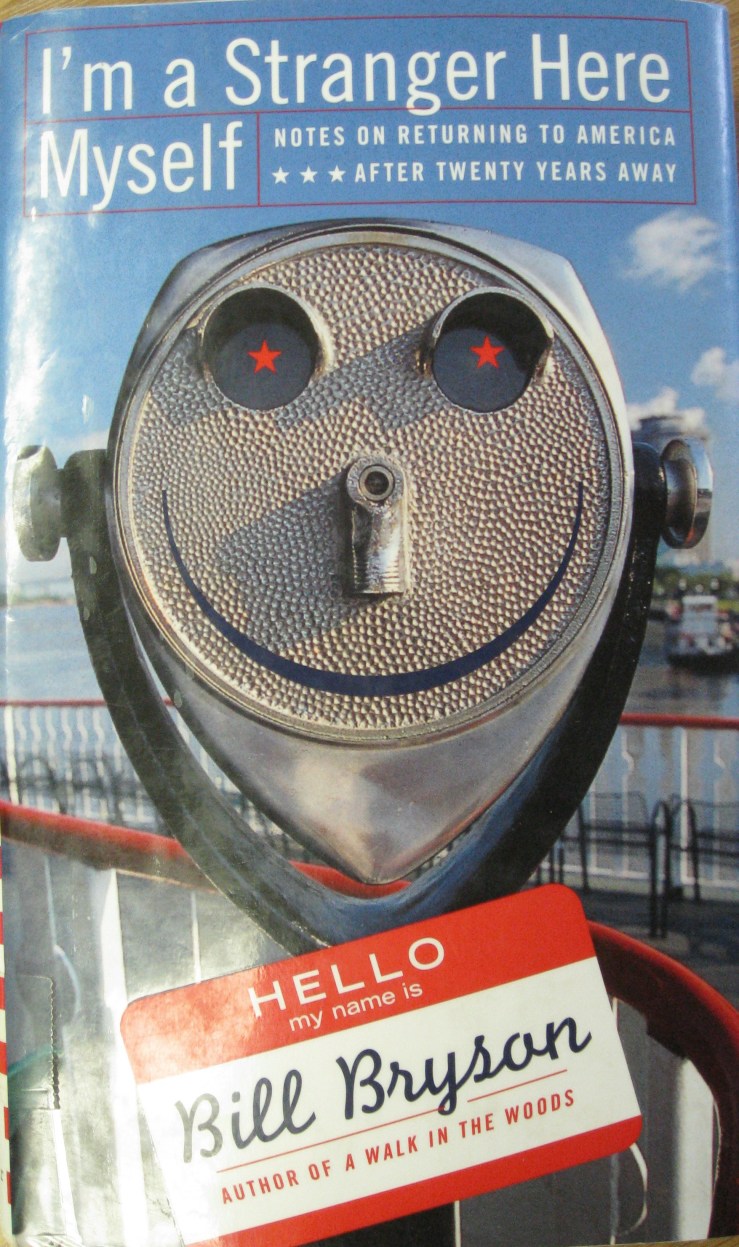
  • I’m a Stranger Here Myself: Notes on Returning to America After Twenty Years Away by Bill Bryson ~ funny, but repetitive!
  • A Family Affair by Rex Stout ~ very strange yet entertaining.
  • Lincoln’s Dreams by Connie Willis ~again, strange but entertaining!
  • Shoeless Joe by W.P. Kinsella ~ okay. I’ll admit it. This one made me cry.
  • ‘Sippi by John Oliver Killens ~ powerful – really, really powerful. That’s all I can really say.
  • Snobs by Julian Fellowes ~ silly story about what happens with you combine boredom with good old fashioned English snobbery.
  • Choice Cuts by Mark Kurlansky ~ really interesting, but a bit dry at times (no pun intended).

For LibraryThing it was the fascinating Honeymoon in Tehran by Azadeh Moaveni (really, really good).

Confession: I started Le Mort d’Arthur and couldn’t deal with neither volume one or two. Just not in the mood for the King, no matter how authoritative the version.

So. 11 books. Two being in the month of November and nine as the cure for what ailed me.

Edited to add: someone asked me to post “the count” at the end of each “— Was” blog. What a great idea. I will be starting that next month – something new to start 2009 with. Thanks, A!

Shoeless Joe

Kinsella, W.P. Shoeless Joe. New York: Ballantine, 1982.

This week of reading seemed to be all about dreams. First, Lincoln’s Dreams by Connie Willis and now Shoeless Joeby W.P. Kinsella. The movie “Field of Dreams” was based on Kinsella’s book. I don’t know if my memory of the the movie chased my reading, but it seemed easier to get through the 224 pages faster than usual.

Ray is a man possessed by love. Love for his family, love for the sprawling farmland of Iowa, and most importantly, love for the game of baseball. It’s this love that makes Ray take chances with all three. Spurred on by a mystical voice Ray builds a left field out in part of his cornfield. But, the voice doesn’t stop there. Soon it has Ray driving to Vermont to kidnap J.D. Salinger and from there the adventure really begins. Battling debt, childhood devils, and indecision Ray leans on his ever-understanding wife (and later, Salinger) to build a cornfield stadium that only a few can understand. It’s a magical story, perfect for Christmastime when the season is all about dreams and believing in the impossible.

Favorite lines: “Mark’s party is bulging with tweed and intellect” (p 47), and ” This is a carnival. People pay to be disappointed” (p 175).

BookLust Twist: In Book Lust and More Book Lust. From Book Lust in the chapter, “Growing Writers” (p 107), and from More Book Lust in the chapter, “Big Ten Country: The Literary Midwest (Iowa)” (p 26).

Lincoln’s Dreams

Willis, Connie. Lincoln’s Dreams. Toronto: Bantam Books, 1987.

Connie Willis typically writes science fiction or fantasy and while Lincoln’s Dreams doesn’t take place in the year 2197 or on the planet Baktakazini, it is equally mind bending and thought provoking. Jeff Johnston is a historical researcher working for a Civil War novelist, Thomas Broun. Broun is obsessed with Abraham Lincoln’s dreams of foreshadowing before his death. Broun goes to great length to analyze them with Jeff’s help. Through his research, Jeff meets Annie, a beautiful Sleep Institute patient who has troubling dreams of her own. Annie has been having dreams not about Robert E. Lee, but AS Robert E. Lee. It’s as if her dreams really are those of Lee’s. Jeff takes it upon himself to not only satisfy the growing obsession Broun has with supporting facts about Lincoln’s dreams but, he also tries to cure Annie of her own Civil War nightmares while falling in love in the process.

Since the bulk of Willis’s storyline centers on Annie having dreams there are a lot of sleep scenes and subsequently the analysis of those dreams. It’s the analysis that I enjoyed the most. The details of the dreams gave life to the Civil War and its participants.

BookLust Twist: From Book Lust in the chapter “Connie Willis: Too Good to Miss” (p 246).

Note:  It is painfully obvious this is a half-assed “review” of sorts. This just goes to show me & myself how out of it we really have been these past few weeks. I have been finished with this book for awhile and never finished this properly. *sigh*

Family Affair

img_4357Stout, Rex. A family Affair. New York: Viking Press, 1975.
When this little book came across my desk I could hardly contain my surprise. First, it’s only 152 pages long. Second, this was the very first time I was seeing Rex Stout’s picture on the dust jacket. I have to admit Jill Krementz took one funky picture of Stout! Incidentally, A Family Affair was Rex Stout’s last book published while he was still alive (he died one month later in October of 1975).

Despite this being a short mystery it certainly had more twists than the usual Rex Stout creation. Told from the point of view of his assistant, Artie, the mystery begins in Wolfe’s own home when his favorite waiter is murdered in his spare room. It’s unheard of for a crime to happen right under his nose. Another strange development is Wolfe’s uncharacteristic emotional outbursts. This is a case he takes very personally – enough to call it “a family affair” and enough for him to spend a night in jail (this coming from a man who never even likes to leave his home)! Because the murder happens in his own home he is more than determined to find the killer before the authorities do, despite not having a client. Typical of other Stout mysteries Wolfe has his beloved orchids and by-the-minute routines and mannerisms. What is different about this particular story is the inclusion of political commentary concerning Nixon and Watergate. Stout displays his displeasure with the political happenings in Washington through Wolfe.

While I didn’t I really didn’t get into the story enough to care how it ended I will say it was nice to read a compact mystery that wasn’t overburdened with subplots and heavy details.

My favorite quotes: “…on the way back there was an open door and I entered. A good detective doesn’t have to be invited” (p 25).
“I am in a rage right now and out of control” (p 30).
“…but I have rules too. No hat before Thanksgiving. Rain or snow is good for hair” (p 49). How odd.

BookLust Twist: From Book Lust in the chapter, “Rex Stout’s Nero Wolfe: Too Good To Miss” (p 228).

I’m a Stranger Here Myself

BrysonBryson, Bill. I’m a Stranger Here Myself: Notes on Returning to America After Twenty Years Away. New York: Broadway Books, 1999.

I was skeptical of this book. The premise is Bryson has been away from American soil for twenty years (living in England) and the book is supposedly his running commentary on how different everything has become. Right off the bat I wanted to ask, “What? They didn’t have ATM machines or public pay phones in England? Not even by the time Mr. Bryson left?” I have to admit, it never crossed my mind that England could be twenty years behind the U.S. in such things as technology and invention.
In actuality, Bryson’s book was, in a word, delightful. I thoroughly enjoyed his opening essay about the differences between English and American postal services. However, for the most part the comparisons ended there. It was more about how nonsensical America could be with it’s rules and regulations. It reminded me of Robert Fulghum with his humorous observations.

Favorite funnies:
“Going to a restaurant is generally a discouraging experience for me because I always manage somehow to antagonize the waitress” (p 13).
“It is all immensely complicated, but essentially it means that practically every team in baseball except the Chicago Cubs gets a chance to go to the World Series” (p 25).
“He converses as if he has heard that someday he will be billed  for it” (p 93). Sounds like my father!

BookLust Twist: From More Book Lustin the chapter, “Bill Bryson: Too Good to Miss” (p 36).