Jerusalem Diet

Besserman, Judith and Emily Budick. The Jerusalem Diet: Guided Imagery and Personal Path to Weight Control. Jerusalem: Green Publishing, 2007.

The very first thing I liked about this book was the statement that it is not a conventional “diet” book. Yay for that! It’s a book about making choices. Sometimes, in the world of nutrition and eating better, it is better to not think in terms of dieting; instead think in terms of getting healthier. Period.
The second thing I liked about this book is the disclaimer about gender. Right in the introduction the subject of why women are ‘targeted’ is addressed. The authors are quick to point out that while men have benefited from their methods, the conversation of this book is directed toward women because a woman’s reasons for dieting differ from a man’s.
Other points made in The Jerusalem Diet seemed to be common sense. A lot of conversation covers emotional eating and how food takes the place of other wants and desires. This is something any dieter has definitely heard before. The recommendation to start a food diary seems commonplace as well. Doesn’t Weight Watchers encourage the same awareness of dietary intake?
The main focus of The Jerusalem Diet is the use of imagery, or guided visualization. Throughout the book there are 43 different imagery exercises to be practiced during both the dieting and maintaining stage of weight loss. The exercises are conveniently indexed in the back as well. There is a pleasant mix of “lecture” and storytelling between exercises. Besserman and Budick share the experiences of their patients, which results in personalizing the “how to-ness” of the rest of the book.
One final addition to the book is a list of soup recipes designed to promote weight loss. It isn’t clear why the program is called the Jerusalem Diet other than the fact Besserman practices in Jerusalem and Budick teaches at the Hebrew University of Jerusalem.

*Disclaimer: while reading The Jerusalem Diet for review I also practiced what it preached to see how effective it was in helping me with my dietary concerns. Stay tuned because I’m still working on it!
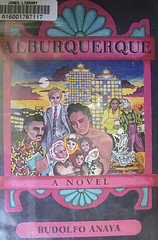

Alburqueque

alburquerque1.jpg

Anaya, Rudolfo. Alburquerque. Alburquerque: University of New Mexico Press, 1992.

My final book of January – chosen to celebrate the month New Mexico became a state. Anaya’s Alburquerque is rich with the culture of New Mexico’s Mexican population. In the center is Abran Gonzalez, a young ex-boxer from Barelas. Upon discovering he is adopted he sets out to learn as much as he can about his birth parents. It is crucial to his understanding of who he really is. Swirling around Abran there is magical realism, cutthroat politics, deep rooted culture, rich history, and tragic romance.
My one complaint – I don’t know why Anaya has Abran have a chance meeting with his birth father in the very first chapter. It seemed a little too coincidental and more than a little cheesy. He is able to come full circle with the same characters at the end. Like I said, a little cheesy.

BookLust Twist: From Book Lust in the chapter simply called, “New Mexico” (p 167).

Everyday Zen

zen.jpg

Beck, Charlotte Joko. Everyday Zen: Love and Work. San Francisco: Haper Collins, 1989.

I had a hard time wrapping my brain around the reading of this book. I think I couldn’t figure out what was bugging me until I realized the reading required more than just my brain. It asked my heart and soul, my beliefs and convictions to get involved. It became a religious thing and that was something I really struggled with in order to read Beck’s book. I admit it – I am a person wrestling with and for a belief. If that bothers you, stop reading right here. I am searching for self-acceptance for what I believe and, ultimately, do NOT have faith in.

I found it insteresting that Beck put the word love in the title of her book because in the chapter specifically on love she states, “love is a word not often mentioned in Buddhist texts. And the love (compassion) they talk about is not an emotion…” (p 71). I had an interesting time coming to terms with that concept.

The other quotes that I took to heart are:
“…the storms of life eventually hit them more lightly. If we can accept things just the way they are we’re not going to be gratly upset by anything. And if we do become upset it’s over more quickly” (p 13).
“We can’t love something we need” (p 39).
“Other people are not me” (p 68).
“Not all problems are as tough as these, but less demanding ones may still send us up the wall with worry” (p 99).

New Words:

  • sesshin
  • zazen
  • koan
  • zendo
  • samadhi

BookLust Twist: From Book Lust in the chapter “Zen Buddhism And Meditation” (p 255).

The Dollmaker

Arnow, Harriette. The Dollmaker. New York: Avon, 1972.

Weighing in at 599 pages this book truly can be called a saga. It’s the story of Gertie Nevens, a simple country woman from Kentucky during World War II. After her husband moves to Detroit, Michigan to find work in the factories, Gertie follows with her five children. Life in the city is cold, dirty, and unkind. Gertie learns of prejudices against “hillbillies” and the importance of the word “adjust”. There is tragedy and triumph with human frailty constantly hanging in the balance. At times I couldn’t believe the hard times Gertie and her family faced. It almost seemed too much to bear. Gertie’s strongest moments are in the very beginning of the book when she has to save her baby from a life threatening illness. After moving from Kentucky it’s as if the city steals Gertie’s strength and spirit.

“…for after the bright whiteness of the hot little room, the cold rain and dark were like old friends” (p 38).
The government owed them at least one man who could fix anything and never got drunk” (p 108).
“‘Are you busy?…Yes and no…I’m in the worst kind of business – tryen to make up my mind'” (p 260).
“She stood, her mind, as always, stumbling around, picking up words, laying them down” (p 538).

BookLust Twist: From More Book Lust and the chapter “Big Ten Country: The Literary Midwest” & the section ‘Michigan’ (p 26).

Funnies (with spoiler)

funniesLennon, J. Robert. The Funnies. New York: Riverhead, 1999.
Tim Mix’s father wrote a comic strip based on his family. Growing up, this comic strip was a source of embarrassment to Tim. Yet, when his father passes away and Tim’s only inheritance is the very comic strip he hated, he decides to try his hand at taking over the strip. Tim is a sarcastic, barely ambitious man who is terrible at conversation, worse at relationships both personal and with his family. This is a formula that always works – the unlikable, unlikely hero goes through a metamorphosis and comes out a pretty decent guy. In the end he doesn’t succeed with the funnies, but he gets the girl.

“This time the pause was longer, a nice slack length of rose to hang the conversation with” (p 52).
“I pushed gently at the sore spot in me and it hurt enough for me to turn away as I talked” (p 132).”
“Susan offered me a bite of her corn dog. I refused, still queasy from the Centrifuge of Death, but didn’t tell her this, and I feared that this rebuff without explanation would give offense. Then I came to my senses and simply let it go. It was a wonderful feeling, like dropping off a box at the Goodwill” (p 155).
And my favorite quote, “I let happiness run its course through me, knowing that it wouldn’t last, but also knowing it would always be there somewhere waiting for me, if I made the effort to find it. This understanding seemed an almost criminally excessive piece of good fortune, but for the time being I accepted it without question” (p 274). For some reason this reminded me of me.

BookLust Twist: From Book Lust twice. Once in the chapter called “Brothers and Sisters” (p 46), and “Families in Trouble” (p83).

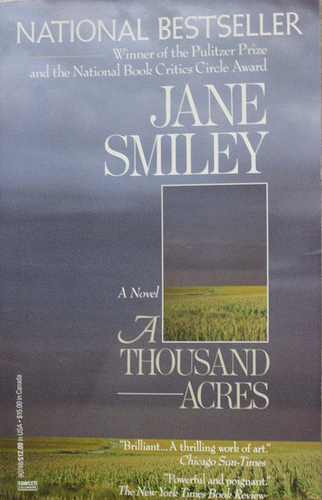
Thousand Acres

acres.jpg

Smiley, Jane. A Thousand Acres. New York: Fawcett Columbine, 1991.

I’ll admit it. It took me forever to even want to read this book even though it has been sitting on my book shelf for months, right within easy reach. I tried picking up Moo a few times and something made me keep putting it down. I have no clue why. I assumed A Thousand Acres would be the same difficult to pick up experience. I was wrong. Once I got into it, Thousand Acres was fascinating, troubling and oh so true to family life. I’ve never lived on a farm. I’ve never set foot in Iowa, but thanks to Smiley I knew exactly what both would be like.
One thing I didn’t understand, nor will I ever, is how a family can so completely and utterly fall apart. By the end of the book not one family is intact and it’s all because of a thousand acres.

“You shouldn’t think somethings changed just because you haven’t seen it in thirteen years” (p 11).
“It was exhausting just to hold ourselves at the table… You felt a palpable sense of relief when you gave up and let yourself fall away from the table and wound up in the kitchen getting something, or in the bathroom running the water and splashing it on your face” (p 101).

BookLust Twist: From More Book Lust and the chapter called “Big Ten Country: The Literary Midwest (Iowa)” (p 27) and Book Lust in the chapter “Growing Writers” (p 107). Personally, I think Pearl also could have put this in her “Families in Trouble” chapter. Not to give anything away but…who tries to poison her own sister? Who does that?

Beyond the Black Stump

Shute, Nevil. Beyond the Black Stump. New York: William Morrow, 1956.

Nancy Pearl likes Nevil Shute. There is a whole chapter on him in More Book Lust. This being my first “Shute book” I was enchanted. Beyond the Black Stump is about an American geologist, Stanton Laird, who is assigned to dig for oil in Australia. Stanton is a stand-up guy with a secret in his past, but when he meets and falls in love with Mollie Regan in the Australian outback, he realizes can’t compete with her past. This is the story of two people too different to make it work. It goes beyond race or religion. Prejudices and historical resentments run deep for both families. Despite the plot being predictable I enjoyed getting to the conclusion no matter how obvious it would be.

“It’s the greed for the gold, the curse of the modern age. Avarice kills more men than any physical disease, I am afraid. These men will not make old bones” (p 136).

BookLust Twist: From More Book Lust and the chapter “Nevil Shute: Too Good To Miss” (p 199).

Always Outnumbered


Mosley, Walter. Always Outnumbered, Always Outgunned. New York: W.W. Norton, 1998.

Always Outnumbered, Always Outgunned is like looking at snapshots of one man’s existence. Each chapter is a different time in Socrates Fortlow’s life, a different picture. His past, his friends, and his skewed sense of morality are the common threads in each scene. Socrates is a man, free after 28 years in prison, trying to make his way in Los Angeles, California. The violent streak that landed him in the penitentiary is still prominent in his personality. He is an angel and a devil all in one. A saint with a dark side. A demon with a halo. My favorite example of this split personality is when a friend’s wife comes looking for her husband at Socrates’s door. While telling Corrine she should leave her no-good husband (and be with Socrates) that same no-good husband is hiding out in Socrates’s back room.

Some of my favorite quotes describing Socrates:
“Back then he enjoyed the company of fear” (p 19).
“He wasn’t a thief. Or, if he was, the only thing he ever took was life” (p 64).

BookLust Twist: from More Book Lust and the chapter “Walter Mosley: Too Good To miss” (p 169). Happy Birthday Mr. Mosley!

Appointment in Samarra

appointment in samarraO’Hara John. Appointment in Samarra. New York: Vintage, 2003.

In honor of Pennsylvania becoming a state in the month of December Appointment in Samarra was my first novel pick. I was excited to see the introduction was written by John Updike. He is another author I have enjoyed over the years. Set in the 1930’s with a keen eye on society, O’Hara tells the story of Caroline & Julian English and their how their elite status is washed away with alcohol and attitude. In an instance the English couple go from being the toast of the town to the talk of trash.

“I love you more than a tongue can tell” (p 63).
“…their position in Gibbsville was just that certain and insecure…” (p 83).
“…she was too conscious of looking like the wrath of God to enjoy any of it” (p 121).
“The worst of that drive was that the sun glare on the snow made you smile before you were ready” (p 200).

As an aside: I don’t remember where I was when I learned that the Lenape Indians believed the turtle was the center of the universe. To this day, it remains the only thing I know about this particular tribe. It was interesting to see O’Hara mention the tribe in his historical ancestry of the English family.

BookLust Twist: From More Book Lust in the chapter “Big Ten Country: The Literary Midwest (Pennsylvania)” (p 30). 

Africa News Cookbook

Africa News Service, Inc. The African News Cookbook: African Cooking for Western Kitchens. New York: Penguin, 1986.African cookbook

Another BookLust pick. There is something magical about this book. Maybe it’s from the introduction, “Cooking by the book is not the African way” (p.xiii). It’s romantic to learn the ingredients, forget the recipe and go with the heart; that’s what this book seems to be telling me.
On a serious side it’s crammed with interesting facts usually not associated with a cookbook. For starters there is a list of African nations and their capitals. Because this cookbook focuses on a geographical location there are maps. Because it focuses on a culture there are stories about African Women and food, and even how to eat with joy.
Probably my favorite aspect of this cookbook is the recognition of the origin of each recipe. From Malawi comes Masamba; from Algeria comes Dess b’l-besla. I think of Aubrey from Malawi who would write letters on onion paper and dream of traveling to Algeria.

BookLust Twist: From More Book Lust under the category of, “Africa: A Reader’s Itinerary” (p.2)