Cancer Come Get Me

Carver, Raymond. “What the Doctor Said.” All of Us, New York: Vintage Contemporaries, 2000.

“What the Doctor Said” is about a patient receiving word from his (?) doctor that he has cancer, a cancer so lethal the doctor “stopped counting” the tumors on one lung. You can’t pray but it won’t make a difference. It’s heart breaking and stark. The message is beyond clear. You. Are. Going. To. Die. No bones about it. No hope. No cure. No way out. Imagine that. You are D-E-A-D.

This poem is perfect timing for me. I have mentioned before I have signed up for a cancer walk. 60 miles in three days. The attitude is yeah-yeah another charity. I’ve even gotten an eye roll. I hear the words: So what? Big freakin’ deal. I shouldn’t take it personally, but it still amazes me. No one has asked how they can help. No one has asked ‘how can we donate to the cause?’ They can’t wrap their brains around the fact that this walk could save a life. This walk, this dollar donated might make a difference. It’s amazing. It’s as if the world has become cynical enough to say “you won’t make a difference so I won’t throw my money away.”

What happens when you get a life threatening illness? What happens when you are told you will die? How does it make you feel to have someone say it won’t help you? The attitude is “so why don’t you go ahead and die? It will be painful but just die because I can’t make a difference. I won’t make a difference.”

Drives me nuts.
Tract

Williams, William Carlos. “Tract.” The Collected Earlier Poems of William Carlos Williams. New York: New Directions, 1951.

This is an ashes to ashes, dust to dust kind of poem. Williams is pleading with his community to spare the glitz and glamour when it comes to burying the dead. He believes in sending a body back to the earth in the simplest way possible. A gentle return, if you will. He asks that his townspeople remember the person for who they were and not who they wanted to be. Do not remember them by the status they kept in society, but rather by the things the departed held dear. Share emotions like grief for they are the true gifts of mourning.

BookLust Twist: In More Book Lust in the chapter, “Poetry Pleasers” (p 189).

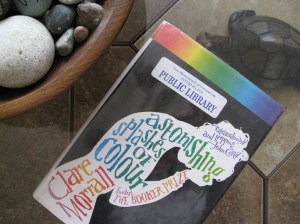
Astonishing Splashes of Colour

MorrallMorrall, Clare. Astonishing Splashes of Colour. New York:  Harper Collins, 2004.


This is the kind of book I could read a thousand times over. This is the style of writing I most identify with. Astonishing Splashes of Colour is so intimate and in-your-face I feel as if Morrall’s main character, Kitty, is leaning in to tell me deep and dark secrets, stories of embarrassing moments, and airing her dirty laundry with a wave of her hand and an air of factual nonchalance. She makes me squirm with her frankness, her vulnerability. Helpless and hopeless, Kitty is the me in the mirror.

Kitty is a thirty-something with something to hide. Her past has as many demons and devils as it does angels. Losing her mother at three years old, the knowledge of an older sister who ran away from home, the fact having four brothers who not only are disconnected from one another but only pretend to be connected to her, the frustrations of having a father who loses himself in painting and has episodes of pouting, the confusion of having an excessively neat husband who lives across the hall in a separate apartment, the heartbreak of a miscarriage Kitty insists on waiting for after school…then there are the colors. Kitty has the uncanny ability to see human emotion, human circumstance as a myriad of color. Her world is not black and white sane, but rather a rainbow of mental chaos. As if all this wasn’t enough everything turns out different from what one would expect. I couldn’t put it down…

Lines I can relate to: “I fight back a wave of giggles that threatens to ripple through me” (p 63). I laugh at inappropriate moments, too.
“I can’t decide which is worse, to not have a mother, or to not have children. An empty space in both directions. No backwards, no forwards” (p 65).
“I would have books around me even if I were blind. I need the smell” (p 138).

There are, of course, many more lines I could quote. This novel, this flash of brilliance definitely resonated with me.

BookLust Twist: From More Book Lust in the chapter called, “Sibs” (p 201).

Table Talk

table talk
Stevens, Wallace. “Table Talk.” Opus Posthumous. New York: Alfred A. Knopf, 1957.

I like the first line best, “Granted, we die for good.” I can just imagine two people sitting around a kitchen table talking about why they like certain things and how it all matters only when you are alive. While all poetry can be manipulated to suit the reader, I believe that Wallace’s philosophical nature comes through in “Table Talk.” There is an awareness to the good things in life; the joys of being alive. It’s almost as if this poem is more than good timing.

BookLust Twist: From More Book Lust in the chapter “Poetry Pleasers” (p 189).

I Go Back

Olds, Sharon. “I Go Back to May 1937.” The Gold Cell. New York: Alfred A. Knopf, 1987.

I must have read “I Go back to May 1937” a dozen times. It’s so personal, so haunting, so intriguing. The narrator (presumably Olds) wishes she could go back to the time just before her parents got married just so she could stop them from getting that together. She wants to warn them of the hurt they will cause each other and their child. Instinctively you want to know more – hurt each other how? Physically? Mentally? Is she talking about divorce? She does say “he is the wrong man.” But!But.But, to stop her parents from falling in love and getting married is to undo her very existence. It’s a dilemma of curious proportions.

BookLust Twist: From More Book Lust in the chapter, “Poetry Pleasers” (p 189).

Industrial Valley

Kitty readsMcKenney, Ruth. Industrial Valley. New York: Harcourt, Brace & Co, 1939.
I love first editions of books. I don’t know why. As a rule I don’t collect books based on what edition they are, first or last. Generally, I like books for what is between the covers. Still. I can’t help but be a little excited by reading the first edition of Industrial Valley. Please don’t ask me why.

The controversy surrounding Industrial Valley reminded me of the controversy Billy Joel faced when he wrote “Allentown.” In the begining townspeople didn’t really care too much for Joel’s bleak description of factory life. Yet, it was the truth. Ashamed or proud, that’s how it was. Same with Akron, Ohio. “Rubbertown” as some would call it.
Industrial Valley was written in a diary-like format. Near daily events, both political and social, between January 1, 1932 and March 21, 1936, recount Akron’s depressed economic state. Some entries seem unrelated to the depression (a boy’s death after being hit by a truck) while others hammer home the effect the ecomony had on daily life in an obvious manner (the suicide of a man who couldn’t feed his family). In the end, it was the historic Goodyear strike that changed the industrial climate. Democracy reined.

Favorite lines: “The bitter realities of unemployment and salary cuts conquered, in the end, any sophorific West Hill could imbibe” (p 60).
“All of Akron jumped like a housewife getting a shock from a loose electric wire on her washing machine” (p 219).

BookLust Twist: From More Book Lust in the chapter, “Big Ten Country: The Literary Miswest (Ohio)” (p 29).

Drowning Season

Hoffman, Alice. The Drowning Season. New York: E.P. Dutton, 1979.

When I first started reading The Drowning Season I was reminded of Yellow Raft in Blue Water by Michael Dorris. Not for the style of writing, the use of language – but rather, the struggle between females within a family. In Yellow Raft you think you should despise the mother because of how she leaves her child. Then you learn of the mother’s past and you think you should hate the grandmother..until you hear her story. It’s all in the hands of perception. Same with The Drowning Season. Esther the Black was born to hate her grandmother. Her father named her as an insult to his mother, Esther the White. Everyone knows you don’t name a child after the living, only the dead. Because Esther the White rules the family with harsh words and a hating heart, even insisting that the family live in seclusion, Esther the Black has had a compromised upbringing. She longs for the day when she can escape not only Long Island, but her grandmother as well. But, then there is the grandmother’s view of the world. She bears resentment for having to raise her son’s child while he fantasizes about suicide every summer and his wife tilts the gin bottle back a little too often. Each generation, grandmother and granddaughter, has her own demons to battle. The Drowning Season is the story of how they go to battle against each other and eventually, when love conquers all, for each other.  

Favorite lines: “Phillip had named his daughter on a hot August day, with an ancient hostility and a smile” (p 5).
“And the beatings began when the house grew too small with winter…” (p49).
“Esther the Black was silent; she wished she could cry, but the sadness never seemed to reach her eyes – it stuck in her throat, unable to be moved” (p 196). 

BookLust Twist: From Book Lust in the chapter called, “A…My Name is Alice” (p 1) and the chapter called, “Families in Trouble” (p 82).

Lone Star

Fehrenbach, T.R., Lone Star: a History of Texas and the Texans. New York: American Legacy Press, 1983.

I had to keep reminding myself Fehrenbach was not actually in Texas 40,000 years ago because his book, Lone Staris so detailed, so expansive that it felt like he should have been. In 719 pages Fehrenbach details every aspect of Texas one could imagine. From practically primordial beginnings to present day the birth, growth and development of Texas is detailed. Everything from agriculture, architecture and attitude to wars (civil and great) is meticulously described. Other reviews have used the words expansive, panoramic, extensive, vast, comprehensive, detailed…and I would have to agree. Not a stone in Texas is left unturned when it comes to recounting the political, the people, the powers, the progression of the state. What sets this book apart from other histories of Texas is the fact that Fehrenbach is from Texas. One can hear the passion for his home state woven into every knowledgeable sentence.

Favorite quotes: “Yet, such is human ingenuity that no other species ever used the resources of a country more fully: the Coahuiltecans consumed spiders, ant eggs, lizards, rattlesnakes, worms, insects, rotting wood, and deer dung” (p 14), and “…a citizen army had won battles, but it could not be used by its government as an instrument of policy during the peace” (p 243).

BookLust Twist: From Book Lust in the chapter, “Texas: A Lone Star State of Mind” (p 233).

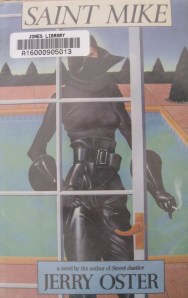
Saint Mike

saint mikeOster, Jerry. Saint Mike. New York: Harper & Row, 1987.

I love it when a book has me scratching my head and asking why in the first chapter. In Saint Mike it actually took the last paragraph at the end of the first chapter before the “huh?” kicked in, but just imagine this: two knights jousting in a field. At the end of the battle one of the knights unscrews his sword to reveal a vial of cocaine. After a good snort he gives it to his jousting mate and tells him they’ll get breakfast afterwards. The kicker is, the scene is neither here nor there in the overall description of the book as described by Nancy Peal in Book Lust, “When Susan Van Meter’s federal narcotics investigator husband is found murdered…she leaves her research position and takes on the task of tracking down and bringing to justice the murderer” (p 6).
I enjoyed every page of Saint Mike. With such a heavy plot (drugs, murder, avenging wife, federal agents) I didn’t expect such playful, witty, sexy language. Granted, there are some really weird scenes (yes, the armor comes back and someone dies by the sword in the most unusual way, but that’s all I’ll say about that). Overall it was an entertaining, fast read.

Favorite scene: I urge every parent of a child on the verge of becoming a teenager to read pages 12-14. Susan is trying to get her daughter up for breakfast, “The sound of drugs and drug paraphernalia and semiautomatic weapons being thrown out the window” (p 13). It’s hysterical.
Favorite line: “Rita tossed her head like a fandango dancer. “It is not just the penis that is flawed; it is the whole organism.”” (p 15).

BookLust Twist: From Book Lust in the chapter called, “Action Heroines” (p 5).

Bethlehem Road Murder

Gur, Batya. Bethlehem Road Murder. New York: Harper Collins, 2004.

I have a confession to make. Bethlehem Road Murder is the last book in a series recommended by Pearl. I should have read this one last. Dead last. Instead I read it first. Oh well.

I read Bethlehem Road Murder at the same time as The Concubine’s Tattoo and immediately I was struck by a huge similarity between the two stories (besides the fact they are from the same chapter in More Book Lust). Both books are centered around the murder of a woman. Both women were strikingly young and beautiful. Both women had experience as fighters (one in the army, one as a samurai). Both women had secret lovers and complicated histories. Both women were in the early stages of pregnancy at the time of death (which always throws a wrench into the question of motive).

Bethlehem Road Murder takes place in Jerusalem in a community locked in the ancient culture of Israeli society. They have their own way of governing; their own way of thinking. In the middle of this community lies a mystery. A beautiful woman is brutally murdered. Chief Superintendent Michael Ohayon must investigate the crime and solve the mystery while keeping within in line with the constraints of the rules of a close-knit community. Political and religion tensions between Jews and Arabs only serve to complicate the case. Of course, no murder mystery would not be complete without a little romantic intrigue and psychological guess work. Gur does not disappoint.

Favorite lines: “Each time he stood over a corpse…he imagined he felt every bone of his body and his skull laughing derisively beneath his flesh” (p 7). “Don’t you know that all real estate agents are crooks?” (p 9). I had to laugh at that one because just having gone through the process of buying a house for the first time my realtor is a saint!

Note: I think this was the first book I have ever read that included a no-nonsense account of most every detail of an autopsy.

BookLust Twist: In More Book Lust in the chapter called, “Crime is a Globetrotter: Israel” (p 58).

Daniel Plainway

Reid, Van. Daniel Plainway, or, the Holiday Haunting of the Moosepath League. New York: Viking, 2000.

 One of the reasons why I love reading books that take place in Maine is because I can identify with most of the locations. Another reason is that sometimes I get to reconnect to a place I haven’t thought about (or heard about) in years. Such is the case with Veazie, Maine.

How to describe this book? I think I’m a little thrown off because Daniel Plainway is part of a series (of which I didn’t read the first or even second book). It’s like coming into a discussion when it’s two-thirds over. Daniel Plainway is a Maine country lawyer who is trying to solve the mystery of the disappearance of a neighboring family. When a portrait of his neighbor’s daughter is rediscovered, Daniel begins a journey that changes his life. Along the way he meets the members of the Moosepath League and that’s when the fun really begins.
Reid writes with hilarity. One of my favorite scenes is when there is an attempted robbery of the Moosepath League members. The robber, young and inexperienced, fumbles with the gun, slips on the ice and snow, and somehow hands his gun over to a member of the Moosepath League, knocking himself and the others down. The League members do not realize they are being robbed and try to give the man back his gun and offer him money for his troubles – for they think they are responsible for knocking the young man over. “He considered Thump’s card through a blur of tears, realizing that he had just tried to rob three men, and in return they might have saved his life” (p 51).
Another great scene is when the members of the Moosepath League are trying to deliver a letter. There is great confusion as to exactly who the letter should go to. In the end, after they think they has successfully did their duty, they do not know how to leave, “There mission completed (however unpleasantly) the members of the club wondered, in collective silence, if they should be moving on to other things, primarily any other things that would take them some distance from the present scene” (p 92).

Favorite singular lines: “Gerald Pinkney and Daniel Plainway had known each other since their days at Colby, and Daniel had always thought of Gerald as a slightly antagonized bee” (p 16). I just love the imagery of this “slightly antagonized bee.”
“Those quickest to kindness are also quickest to forget when they are kind” (p 94).

BookLust Twist: In Book Lustin the chapter, “Van Reid and the Moosepath League: Too Good To Miss” (p 199).

Concubine’s Tattoo

Rowland, Laura Joh. The Concubine’s Tattoo. New York: St. Martin’s Press, 1998.

In addition to being a great 17th century Japanese murder mystery The Concubine’s Tattoo is a commentary on honor and relationships. Sano Ichirois the shogun’s investigator who has recently celebrated an arranged marriage. In both his professional and personal life Sano must balance a code of conduct that is morally, politically and, of course, honorably sound. Sano’s latest case (on the night of his wedding no less) is the murder of the shogun’s favorite concubine. Entwined in this murder are complications concerning an heir, long standing cultural differences and rivalries. Rowland displays Sano’s progress on the case through the eyes of Sano’s new wife Reiko, his enemy Chamberlain Yanagisawa, his partner Hirata, and Sano himself as well as many other fascinating characters. One of the best enjoyments of Rowland’s book is her vivid, descriptive use of imagery. The details are so sensuous and alluring. They exquisitely cater to all five senses. Here are two quotes I particularly liked, “Her voice was a husky murmur that insinuated its way into Hirata’s mind like a dark, intoxicating smoke” (p 86), and “The cold air had a lung-saturating dampness” (p 166). 

One other detail I thought I should point out – Rowland is not afraid to describe vivid sex scenes of varying natures. Man on man, woman on woman, husband and wife, illicit seductions, and even rape. The scenes while reminiscent of lusty bodice-rippers are not overly flowery or “heaving.”

BookLust Twist: In More Book Lust in the chapter called, “Crime is a Globetrotter: China” (p 60).

Color Purple

Walker, Alice. The Color Purple. New York: Pocket Books, 1982.

To put this on the list is either to admit I never read it before or I don’t remember it. Those are the rules. Supposedly. Only this time it’s different. I chose to reread The Color Purple out of respect…and to get from under the sugar rush I got from other books I’ve read this month. Let’s face it, there is not much sweetness and light in The Color Purple.
Alice Walker has a masterful voice. Just by starting chapters “Dear God” the voice evokes prayer, a quiet kind of desperation. It’s even worse when it’s coming from a child in the beginning. Most people start uttering “dear God” when things turn bad and for Walker’s main character, Celie, it’s always bad. From the very first chapter you learn she is being raped by her own father, tolerating pregnancies and beatings while taking care of her siblings, only to be sold off to a man who does exactly the same. Different man, different children to take care of – same struggles to survive. Yet, Celie is clever, strong and more importantly, resilient. She knows how to make it through the toughest of times. She even learns how to blossom when Shug Avery, her husband’s lover, comes to town. She discovers love, sexuality, and a sense of self.

Favorite lines: “Sometimes he still be looking at Nettie, but I always git in his light” (p 6).
“Like more us then us is ourself” (p 14).
“His little whistle sound like it lost way down in a jar, and the jar in the bottom of the creek” (p 71). Love that imagery!

BookLust Twist: In Book Lust twice: in the very first chapter called, “A…My Name is Alice (p 2), and “African American Fiction: She Say” (p 12).

Powers That Be

Halberstam, David. The Powers That Be. New York: Alfred A Knopf, 1979.

When I told a friend I was reading this as my last February book his eyes lit up – said that Halberstam was one of his favorites, “for the sheer irony of him.” Whatever that means.

Despite its heft (being 771 pages long), The Powers That Be was an extremely entertaining read. But, I have to confess I ran out of February and didn’t finish it in time. Back to the book: Halberstam’s style of writing is intimate. It is as if he is taking his reader into his confidences – leaning in to tell the reader secrets in a hushed, yet knowledgeable voice. His prose is not gossipy, but rather matter of fact. Yet, there is a hint of society tell-all about it. In one particular section Halberstam states Edward Murrow was “ungodly handsome” (p 40), but then does not offer proof by way of pictures or real description. The reader simply has to take his word for it (luckily I’m old enough to remember what Murrow looked like). Halberstam deftly wraps the political and economic climates around the historical who, what, where, when and why of all media giants. Events like the Great Depression, World War II, the Cold War, Communism, and Vietnam all played a crucial part in influencing print, radio and television communications. How the world received information changed all landscapes – political, economic, social, forever.

BookLust Twist: Mentioned twice in More Book Lust. First in the chapter called, “The Fourth Estate” (p 92) and in the chapter, “David Halberstam: Too Good To Miss” (p 112).

Cult of Personality

Paul, Annie Murphy. The Cult of Personality: How Personality Tests are Leading Us to Miseducate Our Children, Mismanage Our Companies, and Misunderstand Ourselves. New York: Free Press, 2004.

Okay. How many of us think of a well toned guy with long hair jumping around in bright colored spandex when we hear the words “cult of personality”? Am I the only one who thinks fondly back to Living Colour days? Probably. I’m showing my age.

At any rate, the book The Cult of Personalityby Annie Murphy Paul is compelling. Fearing it to be a dry, psychology “talk-shop” laden lecture on personality tests I read it along side a fictional psycho-babble book. Oddly enough, I found the nonfiction just as interesting as the fiction. Paul’s book didn’t need the fictional bells and whistles to be a page-turner. Paul has a style of writing that is reminiscent of Halberstam such that you feel as if you are getting good society gossip (like the details of a juicy affair) along with the cut and dried information on how a test was conceived.

BookLust Twist: In More Book Lust in the chapter called, “Dewey Deconstructed” (p 62).