Wake Up, Darlin’ Corey

Wren, M.K. Wake Up, Darlin’ Corey. New York: Doubleday & Company, 1984.

Reason read: Wake Up, Darlin’ Corey was published in January of 1984.

Wake Up, Darlin’ Corey is a super fast read and the premise is pretty simple as well. Conan Flagg is primarily a bookseller with a private investigator hobby on the side. This time he is investigating the death of his friend, Corey Benbow. Young, vivacious Corey was found dead after a suspicious car accident. Toxicology reports reveal a lack of alcohol or drugs in her system and there were no skid marks at the scene…so was it suicide? Conan doesn’t think so. To make matters worse, the police seem to be wrapping up the case too quickly (no official autopsy?). Considering the number of Corey’s inlaws who stood to gain something from her disappearing permanently, Conan sets out to discredit alibis and sort out motives. The only negative about this story was the sheer number of characters for such a short book.

Note: Since I didn’t find a lot to quote, I wanted to draw attention to the title of the book. Wren quotes an old folk song of the same name (“Darlin’ Cory”). Since the lyrics were so in line with the story I just had to check it out and I’m so glad I did! This is a really cool song. Lots of great artists have covered it over the years: Bruce Hornsby, Bill Monroe, Pete Seeger and Bob Weir, to name a few.

Author fact: Wren also wrote King of the Mountain which I will be reading in February 2037 for the Challenge.

Book trivia: Wake Up Darlin’ Corey is short, only 180 pages long.

Nancy said: “The mystery shelves are packed with tales set in Cascadia” (p 153) and mentions Wake Up, Darlin’ Corey as one such mystery.

BookLust Twist: from More Book Lust in the chapter called “Living High in Cascadia” (p 148).
Brain Food

Mosconi, Lisa. Brain Food: the Surprising Science of Eating for Cognitive Power. New York: Avery, 2018.

Reason read: as a member of the Early Review Program for LibraryThing…

I admit it. I underline passages in my books. I mark them up, make notes in the margins, circle and highlight. With Mosconi’s Brain Food I was doing a lot of all of that. Pages upon pages were worthy of notation; simply chock full of interesting information. To say that I had several ah-ha moments is an understatement. Those moments were like finally figuring out how to get out of a maze; driving a tangle of street before you finally find a sign for the highway. Like listening to a foreign language and it’s all garbled until you hear that one word you can translate and then the entire sentence becomes clear. What Mosconi is trying to relate makes sense. There is just a lot to process.
But, here’s another element to Brain Food that I didn’t expect. Mosconi makes the information so compelling that you want to listen to it and what’s more, follow it. Case in point: how many times have you heard about the benefits of drinking more water? Me too. Except it never sunk in. No matter how many times I heard the about the science of staying hydrated, it never prompted me to fill the water bottle a second time. Something about Mosconi’s writing made me sit up and take notice. Something she said finally resonated with me. I may only fill the water bottle a second time, but that’s a start.
I think what makes Mosconi’s book different is her approach. The language is not snooty, doctor on high advice. Her tone isn’t didactic or preachy. She simply tells it like it is. She makes it personal and the information, approachable.
Bonus points for the quiz on dietary brain health and the recipes.

What Did It Mean?

Thirkell, Angela. What did It Mean? . New York: Alfred A. Knopf, 1954.

Reason read: Thirkell was born on January 30th and interestingly enough, died on January 29th seventy one years later. Read What Did It Mean? in her honor.

From the onset, I didn’t think I would care for What Did It Mean?. Before the reader gets ten pages in he or she is introduced to a myriad of characters with no clue as to their importance to the plot. I had to start a list and was constantly wondering if I needed to remember these people later on. The plot itself centers around the Coronation of Queen Elizabeth II. Everyone is frantically planning complicated festivities through various committees. Of course, every member has ulterior motives and the main objective is often forgotten in the frenzy. With there being so many different characters, it is a study in society as much as it is about a specific locale, Barsetshire. I couldn’t help it but I found myself getting bored.

The only line I liked, “The Women’s Institutes and the Townswomen’s Guild became as sisters, though always reserving the right of a sister to dislike a sister wholeheartedly (p 7).

Author fact: Thirkell also wrote Pomfret Towers: a Novel which is on my Challenge list. Sigh.
Author gossip: According to Thirkell’s Wikipedia page, Thirkell left her second husband in Australia under the guise of going on holiday to England when, in reality, she was leaving for good. To be fair, Thirkell’s first husband insisted on naming their first child after a former lover.

Book trivia: What Did It Mean is one of almost 30 books in the Barsetshire Chronicles (yes, Anthony Trollope’s fictional Barsetshire).

Nancy said: Nancy had a lot to say about Thirkell’s writing in general, but nothing specific about What Did It Mean? Probably the most interesting comment Pearl had about Thirkell is the “appallingly nasty things” Thirkell had her characters utter.

BookLust Twist: from Book Lust in the chapter called “Barsetshire and Beyond” (p 15).

Practicing History

Tuchman, Barbara. Practicing History: Selected Essays. Read by Wanda McCaddon.  Ashland, OR: Blackstone Audio, 2009.

Reason read: Tuchman’s birth month is in January.

Right off the bat I have to admit some of my cds skipped while listening to the audio version of Practicing History so I missed some parts. Then, and this is even more embarrassing, I found myself tuning out from time to time. McCaddon’s voice had that Charlie Brown’s teacher effect on me.

Unlike Nero Wolfe of West Thirty Fifth Street by William Baring-Gould, which I believe should be read after completing the Rex Stout mysteries, Practicing History should be read before Tuchman’s other books. The first part of Practicing History, “The Craft,” is Tuchman’s way of explaining how she wrote her books without giving too much away. She makes it possible to look forward to reading The March of Folly and Proud Tower with anticipation.
The second part of Practicing History, called “The Yield” presents various topics from different articles she has written over the years (Japan, the Spanish Civil War, Woodrow Wilson and the Six-Day War in the middle east). The third and final part of Practicing History includes editorials on the Vietnam War, Watergate and how we can learn from history if one would only listen. We have a hard time doing that as a nation. Why start now?
Tuchman always writes with sharp wit and humor. Practicing History is no different and does not disappoint.

Favorite quote, “To a historian libraries are food, shelter, and even muse” (p 76). I like this sentence so much I thought I was going to stop there. But, then I found this one: “Women being child bearers, have a primary instinct to preserve life. Probably if we had a woman in the White House and a majority of females in Congress, we could be out of Vietnam yesterday” (p 264). Swap Vietnam for any war torn country in the middle east and that statement is true today.

Author fact: I have seven Tuchman books on my Challenge list. After finishing Practicing History I will be halfway through the list.

Book trivia: Because these are simply Tuchman’s essays there isn’t an index or bibliography to support the narrative.

Nancy said: Nancy said Tuchman explains her thoughts about her craft in Practicing History (p 225).

BookLust Twist: from More Book Lust in the obvious chapter, “Barbara Tuchman: Too Good To Miss” (p 224).

Pep Talks for Writers

Faukner, Grant. Pep Talk for Writers: 50 Insights and Actions to Boost Your Create Mojo. San Francisco: Chronicle Books. 2017.

Reason read: an Early Review for LibraryThing.

Confessional: part of the reason why I requested this book is because of the publisher alone. I admit it, Chronicle is one of my favorites.

When one thinks of a pep talk a didactic three hour seminar or an intense workshop that goes on for days usually does not come to mind. Instead one thinks of an arm-around-the-shoulder delivery of friendly words of encouragement. Cheer leading in the form of an overly optimistic You-Can-Do-It! attitude. That is exactly what you will get with Pep Talk for Writers by Grant Faulkner. 52 pep talks with a little infomercial about the National Novel Writing Month built in for good measure (more on that later). Faulkner’s advice giving approach is friendly, unassuming, and at times even comical. All he really wants to do is unblock your creativity and get you back to writing something… anything. This is the type of book you can buzz through quickly the first time around and then return to for slower savoring when you have more time..like when you are really truly stuck. Faulkner even designs his book that way. In the back lists the problems you might be having and the pages to flip to for possible resolutions. There is no heavy scrutiny of writing technique, no prose bogged down with researched factoids. The advice is simple, bordering on common sense. Be prepared – he draws a lot from what other writers do. Name dropping is a favorite pastime of Faulkner’s.
Now, about that infomercial: Faulkner does mention the National Novel Writing Month (NaNoWriMo) of which he is the Executive Director many, many, many times. So much so that I was surprised he didn’t include information inviting writers (and wannabes) to get involved with NaNoWriMo next November.

Author fact: Grant Faulkner is the executive director of National Novel Writing Month. I said that already.
As an aside, November is National Novel Writing Month (NaNoWriMo). Said that already, too.

Book trivia: 52 chapters implies 52 weeks of writing advice. If you can’t get rid of your writer’s block in a year’s time there might be something else going on with you. Just saying.

Tea From an Empty Cup

Cadigan, Pat. Tea From an Empty Cup. New York: Tom Doherty Associates, 1998.

Reason read: Read in honor of January is Drink Tea month even though this has nothing to do with the beverage.

I have admitted this before, science fiction is usually not my cup of tea. Or in this case, an empty cup is completely accurate. I made an exception with Willis’s Doomsday Book because it was clever and, more importantly, there was substantial character development. I had a hard time drinking in Cadigan’s Tea From an Empty Cup because it was missing the element that matters most to me – the character development. I ended up not really caring about a single character. Unfortunately, that made the ending bitter and hard to swallow.
The premise is simple, a young man is found murdered with his throat slashed. He isn’t the only victim but for homicide detective Dore Konstatin, it is important enough that she dons the victim’s ‘skin suit and enters the artificial reality of Nee Yawk Sitty, the apocalyptic cyberspace playground. She needs to play the same game Tomoyuki Iguchi played before he died. She needs to be him before he died. Her first lead is an allusive witness by the name of Body Sativa. Meanwhile, Tom’s friend, Yuki, is trying to uncover the same mystery.
Confessional: At first I thought this was a science fiction erotica story. The references to sex come quickly and often (pun completely intended).

No quotes to quote.

Author fact: Cadigan is famous for his science fiction.

Book trivia: Tea From an Empty Cup is dedicated to five different people. I wish I knew why. They all seem like very important people, though!

Nancy said: Nancy said Tea From an Empty Cup is “a great example of melding of science fiction with postmodernism” (p 69).

BookLust Twist: from Book Lust in the chapter called “Cyberspace.Com” (p 69).

Mrs. Pollifax and the Golden Triangle

Gilman, Dorothy. Mrs. Pollifax and the Golden Triangle. New York: Doubleday, 1988.

Reason read: I started the Mrs. Pollifax series in September 2017 in honor of Grandparents Day. This is the last book I am reading for the series.

The one word for Mrs. Polllifax: gullible. Either that or the one word for the CIA is inept. Not sure which is more accurate. Emily and her new husband Cyrus are headed to Thailand for a little rest & relaxation; a real vacation without an ulterior motive. After their fiasco in China, they needed a break from all things dark and dangerous. They are all set to head out the door when who should catch wind of their trip, but old friend Bishop, and who should need a favor, but the old CIA. It sounds simple enough – all Bishop needs is for Emily to drop off a package for an informant and in exchange, receive some top secret information too important to send in a letter. What could possibly go wrong? If you have been paying attention to Emily Pollifax’s adventure you already know…a lot. This time, it’s Cyrus who goes missing. Never mess with a feisty woman when her man is kidnapped!

One quote to mention, “Like a toy flower dropped into a glass of water, Mrs. Pollifax felt herself expanding and flowering” (p 19).
Here’s one more, “…one could never know the traumas that such people; everyone carried around with them their own particular defenses, antagonisms, secrets and uncertainties…” (p 136). Very true.

Author fact: So far, I have told you this about Dorothy Gilman: She was born in New Brunswick, New Jersey and she lived in Maine at some point in her life. Since this is my last Mrs. Pollifax book it’s only fitting to tell you Dorothy Gilman died in 2012 on my birthday.

Book trivia: The Golden Triangle is short, short, short. Doesn’t even make it to 190 pages long.

Nancy said: nothing worth mentioning.

BookLust Twist: from Book Lust To Go in the chapter called Thai Tales (p 226). Here is the interesting thing about how Pearl included several books in the Mrs. Pollifax series. Each book is listed independently in a chapter about a foreign country. You would never know each book is connected in a series.

War Child

Jal, Emmanuel. War Child: a Child Soldier’s Story. New York: St. Martin’s Press, 2009.

Reason read: Sudan’s civil war ended in January.

Jal is a typical boy, revering the warriors in uniform who stand before him and looking up to the fighter pilots who banish the enemy from the sky. As a small child he dreams of joining the military to fight the good fight. What is different about Jal is that he is not a pampered American boy playing with G.I. Joe dolls in the backyard in suburbia. Jal is a seven year old boy in war-torn, desert arid Sudan; his family is always on the run from the guns and violence. As he witnesses the deaths of family and friends, Jal’s reverence and admiration for the military grows until, from a place of hatred, comes the desire for violent tortuous revenge. He wants to follow in the footsteps of his father, a commander in the Sudan People’s Liberation Army. Jal hungers to go to school to be a soldier. His singular focus is to kill the enemy; and kill them, he does.

Don’t let the simplicity of Jal’s language fool you. His story is tragic and harsh. His manner might be sparse but it is straight an arrow, truth-telling writing. Consider this phrase, “gulping down pain like hot knives…” (p 86).

Quotes I had to quote, “Fear will always win against pain, and all I had to do was run” (p 32), “I knew I would rather die on my feet than live on my knees and beg a jallaba for mercy” (p 136), and “I had lived with hatred for so long that it was part of me, bleached into my bones and scarred onto my heart” (p 212).

Author fact: Jal becomes an accomplished rapper. He mentions War Child in this video for Amnesty International (around the 3:20 mark). The fact Natalie Merchant is also in this video is purely coincidental! 😉

Book trivia: Don’t expect photographs of young Jal toting an uzi or an AK47. His words are description enough. As an aside, Jal’s story prompted me to see the documentary about him and seek out his music.

Nancy said: Nancy said she could go on for pages “about the terrifyingly sad political accounts of bravery, pain, atrocities, and, unaccountably, hope, as they appear in recent nonfiction about Africa” (p 8) and mentions Jal’s book as an example.

BookLust Twist: from Book Lust To Go in the chapter called “Africa the Greenest Continent” (p 7).

Sarah, Plain and Tall

MacLachlan, Patricia. Sarah, Plain and Tall. New York: Harper & Row, 1985.

Reason read: for the fun of it (because I wanted something super quick to read).

Book summary (taken from inside cover):When their father invites a mail-order bride to come live with them in their prairie home, Caleb and Anna are captivated by her and hope that she will stay.” Not exactly. Widower dad places and advertisement for a wife and Sarah answers. One of the first things she tells them is that she is “plain and tall.” What follows is delightful story about the lengths people will go to in order to banish loneliness. Anna and Caleb are hungry for a new mother and want to see their father happy again so they welcome a stranger with open arms. But, probably the most heartbreaking sacrifice is made by Sarah herself. She gives up the coast of Maine and the ocean for the prairies of the Midwest. I have no idea how she does it.
As an aside, I was glad to learn this is the first book in the Witting Family series. When I finished Sarah, Plain and Tall I didn’t want to leave them, especially Sarah.

Edited to add quote: “There is something to miss no matter where you are” (p 42). How could I forget putting this in the review? I love this!

Author fact: MacLachlan won a Newbery Medal for Sarah, Plain and Tall.

Book trivia: Sarah, Plain and Tall was made into a movie starring Glenn Close and Christopher Walken.

Nancy said: Nancy said Sarah, Plain and Tall was good for both boys and girls.

BookLust Twist: from More Book Lust in the chapter called “Best for Boys and Girls” (p 22).

Black Alibi

Woolrich, Cornell. Black Alibi. New York: Collier Books, 1942.

Reason read: Woolrich was born in December. This book didn’t come in time to read it during the month of December, but I’m breaking a rule and reading it in January because it is so short. Read over one weekend.

In the South American city of Cuidad Real a glamorous woman enters a trendy, high-profile restaurant with a black panther tenuously tethered to the end of a thin gold leash. For Kiki Walker, an up and coming singer, no publicity stunt is too outrageous even though the big cat and Kiki are equally on edge. It isn’t long before disaster strikes and the panther is sprung free. Of course he is! That’s when the grisly murders begin. Young women in different parts of Cuidad Real are found torn to bits but is the panther to blame? One man doesn’t think so. How does an out of work booking agent clear his panther’s reputation when all evidence points to the cat?
Black Alibi is set in an era when establishments hired people to dust off your shoes or straighten your errant hair and the end is a little hokey but, overall, a very entertaining read.

Lines I liked, “One’s sense can identify one’s aura of sounds at all time” (p 41) and “Pain was a thing between oneself and one’s God” (p 52).

Author fact: Woolrich died in 1965 and according to a bio on the IMDB website, his funeral went unattended. So sad!

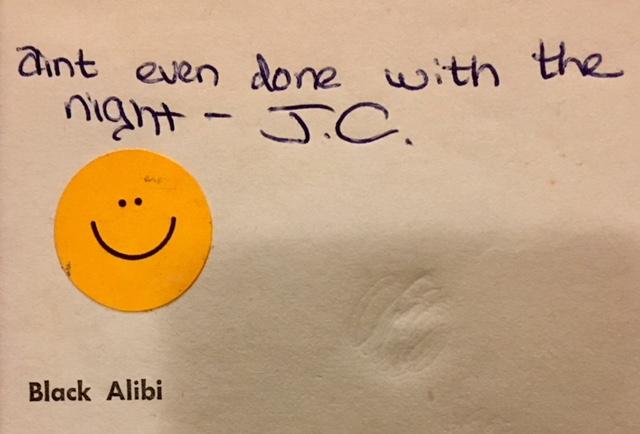
Book trivia: this piece of trivia is unique to my book alone. This is my handwriting from when I was in high school and this is definitely something I would do. I am constantly thinking of lyrics and I loved smiley faces back in the day. However, I don’t remember writing this at all. Nor do I ever remember reading this book before. Odd.

thumbnail

Nancy said: “Woolrich’s [people] are anxious and afraid, stuck in a world that is full of shocking and dangerous surprises” (p 66).

BookLust Twist: from Book Lust in the chapter called “Les Crimes Noir” (p 65).

Clara Callan

Wright, Richard B. Clara Callan: a Novel. New York: Harper Collins Publishers, 2002.

Reason read: January has a Sisters Week for some country.

Engaged. Engaged is the word I would describe how I read Clara Callan. I think I read it in four days. Despite its name, Clara Callan is actually about two women, sisters in fact. Clara is the elder, living in their deceased parents house in a small rural town outside Toronto. She is a no-nonsense serious schoolteacher who loves to play the piano, read and  write poetry; a perfect candidate for spinsterhood and self righteousness despite the fact she no longer believes in God. Since it is the 1930s and Clara is so mysterious, she is also fodder for constant gossip and worry in her village. Meanwhile younger sister Nora Callan has flown the coop to America and the Big Apple to seek fame and fortune as a radio star. Despite their vasts differences the sisters remain close, sharing letters to keep in touch. Clara’s journal rounds out the epistolary tale and fills in the gaps.
Probably my favorite subliminal element to Clara Callan is how Wright weaves current events into to the story. Nora, being in show business, complains of a bratty young man hanging around a pretty brunette. The talented brunette would go on to star in a little movie about a wizard from Oz. Or the radio program designed to sound like a real newscast scaring the bejesus out of everyone. Or the new sensational book, Gone with the Wind. It is very tempting to put together a list of every book Clara reads or every song she mentions.
The novel has a Bridges of Madison County kind of feel to the ending. I was a little disappointed with the tactic.

Favorite lines, “As we drew closer to the great city, we passed freight yards and apartment buildings that were so close to the tracks you could look in on people’s lives” (p 74) and “I wasn’t aware that I muttered in the morning, but I suppose I do” (p 223). That’s what happens when you live alone for so long. You lose track of your habits until someone else finds them again.
One more quote, “The innocuous and banal words of the defeated who hopes to stir just a spoonful of guilt into the heart of the marauder” (p 321). How many times have I been there myself? This was a painful line to read.

Author fact: Wright has written a bunch of books with interesting titles. Unfortunately, this is the only one on my Challenge list. Also, I just found out Wright died in early 2017.

Book trivia: Clara Callan is a 2001 winner of the Giller Prize and the Governor General’s Award.

Nancy said: Clara Callan “won every major Canadian literary award in 1991” (p 201).

BookLust Twist: from More Book Lust in the chapter called “Sibs” (p 199).

On the Beach

Shute, Nevil. On the Beach. Read by Simon Prebble. New York: Recorded Books, 1991.

Reason read: Nevil Shute was born and died in January; read in his honor.

Preoccupation with The Bomb. Nuclear war. Alphaville wrote Forever Young thinking about the bomb. Randy Newman sneered about dropping the bomb…boom goes London. Shute takes it one step further. The nuclear bombs of World War III  have been dropped and as far as anyone knows, the entire northern hemisphere has been completely wiped out. There’s not a soul alive above the equator. It’s only a matter of time before winds blow the deadly radioactive fallout to New Zealand and Australia. For naval officers Peter Holmes and Dwight Towers stationed in Melbourne it is their job to pilot a submarine to the northern hemisphere to seek out survivors and make predictions about their own mortality. Will the deadly dust reach them in a year? A month? A week? No matter the time frame for surely they will all die. It’s a bleak read, there’s no doubt about that, but the characters are worth it. For Dwight Towers, originally from Connecticut, knowing he will never see his wife and children again is a hard pill to swallow. For young and beautiful Moira Davidson drinking her denial is the best policy. Others seek solace in the suicide pill or carrying on as if nothing tragic is going to happen. I found myself asking what would I do in this situation?

Author fact: Shute has his own fan webpage here.

Book trivia: When On the Beach was first published in 1957 it was met with sour reviews. Too depressing they all said.

Nancy said: Nevil is “probably best known for On the Beach” (p 198).

BookLust Twist: from More Book Lust in the obviously called “Nevil Shute: Too Good To Miss” (p 198).