24 hours

Iles, Greg. 24 Hours. New York: G.P. Putnam’s Sons, 2000.

A kidnapping mystery set in Mississippi…sort of an odd read for the holiday season, but December is the month Mississippi became a state.
Here’s the storyline: Basically, this guy, Joe, has set up the perfect kidnapping scheme. He targets a doctor who has a spouse and child, learns all he can about the doctor’s family and then while the doc is at an annual convention he kidnaps his/her child. His cousin (a hulking man with the IQ of a chipmunk) holds the child in a remote location while his “wife” entertains the male parent and Joe entertains the female parent for 24 hours. They call each other every 30 minutes and if a call is missed Cousin Chipmunk kills the kid. In the AM one parent wires the ransom to the other parent so the kidnapper doesn’t have any connection to the withdrawal. The money is always an amount the doctor can afford and the kidnapping always works because the child is worth more than getting the money back or calling the police. The detail that makes the whole thing work are the every 30 minutes phone calls. Everything hinges on those calls and the convention – because the convention is the guarantee the doctor will be separated from the rest of the family for at least 24 hours.
Despite the brilliant plot I have two problems with detail. In the beginning both parents are told their family has been scrutinized and studied in great detail. The kidnappers claim to know everything about the family. If that is true then why did they not know their latest kidnapping victim was diabetic? If they knew everything how did they miss such a large piece of a child’s life? The second problem with detail is on page 164 – one of the kidnappers says “You have to chill, Will!” and is delighted by the rhyme of the doctor’s name, yet two pages later Iles writes, “Why don’t you at least face the truth about something, Will.” It was the first time she [the kidnapper] had used his Christian name” (p 166). No, actually it wasn’t. She told Will to chill two pages earlier. Ugh.
All in all, this moved fast and was a constant page turner. Every time I had to put it down I was at “the good part” and hated to stop reading. The end is a little over-the-top dramatic and there are loose ends, but well worth the read.

BookLust Twist: In More Book Lust in the “Southern Fried Fiction (Mississippi)” chapter (p 208).

The Body is Water

Schumacher, Julie. The Body is Water. New York: SoHo, 1995.

I love it when reading fits the day. I don’t know how to describe it other than the perfect marriage between a book and time. It was snowing, sleeting, windy and freezing cold. Every so often a gust of wind would send pellets of freezing rain drumming against the windows, yet the Christmas tree glowed softly, the cat purred at my feet, a balsam candle burned bright, a fleece blanket was thrown over my lap, a cup of tea at my elbow and I was content. If I could ignore the wind, all was quiet, all was still; the perfect time to lose myself in The Body is Water.
I’m still reading December picks and The Body is Water celebrates the month New Jersey became a state, oddly enough. It’s also the story of single and pregnant Jane, and her return to her New Jersey shore childhood home. In one sitting I read 184 of the 262 pages.

“All my life I’ve never been certain of where I should be” (p 20).
“In a crisis, other families probably rush to hold the ailing person’s hand; our family rushes to the general vicinity of the crisis and putters around, hoping the patient will spontaneously recover on her own” (p 61).
“No matter where I lived, I never knew my way around; there was no ocean, no rushing noise of a heartbeat from the east” (p 230).
“I start to cry, remembering the days before my mother died, before Bee slept in another room. That was when we loved each other best and didn’t know it” (p 262).

I ended this book sobbing. I connected with Jane even though she was the younger sister (Bee was four years older); even though Jane lost a mother and I lost a father; even though she became a mother and I remain sans motherhood. I connected through the simple loss of a parent, the soothing sound of the ocean, and the complex closeness of sisters.

BookLust Twist: From More Book Lustin the chapter called “Jersey Guys and Gals” (p 129). This also could have been mentioned in chapter called “Maiden Voyages” (p 158) because this was Schmacher’s first novel.

Appointment in Samarra

appointment in samarraO’Hara John. Appointment in Samarra. New York: Vintage, 2003.

In honor of Pennsylvania becoming a state in the month of December Appointment in Samarra was my first novel pick. I was excited to see the introduction was written by John Updike. He is another author I have enjoyed over the years. Set in the 1930’s with a keen eye on society, O’Hara tells the story of Caroline & Julian English and their how their elite status is washed away with alcohol and attitude. In an instance the English couple go from being the toast of the town to the talk of trash.

“I love you more than a tongue can tell” (p 63).
“…their position in Gibbsville was just that certain and insecure…” (p 83).
“…she was too conscious of looking like the wrath of God to enjoy any of it” (p 121).
“The worst of that drive was that the sun glare on the snow made you smile before you were ready” (p 200).

As an aside: I don’t remember where I was when I learned that the Lenape Indians believed the turtle was the center of the universe. To this day, it remains the only thing I know about this particular tribe. It was interesting to see O’Hara mention the tribe in his historical ancestry of the English family.

BookLust Twist: From More Book Lust in the chapter “Big Ten Country: The Literary Midwest (Pennsylvania)” (p 30). 

Bill Bryson’s African Diary

African DiaryBryson, Bill. Bill Bryson’s African Diary. New York, Broadway Books, 2002.

I added this to the December list when I read a review describing it as “short.” It’s much shorter than I thought – only 49 pages of “diary” and a few more pages of statistical information. So short that I was able to read it over a lunch break. I’m glad it was a quick read because I couldn’t put it down. I’m a sucker for charitable tactics, especially unique ones, and this book definitely qualifies. CARE International (a non-profit organization dedicated to fighting global poverty) funded Bill Bryson’s trip to Nairobi, Africa with the request that he write about his eight day adventure. Bryson is known for his travel literature, his humor, and his expressive way of describing life around him. He would certainly be able to describe the poverty, the landscape, and best of all, the people of Africa. Many reviewers called this book a charity puff-piece, a lengthy advertisement for the work of CARE, and were bitter about the $12 price tag. What they missed out on was the stunning photography, the wry humor and the painless way to do good (all royalties and profit from the sale of the book went to CARE International).
Speaking of humor, here are a few of my favorite lines: “…tireless commitment to mediocrity” (p 2), “you had to be really unlucky to be shot and stabbed” (p 4), “Kenyan Railways has something of a tradition of killing its passengers” (p 21) and, “Watamu was tranquil to the point of being comatose” (25). There are other funny moments: “flying toilets,” and flying for real, to name two.

For more information on CARE, International go here.

BookLust Twist: From More Book Lust and the chapter “Bill Bryson: Too Good to Miss” (p 36). This being my first introduction to Bryson I am looking forward to more.

Crossley Baby (with spoiler)

Crossley BabyCarey, Jacqueline. The Crossley Baby. New York: Ballantine, 2003.

November is National Adoption Month. Out of everything I am currently reading, I thought this would be my favorite. I’m sorry to say I was a little disappointed. The Crossley Baby is the story of two sisters (Sunny & Jean) battling for their dead sister (Bridget)’s baby. Well, that’s what it’s supposed to be about. Instead, it’s more of a commentary on wealth (Jean has it, Sunny does not), parenting (Sunny is a mother of two, Jean is not) and manipulation (they both do it, for one reason or another). More time is spent setting up where Jean, Sunny and Bridget came from than the actual adoption process. More time is spent on describing the vast financial differences between Sunny and Jean than on their personalities. By the end of the book I didn’t know Jean or Sunny any better so I didn’t care who got the baby. I was completely indifferent to their struggle for baby Jade. Probably what bothered me most was the lack of real grief shown by either sister over the death of their elder sister. Crossley adds flickers of sadness, glimpses of sorrow, but for the most part Bridget’s death goes mostly unmourned. Possibly that is because they never got along. If there is one thing the three sisters did really well it was avoiding closeness.
In the end, Sunny wins custody. Everything points in the direction of Jean winning – money, power, people in her corner – while Sunny’s husband is filing for bankruptcy, old favors aren’t worth cashing in, and they have to sell their home. In a last minute surprise ending Jean withdraws her application for adoption and doesn’t contest the award going to Sunny. No one from Bridget’s life is there to put in a word edgewise.
Ironically enough, it was Bridget who was my favorite character because of this one line, “Bridget tasted her words before she spoke…” (p 112).

BookLust Twist: From More Book Lust and the very first chapter called “Adapting to Adoption” (p 1).

Reading Lolita in Tehran

Reading lolitaNafisi, Azar. Reading Lolita in Tehran: A Memoir in Books. New York: Random House, 2004.

The first thing I think as I am 13 chapters into Reading Lolita in Tehran is maybe, just maybe I should have read Lolita first. Yet, it is not just about Lolita. It’s also about Gatsby, Daisy Miller and Pride & Prejudice. Those, I have read. But, these four books are not the only ones Nafisi recommends. There is a whole list of them. I am tempted to start another challenge and add them to my “must read” list.

But, back to Reading Lolita in Tehran. Where do I start? Blanketing the entire story (nonfiction) is the outrage I felt. Professor Azar Nafisi must secretly meet with seven students to study Western classics, books that are forbidden in the Islamic Republic of Iran. I don’t know how they dared. Morality squads roamed the streets, raiding homes and shops whenever they wanted, fundamentalists took over the university where Nafisi formally taught, women are arrested for not wearing the veil, being seen in public with men other than their husbands, brothers or fathers, for wearing makeup…It just reminds me I am a spoiled Westerner who can paint my eyes black as night, show the curve of my neck, and most importantly, read any book I want.
Think of a braid. One strand is politics, another literature, the last society. This is Reading Lolita in Tehran. Woven over and under and throughout is Azar Nafisi’s life. Her personal views on relationships, society and of course, the books she loves. Because it’s her point of view and hers alone we have to trust that she is telling us the truth. Her truth. Here are my favorite quotes – some with my commentary after.

Reality has become so intolerable, she said, so bleak, that all can paint now are the colors of my dreams” (p 11).
“I think I somehow felt that as long as I was conscious, nothing bad could happen, that bad things would come in the middle of my dreams” (p 45).
“Some people take up alcohol during periods of stress. I took up Jeff” (106).
“In the midst of gunshots and chants we hugged and chatted about the almost two decades since we had last seen each other” (p 148).
“The administration wanted us to stop working and at the same time pretend that nothing has changed” (p 151). ** I’m reminded of a relationship I once had when the entrapment was the same. **
If I turned towards books, it was because they were the only sanctuary I knew, one I needed in order to survive, to protect some aspect of myself that was now in constant retreat” (p 170).
I became more anxious. Until then I had worried for the safety of my parents, husband, brother and friends, but my anxiety for my children overshadowed all” (170). ** I thought of my sister when I read this line. I think she would agree. **

Random comments~ I want someone to explain these things to me. How someone can be pompous and meek at the same time; how someone can speak precisely and leisurely; and how someone can murmur a defiant no. Just odd descriptors in my opinion.

BookLust Twist: From More Book Lust and the chapter called “Me, Me, Me: Autobiographies and Memoirs” (p 162). I would say Nafisi’s story is a chapter of a memoir; a partial snapshot of a life.

Middlesex

MiddlesexEugenides, Jeffrey. Middlesex. New York: Picador, 2002.

First the cover. Before I even read a word it frightens me. Inky black (my cancer) smoke swirls from a cigarrette-bearing person lounging with a friend. That same smoke meets up with the smoke stack of an ocean-going vessel and encircles the skyline of a city. I instantly recoil from the seductive swirls and think, “I’m gonna hate this book.”

But I don’t. It’s long (529 pages), but I’ve enjoyed every page. I can see why it won a Pulitzer Prize. It’s the story of Calliope Stephanides and the two generations that brought her into this world. It’s Greece and Germany and Grosse Point. It’s the science of genetics meeting the mother of all family secrets. Calliope is also Cal, one and the same. Girl meets Boy. Girl is Boy. Boy is Girl. Sound confusing? It isn’t. It’s poetic and sad, funny and smart. Something you just have to read for yourself. Cal will tell you the story. His story. Her story. My favorite lines:

“…German wasn’t good for conversation because you had to wait to the end of the sentence for the verb, and so couldn’t interrupt” (p 7).
“Filling her head with music, she escaped her body” (p 115).
“The only thing that roused her was her daily lineup of soap operas. She watched the cheating husbands and scheming wives as faithfully as ever, but she didn’t reprimand them anymore, as if she’d given up correcting the errors of the world” (p 271).
“…her application to join her husband in heaven was still working its was through a vast, celestial bureaucracy” (p 286).

BookLust Twist: From More Book Lust. Pearl mentions this book several times. First, on page 97 in the chapter “Gender Bending” then on page 141 in the chapter “Lines That Linger, Sentences That Stick.” She is referring to Middlesex‘s opening line. It’s a doozy. Finally, on page 166 in “Men Channeling Women” Middlesex is listed one last time. As you can see Jeffrey Eugenides hit a homerun with this one.

ps~ The cover makes perfect sense to me now.

Abyssinian Chronicles

Abyssinian ChroniclesIsegawa, Moses. Abyssinian Chronicles. New York: Alfred A Knopf, 2000.

This took me absolutely forever to read. In the beginning Athenian Murders seemed more interesting. No, I take that back. It seemed a faster read. Honesty is the best policy. Then, I started Autumn Across America. Juggling two “landscapes” as sweeping as Abyssinian and Autumn wasn’t easy. Both are elaborate, even panoramic, if you will. Very descriptive. But, enough excuses – back to Abyssinian Chronicles.
This is story of Mugezi. It is more than a coming-of-age chronicle. It is Mugezi’s life story from childhood to harsh adulthood in the span of twenty years and the necessary means it took to survive each and every day. In addition, it weaves in the landscape of Uganda, the politics of the 1970s, society, religion, violence,  and the family traditions of African clan. It is panoramic and profound. Isegawa’s language is harsh, his subjects, brutal. For example, the children Mugezi looks after are caller “shitters.” A line that made me laugh outloud was Muzegi’s aunt’s warning to a woman who was letting herself go, “If she did not take care, Nakibuka thought, soon birds would be nesting in her hair, baby hippos snorting in her belly and hyenas rubbing their rumps in her armpits” (p 162). If you are anything like me, you read that sentence and said “whaaaat?” I read it twice, said “whaa?” and then laughed out loud. I have no idea what it means (especially the hyena part) but it was funny. Female cattiness. I can relate to that. But, probably the section I can relate to the most is a tie between politics and family. First, politics: “Local politics were also at work: you never bit the hand that fed you… Consequently, there was much turning of the other cheek and much patience in the hope that everything would turn out right in the end” (p 218). Words I should take to heart in my present situation. Now, family: “Grandpa’s old lawyerly dreams boiled inside me. I felt I had stepped onto holy ground” (p 341). I felt that way when I was training for the Leukemia Society…something about fighting the ghosts of cancer, cradled in my grandmother’s name…

BookLust Twist: From More Book Lust and the chapter “Africa: A Reader’s Itinerary” (p 3). While I called Isegawa’s novel panoramic and sweeping Pearl describes it as sprawling and ambitious. Either way it’s 462 pages long. I think you get the point.

Autumn Across America

redsky.jpg

Teale, Edwin Way. Autumn Across America. New York: Dodd, Mead & Co., 1965.

I’m sure hundreds of books about traveling across the country have been written (I’m thinking specifically of Steinbeck’s Travels With Charley among others), but this is one of my favorites. It is a great combination of science and ecology, history and socialism with personal antidotes sprinkled throughout: a story of a deaf, mute man who lost his dog; the antics of sea otters playing in the surf; pages from John Muir’s diary and lines from Emerson’s poetry, to name a few. You can tell that Teale loves the land and everything above, around, on and in it. He has stories about birds and butterflies, deer and dogs, trees and turtles, flowers and faces. He introduces you to wonderful people, interesting facts. My favorite part, which I read outloud to kisa, involved scaring a pond load of birds only to have them all react in precisely the same way. Not one bird reacted more than another. They all did the exact same thing at the exact same time. I found that so fascinating.

My favorite line, by far, “We had, for the space of a whole glorious autumn, been time-rich” (p 356). Wouldn’t that be nice? Where would you go if you had a whole season to travel in?

BookLust Twist: From More Book Lust in the chapter appropriately called “Nature Writing” (p 173). Pearl writes, “…these books beckon us to emulate Teale’s own travels…” (p 174).

Absent Friends

Absent FriendsBusch, Frederick. Absent Friends: Stories. New York: Alfred A. Knopf, 1989.

“From the New World”
Norman is a man returning to his childhood home after his father’s passing to divy up belongings with his sister, his last surviving family member. I found myself yawning through this short story as it’s a well-known plot. Son is disowned for marrying outside his color (although they blame it on something else). His father leaves him $2,000 while his sister, Anna, gets everything else. Norman feels disconnected from Anna. The clever parts: Norman is a film producer so the story is told in script language, from Norman’s p.o.v. One particular scene is played out like a poker game, with conversation acting as the card values – bluffing and backstabbing. My favorite line: from page 61, Tess (Norman’s wife) is talking about love, “that shows you…how chewed up and spat out and stepped on on the sidewalk that word can be.” 

“Ralph the Duck”
You never learn his name. He’s some security / maintenance guy at a college taking classes on the side. He calls himself “the world’s oldest college student” even though he knows he’s not. When he gets a ‘D’ on an assignment (called Ralph the Duck) he lets the disappointment leak out.

“Comrades”
I pictured a tightrope walker when reading this story. The walker carries a pole called “Relationship” and when he waivers to the right he is feeling loving towards his wife. When he teeters to the left, he has animosity. The couple decides to divorce as amicably as possible but the tension and anger is always just below the surface.

“Orbits”
A commentary on getting old. On parenting. On life slipping away, unstoppable. My favorite line, “Her mother limped into the house and they sat in the memory of her tension” (p 100).

“Greetings From a Far-Flung Place”
I could relate to this story. She is a singer in a second rate band. She travels around with a group of men and no one in her family can understand her life. Her sister is married, has a kid, lives the suburban life, and is lonely. Mom is widowed and can understand sis better than singer.

“Naked”
Seen through the eyes of a 13 year old boy. He witnesses adult relationships and experiences changing loyalties. My favorite line, “And I still don’t know if he meant wait for seconds or for years” (p 125).

“In Foreign Tongues”
A group of people in therapy talk their way through their problems outside of sessions. Lonely in the middle of Manhattan.

“Gravity”
The gravity of growing old, getting older. The gravity of weight, of life. The gravity of death. Seriousness and weight.

“Dog Song”
What’s that Harrison Ford movie where he’s a lawyer, gets shot, and has to relearn his life (only to discover he’d been leading the double life of infidelity)? “Dog Song” is like that. Richard is a judge who gets into a horrible car accident (on purpose?). As he slowly remembers the accident, details start to surface. He was in the car with his mistress…

“One More Wave of Fear”
Family life in Brooklyn. One kid’s memory of growing up – from catching squirrels in the attic to going on nature walks with the fam. My favorite line sums up that age, “I didn’t want to be mistaken for someone who cared about birds” (p 201).

“North”
I could mistake “North” for so many things. Kelly divorces her husband because he won’t look North of her female features, She wants to head North – two hours to the Adirondaks – but she doesn’t. “North” is the story of a woman who needs an internal compass.

“Reruns”
“Reruns” was tricky. A doctor’s estranged wife is kidnapped by terrorists in the Middle East. The doctor could care less if she is released but for the sake of his children he plays the part of concerned father. In the end the reader is left wondering how much does he not care?

“Name the Name”
This was actually one of my favorite stories. Told from a traveling teacher’s point of view, he travels to children who can’t be in school for whatever reason. A 12 year old is 7 months pregnant, a girl tries to commit suicide and is on a ventilator, his own son is in jail for nearly two weeks. It’s about commitment and responsibility – owing up to the name.

“To the Hoop”
After his wife commits suicide a father and son struggle to get back on track. Using basketball as for “getting back into the game” both literally and figuratively, both father and son learn to try again. I think this passage sums it up,”He was on the stairs, and something like “good night” trailed his slow and heavy-footed climb. So I was alone, with ham and good intentions, and the usual fears that ranged from drugs to teenage schizophrenia. Jackie had died alone, and in silence. She had left us no word” (p 267).

BookLust Twist: From Book Lust and the chapter “Frederick Busch: Too Good To Miss” (p 48). This is the second collection of short stories I have read from Busch so far.

Accidental Connoisseur

Accidental ConnoisseurOsborne, Lawrence. The Accidental Connoisseur: An Irreverent Journey Through the Wine World. New York: Fair Point Press, 2004.
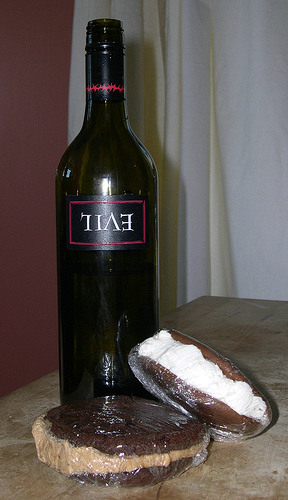
Even though I don’t know much about wine and I probably wouldn’t have picked up this book if it weren’t for the challenge, I had to admit this: ILMAO. Lawrence Osborne has a great deal of fun with the punny, the witty, and the downright funny. Right off the bat, on page four, he had me giggling with “all drinks came under the Arabic word alcohol, essentially reducing them to a level of chemical sin, and none of them could be bought on Sunday.” Especially since we had downed a wine called Evil on vacation, thanks to Stacey. See below for the proof.

Even if you aren’t a wine drinker or even a wine liker, Osborne’s writing will amuse you. He has phrases that are somewhat identifiable as my own, “when the happiness of drinking overwhelms you, you cannot resist it” (p 21) and “Wine is 99% psychological, a creation of where you are and with whom” (p 22). This makes me sound wildly alcoholic, but bear with me a second. Think of any great seduction scene. Who is usually front and center (along with soft music and sexy candlelight)? Partners in  crime – a wine bottle and two wine glasses. I found that a glass of wine is definitely more pleasurable when enjoyed in the presence of good friends and equally good scenery.
Seriously, I learned a lot from this short book. For example, how you space the vines in each row determines the complexity of a wine (according to one grower). The theory is plants with less crowding don’t have to compete for sunlight and growth space. They are more relaxed and get this, less stressed out. You see, the more stressed out a plant is, the more psychotic it is. It’s this aggrivated state that develops the complexity of flavor. Got it? I learned a new wine word, too: terroir. Makes me think of ‘terror’ but whatever.

Other favorite parts: “”what do you taste?” “Grapes,” I said. “Good. That’s what’s in it!”” (p 97)

“If wine is sex, ” I said, “this is like yoga.”
“Yoga? You’re saying it’s like yoga?”… I’m not sure I get you there. You mean athletic?”
“Virtuous. Unsexy.”
“Ah, you mean American!” (p 101)

But, probably my favorite line is an obvious one, “Wine summons ghosts out of the cupboard” (p 228).

BookLust Twist: From More Book Lust in the chapter “A Holiday Shopping List” (p 115). It’s true that I would buy this for the wine lover that I know, only I don’t think he drinks and reads. Is that a problem?
wine.jpg

Gift from the Sea

GiftsLindbergh, Anne Morrow. Gift From the Sea. New York: Vintage Books, 1991.

I have to say this is something every woman should read annually. The words and their meaning will change every single time and they will be different for every reader. In the simpliest of terms Gift From the Sea uses seashells, (whelk, moon shell, oyster) all gifts from the sea, as metaphors for life, vehicles for deeper thoughts. On vacation (ironically on an island, like me) Anne picks seashells and ponders religion, relationships, growing old, being young, nature, love and marriage…She picks at nagging thoughts like scabs, letting them bleed, revealing raw emotion and a tender heart. Here are a few of my favorite quotes:

“…I think best with a pencil in my hand” (p 9). I agree!
“…I have shed the shell of my life for these few weeks of vacation” (p 22). Since I was on vacation when I read that I had to smile because it happens to me, too.
“…social life is exhausting; one is wearing a mask” (p 32). Very true! Couldn’t have said it better myself.
“And since our communication seems more important to us than our chores, the chores are done without thinking” (p 100).

I read this in an afternoon. Gulls cried overhead, sea air salted my skin, waves crashed in the distance. It was the perfect setting for Gift from the Sea.

BookLust Twist: From the chapter called “Journals and Letters: We Are All Voyeurs at Heart” (p 130). I swear on everything holy I did NOT have More Book Lust with me when I wrote this review. I was still home without any of my Pearl books. So, I was incredibly surprised to read these words from Pearl, “Some of us still reread them yearly to remind ourselves of what’s important in this frantic world” (p 131). Pearl is referring to everything written by Lindbergh, but I had the exact same thought specifically about Gift from the Sea. Gift from the Sea is also in Book Lust in the chapter, “100 Good Reads, Decade by Decade” (p 175).

Under the Tuscan Sun

Mayes, Frances. Under the Tuscan Sun: At Home in Italy. New York: Broadway Books, 1997.Under the Tuscan Sun

Under the Tuscan Sun was made into a movie I have never seen, nor do I think I ever want to. I don’t see how the richness of Mayes’s Italy comes to life on the silver screen. I can’t picture the blood, sweat and tears of rebuilding a house; the glorious smells of garden fresh cooking; the love and laughter of enjoying one’s surroundings in moving pictures. I don’t see how Mayes’s  lush language is communicated. Really. Tuscan Sun is the journey of a woman (with the help of her second husband) to rebuild a Tuscan farmhouse. While she struggles with culture, language barriers and politics she falls in love with her Italian life. Try as I might I can’t see it as a movie. Okay, so now maybe I’ve convinced myself to see it out of curiosity!
I think I’m having trouble picturing a movie because I read Under the Tuscan Sun in my own personal paradise – by the dying light of fiery sunsets with the cadance of the surf as my only distractions. To say that I devoured Under the Tuscan Sun is an understatement. During the day I read it between hiking, eating, and breathing in my own love affair with a place. Every single time Mayes gushed about her Italian home I wanted to challenge her. I wanted to boast that it was I, not she, who was living the perfect life. On page 86 she says, “Where you are is who you are. The further inside you the place moves, the more your identity is intertwined with it. Never casual the choice of place is the choice of something you crave.” I found that quote so profound to my place I had to choke back tears. It is hard to explain arriving on Monhegan and reading those words on the very first night home. I had arrived to the only place my soul knows intimately. The only place where my whole being breathes a sigh of relief. Home is who I am, for sure. Later, I bought a guestbook for our rental cottage and wrote Mayes’s same words on the inside cover.

BookLust Twist: From More Book Lust in the chapter called “Ciao, Italia” (p 46). I like that Pearl describes Mayes adventure as a “love affair” (p 47). We’re both on the same page with this book.

My love affair:
875069607_94b33dab01.jpg

Autobiography of a Face

AutobiographyGrealy, Lucy. Autobiography of a Face.New York: HarperCollins, 2003.

I had all the right conditions to finish this book in two days – traveling, vacationing, but most of all, fascination. I couldn’t put it down. On the surface Autobiography of a Face is the tragic story of one woman’s struggle with cancer and journey through recovery. Only her struggle isn’t as an adult. She is a child. Confronting Ewing’s sarcoma at age nine Lucy battles through radiation therapy and chemotherapy. Her tone can only be described as matter of fact as she recounts the loneliness and pain after countless surgeries to correct the deformity of losing a third of her jaw. Deeper than that, Autobiography is about rising above the cruelty of others, shaking off the superficial prejudices of what supposedly makes a face beautiful. Lucy is defiant and remarkably stoic in her recollections of childhood taunts, adult avoidance, and across the board lack of social acceptance.
Critics call this book the vehicle with which to free oneself from self loathing and fears of rejection. It is a message to stop wallowing in self pity and live with dignity – no matter what. It’s also a call to be human and have real emotions as Lucy admits, “and as much as I wanted to love everybody in school and waft esoterically into the ether when someone called me ugly, I was plagued with petty desires and secret, evil hates” (p 181).

My favorite quote: “speaking seemed like something one could grow tired of” (p 77).

Lucy’s story ends with her getting published, finding friendships and getting on with her life. Yet, there is a darkness to it all. She is criticized for not telling the whole truth. There is mystery surrounding her untimely death in 2002. Her story leaves you asking what happened and wanting more. What the book doesn’t tell you is that her multiple surgeries led to an addiction to pain meds and subsequently, heroin. She died of an overdose at the age of 39. There is more drama after death, but I’ll leave that for you to figure out.

BookLust Twist: From More Book Lust and the chapter “Other People’s Shoes” (p 181). I can’t even begin to imagine being in Lucy’s shoes.

The African Cookbook

African CookbookSandler, Bea. The African Cookbook: Menus and Recipes From Eleven African Countries and the Island of Zanzibar. New York: Citadel Press Book, 1993.

This is a gorgeous cookbook. Not just for the recipes and menus, but also for the art. The illustrations by Diane and Leo Dillon are amazing. My personal favorite introduces the recipes of Tanzania (p. 57).
In the first half of the cookbook the recipes cover all the regions of African cooking. In addition each chapter has a section on the culture of the region, how meals are served (traditionally) and how you, the American cook, can pull off your own Tanzanian, South African or Liberian meal. The second half of the cookbook covers additional recipes. Chapters are gouped by product – fish, poultry, beef, starch, etc.
Something else I find interesting is the nontraditional layout of each recipe. You won’t find a list of ingredients and then preparation instructions. Instead, each ingredient is presented as needed in the preparation instructions. Something I am never good at is reading through the entire recipe before starting and with The African Cookbook that step would be imperative.

BookLust Twist: From More Book Lust in the chapter “Africa: A Reader’s Itinerary” (p4).