
Where the Pavement Ends

BikesWarmbrunn, Erika.  Where the Pavement Ends: One Woman’s Bicycle Trip Through Mongolia, China & Vietnam. Seattle: Mountaineers Books, 2001.

Reading books such as Where the Pavement Ends has a confusing effect on me. On the one hand, I start to think of my personal landscape as being too small, too confining. The need for movement and travel start to stir within me. On the other hand, I realize I am coddled, comfortable – too careful to conquer the great unknown. The idea of going where I don’t speak the language has always intimidated me. Okay. Scares the pants off me.

Where the Pavement Endsis not only a memoir about one woman’s eight month trek across Mongolia, China and Vietnam. It is also a  compassionate commentary on Erika Warmbrunn’s five (and sometimes sixth) senses. She relates everything she sees (sharing some gorgeous photographs throughout the book), everything she hears, touches, smells and tastes. From learning to enjoy Mongolian tea to ignoring sheep’s tail and demanding to eat like the natives rather than a coddled Western tourist. From the spanning the vast landscapes and bustling cities mostly by bicycle (accepting rides every so often). Every leg of Warmbrunn’s journey reflects the culture she encounters. She relies on the kindness of strangers to have decent meal, a roof over her head and to expand her social awareness. She is eager to learn the language, drink in the customs, and learn something from everyone she meets.

A small sampling of the favorite lines: “…to make things new, you have to keep going further and further away from what you know” (p 11). This is the perfect definition of bravery, “I was completely intimidated, and I was absolutely at peace” (p 13). Another one, “In the absence of language, ritual becomes a way of communication, of making yourself a little less foreign” (p 42).

BookLust Twist: From Book Lust in the chapter called simply, “Bicycling” (p 35).
Quartered Safe Out Here

Fraser, George MacDonald. Quartered Safe Out Here: a Recollection of the War in Burma. New York: Akadine Press, 2001. 

I was hoping to take this on my 60 mile cancer walk – thinking I would have quiet nights to read and recuperate. No such thing. I never opened a page. Instead, I took it home to Monhegan and on the second to last day got it read. Confession: no small feat because I found it dull, dull, dull.

Quartered Safe Out Here is George MacDonald Fraser’s “memoir” about being in Burma as a 19 year old soldier in World War II. While it’s a vivid and honest first hand account about being in the thick of battle, I found it slow moving and tiring. Fraser takes great pains to get every accent phonetically spelled out – so much so that the written page looks like a foreign language at times. But, it wasn’t the accents that I found the most tiresome. It was the fact that nearly every every other page contained a footnote containing a special explanation or definition. Fraser could have added another 50 pages if the footnotes were included in the body of the text. Probably the scene that held my attention the best was when Fraser was looking in bunkers for ‘Japs.’ His innocence to the danger is touching.

BookLust Twist: From More Book Lust in the chapter ” Living Through War” (p 154).

Off Keck Road

Simpson, Mona. Off Keck Road. New York: Alfred A. Knopf, 2000.

I didn’t realize this book is a novella. 167 pages long. A piece of cake to read on a quiet Sunday. The sad thing is I didn’t really get into it, despite it being a quick read. The story starts off being about Bea Maxwell but then veers away to take in other members on and off Keck Road. The character placement seems jumbled. New characters appear without clear introduction or connection to Bea. I felt I needed a chart to keep characters straight. However, character development was brilliant, intimate even. When we first meet Bea, she is a college girl, home on vacation in the 1950s. She has certain definable traits that stay with her throughout the rest of the novella, ending in the 1980s. It’s a portrait of a woman who never leaves her small town. Her life never really takes her beyond Green Bay, Wisconsin’s city limits without reeling her back in.

Favorite lines, “He was the kind of man who ceded his place in traffic. He never asserted himself in conflicts over lanes or parking spaces” (p 80).

BookLust Twist: From More Book Lust in the chapter, “Big Ten Country: The Literary Midwest (Wisconsin).
Also in the chapter, “Two, or Three, Are Better Than One” (p 226). Note: in this chapter Pearl suggests reading Off Keck Road together with Our Kind: a Novel in Stories by Kate Walbert; two stories about the lives of women.

Bordeaux

Puertolas, Soledad. Bordeaux. Lincoln: University of Nebraska, 1998.

Despite being under 200 pages this took me a long, long time to finish. Maybe it’s the fact it was originally written in Spanish (Soledad Puertolas is one of Spain’s most acclaimed writers).  I’m thinking maybe something got lost in the translation. That’s always possible. I found the whole storyline to be choppy, disjointed, even abrupt in some places. It was if Puertolas took three short stories and tied them together by location. On the surface all three chapters focus on a single character located in the same city. They all have Bordeaux, France in common. It’s the villa that apparently ties these stories together.
First, there is Pauline Duvivier, an lonely elderly woman asked to do a favor outside her comfort zone – something scandalous involving adultery and blackmail. As the reader you really don’t get the whole picture. Then, there is Rene Dufour. He is unlucky in love, worse in relationships of any kind. You can’t help but feel sorry for him and wondering what’s wrong with him. The last character, Lilly Skalnick, is a young American traveling through Europe. She’s just as lost as the rest of them. As each character is introduced and explored  it is hard to ignore the social portrait being drawn. Every character is lost, lonely, searching for something or someone to satisfy an unknown longing.

Favorite lines: “Her father’s death had left her alone with herself, and she lamented then not having known that that life was, perhaps the one she would have chosen” (p 7), and “His blueish-gray eyes didn’t seem to place much trust  in the wisdom contained in books” ( 84).

BookLust Twist: From Book Lust  in the chapter, “Latin American Fiction” (p 144).

Rise of David Levinsky

Cahan, Abraham. The Rise of David Levinsky. Glouster: Peter Smith, 1969.

Written in 1917 The Rise of David Levinsky is the story of Russian born immigrant David Levinsky and his rise to riches in the garment industry in New York City. Cahan’s depiction of Levinsky remains one of the best accounts of not only immigrants seeking opportunity and fortune in America at the turn of the century, but also the Jewish experience on New York’s East Side as well. Cahan illustrates social attitudes towards poverty, religion, ethnicity and economic status through David’s character. Using his situation as an orphan, David accepts pity from those with means. He has an uncanny ability to sense the heart of others and use it to his advantage. It is interesting to watch his rise to wealth over the course of David’s lifetime.

Good lines: “I had a notion that a married woman, no matter how young, must have a married face, something quite distinct from the countenance of a maiden, while this married woman did not begin to look married” (p 67), and “Shall I turn my heart out to show you how hard it is to live without you?” (p 301). Both of these quotes evoke so much psychology!

BookLust Twist: From Book Lust in the chapter, “The Jewish American Experience” (p 132).

Jameses

Lewis, R.W.B. The Jameses: a Family Narrative. New York: Farrar, Straus & Giroux, 1991.

Having read Lewis’s biography of Edith Wharton I knew what to expect when reading about the Jameses. Lewis approaches his subjects with an air of authority and an eye on detail and The Jameses: a Family Narrative was no different. Lewis covers the James family from 18th century Ireland up to the death of novelist Henry James in 1916. It is an impressive cast of characters. At best I could relate to Henry James, Sr., a man who railed against any model of institutionalized or organized religion. He spent a better part of his life on a quest to understand God, spirituality, and redemption. At times I found the rest of the narrative drawn out and too expansive. I have to admit, I did not finish.

Favorite quotes: “With Burnet as his agent, James bought Syracuse for $30,000” (p 12). Imagine that.

BookLust Twist: From More Book Lust in the chapter, “Literary Lives: The Americans” (p 144).

Flashman

Fraser, George MacDonald. Flashman. New York: Harper Collins, 1993.

This is one of those giggly books. The main character is so awful you can’t help but laugh at him and dare I say, even like him a little for his brazen attitude. The premise is Flashman is the first installment of the “Flashman Papers 1839-1842” a sort of journal of Harry Flashman’s. Readers get a taste of Harry’s storytelling from the very start: British boy Harry Flashman manages to get himself drunk, expelled from school and into his father’s mistress’s bed in less than the first dozen pages. What first appears as a punishment for another indiscretionary roll in the hay ultimately becomes Harry’s greatest triumph. He is sent to be a secret agent in Afghanistan and manages to emerge a brave hero after the Retreat from Kabul. Harry is so shameless he basks in the honor despite the fact his cowardice is the only thing that saved him. But, his story is told with such honest sarcasm you can’t help but enjoy his villainy.

Two of Harry’s lesser laughed at traits are his womanizing and his racial comments. One has to keep in mind the Victorian era in which these events take place. Women and minorities are not seen as equals on any level.

Typical Flashy moment: “She stood glaring at me. Her bosom was what the lady novelists call agitated, but if they had seen Judy agitated in a negligee they would think of some other way of describing feminine distress: (p 29).

BookLust Twist: From Book Lust in the chapter, “George MacDonald Fraser: Too Good To Miss” (p 94).

Apple That Astonished Paris

Collins, Billy. The Apple That Astonished Paris. Fayetteville: University of Arkansas Press, 1988.

Such a slim, unassuming little book of poetry! Who knew it would pack a punch of powerful words neatly disguised in short and sweet poems? I have decided Billy Collins is one of my favorite poets. His poetry is not pretentious. It’s within reach; a drinking buddy; a lovable troublemaker disguised in a string of words. There is wild imagination (walking across water and thinking of what the fish below see), seriousness (a former teacher looks back on the “community” of students he has taught), nostalgic (remembering a Tuscany vacation), clever (questioning Basque language), humorous (Smokey the Bear is fed up with warning tourists about forest fires) and moving (how cancer is a bad word). Each poem is about a page long or less. Short enough to read again and again. Let the words soak in and open your mind to fun poetry.

Favorite lines:
“…a jaded traveler with an invisible passport” (p 6).
“The evening hangs in the air like lace” (p 13).
“My sentiments are tangled like kites in the branches of her incomprehension” (p 21).

BookLust Twist: From Book Lust  in the chapter called, “Kitchen-Sink Poetry” (p 139).

Fan Man

Kotzwinkle, William. The Fan Man. New York: Equinox, 1974.

My first thought of  The Fan Man was what drug induced craziness is this? It also happened to be my last thought when I finished Fan Man. It is chaotic and garbled. To say that I didn’t like it is not quite accurate. I get closer to the truth when I admit I didn’t understand it. Nancy Pearl described this as a book about the Age of Aquarius and maybe that’s the problem – despite being born under the sign of Aquarius, I don’t get the Age.

The Fan Man is also Horse Badorties. He is a slob, obsessed with 15 year old “chicks” he can introduce into his “love choir”, fans (the Japanese hand-held folding kind) and phones. At one part of the book he spends an entire night in a phone booth making random phone calls. At first I thought the obsession with 15 year olds was a metaphor for something else, something spiritual – especially in the context of a love choir.

BookLust Twist: From More Book Lust in the chapter called, “The Book Lust of Others” (p 33). The Fan Man happens to be a favorite of novelist Herbert Gold.

an omelette & a glass of wine

David, Elizabeth. An Omelette and a Glass of Wine. New York: Lyons, 1984.

I think when it comes to writing about food Elizabeth David is an icon. Her books are not only widely read, but evenly more widely discussed and considered bibles in the world of gastronomy. For a woman who cooked the way she did, living all over the world, it is no surprise she is still considered one of the best food writers of all time.
David’s “career” in food writing began in 1947 with a frustration. Unable to get meals she enjoyed she vented her frustration by writing down descriptions of the food she craved, “I sat down…and started to work out an agonizing  craving for the sun and a furious revolt against that terrible, cheerless, heartless food by writing down descriptions of Mediterranean and Middle Eastern cooking” (p 21). And so it began. 

Probably the best surprise to David’s writing is her humor laced with sarcasm. An Omelette and a Glass of Wine is comprised of essays the wrote for well-reputed publications such as Vogue and The Spectator. While the writing is knowledgeable and professional there is an air of whimsy and playfulness running throughout. Here is an example, just to get you started: “He [the waiter] has been five years with the French navy, alors vous comprenez madame je connais les vins, moi. What he doesn’t connait is that I like my Beaujolias cold, straight from my cellar” (p 42). In addition to having thoughtful, knowledgeable essays, An Onelette and a Glass of Wine is peppered (excuse the pun) with wonderful photographs and illustrations. This was a book I enjoyed savoring one essay at a time.

BookLust Twist: From Book Lust in the chapter called, “Food for Thought” (p 91).

If Elizabeth David was alive and I could ask her one question I would have to ask when, exactly, is mayonnaise season and how can I avoid it?

Noblest Roman

Halberstam, David. Noblest Roman. Boston: Houghton Mifflin, 1961.

Noblest Roman is Halberstam’s first book. It is also one of the only two works of fiction he wrote. He would go on to prefer writing nonfiction after One Very Hot Day. It makes me wonder about the artistic preference. Why switch from fiction to nonfiction – never to go back again? It’s like the musician who prefers classical music after years of performing heavy metal. Or the watercolor painter who switches to pencil halfway through his career.

Okay. I’m off track.

Noblest Roman takes place in the south (Mississippi) and is a sly commentary on state level elections and the crookedness that comes about in small, rural communities – especially when bootlegging and prostitution are involved. I found the plot to plod and character development to be contradictory. Everything moved too slow for my taste and while one might argue that is the southern way, I found myself sleeping at the wheel too often. It is curious to note that Noblest Roman was inspired by true Mississippi events. Maybe Halberstam wasn’t that far away from nonfiction after all.

Favorite lines: “He changed the subject from Little Bilbo’s woman because listening to the old man talk about her was almost as bad as listening to her in person” (p 10). Had to laugh at that one.
“By all rights he should have been tired and unshaven and rumpled, but he looked fresh and rested. The campaign did not show on him” (p 49).
‘”I’m an old man, Angelo. Before I had a wife. Now I have a wife and a doctor”‘ (p 106).

BookLust Twist: From More Book Lust in the chapter, “David Halberstam: Too Good To Miss” (p 112).

Punch

Feinstein, John. The Punch: One Night, Two Lives, and the Fight That Changed Basketball Forever. Boston: Little, Brown & Company, 2002.

Once I learn of a story, an incident that captures my imagination I have to research it, follow it, own it. The story behind “the punch” was no different. What happened on December 9th, 1977 was such a huge deal I needed to see the actual punch itself. Was it really that bad? That shocking? That horrible? I needed to know. In truth, the video evidence is grainy, distorted. To me, there is no way of knowing just how terrible “the punch” really was from a human nature standpoint. Guess it’s a location thing – you had to be there. If anything, I would call the punch a perfect storm. All of the elements needed to make it a horrific moment were in place: Kermit didn’t know why Rudy was charging at him – out of the corner he saw a figure in red barreling towards him. In the game of basketball you are trained to be aware of your opponent’s existence at all times. Rudy was the opponent in red. Rudy didn’t know Kermit was going to turn around and sock him. He was unaware of the danger as he ran full speed down the court. Fist meets face at full speed. Add another element: strength. Kermit was a strong, powerful man. His punching fist would have floored anyone, even if it didn’t have uninterrupted impact. When he hit Rudy, there was nothing slowing either man down.

What makes the Punch such a fascinating read is not only the play by play of the punch and the events leading up to it, but Feinstein is adament about making the reader understand these two players as people. Sports writing meets biography. There is an urgency to make one understand that both of these men were passionate people before they were passionate players. Feinstein carefully illustrates the tough beginnings, the drive and potential each of these basketball stars demonstrated at an early age, including their schooling, family lives and social circles. Even black and white photographs help bring Kermit and Rudy into reality. What is gracefully missing is, of course, the punch itself.

One of my favorite aspects of the book is Feinstein’s casual tone. Here’s how he describes Kermit meeting his wife, “The story of how she ended up meeting Kermit is a complicated one. It happened because of a friend of a friend who had once dated someone who knew another friend of Kermit’s – or something like that” (p 139).

BookLust Twist: From Book Lust twice – both times in the chapter called, “Sports and Games” (p 225 & 226).

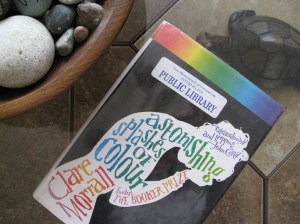
Astonishing Splashes of Colour

MorrallMorrall, Clare. Astonishing Splashes of Colour. New York:  Harper Collins, 2004.

This is the kind of book I could read a thousand times over. This is the style of writing I most identify with. Astonishing Splashes of Colour is so intimate and in-your-face I feel as if Morrall’s main character, Kitty, is leaning in to tell me deep and dark secrets, stories of embarrassing moments, and airing her dirty laundry with a wave of her hand and an air of factual nonchalance. She makes me squirm with her frankness, her vulnerability. Helpless and hopeless, Kitty is the me in the mirror.

Kitty is a thirty-something with something to hide. Her past has as many demons and devils as it does angels. Losing her mother at three years old, the knowledge of an older sister who ran away from home, the fact having four brothers who not only are disconnected from one another but only pretend to be connected to her, the frustrations of having a father who loses himself in painting and has episodes of pouting, the confusion of having an excessively neat husband who lives across the hall in a separate apartment, the heartbreak of a miscarriage Kitty insists on waiting for after school…then there are the colors. Kitty has the uncanny ability to see human emotion, human circumstance as a myriad of color. Her world is not black and white sane, but rather a rainbow of mental chaos. As if all this wasn’t enough everything turns out different from what one would expect. I couldn’t put it down…

Lines I can relate to: “I fight back a wave of giggles that threatens to ripple through me” (p 63). I laugh at inappropriate moments, too.
“I can’t decide which is worse, to not have a mother, or to not have children. An empty space in both directions. No backwards, no forwards” (p 65).
“I would have books around me even if I were blind. I need the smell” (p 138).

There are, of course, many more lines I could quote. This novel, this flash of brilliance definitely resonated with me.

BookLust Twist: From More Book Lust in the chapter called, “Sibs” (p 201).

Industrial Valley

Kitty readsMcKenney, Ruth. Industrial Valley. New York: Harcourt, Brace & Co, 1939.

I love first editions of books. I don’t know why. As a rule I don’t collect books based on what edition they are, first or last. Generally, I like books for what is between the covers. Still. I can’t help but be a little excited by reading the first edition of Industrial Valley. Please don’t ask me why.

The controversy surrounding Industrial Valley reminded me of the controversy Billy Joel faced when he wrote “Allentown.” In the begining townspeople didn’t really care too much for Joel’s bleak description of factory life. Yet, it was the truth. Ashamed or proud, that’s how it was. Same with Akron, Ohio. “Rubbertown” as some would call it.
Industrial Valley was written in a diary-like format. Near daily events, both political and social, between January 1, 1932 and March 21, 1936, recount Akron’s depressed economic state. Some entries seem unrelated to the depression (a boy’s death after being hit by a truck) while others hammer home the effect the ecomony had on daily life in an obvious manner (the suicide of a man who couldn’t feed his family). In the end, it was the historic Goodyear strike that changed the industrial climate. Democracy reined.

Favorite lines: “The bitter realities of unemployment and salary cuts conquered, in the end, any sophorific West Hill could imbibe” (p 60).
“All of Akron jumped like a housewife getting a shock from a loose electric wire on her washing machine” (p 219).

BookLust Twist: From More Book Lust in the chapter, “Big Ten Country: The Literary Miswest (Ohio)” (p 29).

Drowning Season

Hoffman, Alice. The Drowning Season. New York: E.P. Dutton, 1979.

When I first started reading The Drowning Season I was reminded of Yellow Raft in Blue Water by Michael Dorris. Not for the style of writing, the use of language – but rather, the struggle between females within a family. In Yellow Raft you think you should despise the mother because of how she leaves her child. Then you learn of the mother’s past and you think you should hate the grandmother..until you hear her story. It’s all in the hands of perception. Same with The Drowning Season. Esther the Black was born to hate her grandmother. Her father named her as an insult to his mother, Esther the White. Everyone knows you don’t name a child after the living, only the dead. Because Esther the White rules the family with harsh words and a hating heart, even insisting that the family live in seclusion, Esther the Black has had a compromised upbringing. She longs for the day when she can escape not only Long Island, but her grandmother as well. But, then there is the grandmother’s view of the world. She bears resentment for having to raise her son’s child while he fantasizes about suicide every summer and his wife tilts the gin bottle back a little too often. Each generation, grandmother and granddaughter, has her own demons to battle. The Drowning Season is the story of how they go to battle against each other and eventually, when love conquers all, for each other.  

Favorite lines: “Phillip had named his daughter on a hot August day, with an ancient hostility and a smile” (p 5).
“And the beatings began when the house grew too small with winter…” (p49).
“Esther the Black was silent; she wished she could cry, but the sadness never seemed to reach her eyes – it stuck in her throat, unable to be moved” (p 196). 

BookLust Twist: From Book Lust in the chapter called, “A…My Name is Alice” (p 1) and the chapter called, “Families in Trouble” (p 82).