Dalva

Harrison, Jim. Dalva. New York: E.P. Dutton, 1988.Dalva

What I wrote on LibraryThing:
There are two elements that make this story compelling: the characters and the sweeping shadow of history under which they live. Dalva is supposed to be the main character, but her story is told through the richness of the other characters. Michael, the alcoholic professor bumbling his way through Dalva’s history in attempt to reach tenure; Duane, Dalva’s teenage half Sioux love; Dalva’s mother, Naomi; Uncle Paul and the diaries of her great-grandfather, the missionary who first came to Nebraska.

There are more quotes than this, but here are my favorites:
“You are at an age when you are not to yourself as you are to others” (p 51).
“I rehearsed my entire life and heard my heart for the first time” (p 56). Who hasn’t done this at least once?
“It’s not what turns one on, but what turns one on the most strongly” (p 61). Good explanation for the fickle.
“There was a loud noise that turned out to be my yelling, which I managed to do while running backwards” (p 115). Just a really funny image.
“In these semi-angry moods or after she had a few drinks she owned the edge of a predator” (p 122). Aren’t we all?
“Nebraska strikes one as a place where it never occurs to the citizens to leave” (p 126). I think that’s why I don’t know of anyone from Nebraska.
“Some wise soul said that grownups are only deteriorated children” (p 257).
“My mind so clear it shivered inside” (p 296).

The one thing I didn’t care for was the sense of false advertising I got from the description of the book – “this is the story of Dalva’s search for her lost son who was given away for adoption.” Out of a 324 page book it wasn’t until page 221 that Dalva has a serious dialogue about finding her son. Up until then it isn’t mentioned barely at all. That only leaves 103 pages for the story of searching. In truth, I found the first 221 pages were spent explaining Dalva’s past and the important people in her life. They all have stories to tell and fascinating ones at that!
BookLust Twist: From More Book Lust actually twice – once in the chapter “The Great Plains: Nebraska” (p 108) and again in “Men Channeling Women” (p 166).

Carter Clay

IMG_0624
Evans, Elizabeth. Carter Clay: a Novel. New York: HarperFlamingo, 1999.

The LibraryThing review:
The premise of Carter Clay is a guilty conscience. Instantly, I was brought back to Charles Dickens because same could have said for Great Expectations. In Great Expectations, Pip becomes a gentleman through the generosity of a convict Pip was forced to help earlier in his life. When he first finds out, he is disappointed his benefactor isn’t someone more appropriate to society’s standards. In Carter Clay there is a similar parallel. Carter Clay is a homeless drunk who accidentally plows his van into a family, killing the father and seriously wounding the mother and daughter. His guilt and sense of debt drive him to be close to his victims, to care for them as penance. Additional factors, such as the man who wants to kill him, complicate the plot.
While I was impressed by the way Evans tells the story, weaving past and present through the different voices, I didn’t find her writing quotable. Nothing grabbed me in that way. Character development was my favorite. From flashbacks you got a sense of how everyone used to be before the accident. But, those flashbacks are subjective to human emotion and the desire to remember things a certain way which may or may not reflect reality. I found the psychology of what has or hasn’t changed for each character very interesting.

BookLust Twist: From More Book Lust and the chapters “Florida Fiction” (p 90) because most of the plot (and accident) happens in Florida, and “Teenage Times” (p 217) because Jersey, the daughter paralyzed in the accident, is a central character.

Great Expectations

Dickens, Charles. Great Expectations. New York: Oxford University Press, 1998.

Believe it or not, I had never read this before. Not in high school, not in college, not in fun. Go figure. It’s a classic which translated (back in the day) into the assumption of being boring. It was written in 1861 which translated into practically a foreign language (ekerval?). All that translated into me being narrow minded. Great Expectations is wonderful. It opens with Pip (our young main character) encountering an escaped convict in a field. The convict threatens bodily harm if Pip can’t produce some food and, of course, a file. Why was Pip targeted? His brother-in-law is a blacksmith. Of course he is going to have instruments strong enough to tackle something like…leg irons. So, it starts out pretty exciting and not at all unrealizable.

Here are some of my (early) favorite quotes from Pip’s life with his sister and her husband, Joe:
“She concluded by throwing me – I often served as a connubial missle- at Joe, who, glad to get hold of me on any terms, passed me onto the chimney and quietly fenced me up there with his great leg” (p 7).
“My sister having much to do, was going to church vicariously; that is to say, Joe and I were going” (p 20). While Pip’s sister is seen as cruel I cannot help but find humor in both these passages.
After Pip decides to become a gentleman he makes an observation that struck me: “So, throughout life, our worst weaknesses and meannesses are usually committed for the sake of the people whom we most despise” (p 206). Estrella, his love interest, has another observation akin to Pip’s: “I’ll tell you what real love is…It is blind devotion, unquestioning self-humiliation, utter submission, trust and belief against yourself and against the whole world, giving up your whole heart and soul to the smiter…! (p 227).

The LibraryThing review:
A classic from Charles Dickens. All of the characters are so well developed that the reader cannot help but drawn into their individual plots. From Pip, the blacksmith apprentice turned gentleman in the making (and the hero of our story) to Miss Havisham, a wealthy woman locked away in self-induced seclusion. “

BookLust Twist: From Book Lust and the chapter “A Dickens of a Tale” (p 72). It’s funny that Pearl laments about Dickens having to be a high school mandatory read that students had to “choke down” because many of the reviews I have read recently about Great Expectations mention having to read it in this manner.

Baby Sister for Frances

BabySisterForFrancisHoban, Russell. A Baby Sister for Frances. New York: Scholastic, 1992.

Who doesn’t remember this one from their childhood? Originally published in 1964 this was a standard in my young life. I don’t remember if my parents bought this for me in preparation for my sister’s arrival, but I was certainly old enough to be skeptical (and more than a little jealous) of the little bundle everyone kept cooing over. This book would have made sense for that reason alone.

LibraryThing Review:
This is childrens’ book classic. Told from the point of view of a badger, Frances is jealous of her new baby sister, Gloria. Gloria seems to be distracting enough that mama badger is forgetting to do the laundry and shop for groceries. As a result, Frances feels neglected and needs to be noticed. Accepting a new sibling can be hard on anyone, even badgers.

There must be hundreds of self help books out there, all tackling the tricky question of sibling rivalry and what to do when a new baby comes along. All parents need to do is read A Baby Sister for Frances and they’ll be reminded of how the older child often feels diminished, neglected. Hoban hit that one on the head. How Frances “runs away” is hilarious. I know I did the same thing – only I think I didn’t run away long enough to be missed!
My favorite part is when Frances “calls” her parents from under the dining room table then comes “home” singing a rhyme. Very cute.

BookLust Twist: From More Book Lust and the chapter “Russell Hoban: Too Good To Miss” (p 113).

His Excellency

IMG_0571Ellis, Joseph J. His Excellency: George Washington. New York: Afred A Knopf, 2004.

In honor of Presidents’ Day and Washington’s birthday. The LT review: Ellis writes in an easy, flowing style. Almost conversational in tone, Washington’s life comes alive as the pages turn. While not a great deal of evidence of Washington’s personal life has survived, Ellis does a fantastic job filling in the gaps with Washington’s military career and political rise to power. The text is supplemented by a few pages of photographs – mostly portraits Washington had commissioned of himself.

A few of my favorite quotes that make Washington seem less historical and more human. First, a  description of Washington as a 20-something year old man: “He was the epitome of the man’s man: physically strong, mentally enigmatic, emotionally restrained” (p 12).
A commnet on Washington’s unique military order: “…when a ranger…is killed in action, continue his salary for 28 days to pay for his coffin” (p 26).

BookLust Twist: From More Book Lust in the chapter “Founding Fathers” (p 91). Last month I read about Benjamin Franklin from the same chapter. Note to self: Self, don’t read anything from that chapter in March!

Bridget Jones

IMG_0570Fielding, Helen. Bridget Jones’ Diary. New York: Penguin, 1996.

When I first learned this chick-lit was on my list I didn’t know whether to groan or grin. But, after pages and pages of stuffy political biographies I knew I’d need a fluffy change. I just didn’t expect it to be so funny! Luckily, my good friend let me borrow it…Here’s the LibraryThing Review:
Bridget Jones is a likable 30-something Londoner. A little on the plump side (so she thinks) and more than a little single (so everyone keeps pointing out), her year long diary takes the reader on a journey through her attempts at weight loss and dating. While her weight gain is more that her ultimate loss and her initial love interest cheats on her, Bridget triumphs with humor and a naivete that is undeniably charming. Obsessive and narcisstist characteristics aside, Bridget could be any woman’s best friend. A delightful (quick) read.

My favorite lines:
“I know what her secret is: she’s discovered power” (p 58).
“Love the friends, better than extended Turkish family in weird headscarves any day” (p 74).
“There’s nothing worse than people telling you you look tired. They might as well have done with it and say you look like five kinds of shit” (p 92).
“By 11:30 Sharon was in full and splendid auto-rant” (p 108).

The only disappointment was a discrepancy with dates. On Wednesday, March 15 Bridget writes “only two weeks to go until birthday” yet, on Tuesday, March 21 she claims it’s her birthday. Two weeks from the 15th is the 29th or at least the 28th. Even if she is counting work weeks it would have been the 25th. Not sure what to think of that. Then there is the time she spends doing something. How is it possible to spend 230 minutes inspecting your face for wrinkles? I’ve done the math. That’s nearly 4 hours – unless London has more minutes to an hour than we do…(ps~ I’m being a snob here. Of course I know Bridget isn’t spending that much time on one activity…)
Another weirdness is that Bridget makes reference to Goldie Hawn and Susan Sarandon a lot. I couldn’t figure out what the reference was all about considering The Banger Sisters didn’t come out until 2002. I’m thinking she meant Thelma and Louise but in that case she didn’t mean Goldie Hawn, but rather Geena Davis. Whatever.

BookLust Twist: From Nancy Pearl’s Book Lust in the chapter called, you guessed it, “Chick-Lit” (p 53).

American Century

IMG_0397

Evans, Harold. The American Century. New York: Alfred A. Knopf, 1998.

Weighing in at over 700 pages, American Century is nothing short of gorgeous. Bold black and white photos stand out on nearly every page, while satiric comics adorn the others. I have always loved the Brown Brothers photo of the construction workers on the Woolworth Building and was pleasantly surprised to see its inclusion on page xvii. 

I liked learning that President Cleveland bought the “dirt” on an opponent and upon receiving the envelope burned it, unopened, on the spot. He also suffered from cancer of the mouth and had an entire artificial jaw.

“You feel small in the presence of dead men, and you don’t ask silly questions” (p 332).
Here’s the LibraryThing version of my review:
“Any history buff should have this sitting on his or her shelf (and have a shelf sturdy enough to support this 700+ book). Chock full of intriguing cartoons and mesmerizing photographs, American Century covers every aspect of U.S. history from 1889 to the mid 1990s. Well written with commentaries and first hand accounts, history comes alive. The people, the politics, the power, the pitiful downfalls. The 20th century is laid out and every historical moment of worth is described and detailed.”

BookLust Twist: From Book Lust and the chapter “American History: Fiction” (p 21). I have to explain that this isn’t fiction. Pearl referenced The American Century while talking about Ken Baker’s novels. Ken Baker helped Harold Evans with The American Century.

Jerusalem Diet

Besserman, Judith and Emily Budick. The Jerusalem Diet: Guided Imagery and Personal Path to Weight Control. Jerusalem: Green Publishing, 2007.

The very first thing I liked about this book was the statement that it is not a conventional “diet” book. Yay for that! It’s a book about making choices. Sometimes, in the world of nutrition and eating better, it is better to not think in terms of dieting; instead think in terms of getting healthier. Period.
The second thing I liked about this book is the disclaimer about gender. Right in the introduction the subject of why women are ‘targeted’ is addressed. The authors are quick to point out that while men have benefited from their methods, the conversation of this book is directed toward women because a woman’s reasons for dieting differ from a man’s.
Other points made in The Jerusalem Diet seemed to be common sense. A lot of conversation covers emotional eating and how food takes the place of other wants and desires. This is something any dieter has definitely heard before. The recommendation to start a food diary seems commonplace as well. Doesn’t Weight Watchers encourage the same awareness of dietary intake?
The main focus of The Jerusalem Diet is the use of imagery, or guided visualization. Throughout the book there are 43 different imagery exercises to be practiced during both the dieting and maintaining stage of weight loss. The exercises are conveniently indexed in the back as well. There is a pleasant mix of “lecture” and storytelling between exercises. Besserman and Budick share the experiences of their patients, which results in personalizing the “how to-ness” of the rest of the book.
One final addition to the book is a list of soup recipes designed to promote weight loss. It isn’t clear why the program is called the Jerusalem Diet other than the fact Besserman practices in Jerusalem and Budick teaches at the Hebrew University of Jerusalem.

*Disclaimer: while reading The Jerusalem Diet for review I also practiced what it preached to see how effective it was in helping me with my dietary concerns. Stay tuned because I’m still working on it!

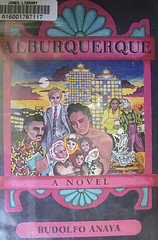
Alburqueque

alburquerque1.jpg

Anaya, Rudolfo. Alburquerque. Alburquerque: University of New Mexico Press, 1992.

My final book of January – chosen to celebrate the month New Mexico became a state. Anaya’s Alburquerque is rich with the culture of New Mexico’s Mexican population. In the center is Abran Gonzalez, a young ex-boxer from Barelas. Upon discovering he is adopted he sets out to learn as much as he can about his birth parents. It is crucial to his understanding of who he really is. Swirling around Abran there is magical realism, cutthroat politics, deep rooted culture, rich history, and tragic romance.
My one complaint – I don’t know why Anaya has Abran have a chance meeting with his birth father in the very first chapter. It seemed a little too coincidental and more than a little cheesy. He is able to come full circle with the same characters at the end. Like I said, a little cheesy.

BookLust Twist: From Book Lust in the chapter simply called, “New Mexico” (p 167).

Everyday Zen

zen.jpg

Beck, Charlotte Joko. Everyday Zen: Love and Work. San Francisco: Haper Collins, 1989.

I had a hard time wrapping my brain around the reading of this book. I think I couldn’t figure out what was bugging me until I realized the reading required more than just my brain. It asked my heart and soul, my beliefs and convictions to get involved. It became a religious thing and that was something I really struggled with in order to read Beck’s book. I admit it – I am a person wrestling with and for a belief. If that bothers you, stop reading right here. I am searching for self-acceptance for what I believe and, ultimately, do NOT have faith in.

I found it insteresting that Beck put the word love in the title of her book because in the chapter specifically on love she states, “love is a word not often mentioned in Buddhist texts. And the love (compassion) they talk about is not an emotion…” (p 71). I had an interesting time coming to terms with that concept.

The other quotes that I took to heart are:
“…the storms of life eventually hit them more lightly. If we can accept things just the way they are we’re not going to be gratly upset by anything. And if we do become upset it’s over more quickly” (p 13).
“We can’t love something we need” (p 39).
“Other people are not me” (p 68).
“Not all problems are as tough as these, but less demanding ones may still send us up the wall with worry” (p 99).

New Words:

  • sesshin
  • zazen
  • koan
  • zendo
  • samadhi

BookLust Twist: From Book Lust in the chapter “Zen Buddhism And Meditation” (p 255).

Americanization of Benjamin Franklin


Wood, Gordon S. The Americanization of Benjamin Franklin. New York: Penguin, 2004.

Benjamin Franklin celebrates a birthday in January (on the 17th day in the year 1706 to be precise; in other words, today); hence my reading of his biography (one of many on my list).
Let me say first and foremost that Mr. Franklin is a personal hero of mine for advocating for libraries so much! If it were not for him who knows where my profession would be. I do not, however, approve of his treatment of his wife Deborah. Can you imagine being married to someone who insisted on living in a different country (and only returns home after your death)? Even Franklin’s friends made no mention of Deborah’s passing after he returned to America.
Wood’s biography deals mostly with Franklin’s political aspirations and most pointedly, his “switch” from supporting Britain to supporting America (hence “americanization” in the title). Of course, Franklin’s involvement in postal services and electricity were also touched upon, but only because they are important elements to Franklin’s history.

My favorite quotes:
“Things that struck him as new and odd were always worth thinking about, for experiencing them might advance the boundaries of knowledge” (p 62).
“…but Franklin thought the electrical charge necessary to kill large animals might end up killing the cook” (p 64).
“The degree of Franklin’s Revolutionary fervor and his loathing of the king surprised even John Adams, who was no slouch himself when it came to hating (p 154).

BookLust Twist: From More Book Lust and the chapter called “Founding Fathers” (p 91).

The Dollmaker

Arnow, Harriette. The Dollmaker. New York: Avon, 1972.

Weighing in at 599 pages this book truly can be called a saga. It’s the story of Gertie Nevens, a simple country woman from Kentucky during World War II. After her husband moves to Detroit, Michigan to find work in the factories, Gertie follows with her five children. Life in the city is cold, dirty, and unkind. Gertie learns of prejudices against “hillbillies” and the importance of the word “adjust”. There is tragedy and triumph with human frailty constantly hanging in the balance. At times I couldn’t believe the hard times Gertie and her family faced. It almost seemed too much to bear. Gertie’s strongest moments are in the very beginning of the book when she has to save her baby from a life threatening illness. After moving from Kentucky it’s as if the city steals Gertie’s strength and spirit.

“…for after the bright whiteness of the hot little room, the cold rain and dark were like old friends” (p 38).
The government owed them at least one man who could fix anything and never got drunk” (p 108).
“‘Are you busy?…Yes and no…I’m in the worst kind of business – tryen to make up my mind'” (p 260).
“She stood, her mind, as always, stumbling around, picking up words, laying them down” (p 538).

BookLust Twist: From More Book Lust and the chapter “Big Ten Country: The Literary Midwest” & the section ‘Michigan’ (p 26).

Funnies (with spoiler)

funniesLennon, J. Robert. The Funnies. New York: Riverhead, 1999.
Tim Mix’s father wrote a comic strip based on his family. Growing up, this comic strip was a source of embarrassment to Tim. Yet, when his father passes away and Tim’s only inheritance is the very comic strip he hated, he decides to try his hand at taking over the strip. Tim is a sarcastic, barely ambitious man who is terrible at conversation, worse at relationships both personal and with his family. This is a formula that always works – the unlikable, unlikely hero goes through a metamorphosis and comes out a pretty decent guy. In the end he doesn’t succeed with the funnies, but he gets the girl.

“This time the pause was longer, a nice slack length of rose to hang the conversation with” (p 52).
“I pushed gently at the sore spot in me and it hurt enough for me to turn away as I talked” (p 132).”
“Susan offered me a bite of her corn dog. I refused, still queasy from the Centrifuge of Death, but didn’t tell her this, and I feared that this rebuff without explanation would give offense. Then I came to my senses and simply let it go. It was a wonderful feeling, like dropping off a box at the Goodwill” (p 155).
And my favorite quote, “I let happiness run its course through me, knowing that it wouldn’t last, but also knowing it would always be there somewhere waiting for me, if I made the effort to find it. This understanding seemed an almost criminally excessive piece of good fortune, but for the time being I accepted it without question” (p 274). For some reason this reminded me of me.

BookLust Twist: From Book Lust twice. Once in the chapter called “Brothers and Sisters” (p 46), and “Families in Trouble” (p83).

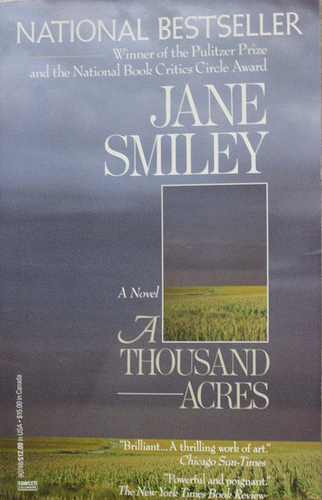
Thousand Acres

acres.jpg

Smiley, Jane. A Thousand Acres. New York: Fawcett Columbine, 1991.

I’ll admit it. It took me forever to even want to read this book even though it has been sitting on my book shelf for months, right within easy reach. I tried picking up Moo a few times and something made me keep putting it down. I have no clue why. I assumed A Thousand Acres would be the same difficult to pick up experience. I was wrong. Once I got into it, Thousand Acres was fascinating, troubling and oh so true to family life. I’ve never lived on a farm. I’ve never set foot in Iowa, but thanks to Smiley I knew exactly what both would be like.
One thing I didn’t understand, nor will I ever, is how a family can so completely and utterly fall apart. By the end of the book not one family is intact and it’s all because of a thousand acres.

“You shouldn’t think somethings changed just because you haven’t seen it in thirteen years” (p 11).
“It was exhausting just to hold ourselves at the table… You felt a palpable sense of relief when you gave up and let yourself fall away from the table and wound up in the kitchen getting something, or in the bathroom running the water and splashing it on your face” (p 101).

BookLust Twist: From More Book Lust and the chapter called “Big Ten Country: The Literary Midwest (Iowa)” (p 27) and Book Lust in the chapter “Growing Writers” (p 107). Personally, I think Pearl also could have put this in her “Families in Trouble” chapter. Not to give anything away but…who tries to poison her own sister? Who does that?

Beyond the Black Stump

Shute, Nevil. Beyond the Black Stump. New York: William Morrow, 1956.

Nancy Pearl likes Nevil Shute. There is a whole chapter on him in More Book Lust. This being my first “Shute book” I was enchanted. Beyond the Black Stump is about an American geologist, Stanton Laird, who is assigned to dig for oil in Australia. Stanton is a stand-up guy with a secret in his past, but when he meets and falls in love with Mollie Regan in the Australian outback, he realizes can’t compete with her past. This is the story of two people too different to make it work. It goes beyond race or religion. Prejudices and historical resentments run deep for both families. Despite the plot being predictable I enjoyed getting to the conclusion no matter how obvious it would be.

“It’s the greed for the gold, the curse of the modern age. Avarice kills more men than any physical disease, I am afraid. These men will not make old bones” (p 136).

BookLust Twist: From More Book Lust and the chapter “Nevil Shute: Too Good To Miss” (p 199).