Miracle

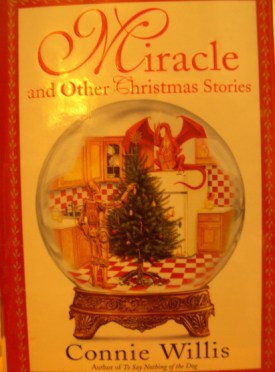
Willis, Connie. Miracle and Other Christmas Stories. New York: Bantam, 2000.

A collection of short stories centered around Christmas.
image0001.jpg

  • Miracle ~ Lauren reminds me of me. She’s well-meaning yet corner cutting when it comes to Christmas. Her cards go out on time and she buys gifts for everyone in the office yet something is missing. Enter Spirit of Christmas Present, a environmentally exuberant specter sent to show Lauren the real meaning of Christmas.
  • Inn ~This is an odd little story about a woman who, while in choir practice for her church pageant, discovers a homeless couple who turn out to be Joseph and Mary. That Joseph and Mary, lost on their way to Bethlehem.
  • In Coppelius’s Toyshop ~ This is one of my favorites. It’s so reminiscent of Will from About a Boy lost in a crazy, confusing, chaotic toystore. Throughout the whole thing I could imagine rows and rows and floors and floors of toys, games, puzzles, colors, lights, noises, and the sounds of children everywhere.
  • Pony~ Moral of the story: it is never too late to get the ultimate present of your dreams…even if you no longer want it.
  • Adaptation ~ An interesting twist on A Christmas Carol. A divorced father wants nothing more than to give his daughter the ultimate Christmas but work and his exwife have other plans.
  • Cat’s Paw ~ A famous detective has been sent to solve a mystery on Christmas Eve. A weird tale involving monkeys and murder. “We are all capable of murder. It’s in our genes” (p 208).
  • Newsletter ~ Has the world been taking over by a parasite that causes goodness and peace of earth? How can we take humanity that’s just a little more…well…human? Turns out, we can’t.
  • Epiphany ~ Another twist on a classic tale. Mel is convinced he has had an epiphany about the Second Coming. He gets a friend and a stranger involved in his travels and suddenly they are the three wise “men.” It’s funny.
  • A Final Word~
  • BookLust Twist: From Book Lust  in the chapter “Connie Willis: Too Good To Miss” (p 248).

    Boy’s Life

    McCammon, Robert. Boy’s Life. New York: Pocket Star, 1991.

    I would almost venture to say there is almost too much adventure in this book. More stuff happens to CoreyMackenson in his life, in his boyhood life, than I can begin to explain. There is magic and imagination on nearly every page. Corey is an all-around good kid but that doesn’t mean he doesn’t have his share of trouble at school, confrontations with bullies and disagreements with his parents. All normal stuff until you add the mystery of a dead man, the mob, a dog that won’t die, a eye-blinking bike, a run-in with Nazis, kidnapping, a prostitute, the klu klux klan, several monsters and more mayhem. 

    I love a book that has almost every page flagged for a good line; a line I wish I had written, or one that made me think. Here are a few of my favorite lines from early in Boy’s Life:
    “You realize that every person in the world is a compromise of nature” (p 9).
    “Maybe crazy is what they call anyone who’s got magic inside them after they’re no longer a child” (p 10).
    “Oh, I knew what the word meant and all, but its casual use from a pretty mouth shocked the fool out of me” (p 20).
    “There are horrors that burst the bounds of screen and page, and come home all twisted up and grinning behind the face of somebody you love” (p 50).
    “I had never seen a black Jesus before, and this sight both knocked me for a loop and opened up a space in my mind that I’d never known needed light” (p 120).

    BookLust Twist: From More Book Lust and the section on Alabama in “Southern Fried Fiction” (p 207).

    Polar Express

    polar expressVan Allsburg, Chris. The Polar Express. Boston: Houghton Mifflin, 1985.

    Is it any wonder that The Polar Express won a Caldecott award? Is it any wonder that Hollywood made a movie out of it? This is a gorgeous book for adults as well as children. It’s fantastic to read aloud to a child because not only is are the pictures spectacular, but the storyline is wonderful, too. See, I can’t say enough nice things about this book!
    It’s simply the story of a boy who takes a trip by train to visit Santa at the North Pole. He is given a special gift that proves his belief in all things Christmas – the elves, the gifts, the reindeer, the North Pole, and of course, Santa Claus himself. This book was such a treat that I now want to go see the movie!

    “We climbed mountains so high it seemed as if we would scrape the moon” (p 9) and “Though I’ve grown old, the bell still rings for me as it does for all who truly believe” (p 29) are my favorite lines.

    BookLust Twist: From Book Lust  and the chapter on “Christmas Books for the Whole Family to Read” (p 55).

    Appointment in Samarra

    appointment in samarraO’Hara John. Appointment in Samarra. New York: Vintage, 2003.

    In honor of Pennsylvania becoming a state in the month of December Appointment in Samarra was my first novel pick. I was excited to see the introduction was written by John Updike. He is another author I have enjoyed over the years. Set in the 1930’s with a keen eye on society, O’Hara tells the story of Caroline & Julian English and their how their elite status is washed away with alcohol and attitude. In an instance the English couple go from being the toast of the town to the talk of trash.

    “I love you more than a tongue can tell” (p 63).
    “…their position in Gibbsville was just that certain and insecure…” (p 83).
    “…she was too conscious of looking like the wrath of God to enjoy any of it” (p 121).
    “The worst of that drive was that the sun glare on the snow made you smile before you were ready” (p 200).

    As an aside: I don’t remember where I was when I learned that the Lenape Indians believed the turtle was the center of the universe. To this day, it remains the only thing I know about this particular tribe. It was interesting to see O’Hara mention the tribe in his historical ancestry of the English family.

    BookLust Twist: From More Book Lust in the chapter “Big Ten Country: The Literary Midwest (Pennsylvania)” (p 30). 

    Twelve Days of Christmas

    12 days of ChristmasKnight, Hilary. Hilary Knight’s Twelve Days of Christmas. New York: Simon & Schuster Books for Young Readers, 2001.

    On the surface this book looks like your average kids’ book. Cute pictures and a storyline you can sing. We all know “The Twelve Days of Christmas” – it’s that silly song that involves milking cows, egg producing hens, and ladies dancing among other things. What makes this book special is what is going on behind the scenes. There’s a whole other story unfolding in the illustrations.  On the surface Bedelia the bear is trying to tell you what her true love gave to her during the twelve days of Christmas (Dec 25- Jan 6) and then there is Benjamin, for those twelve days straight, bringing her the goods. In the background there’s Reginald the raccoon. He lives in Bedelia’s basement for some strange reason, and if you are observant, you learn that he pines for the perfect girl. Throughout Benjamin’s trips to Bedelia’s door with various (odd) gifts, you see Reginald struggling with something of his own.
    In the end (and I won’t ruin it for you), you will want to go back and look at all the illustrations just a little closer. Everything has a meaning – beyond Benjamin looking to woo Bedelia with twelve lords a~leaping (my favorite). Seriously. Check out the lords. They’ll crack you up.

    BookLust Twist: From Book Lust and the chapter “Christmas Books for the Whole Family to Read” (p 55).

    Father Christmas Letters

    Father ChristmasTolkien, J.R.R. The Father Christmas Letters. Boston: Houghton Mifflin, 1976.

    Pure magic. I loved every minute of this book! I have always loved J.R.R. Tolkien’s imagination. From The Hobbit to The Two Towers I have always enjoyed submerging myself in his work. This book is something special. I think Nancy Pearl sums it up best in Book Lust “Tolkien wrote these letters for his children, beginning in 1920 and ending in 1939. Whimsical pictures complement the descriptions of Father Christmas’s life at the North Pole” (p 56). But, what Pearl doesn’t tell you is that Tolkien is posing as Father Christmas, and each letter (one for each year) is a continuation a story (involving a polar bear, elves and ) from the year before. The illustrations that accompany the letters are as captivating as the storyline. I can truly imagine being a child, caught up in waiting for the letter from Father Christmas.
    The sobering thing about this book is that it ends the same year that World War II starts. Tolkien even makes mention of it on the last page “Half the world seems in the wrong place.” It seems like everyone needed to put aside childhood in 1939.

    BookLust Twist: From Book Lust  in the chapter “Christmas Books For The Whole Family To Read” (p 55).

    Bill Bryson’s African Diary

    African DiaryBryson, Bill. Bill Bryson’s African Diary. New York, Broadway Books, 2002.

    I added this to the December list when I read a review describing it as “short.” It’s much shorter than I thought – only 49 pages of “diary” and a few more pages of statistical information. So short that I was able to read it over a lunch break. I’m glad it was a quick read because I couldn’t put it down. I’m a sucker for charitable tactics, especially unique ones, and this book definitely qualifies. CARE International (a non-profit organization dedicated to fighting global poverty) funded Bill Bryson’s trip to Nairobi, Africa with the request that he write about his eight day adventure. Bryson is known for his travel literature, his humor, and his expressive way of describing life around him. He would certainly be able to describe the poverty, the landscape, and best of all, the people of Africa. Many reviewers called this book a charity puff-piece, a lengthy advertisement for the work of CARE, and were bitter about the $12 price tag. What they missed out on was the stunning photography, the wry humor and the painless way to do good (all royalties and profit from the sale of the book went to CARE International).
    Speaking of humor, here are a few of my favorite lines: “…tireless commitment to mediocrity” (p 2), “you had to be really unlucky to be shot and stabbed” (p 4), “Kenyan Railways has something of a tradition of killing its passengers” (p 21) and, “Watamu was tranquil to the point of being comatose” (25). There are other funny moments: “flying toilets,” and flying for real, to name two.

    For more information on CARE, International go here.

    BookLust Twist: From More Book Lust and the chapter “Bill Bryson: Too Good to Miss” (p 36). This being my first introduction to Bryson I am looking forward to more.

    A Child’s Delight

    Perrin, Noel. A Child’s Delight. Hanover: University Press of New England, 1997.

    So. After giving up All Souls Rising, I have switched to something lighter, more innocent if you will: essays on children’s classic books. Really. I needed a break and this has been the perfect remedy. This is going to sound all too punful, but this book is delightful. My word of advice though, ignore the preface. If you are like me, you don’t need a chart of what children’s stories you haven’t read much, less even heard of. I resent the list as if it insinuates I had a poor upbringing because I was in the 93rd percentile who has never heard of E. Nesbit”s The Phoenix and the Carpet. Never mind that Disney made a movie out of it. No matter. I’ll read it now. But. But. But, because of the preface I am constantly aware of what I don’t know. I actually find myself overly proud when I’ve read a Noel Perrin choice (like The Borrowers Series by Mary Norton or The Story of Ferdinand by Monroe Leaf).

    Anyway, I’m taking notes on Perrin’s picks. I’m thinking my niece and nephews could benefit from my new-found knowledge of “classic” books for kids.

    BookLust Twist: In Pearl’s More Book Lust under “Dewey Reconstructed, the 000s” (p.62).

    All Souls’ Rising (with Disappointments)

    Bell, Madison Smartt. All Souls’ Rising. New York: Vintage Books, 1995.

    I’m having a love/hate relationship with this book. Only 110 pages into it I waiver between devouring it and chucking the whole thing across the room. The first chapter opens with a description of a women nailed to a pole. She is being punished for killing her child. She drove a nail through her newborn’s skull. Lemme back up – she’s a slave and she was raped on a ship bound for Haiti. The year is 1757. Need I say more? When the woman finally dies, her feet, hands and head are chopped off and displayed as an example for other slaves. Some example! As a rule, I don’t get “into” historical fiction, especially those with such a political, violent underbelly. However, this is a Booklust book and I’m bound to at least give it a try. When I started this venture I agreed to Pearl’s 50 Page Rule (stop reading if by 50 pages you can’t get into it). In All Souls’ Rising‘s case, when I got to page 50 I was in the love phase and couldn’t put it down. C’est la vie.

    Booklust Twist: Pearl labels this, “novelistic history” of Haiti (More Book Lust p55)

    12/30/06: Update~ I am admitting defeat with Bell’s book. After the slave uprising it has been nothing but vivid descriptions of violence. I think this book is responsible for my week’s worth of nightmares about war. Here’s an excerpt. I warn you, this is one of the tamest scenes of cruelty!

    “He cut a bracelet all around Maltrot’s wrist, just above the thong that bound it to the branch. He made a vertical incision into the palm and turned back the flaps of the skin from the whitish fatty layer underneath and began peeling it back towards the fingertips as if he were slowly taking off a glove…” (are you getting the picture?)…”Maltrot ground his teeth and bit his lips until the blood ran freely, but finally he could not contain the scream and when it came it was large and loud enough to split the sky.” (p235)

    I realize flaying, raping, torturing, murdering, baby impaling, etc is common in times of war. It’s happening today. My problem is Bell. He is such the amazing storyteller that not only do I believe every eye gouging, I can almost feel it too!

    BookLust Twist: Found in Pearl’s More Book Lust under the chapter, “The Contradictory Caribbean: Paradise and Pain” (p.55). She wasn’t kidding.

    Banner in the Sky (w/ spoilers)

    Ullman, James Ramsey. Banner in the Sky. New York: Scholastic, Inc. 1954.

    Banner I read this young adult book in one sitting. It’s cute and heroic and it won a Newbery Award. Basically, it’s the Swiss tale of a teenage boy looking to finish the challenge that finished his father – climbing the final, unconquered summit in the Alps, the Citadel. Rudi is a sweet sixteen rebel dishwasher who dreams of finishing what his father started, much to the dismay of his mother. Widowed and overprotective, mom relies on her brother to help keep her son in check. The only problem? Uncle is an accomplished guide with mountaineering in his blood. So is the kid’s restaurant boss. And his arch rival, 18 year old Klaus. Everyone looks to Citadel as the great lost challenge and Rudi’s leading the lack.

    Spoiler: Rudi not only reaches the summit, but he also saves a more experienced, rival climber along along the way.

    BookLust Twist: “Adventure By the Book: Fiction” (Book Lust, p. 7), Pearl describes Banner in the Sky as, “an adventure book that makes for good read for adults.”

    Travels with Charley

    Steinbeck, John. Travels With Charley: In Search of America. New York: Viking Press, 1962.

    Charley This could easily be my favorite Steinback story. Maybe because it’s a true one. Maybe because it hasn’t left me wanting to slit my wrist by the last page. Maybe because Steinbeck writes about something I am interested in: traveling the country. His humor and DownToEarth voice make reading easy. I was thrilled when, by the 26th page, Steinbeck had already mentioned Deerfield, MA and my father’s school (the Eaglebrook School). His own son had attended there, hence the shout out.
    Steinbeck does a wonderful job describing the small towns, the set-in-their-ways locals who inhabit each place, and the passing autumn into winter scenery. Like all his other tales (fiction or not), he makes the people and places come alive with vivid realism. My favorite part: Steinbeck wants to see the birthplace of Sinclair Lewis. He asks some locals about finding the small town of Sauk. They know the sign, “Birthplace of Sinclair Lewis” but it’s obvious they have no clue who Lewis was.

    Booklust Twist: Pearl hides this gem in a chapter called ‘The Beckoning Road”, (More Book Lust, p.20)

    Admiral Hornblower (w/ spoiler)

    Forester, C.S. Admiral Hornblower in the West Indies. Toronto: Little, Brown and Co., 1958.

    Hornblower

    I guess I read this series out of order because Admiral Horatio Hornblower retires at the end of this one. Woops. Anyway – rewind: it’s peacetime, right after the Napoleonic Wars. Admiral Hornblower is riding the high seas, battling pirates, confronting revolutionaries, and roughing the winds of a hurricane. This book is the reason why I’m doing this booklust challenge. This is a book I never would have picked up otherwise. At times I thought, “this is perfect for a teenage boy.” It’s easy reading…definitely easy, but exciting. Hornblower has challenge after challenge in every chapter. I loved his bluff about Napoleon being dead and then finding out “Boney” really did die. My favorite aspect of the book however, is more psychological. I loved the necessary “game face” Hornblower has to put on in different situations. There was a certain decorum, a definite mind-game to everything he did. He couldn’t look vulnerable to anyone, including his own wife.

    Booklust Twist: Pearl calls C.S. Forester “the greatest storyteller of life on the high seas.” (Book Lust p 217). Confession – I should have read this one later in the series.

    Beautiful Joe

    JosephSaunders, Marshall. Beautiful Joe: A Dog’s Own Story. Storytellers Ink, 1990.

    Another Booklust special. I’m not being sarcastic. This book is special. I loved it. Decidedly a children’s book with great illustrations, I dove into it for a quick-like-bunny read (think an hour or so). I think I just needed a break from Admiral Hornblower and all his blowing (more on that in another post). Beautiful Joe is the haunting story of an abused puppy told from the puppy’s point of view. Very unique. This dog suffers cruelty at the hands of his farmer owner (like his tail and ears being chopped off). If you need a good cry, pick up this book! For all its sadness, at times it also is poetic and preachy. I’ve heard of other versions being underwritten by the ASPCA, though my edition made no mention. The narration does leave the story and focus more on animal rights from time to time, but all in all it is a moving story. It has touched the hearts, and remained in the memory of many.

    Spoiler: Joe is rescued and ends up in a loving household.
    Booklust Twist: Pearl calls this a “three hanky read” (Book Lust p.237). If you love animals I agree!

    Things Fall Apart

    Achebe, Chinua. Things Fall Apart. Portsmouth: Reed Publishing, Inc. 1992.

    achebe I started The Plague (you all have read Albert Camus) before I got sick. Not a good thing while you’re puking as you can surely imagine. So, I’ve started Things Fall Apart, instead. It’s another Booklust choice (of course). My library has a pretty cool edition complete with a list of principal characters, a glossary of terms, a background history of culture, and suggestions for further reading – all before you even get into the story by Achebe. I’m only at the part where it’s announced that Ezeugo, the wife of Ogbuefi, is murdered. Page eight. More later.
    12/7/06: Puzzlement: Okonkwo learns that when is father is called, “agbala” it’s not only another name for a woman, but it’s also a term for a man without a title, a purpose. A seemingly derogatory term for sure. But, wait! The Oracle was also called Agbala and people came from all over to consult it. Maybe being called, “agbala” isn’t so bad after all.

    Booklust Twist: this is categorized as “African Literature in English” and as a companion read with Heart of Darkness by Joseph Conrad, The Poisonwood Bible by Barbara Kingsolver, and King Leopold’s Ghost by Adam Hoschild (Book Lust, p.15 & 63).

    An Unofficial Rose

    Murdoch, Iris. An Unofficial Rose. New York: Viking Press, 1962.

    I read this book in practically one night. I have mixed feelings about Murdoch’s Unofficial Rose. For starters, I never felt like I got to know the characters well enough to care about what happened to them. To be honest I was disgusted by them, all of them. The relationships could be broken at a whim. Marriages meant nothing. It reminded me of a throw of the dice. Partnerships came and went, were formed and were broken again. Nothing was permanent or sacred.
    The thing I liked the most was the suspense. No one knew who was really being honest with anyone else. I didn’t know where anyone’s true heart was laid. Okay – here’s a spoiler: son wants to run off with his young mistress. He demands money from his father in the form of the sale of a beloved painting just so he can run away with said mistress. Father sells painting, even though it was his prized possession (and the very item he thinks he married his wife for). Son’s wife has a chance at divorce and a new relationship with someone who might love her and she admits loving back. She declines just in case cheating hubby changes his mind and comes back to her. I was irritated with her but I did not know the character enough to care.

    Booklust Twist: Nancy Pearl recommends anything and everything by Iris Murdoch (Book Lust, p.162).