Final Flight

Stekel, Peter. Final Flight: the Mystery of a WWII Plane Crash and the Frozen Airmen in the High Sierra. Berkley: Wilderness Press, 2010

The backdrop for Final Flight is November 18, 1942 – the day a Beech 18 airplane went missing during a training mission in the mountains of the High Sierra. Peter Stekel, a longtime hiker of the Sierra Nevada, was introduced to the story in 2005 when a “Frozen Airman” was found and identified as part of the four-man crew in the Beech 18 crash. Stekel spends two years engrossed in the events surrounding the 63 year old tragedy, learning everything he can about the airmen on board, the weather conditions, the media reports (and misreports) and of course, the unforgiving landscape where the crash occurred. When he, himself, finds a second body in the High Sierra the research becomes a must-tell story. Enter Final Flight, the story Stekel just had to tell. I enjoy a “complete package” book: great story, compelling mystery, photographs that tell a little more, biographies that endear you to people, maps to ground you to location, references and details that urge you to learn more. I found Final Flight to have all of these elements and much, much more. First and foremost it is a true story. That alone draws you in. Then you learn two of the airmen are still missing despite reports that clearly state all four airmen were recovered and given a group burial in Golden Gate National Cemetery. Why the misinformation? That creates intrigue. Where are the remaining airmen? Will they ever be found? You want Stekel to keep digging only so he can keep you informed. The photographs not only give the visual boost to description of the glacier’s location high in the Kings Canyon National Park, but also illustrates just how difficult it was to find any remains in 1942. Finally (and above all else), Final Flight is a proper tribute to the families of the four airmen who lost their lives on November 18, 1942. Stekel’s story shows respect and offers closure.

Crooked Letter, Crooked Letter

Franklin, Tom. Crooked Letter, Crooked Letter. New York: William Morrow, 2010.

Confession: I couldn’t put this down. A friend from Germany was in town, someone I hadn’t seen in almost three years and all I wanted to do was read Crooked Letter. I don’t normally want to ignore friends!

Crooked Letter takes place in rural Mississippi bouncing between the early 1970s and the late 2000s. From the very first sentence you are pulled into something sinister. Hints of evil lurk between the lines. Larry Ott has always been strange. A social outcast since grade school Larry pulls outrageous stunts, desperate to be noticed; bringing snakes to school, scaring girls with a grotesque Halloween mask. When a pretty high school classmate disappears Larry is suspected of murder. Unbelievably, he is the last person to be seen with her. While her body was never found and Larry’s guilt couldn’t be proven, he remained the town’s only suspect. Fast forward 25 years and another pretty young girl has gone missing. When she is found, raped and murdered, on Larry’s property it seems like an open and shut case. Except, Larry has a silent almost forgotten ally – Silas “32” Jones, a former classmate and one-time secret friend. Secret because in 1970s deep south Mississippi pockets of racism were more than alive and well. It wasn’t acceptable for white Larry to be seen with black Silas. As Chabot, Mississippi’s only constable Silas sets out to learn the truth, even if it means digging up the ugly past. Tom Franklin is very thorough with descriptions of each character’s personal life . You are pulled into Larry Ott’s mechanic shop and can smell the grease just as easily as riding along with Constable Silas Jones as he works his investigation. This is a story first and foremost about friendship and guilt and forgiveness. It is also a story about the harsh realities of racism and poverty and the scars that run deep.

I only found one bothersome discrepancy. Larry Ott is described as 41 years old. Miss Voncille is described as a woman in her “early 50s.”  That would mean at the very minimum there is a ten-year age difference between Larry and Voncille. But because they both attended the same high school Constable Silas asked Voncille if she knew Larry. Here’s the thing –  Larry would have been a toddler when Voncille started high school. If their ages had been reversed it would have allowed for the “legend” of Larry and his weirdness to be played up – Voncille could have heard stories of Larry despite the fact he graduated ten years ahead of Voncille.

In a way I could relate to Larry, especially his obsession with books. His father didn’t want him “wasting” the day by reading either.

Best line I hope is kept, “When he left, Larry lay amid his machines, thinking of Silas, how time packs new years over the old ones but how those old years are still in there, like the earliest, tightest rings centering a tree, the most hidden, enclosed in darkness and shielded from the weather” (p 251).

Yes You Can!

Drake, Jane and Ann Love. Yes You Can!: Your Guide to Becoming an Activist. Ontario: Tundra Books, 2010.

Right away I have to say I wouldn’t have classified this as “juvenile” literature. The language might be a little simplistic, definitely geared toward young adults, but the message is something we should all sit up and take notice of no matter what our age: if the world around you makes you sick do something. It’s the age-old promise, “you CAN make a difference!” But first you have to DO something.

Yes You Can is a how-to manual of sorts. Each chapter covers a different step to becoming an activist including an example of someone taking that particular step. The histories of organizations such as Amnesty International and Save the Children illustrate what can happen if the right steps are taken successfully. For every chapter there is a section on the historical time line of that step in action. There is also a section on the accomplishments as well as the challenges called, “Milestones and Setbacks” which put everything into perspective. Almost like a textbook there is a checklist to test what the reader has (or hasn’t learned). My favorite piece of advice was “know your cause inside and out.” The ability to see both sides of any argument can go a long way in the effort to sway opinion or make a change.

My only sticking point? This classification of juvenile literature. Why juvenile? It really should be “for all ages” because the vocabulary used in Yes You Can! is not consistent. There is talk of “family” and “classmates” in one chapter and “colleagues” in another. I don’t know any child who would refer to his or her peer as a colleague.

Play Their Hearts Out

Dohrmann, George. Play Their Hearts Out: A Coach, His Star Recruit, and the Youth Basketball Machine. New York: Ballentine Books, 2010.

Play Their Hearts Out was a roller coaster of a read. Not because it had nonstop heart pounding excitement but more because some chapters moved faster than others. Like being pulled up to the crest of the ride, some moments in the book were bogged down with unnecessary detail making it long winded and rambling. Other moments, once released from over-worded detail, moved at a much faster pace and were quite enjoyable. Play Their Hearts Out is  everything you need to know (the good, the bad, and the ugliest of ugly) about AAU basketball. It is gritty and uncensored. Dohrmann had an all-access pass to the sidelines of Coach Joe Keller’s world for eight years. In that time he follows Coach Keller and his star recruit, Demetrius Walker, from middle school to major success. Orbiting the story are other key players who influence Keller like competing coaches, opposing teams, and ever present parents.

On a personal note, I found myself asking if the attitudes and actions of Coach Joe Keller seemed exaggerated because if they weren’t Dohrmann’s depiction of Mr. Keller irritated me. From Dohrmann’s writing Keller’s philosophy on recruitment and coaching seemed cutthroat and conniving – more appropriate for professional basketball than for anything considered “grassroots.” The portrayal of Joe Keller is the quintessential shark, hungry for the kill, unconventional and caustic to everyone around him. I guess greed can do that to a person, especially when there’s a big Nike or Adidas contract involved.

August ’10 was…

August. The last gasp of summer before everyone starts thinking about back-to-school clothes, back-to-school school supplies and back-to-school attitudes. I know my college has already adopted the attitude now that the athletes and international students have started arriving on campus. August was quiet compared to July’s crazy traveling. But, for books it was:

  • The All-Girl Football Team by Lewis Nordan ~ Nordan is my emotional train wreck.
  • Zarafa: a Giraffes’s True Story, from Deep in Africa to the Heart of Paris by Michael Allin ~ in honor of Napoleon’s birth month even though Napoleon is a teeny part of the story
  • Zel by Donna Jo Napoli ~ the clever, psychological retelling of Rapunzel.
  • The Meaning of Everything: the Story of the Oxford English Dictionary by Simon Winchester ~ in honor of National Language Month, but I didn’t finish it. Not even close.
  • Undaunted Courage by Simon Winchester ~ a really interesting account of the Lewis & Clark Expedition.
  • A Separate Peace by John Knowles ~ probably one of my all-time favorite books.

For LibraryThing and the Early Review Program: I started reading Play Their Hearts Out by George Dohrmann. Review coming in September.

For fun I read:

  • fit = female: the perfect fitness and nutrition game plan for your unique body type by geralyn b. coopersmith ~ the cover of the book didn’t use capital letters so neither did i.
  • Nutrition for Life: The no-fad, no-nonsense approach to eating well and researching your healthy weight by Lisa Hark, Phd, RD & Darwin Deen, MD ~ this is a really, really informative book.

July ’10 was…

July was the great escape. I was able to go home twice. Each trip was for a very different purpose and as a result each was a very different experience, but I was homehome just the same. Got the tan I didn’t need. July was also a double shot of Natalie music. Again, two very different experience, but amazing nonetheless. Blogs about both shows coming soon. An absolutely fantastic Rebecca Correia show rounded out the month, musically. She performed with Jypsi at the Bennett Farm. A really great night.
All in all, July was so many different things and unfortunately, reading wasn’t a big part of it. I stole time where I could (often in cars driven by other people):

  • The Great Gatsby by F. Scott Fitzgerald ~ something small and short to read on the cliffs of Monhegan
  • Firewall by Henning Mankell ~ a murder/police procedural mystery set in Sweden; something to read in the tent!
  • The Eyes of the Amaryllis by Natalie Babbitt ~ a great book for kids about living by the ocean. Another great book to read on the cliffs of Monhegan.
  • Are You There God? It’s Me, Margaret. by Judy Blume ~ a blast from the past! Read this on the couch…
  • The Tipping Point: How Little Things Can Make a Big Difference ~ read in honor of job fair month & added because I gave up on the Richard Rhodes book (see below)
  • Love of a Good Woman: Stories by Alice Munro ~ read in honor of Munro’s birth month
  • In the Wilderness: Coming of Age in Unknown Country by Kim Barnes ~ in honor of July being the month Idaho became a state

If you notice I focused on stuff for young adults – kind of like easy listening for the brain.

Attempted, but did not finish:

  • The Making of the Atomic Bomb by Richard Rhodes ~ see, I told you so! I added it back on the list for another time…

For LibraryThing and the Early Review Program:

  • My Formerly Hot Life by Stephanie Dolgoff ~ a really fun book.
  • What is a Mother (in-law) To Do by Jane Angelich ~ unfortunately, I didn’t enjoy this very much.

I guess nine books is a decent “read quota” for the month. At least five of them were extremely easy to read, though…

My Formerly Hot Life

Dolgoff, Stephanie. My Formerly Hot Life: Dispatches From Just the Other Side of Young. New York: Ballantine Books, 2010.

Funny, funny, funny. I loved My Formerly Hot Life and not because I am over 40 and formerly had a hot life. I am over 40 but I would call my past “fireside cozy” and leave it at that. Dolgoff, however, claims to have had a hot life. Her book is all about how “formerly” her life has become now that she is over 40 and married with children. She dishes out how reality bites when gravity takes over. Sexy clothes don’t fit anymore, bars are too loud and it takes forever to plan a girls night out. Yet, all that doesn’t matter because you’re too tired to go out anyway.
My Formerly Hot Life is not just all fun and games. There is a serious side to Dolgoff as well, especially when she delves into subjects such as aging parents, the question of having kids at a Formerly age, health issues, and ultimately recognizing your own mortality. These are sections of the book I hope she keeps because as fun as it is to poke fun at sagging breasts and lumpy butts, there is this not-so-fun side to aging that shouldn’t be ignored.

What’s a Mother (in-law) To Do?

Angelich, Jane. What’s a Mother (in-law) To Do?: 5 Essential Steps to Building a Loving Relationship with Your Son’s New Wife. New York: Howard Books, 2009.

I have to start off by saying this was a May 2009 Early Review book from LibraryThing. That means roughly a year ago I was supposed to read and review this book. I received it in the mail today. Today. June 26th, 2010. I am assuming this has already hit book stores and doesn’t really need my promotion. However, because I respect the program and the review process I am still going to write about it.

My first impression of What’s a Mother (in-law) To Do? was, “wow, this is short!” Indeed, it’s an odd little book. Hardcover yet the size of a paperback and only 130 pages long. As a librarian I automatically went to the back pages to look for a bibliography of sorts. If this is a book that involved research I expected to see a works cited page. There wasn’t one.

In the end I was disappointed by What’s a Mother (in-law) to Do? because I felt like it was something any old MIL could write: all she would have to do is fill 131 pages with a variety of stories from other in-laws (mothers and daughters), sprinkle in a few personal experiences, and add a layer of common sense advice.  What would have been really interesting (and cater to a larger audience) is if Angelich researched building a relationship with your child’s new spouse. In other words, remove the specificity of the subject and make it work for any in-law relationship.

I honestly couldn’t take What’s a Mother (in-law) To Do? seriously. Angelich talks about conducting research but doesn’t provide real sources. She mentions “research conducted” but there’s no weight behind like what kind of research it was or who conducted it. She talks about taking advice from experts but doesn’t elaborate on how she solicited this advice. In short, I didn’t believe her “research.” This is a book I would have picked up and immediately put back, writing it off as “fluff” or pop psychology. I would recommend it for someone with a fair to mediocre relationship with their new daughter-in-law, but not to someone with a strained or terribly difficult one.

June ’10 was…

June was a month of reconnection. By far, my favorite musical moment was the lovely Rebecca Correia at the Iron Horse. It is awful to say but every single artist that follows her on stage can’t compare. Not that they are NailsOnaChalkboard bad, but they have nothing on Rebecca. On the professional side of things June was a very frustrating month. On the personal sides I got one of the best hugs of my life (thanks, Gracie). For books, it was this:

  • Happenstance by Carol Shields ~ this should be a movie
  • Hatchet by Gary Paulsen ~ this also should be a movie
  • The Confession of Nat Turner by William Styron ~ this was a hard one to read
  • Writing Dangerously: Mary McCarthy and Her World by Carol Brightman ~ a very thorough biography that helped with my insomnia
  • I Don’t Know Why I Swallowed the Fly by Jessica Maxwell ~ first year fly fishing story
  • Less Than Angels by Barbara Pym ~ a sociology experiment in a land of anthropologists
  • Master & Commander by Patrick O’Brien ~ this took some time to get into…so much so that I didn’t finish it.
  • The Great Gatsby by F. Scott Fitzgerald ~ I needed to lick my wounds with something enjoyable!

For LibraryThing’s Early Review program:

  • The House on Oyster Creek by Heidi Jo Schmidt ~ once I got beyond the first chapter I loved it. Beautiful writing.

For the fun of it:

  • Winning By Losing by Jillian Michaels ~ I’m most interested by the subtitle on the cover of her book, “Change You Life.” I’m up for that. Really.

House on Oyster Creek (with spoiler)

Schmidt, Heidi Jon. The House on Oyster Creek. New York: NAL Accent, 2010.

Probably the most distracting aspect of Schmidt’s style of writing was her almost fanatical need to portray Henry as the older, colder, and uncaring husband. I get it. Schmidt wants the reader to cheer Charlotte on when she meets a man more to her liking, more to her temperament, more to her everything. You aren’t supposed to hate the damsel in distress. You aren’t even allowed to dislike her. In order to make the damsel’s potential affair acceptable said damsel’s husband needs to be bad. Very bad. If the husband is really awful you wind up begging, praying for that knight in shining armor. In an attempt to make Henry bad I think Schmidt went overboard. As a result Henry became a caricature of the very worst. In the first chapter alone (we’re talking 13 pages) there were over 24 negative words associated with Henry. Here are some, but not all, of the words and phrases used to describe Henry’s words, actions and demeanor. I left out dialogue with Charlotte:

  • irritation
  • seething
  • contempt
  • staunch
  • “heart seemed to harden” (p 3)
  • bleak
  • rebellious
  • stark
  • “nothing pleased him” (p 6)
  • fury
  • bitter
  • “fit to kill” (p 7)
  • “real hatred” (p 8.)
  • rigid
  • suspicion
  • jeer
  • scorn
  • irritated
  • contemptuous
  • darkening
  • “glance was poison” (p 11)
  • infuriating
  • infuriated
  • “patience stretched to breaking” (p 13)
  • shuddered
  • “spasm of disgust” (p 13)
  • icy

To make matters worse, on the other side of this marriage is Charlotte and her demure, sweet, sensitive, caring, loving, “made of empathy” personality. Schmidt is not as fanatical about driving that point home. But, you get the point just the same.

However…once I got beyond page 14 I loved The House on Oyster Creek. Charlotte is a little self-righteous at times but after putting up with Henry all those years she deserves to. While House on Oyster Creek focuses on Charlotte as she makes her way the book is really about the entire community she joins. Schmidt is extremely accurate when introducing Charlotte to the new community. when it comes to a tight-knit community there will always be this Them and Us attitude. You could be in a community for over 30 years and just because you are the first generation to do so, you are still the newcomers in town. The more generations you can brag of, the more clout you have in the community.

Of course, I had favorite lines that I really hope Schmidt keeps in the book, but I won’t quote them here.

I have to admit I never rooted for Charlotte to have an affair. There was something so broken about Henry that I think Charlotte owed it to him to work it out. When Darryl ends up marrying someone else I was happy. I can admit the story ended exactly how I wanted it to end.

May ’10 was….

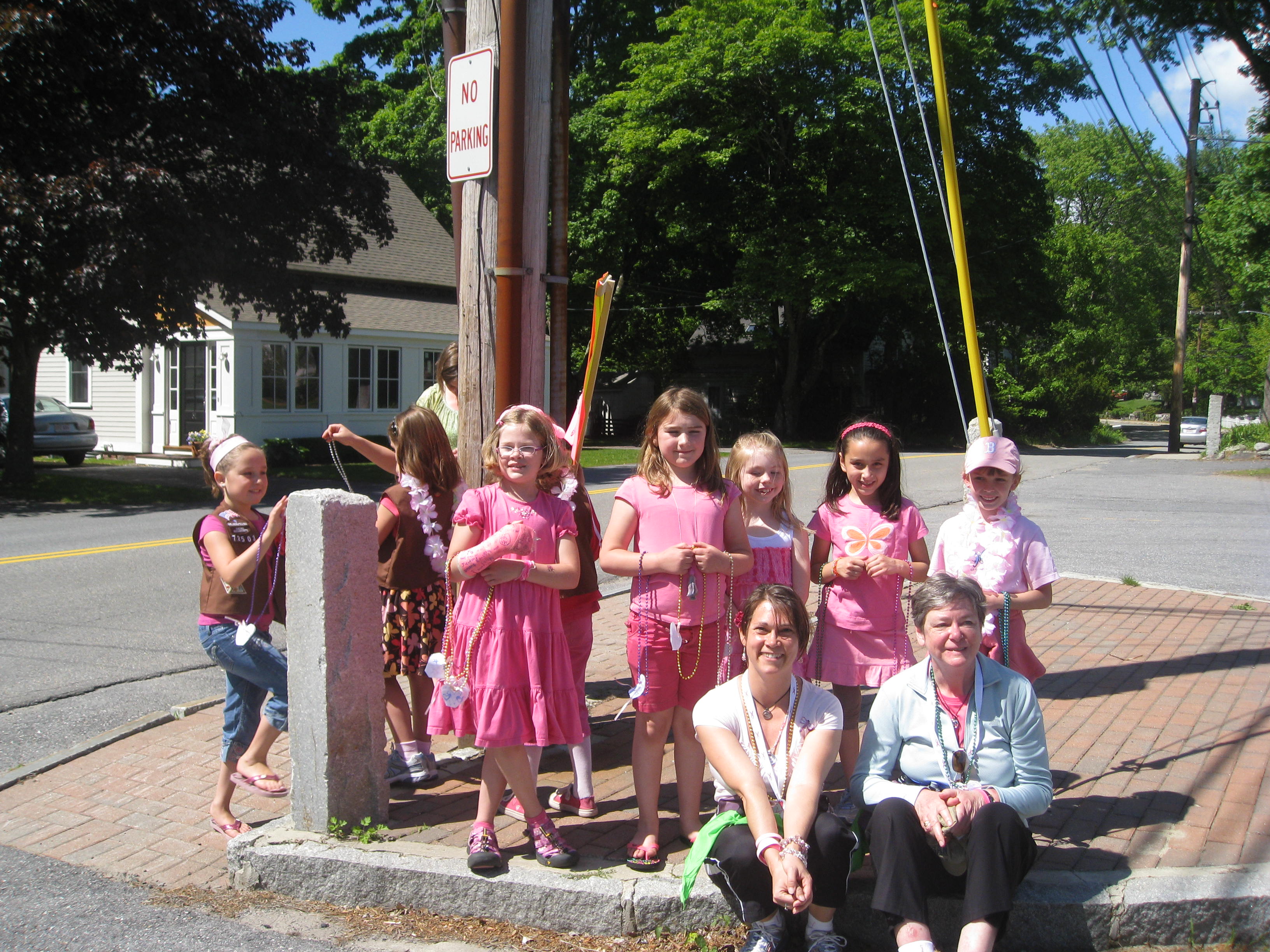
Pretty in Pink

May. What to say about May? For obvious reasons it wasn’t the month for reading. I still haven’t mastered walking and reading without doing both at an excruciatingly slow pace!

  • Endless Love by Scott Spencer ~ apparently this was made into a movie. I am curious how they handled the anal sex scene…
  • You Make Me Feel Like an Unnatural Woman: Diary of a New (Old) Mother by Janet Newman ~ funny, funny, funny (although, an odd choice to honor Mother’s Day)
  • Wobegon Boy by Garrison Keillor ~ my first Keillor book. Now I know what all the fuss is about. Another funny one!
  • Zorba the Greek by Nikos Kazantzakis ~I admit it. I gave up on this after 50 pages. I moved onto a Jillian Michaels book. More on that next month….

For LibraryThing & the Early Review Program:

  • Fundamental Weight Training by David Sandler
  • Fall Asleep Forgetting by Georgeann Packard ~ this should be a movie. It was weird but good!

For the hell of it:

  • Homer’s Odyssey by Gwen Cooper

Fundamental Weight Training

Sandler, David. Fundamental Weight Training: 102 Exercises to Start Training. Champaign: Human Kinetics, 2010.

I had many false starts trying to write a review for this book. My hesitancy directly related to my love-hate relationship with content and how it was arranged. There were many, many things to love about this book…and yet I found a few things to hate.

On the didactic side of things Fundamental Weight Training has it all. Simple weight lifting exercises for beginners that take into consideration using a professional gym, a home gym, or even just a person’s own body weight. There are simple black and white photographs to illustrate each exercise, showing correct form and posture. There is even sections on stretching, warming up and cooling down – all essential elements of working out and avoiding injury. In addition, Sandler goes above and beyond to explain gym etiquette and terminologies with a chapter called, “weight room language and protocol” (p 7). My favorite section was “Give it a Go” which gives the reader the opportunity to put lesson to life and try a series of exercises dedicated to a particular group of muscles like arms, for example.

But, here is where the hate comes in. The “Give it a Go” section assumes a person has every weight machine and accessory at his or her disposal. The exercises are a mix of free weights and machines usually found at the gym. Organization-wise, Fundamental Weight Training would have been easier for me if the “Give it a Go” section was combined with the “Take it to the Gym” and “Train at Home” sections rather than separate section.

A final frustration is, as with any exercise book, a person would need to not only memorize the names of each exercise but the proper way to perform them. Holding a book while trying to flex the a dumbbell is not all that easy. Flipping from the “Give it a Go” page to the section with the exercise can be frustrating.

All in all, I enjoyed reading Fundamental Weight Training. After reorganizing the information on my own I have a great training plan that I can take to the gym or use at home.

Fall Asleep Forgetting

Packard, Georgeann. Fall Asleep Forgetting. New York: Permanent Press, 2010.

I have a love-hate relationship with books like Fall Asleep Forgetting. The problem is Packard’s writing is too good. Like a delicious meal I couldn’t slow down when it came to eating it up; devouring whole chapters at a time. What’s wrong with that? In truth, this is a book meant to be savored slowly. The writing is delectable, deliriously rich and expressive. One minor distraction is character focus is a little out of focus. I would have preferred Claude as the obvious heroine rather than swirled in a mishmash of other incredibly strong personalities. Because Fall Asleep Forgetting really is about Claude and her strange involvement with a married couple, Paul and Sloan, that fact really needs to be teased out. Paul is dying and his wife is bisexual and mentally ill…sort of. Claude is caught up in their relationship until it becomes her relationship, her obsession, but as I mentioned before, she is not the only one. There is nine-year-old Six and her parents Rae and Sonny, Cherry the transvestite owner of the trailer park where most everyone lives and her partner Barton, and elderly Mr. and Mrs. Saugerties. Each one of these characters has a unique and tantalizing story.

Quotes that I really hope are kept: “Once your parents hate you for who you are, the scorn of others in mere child’s play” (p 42), and “I see now that equal parts repulsion and attraction make for the most voracious form of lust” (p 124).

Personal note: I was really excited to see e.e. cummings quoted at the beginning of the chapter called “The Curving Support of Feather Pillows” (p 129). ‘Milly and Maggie and Molly and May’ is a great poem. My only argument would be against calling it a poem about just Maggie because Milly, Molly and May all had important parts.

Man From Saigon

Leimbach, Marti. The Man From Saigon. New York: Doubleday, 2010.

This was an interesting read for me due, in part, to the fact I was reading The Making of a Quagmire by David Halberstam at the same time. Leimbach’s descriptions of Vietnam mirrored Halberstam’s almost perfectly. The rainy, muggy climate, the poverty stricken communities, the brash (trying-to-be-brave) military presence, but above all, the reporters trying to capture the atrocities of politics and war while remaining mentally sound and physically safe. Of course, Leimbach’s story is a bit less intense with the addition of an adulterous romance threaded through the bomb blasts and sniper attacks. Susan Gifford is a green reporter trying her hand at covering the U.S. involvement in Vietnam. When she is taken captive by the Vietnam Communists, the Vietcong, along with her photographer, Hoang Van Son, the plot thickens. Susan is suddenly confronted with a profound and deep relationship that was originally a professional partnership forged out of necessity.

There are, of course, a few lines that became my favorite. The one I hope makes it into the final copy is “It was a feeling of being trapped and desperate, of having been cornered by her own mistakes” (p 6). Been there. Done that.

No Instructions Needed

Hewitt, Robert G. No Instructions Needed: An American Boyhood in the 1050s.

Okay. I have to get this off my chest. I was curious about the publisher for No Instructions Needed so I did a simple Google search. On my first run-through I found an ArbeitenZeit Media website with design and content credit going to Robert G. Hewitt. On my second attempt to find other authors published through ArbeitenZeit Media I found Gail Hewitt and L.G. Hewitt. Did I stumble across a family-run vanity publication? Am I writing a review as a vehicle for marketing purposes? Does that mean no one else would publish their work? That bothers me because when a writer finds someone who is willing to publish his or her words it’s as if that publisher is saying, “I believe in your craft.”

Robert G. Hewitt learned of the demise of his high school and was flooded with memories from his boyhood. As a salute to his youth he wrote No Instructions Needed, a collection of remembrances of the 1950s complete with cute illustrations. Everything from Christmas to Hewitt’s first car is covered with great nostalgic fondness. As mentioned by other reviewers, nothing really happens in No Instructions Needed. The memory lane is not paved with problems and the end result is a simple, yet pleasant read.