Colette

Hirsch, Edward. “Colette.” On Love. New York: Alfred A. Knopf, 1998.

 Probably the thing that grabbed me first about “Colette” is the fact it’s a mother talking to her daughter about marriage. The dos and don’ts on love. For a man writing from the female perspective it’s pretty cynical. There is a hint of humor when the mother mentions “one of her husbands” implying she hasn’t been all that expert on relationships either.

Favorite line: “Never underestimate the mysteries of love” (p 84)

BookLust Twist: From More Book Lust in the chapter, “Poetry Pleasers” (p 189).

Apple That Astonished Paris

Collins, Billy. The Apple That Astonished Paris. Fayetteville: University of Arkansas Press, 1988.

Such a slim, unassuming little book of poetry! Who knew it would pack a punch of powerful words neatly disguised in short and sweet poems? I have decided Billy Collins is one of my favorite poets. His poetry is not pretentious. It’s within reach; a drinking buddy; a lovable troublemaker disguised in a string of words. There is wild imagination (walking across water and thinking of what the fish below see), seriousness (a former teacher looks back on the “community” of students he has taught), nostalgic (remembering a Tuscany vacation), clever (questioning Basque language), humorous (Smokey the Bear is fed up with warning tourists about forest fires) and moving (how cancer is a bad word). Each poem is about a page long or less. Short enough to read again and again. Let the words soak in and open your mind to fun poetry.

Favorite lines:
“…a jaded traveler with an invisible passport” (p 6).
“The evening hangs in the air like lace” (p 13).
“My sentiments are tangled like kites in the branches of her incomprehension” (p 21).

BookLust Twist: From Book Lust  in the chapter called, “Kitchen-Sink Poetry” (p 139).

Ancestral Truths

Ancestral TruthsMaitland, Sara. Ancestral Truths. New york: Henry Holt & Co., 1993.

To be quite honest I don’t know how this came into my hands. I’ve already read one book in honor of National Sibling Month. This was supposed to be on the list for next year, or maybe even the year after that. I wasn’t supposed to read two sib books in one month. But, suddenly there it was and after I picked it up I couldn’t put it down.

Ancestral Truths is a bizarre tale about a woman who starts a journey climbing a mountain in Zimbabwe with her lover and ends it with her alone with an amputated hand and the nagging doubt of murder in her heart. Reliving her days in Italy and on Mount Nyamgani while on holiday with her large family in Scotland, Clare Kerlake tries to figure everything out. Did she kill her boyfriend? Can she live without her right hand? She comes from a large family and they all have baggage so it’s no surprise when the plot gets a little preachy and over the top. Religion, feminism, mysticism and witchcraft all play a part in this novel. It gets heavy at times but well worth slogging through.

Favorite parts: “She was an amputee, a cripple, stared at discreetly and pitied; or completely ignore, invisible in the embarrassment of strangers” (p 10). “‘You named me,’ Joseph once said irritably, ‘not only  after the only married male virgin in the Church’s calendar, but after the only bloke in history who would take his pregnant  girlfriend on a trip without booking in advance'” (p 110). Last one, “Clare had been embarrassed, self-conscious in her laughter while Julia was free in hers” (p 286).

BookLust Twist: From Book Lust in the chapter called, “Brothers and Sisters” (p 47).

Fan Man

Kotzwinkle, William. The Fan Man. New York: Equinox, 1974.

My first thought of  The Fan Man was what drug induced craziness is this? It also happened to be my last thought when I finished Fan Man. It is chaotic and garbled. To say that I didn’t like it is not quite accurate. I get closer to the truth when I admit I didn’t understand it. Nancy Pearl described this as a book about the Age of Aquarius and maybe that’s the problem – despite being born under the sign of Aquarius, I don’t get the Age.

The Fan Man is also Horse Badorties. He is a slob, obsessed with 15 year old “chicks” he can introduce into his “love choir”, fans (the Japanese hand-held folding kind) and phones. At one part of the book he spends an entire night in a phone booth making random phone calls. At first I thought the obsession with 15 year olds was a metaphor for something else, something spiritual – especially in the context of a love choir.

BookLust Twist: From More Book Lust in the chapter called, “The Book Lust of Others” (p 33). The Fan Man happens to be a favorite of novelist Herbert Gold.

Noblest Roman

Halberstam, David. Noblest Roman. Boston: Houghton Mifflin, 1961.

Noblest Roman is Halberstam’s first book. It is also one of the only two works of fiction he wrote. He would go on to prefer writing nonfiction after One Very Hot Day. It makes me wonder about the artistic preference. Why switch from fiction to nonfiction – never to go back again? It’s like the musician who prefers classical music after years of performing heavy metal. Or the watercolor painter who switches to pencil halfway through his career.

Okay. I’m off track.

Noblest Roman takes place in the south (Mississippi) and is a sly commentary on state level elections and the crookedness that comes about in small, rural communities – especially when bootlegging and prostitution are involved. I found the plot to plod and character development to be contradictory. Everything moved too slow for my taste and while one might argue that is the southern way, I found myself sleeping at the wheel too often. It is curious to note that Noblest Roman was inspired by true Mississippi events. Maybe Halberstam wasn’t that far away from nonfiction after all.

Favorite lines: “He changed the subject from Little Bilbo’s woman because listening to the old man talk about her was almost as bad as listening to her in person” (p 10). Had to laugh at that one.
“By all rights he should have been tired and unshaven and rumpled, but he looked fresh and rested. The campaign did not show on him” (p 49).
‘”I’m an old man, Angelo. Before I had a wife. Now I have a wife and a doctor”‘ (p 106).

BookLust Twist: From More Book Lust in the chapter, “David Halberstam: Too Good To Miss” (p 112).

Why so Few Blacks Study Creative Writing

Eady, Cornelius. “Why So Few Blacks Study Creative Writing.” The Gathering of My Name. New York: Carnegie Mellon University Press, 1991.

Such a long title for such a short poem! Here are the tags words I used for this poem: teacher, education, writing, students, culture, and faith. To me this was all about a growing frustration of a teacher; frustration with his students and their lack of interest in writing. I could almost see the blank stares, the “I don’t get it attitude.” I don’t think this is a cultural problem, but a culture-less epidemic that spans illiteracy and disinterest.

BookLust Twist: From More Book Lust in the chapter called, “Poetry Pleasers” (p 189).

Tract

Williams, William Carlos. “Tract.” The Collected Earlier Poems of William Carlos Williams. New York: New Directions, 1951.

This is an ashes to ashes, dust to dust kind of poem. Williams is pleading with his community to spare the glitz and glamour when it comes to burying the dead. He believes in sending a body back to the earth in the simplest way possible. A gentle return, if you will. He asks that his townspeople remember the person for who they were and not who they wanted to be. Do not remember them by the status they kept in society, but rather by the things the departed held dear. Share emotions like grief for they are the true gifts of mourning.

BookLust Twist: In More Book Lust in the chapter, “Poetry Pleasers” (p 189).

Astonishing Splashes of Colour

MorrallMorrall, Clare. Astonishing Splashes of Colour. New York:  Harper Collins, 2004.

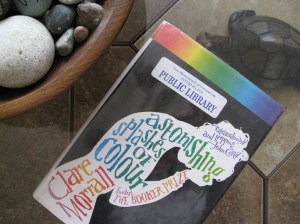
This is the kind of book I could read a thousand times over. This is the style of writing I most identify with. Astonishing Splashes of Colour is so intimate and in-your-face I feel as if Morrall’s main character, Kitty, is leaning in to tell me deep and dark secrets, stories of embarrassing moments, and airing her dirty laundry with a wave of her hand and an air of factual nonchalance. She makes me squirm with her frankness, her vulnerability. Helpless and hopeless, Kitty is the me in the mirror.

Kitty is a thirty-something with something to hide. Her past has as many demons and devils as it does angels. Losing her mother at three years old, the knowledge of an older sister who ran away from home, the fact having four brothers who not only are disconnected from one another but only pretend to be connected to her, the frustrations of having a father who loses himself in painting and has episodes of pouting, the confusion of having an excessively neat husband who lives across the hall in a separate apartment, the heartbreak of a miscarriage Kitty insists on waiting for after school…then there are the colors. Kitty has the uncanny ability to see human emotion, human circumstance as a myriad of color. Her world is not black and white sane, but rather a rainbow of mental chaos. As if all this wasn’t enough everything turns out different from what one would expect. I couldn’t put it down…

Lines I can relate to: “I fight back a wave of giggles that threatens to ripple through me” (p 63). I laugh at inappropriate moments, too.
“I can’t decide which is worse, to not have a mother, or to not have children. An empty space in both directions. No backwards, no forwards” (p 65).
“I would have books around me even if I were blind. I need the smell” (p 138).

There are, of course, many more lines I could quote. This novel, this flash of brilliance definitely resonated with me.

BookLust Twist: From More Book Lust in the chapter called, “Sibs” (p 201).

Table Talk

table talk
Stevens, Wallace. “Table Talk.” Opus Posthumous. New York: Alfred A. Knopf, 1957.

I like the first line best, “Granted, we die for good.” I can just imagine two people sitting around a kitchen table talking about why they like certain things and how it all matters only when you are alive. While all poetry can be manipulated to suit the reader, I believe that Wallace’s philosophical nature comes through in “Table Talk.” There is an awareness to the good things in life; the joys of being alive. It’s almost as if this poem is more than good timing.

BookLust Twist: From More Book Lust in the chapter “Poetry Pleasers” (p 189).

I Go Back

Olds, Sharon. “I Go Back to May 1937.” The Gold Cell. New York: Alfred A. Knopf, 1987.

I must have read “I Go back to May 1937” a dozen times. It’s so personal, so haunting, so intriguing. The narrator (presumably Olds) wishes she could go back to the time just before her parents got married just so she could stop them from getting that together. She wants to warn them of the hurt they will cause each other and their child. Instinctively you want to know more – hurt each other how? Physically? Mentally? Is she talking about divorce? She does say “he is the wrong man.” But!But.But, to stop her parents from falling in love and getting married is to undo her very existence. It’s a dilemma of curious proportions.

BookLust Twist: From More Book Lust in the chapter, “Poetry Pleasers” (p 189).

Drowning Season

Hoffman, Alice. The Drowning Season. New York: E.P. Dutton, 1979.

When I first started reading The Drowning Season I was reminded of Yellow Raft in Blue Water by Michael Dorris. Not for the style of writing, the use of language – but rather, the struggle between females within a family. In Yellow Raft you think you should despise the mother because of how she leaves her child. Then you learn of the mother’s past and you think you should hate the grandmother..until you hear her story. It’s all in the hands of perception. Same with The Drowning Season. Esther the Black was born to hate her grandmother. Her father named her as an insult to his mother, Esther the White. Everyone knows you don’t name a child after the living, only the dead. Because Esther the White rules the family with harsh words and a hating heart, even insisting that the family live in seclusion, Esther the Black has had a compromised upbringing. She longs for the day when she can escape not only Long Island, but her grandmother as well. But, then there is the grandmother’s view of the world. She bears resentment for having to raise her son’s child while he fantasizes about suicide every summer and his wife tilts the gin bottle back a little too often. Each generation, grandmother and granddaughter, has her own demons to battle. The Drowning Season is the story of how they go to battle against each other and eventually, when love conquers all, for each other.  

Favorite lines: “Phillip had named his daughter on a hot August day, with an ancient hostility and a smile” (p 5).
“And the beatings began when the house grew too small with winter…” (p49).
“Esther the Black was silent; she wished she could cry, but the sadness never seemed to reach her eyes – it stuck in her throat, unable to be moved” (p 196). 

BookLust Twist: From Book Lust in the chapter called, “A…My Name is Alice” (p 1) and the chapter called, “Families in Trouble” (p 82).

April 2009 is…

April is the month of settling in, days getting warmer and the promise of good music. March was moving, but April is all about adjustment. In the meantime, it is also about these books:

  • Noblest Roman by David Halberstam ~ in honor of Halberstam’s April birthday
  • The Punch by John Feinstein~ in honor of National Youth Sports Safety month (weird, I know, but it more appropropriate than you think -after “the punch” the NBA changed rules about fighting and how many officials were on the court during a game).
  • The Jameses by R.W.B. Lewis ~ in honor of Henry James’ birthday this month
  • An Omelette and a Glass of Wine by Elizabeth David ~ in honor of National Food month

One of the things that struck me as odd is that this list is almost completely comprised of nonfiction reading. I didn’t plan it that way at all. So, I have added two more fiction books just to round out the reading, if there is time:

  • Astonishing Splashes of Colour by Clare Morrall ~in honor of sibling month
  • Flashman by George MacDonald Fraser ~ in honor of Fraser’s birthday

I did get word of an Early Review book, but I have no idea when I’ll get it – if at all. Since moving my mail has been really sporadic. I don’t know how book rate packages will be handled, if at all.


March 2009 was…

March was all about the new house. Moving, moving, moving. Living in limbo. For books it managed to be:

  • The Concubine’s Tattoo by Laura Joh Rowland ~ fascinating tale that takes place in 17th century Japan (great sex scenes to get your libido revving). So good I recommended it to a friend.
  • The Bethlehem Road Murder by Batya Gur ~ Israeli psychological thriller.
  • The Drowning Season by Alice Hoffman ~ a grandmother and granddaughter struggle to understand one another.
  • Daniel Plainway or The Holiday Haunting of the Moosepath League by Van Reid ~ this was a really fun book with lots of subplots and meandering stories.
  • The Famished Road by Ben Okri ~ I will admit I failed on this one. Magical realism at this time is not a good idea.I need to keep my head grounded, so to speak.
  • The Old Gringo by Carlos Fuentes ~ This was a powerful little book, one that I definitely want to reread when I get the chance.
  • Lone Star by T.R. Fehrenbach ~ The history Texas. More than I needed to know. More than I wanted to know.
  • Saint Mike by Jerry Oster~ an extra book in honor of hero month. I was able to read this in a night.
  • Industrial Valley by Ruth McKenney ~ in honor of Ohio becoming a state in the month of March.
  • The Fan Man by William Kotzwinkle ~ in honor of the Book Lust of others. Luckily, it was only 182 pages.

For the Early Review program:

  • When the Time Comes: Families with Aging Parents Share Their Struggles and Solutions by Paula Span ~ this was gracefully written. Definitely worth the read if you have elderly people in your care.

For fun:

  • Dewey: The Small-Town Library Cat Who Touched the World by Vicki Myron ~ really, really cute story. Of course I cried.

I think it is fair to say work had me beyond busy. But, I will add it was a learning experience and for that, I am glad. Reading these books during the crazy times kept me grounded and for that, I am doubly glad and grateful.

Saint Mike

saint mikeOster, Jerry. Saint Mike. New York: Harper & Row, 1987.

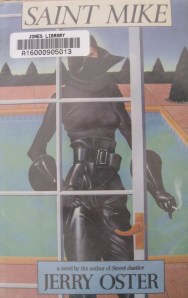
I love it when a book has me scratching my head and asking why in the first chapter. In Saint Mike it actually took the last paragraph at the end of the first chapter before the “huh?” kicked in, but just imagine this: two knights jousting in a field. At the end of the battle one of the knights unscrews his sword to reveal a vial of cocaine. After a good snort he gives it to his jousting mate and tells him they’ll get breakfast afterwards. The kicker is, the scene is neither here nor there in the overall description of the book as described by Nancy Peal in Book Lust, “When Susan Van Meter’s federal narcotics investigator husband is found murdered…she leaves her research position and takes on the task of tracking down and bringing to justice the murderer” (p 6).
I enjoyed every page of Saint Mike. With such a heavy plot (drugs, murder, avenging wife, federal agents) I didn’t expect such playful, witty, sexy language. Granted, there are some really weird scenes (yes, the armor comes back and someone dies by the sword in the most unusual way, but that’s all I’ll say about that). Overall it was an entertaining, fast read.

Favorite scene: I urge every parent of a child on the verge of becoming a teenager to read pages 12-14. Susan is trying to get her daughter up for breakfast, “The sound of drugs and drug paraphernalia and semiautomatic weapons being thrown out the window” (p 13). It’s hysterical.
Favorite line: “Rita tossed her head like a fandango dancer. “It is not just the penis that is flawed; it is the whole organism.”” (p 15).

BookLust Twist: From Book Lust in the chapter called, “Action Heroines” (p 5).

Old Gringo

Fuentes, Carlos. The Old Gringo. New York: Farrar, Straus & Giroux, 1985.

Everything about this story was deceiving. Despite the fact it was written in 1985 it has an old world language and culture to it. The time frame is supposed to take place in 1914 but to read it, it wasn’t full of new language trying to sound old, elderly, or even ancient. Despite the fact it is only 199 pages long it was packed with histories of places and people, cultures and religions. The language was both accessible and challenging. It reminded me of fun house mirrors. Not everything was as it seemed.
Ambrose Bierce is an American writer and soldier traveling to Mexico to die. He is known throughout the story as simply the Old Gringo. Once in Mexico he meets several characters with equally troubling, mysterious stories. Tomas Arroyo is a Villa general who gives the Old Gringo competition when vying for the attention of Harriet Winslow, another American who came to Mexico to teach English. All the characters have a past they can’t forget and a future they can’t escape. The Old Gringo tells the story of these personalities with the same passion used to describe the Mexican landscape. In the end, the Old Gringo does die, but it is worth the read because there is definitely more to the story than that.

Favorite lines: “But the old man wanted to make life difficult for himself” (p 10), and “If her soul was not different from her dreams, she could accept that both were instantaneous. Like a dream, her soul revealed itself in flashes” (p 48).

BookLust Twist: From Book Lust in the chapter, “Mexican Fiction” (p153).