Twelve Days of Christmas

12 days of ChristmasKnight, Hilary. Hilary Knight’s Twelve Days of Christmas. New York: Simon & Schuster Books for Young Readers, 2001.

On the surface this book looks like your average kids’ book. Cute pictures and a storyline you can sing. We all know “The Twelve Days of Christmas” – it’s that silly song that involves milking cows, egg producing hens, and ladies dancing among other things. What makes this book special is what is going on behind the scenes. There’s a whole other story unfolding in the illustrations.  On the surface Bedelia the bear is trying to tell you what her true love gave to her during the twelve days of Christmas (Dec 25- Jan 6) and then there is Benjamin, for those twelve days straight, bringing her the goods. In the background there’s Reginald the raccoon. He lives in Bedelia’s basement for some strange reason, and if you are observant, you learn that he pines for the perfect girl. Throughout Benjamin’s trips to Bedelia’s door with various (odd) gifts, you see Reginald struggling with something of his own.
In the end (and I won’t ruin it for you), you will want to go back and look at all the illustrations just a little closer. Everything has a meaning – beyond Benjamin looking to woo Bedelia with twelve lords a~leaping (my favorite). Seriously. Check out the lords. They’ll crack you up.

BookLust Twist: From Book Lust and the chapter “Christmas Books for the Whole Family to Read” (p 55).

Father Christmas Letters

Father ChristmasTolkien, J.R.R. The Father Christmas Letters. Boston: Houghton Mifflin, 1976.

Pure magic. I loved every minute of this book! I have always loved J.R.R. Tolkien’s imagination. From The Hobbit to The Two Towers I have always enjoyed submerging myself in his work. This book is something special. I think Nancy Pearl sums it up best in Book Lust “Tolkien wrote these letters for his children, beginning in 1920 and ending in 1939. Whimsical pictures complement the descriptions of Father Christmas’s life at the North Pole” (p 56). But, what Pearl doesn’t tell you is that Tolkien is posing as Father Christmas, and each letter (one for each year) is a continuation a story (involving a polar bear, elves and ) from the year before. The illustrations that accompany the letters are as captivating as the storyline. I can truly imagine being a child, caught up in waiting for the letter from Father Christmas.
The sobering thing about this book is that it ends the same year that World War II starts. Tolkien even makes mention of it on the last page “Half the world seems in the wrong place.” It seems like everyone needed to put aside childhood in 1939.

BookLust Twist: From Book Lust  in the chapter “Christmas Books For The Whole Family To Read” (p 55).

After the Plague

After the plagueBoyle, T. Coraghessan. After the Plague and Other Stories. New York: Viking, 2001.

After finishing A Diary from Dixie, Band Land, and The Crossley Baby I still had time for a couple more “November” reads. The topics already covered for November were: the month the civil war ended, the month Montana became a state, national train month, and national adoption month. I chose After the Plague because I hadn’t recognized National Writers Month yet (and if there is time I’ll also recognize November as the month World War I ended and read Storm in Flanders). The only thing I won’t get around to is honoring Winston Churchill’s birthday (born in November).

So, onto After the Plague. This is a collection of sixteen short stories. Pearl calls them “Boyle’s best.” They hang open, unfinished and unresolved like a to-be-continued drama on television. Each story is like being dropped into the middle of a movie, watching for a scene or two, and then being ushered away before the conclusion. If you like to hang in the balance this collection of short stories is for you. Even stories within stories are left unfinished. Boyle shows off diversity in every story. Some will shock you, some will make you remember something from your own life, but all of them will be a pleasure to read.
Some favorite lines: “I started smoking two or three nights a week, then it was five or six nights a week, then it was everyday, all day, and why not?” (p 48), and “I just watched her, like some sort of tutelary spirit, watched her till she turned over and I could see the dreams invade her eyelids” (p 164).

BookLust Twist: From Book Lust in the chapter called “Growing Writers” (p 107) and “Short Stories” (p 219). I love how Pearl describes Boyle’s work, “…nervy and disconcerting, and often very funny, leaving you uncomfortable with yourself and the world” (p 219). So true!

Crossley Baby (with spoiler)

Crossley BabyCarey, Jacqueline. The Crossley Baby. New York: Ballantine, 2003.

November is National Adoption Month. Out of everything I am currently reading, I thought this would be my favorite. I’m sorry to say I was a little disappointed. The Crossley Baby is the story of two sisters (Sunny & Jean) battling for their dead sister (Bridget)’s baby. Well, that’s what it’s supposed to be about. Instead, it’s more of a commentary on wealth (Jean has it, Sunny does not), parenting (Sunny is a mother of two, Jean is not) and manipulation (they both do it, for one reason or another). More time is spent setting up where Jean, Sunny and Bridget came from than the actual adoption process. More time is spent on describing the vast financial differences between Sunny and Jean than on their personalities. By the end of the book I didn’t know Jean or Sunny any better so I didn’t care who got the baby. I was completely indifferent to their struggle for baby Jade. Probably what bothered me most was the lack of real grief shown by either sister over the death of their elder sister. Crossley adds flickers of sadness, glimpses of sorrow, but for the most part Bridget’s death goes mostly unmourned. Possibly that is because they never got along. If there is one thing the three sisters did really well it was avoiding closeness.
In the end, Sunny wins custody. Everything points in the direction of Jean winning – money, power, people in her corner – while Sunny’s husband is filing for bankruptcy, old favors aren’t worth cashing in, and they have to sell their home. In a last minute surprise ending Jean withdraws her application for adoption and doesn’t contest the award going to Sunny. No one from Bridget’s life is there to put in a word edgewise.
Ironically enough, it was Bridget who was my favorite character because of this one line, “Bridget tasted her words before she spoke…” (p 112).

BookLust Twist: From More Book Lust and the very first chapter called “Adapting to Adoption” (p 1).

The Way Men Act

Way Men ActLipman, Elinor. The Way Men Act. New York: Washington Square Press, 1992.
 I had to laugh when I wrote out the title of this blog. Yet another one that could be misconstrued as something juicy and personal. I guess I could write a whole dissertation on the way men act towards me, but that wouldn’t be the book review that this is intended to be.

Elinor Lipman celebrates a birthday in October so it was only appropriate that I try to squeeze in a novel of hers in the last days of the dying month. I have met Lipman before (at a local conference) so it was no surprise to discover The Way Men Act takes place in “my” town. While thinly veiled as somewhere else it was easy to recognize the landmarks and quirks that make up where I live. I have to admit that made reading The Way Men Act a little difficult. The entire time I pictured real store fronts, real schools, real people.
All in all I breezed through this book because it was a simple read. The kind of chick lit you crawl in the bath with and can read in one soak. The plot isn’t complicated, only fun fun fun, the way chick lit is supposed to read. Lipman’s heroine, Melinda LeBlanc returns home to Harrow. She has mixed feelings about being back where she grew up as if being home implies she didn’t make it in the real world. She comes back (single at 30) to work in her cousin’s flower shop. Her job is sandwiched between two other come-home-again classmates from high school: Libby, a fashion designer with her own shop, and Dennis, a wiz at tying flies for fishing for his own shop. In addition to being hung up on being home, Melinda has issues with educational status (Harrow is a snobby college town and she only has a high school degree) and of course, men. The ending was predictable. Melinda is too talented to be working for someone else, and yes, she’s gets the guy.

Favorite line: “Could a man hate me that strenuously that the weight of it would flip itself over and come up again as love?” (p 49)
I flagged other lines only to realize it wasn’t the wording I admired so much. It was Melinda’s relationship with her mother. Every scene had me envious of their obvious closeness.

BookLust Twist: Mentioned twice in Book Lust once in the chapter “Elinor Lipman: Too Good To Miss (p 146), and “My Own Private Dui” (p 165).  The latter chapter begs an explanation: Pearl has her own classification system for her books and The Way Men Act falls under the category of “books I reread when I’m feeling blue” (p 166).

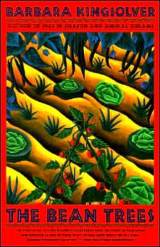
Bean Trees

Bean TreesKingsolver, Barbara. The Bean Trees.New York: HarperPerennial, 1989. 

Barbara Kingsolver is my favorite author. I’ve said it before and I’ll say it again. I love the way she writes. The Bean Trees is on my Book Lust list and I’ve already read it hundreds of time. It’s the book I grab when I am in between other reads. It’s the book I reach for when I have a few minutes to kill while the rice bubbles on the stove. Given the chance to read it again just for Book Lust I am more than happy to jump at the chance.

Taylor Greer isn’t Taylor until she takes to the highway. Leaving her hometown of Kentucky to see something other than small town rumors and ruts she finds herself on the road, “adopting” a three year old American Indian girl on the way then finally landing in Tucson, Arizona.  Taylor is smart, witty and, for lack of a better word, feisty. She tells us her story with great observance to the spirit of humanity.

One of the things I love about Kingsolver’s work is the reoccurring themes: respect for nature described in gorgeous, vibrant detail, immigration and the political implications, the joys and struggles of motherhood (especially the single mother), the value of both belonging to a community and having independence. The Bean Trees is no different. All of these themes are carefully woven into the framework of the novel.

My favorite lines (okay some of them): “Whatever you want the most, it’s going to be the worst thing for you” (p 62).
“There were two things about Mama. One is she always expected the best out of me. And the other is that then no matter what I did, whatever I came home with, she acted like it was the moon I had just hung up in the sky and plugged in all the stars. Like I was that good” (p 10).

BookLust Twist: From More Book Lust’s first chapter called”Adapting to Adoption” (p 1). I have to admit I don’t agree with Pearl’s description of how Taylor “acquires” the American Indian child. Pearl says “When Taylor Greer leaves Kentucky for points west in order to escape the confines of small-town life, she finds an abandoned and abused Cherokee child left in her car…” (p 2). It actually went more like this: “Then she set this bundle down on the seat of my car. “Take this baby,” she said….”where do you want me to take it?” She looked back at the bar, and then looked at me. “Just take it.” I waited a minute, thinking that soon my mind would clear and I would understand what she was saying. It didn’t.” (The Bean Trees p 17). This is a poignant scene to me and it makes a big difference (to me) whether the child was left or handed over.

ps~ November is National Adoption month. I reread this just a tad early.

Song of Solomon

Song of SolomonMorrison, Toni. Song of Solomon. New York: Plume, 1987.

Another must-read from the days in Maine. Although, I don’t remember reading it then. I don’t remember reading it, ever. Is that sad or what? This is a classic. Something everyone should read.

I don’t think I could summarize the plot adequately. Basically, it’s the story of Macon “Milkman” Dead III. He got the nickname Milkman from being breastfed by his mother way past infancy. But, this story goes beyond coming-of-age; it transcends stereotypical stories of racial strife and strained family relations. Yes, there is all of that. This is a story that has been described as tragic and magic in the same line. It may be a story about one man’s rise to adulthood, but it is told from many different points of view. We learn about Milkman’s ancestry and the culture of his time. Morrison weaves imagery and symbolism together so that everything important means something different. Family names are not just names. They come from religion, mistaken identity and social injustice. Family ties are tethered and severed through love and hate, peace and violence, poverty and wealth. One man’s perception is another man’s reality.

Quotes I liked: “I’m on the thin side of evil and trying not to break through” (p 21).
“He wouldn’t know what to feel until he knew what to think” (p 75).
“She was the third beer” (p 91).

BookLust Twist: Toni Morrison is mentioned twice in Book Lust. Song of Solomon is in the chapter “100 Good Reads, Decade by Decade” (p 175) under the section 1970s. 

Turn of the Screw

James, Henry. The Turn of the Screw. New York: Dutton, 1963.Turn of the Screw

Even though October is more than half over I decided to read something scary for the rest of the month…in honor of Halloween and all that. Turn of the Screw seemed like the most obvious choice. A novella only 160 pages long, I knew it wouldn’t take too long to get through.
Written in 1898 and republished numerous times Turn of the Screw has also been  adapted for the stage, television and the big screen. Someone told me it was even mentioned in an episode of “Lost” (I wouldn’t know).  James’s technique is to tell the story within a frame – one story within another. We are first introduced to a man at a Christmas party telling a tale of a governess. From there we are in the story, told from the point of view of the governess. She has been hired to look after two small children after their parents are killed and they are sent to live on an uncle’s estate. Soon after the governess’s arrival she starts to notice strange occurrences, shadowy figures stalking the grounds. She learns they are former lovers and hired hands, back to supposedly recreate their relationship through the children.
While James uses words like “hideous”, “sinister”, “detestable”, and “dangerous”, there is great debate as to exactly what he is describing as so terrible. He refers to evil again and again, but his ghosts are not the usual specters. They only hint at danger rather than taking action and “attacking”. The other great debate is whether the governess is insane (or goes insane while at Bly). Because no one else really backs up her ghost sightings you have to wonder.

BookLust Twist: Mentioned several times in Book Lust. Once in the chapter called “Science Fiction, Fantasy, and Horror” (p 113) and “Ghost Stories” (p 99). I would agree that The Turn of the Screw deserves ghost story status, but horror? Maybe I’m stuck in slasher movie mode where everything horrible has to end up in blood and gore.

Yellow Raft in Blue Water

Yellow raft in blue waterDorris, Michael. A Yellow Raft in Blue Water. New York: Warner Books, 1987.

This is high school to me. I remember being holed up somewhere reading this nonstop. Hot off the press, freshly published and oh so new I couldn’t put it down. I reread it and reread it until finally I could move on to other Michael Dorris creations, which somehow were never quite as good. Nothing compared to A Yellow Raft in Blue Water back then and it is still a faovrite to this day.

Someone described this book as an onion, reading it was like peeling back the layers of a story, and while that imagery is accurate enough, I like to think of Yellow Raft as a game of telephone. First, there is Rayona. She tells the story from her perspective. She is all of fifteen years old…at that difficult age where rebellion against your mother is the easiest thing to do. As she says, “when mom and I have conversations, they mostly involve subjects not personal to our lives” (p 26). She tells her story like it’s the honest truth. Then, there is Christine, her alcoholic mother, and her story. In the beginning you want to hate her for how seemingly unfair she had been to Rayona. But, learning about Christine’s heartbreak you realize Rayona’s reality is only her perception. The wires of communication have been crossed and in some cases, completely disconnected. Christine had her reasons for everything she did (and didn’t do). “I never had been good company for myself” says Christine (p 185). Finally, there is Ida, Christine’s mother. Her story is, by far, the most revealing and tragic. Everything you heard whispered from Rayona through Christina is trapped in the warped truth of Ida. All three women are stubborn, flawed by fate, and determined to make the best of life as they know it even if it means coming off as cruel to others. Being on the inside, privy to their hearts, makes you want to shake each one screaming, “talk to your daughter!”

Favorite lines:
“Ghosts were more lonesome than anything else. They watched the living through a thick plate of glass, a one-way mirror” (p176).
“A bath brought me peace, made me float free” (p340).

BookLust Twist: In both Book Lust and More Book Lust. In Book Lust Pearl mentions A Yellow Raft in Blue Water early; on page 23 in the chapter “American Indian Literature.” In the chapter “Men Chanelling Women” (p 166) in More Book Lust Pearl adds A Yellow Raft in Blue Water because Michael Dorris does an amazing job setting the voices of three very different women free.

A Map of the World

map of the worldHamilton, Jane. A Map of the World. New York: Anchor Books, 1995.

National bestseller. Oprah book. A movie. All that should tell you something. Normally, I don’t try to read reviews before I myself have read the very last page. This one was a little different. Praise for A Map of the World was on the inside cover and I couldn’t resist. One line really said it all for me, “the story of how a single mistake can forever change the lives of everyone involved.” If you read my blogs you know I am fascinated by the what could have been, fate and serendipity. The path less taken, the path not known to take at all. This is the story of a mistake, an err in judgment, and the time and effort it takes to get back to good.

Told in first person from both Alice & Howard, husband and wife. Alice begins and ends the tale with Howard interjecting in the middle. Details that overlap her story and his tie the couple and their voices together. It’s their marriage talking. Yet, their views on life are very different. There is a moment when Howard is driving by the library and he thinks of the librarian, a man with a hook for one hand. Howard remembers that his wife thinks of the librarian as Captain Hook, not only because of the hook, but because the librarian was supposedly “cranky and unhelpful” to her. Howard recalls learning from the librarian and how he “never even noticed his hand.” Walking down the road of life Alice and Howard see the scenery differently, despite being hand in hand.

Favorite lines:
“I used to think if you fell from grace it was more likely than not the result of one stupendous error, or else an unfortunate accident” (p 3).
“She was all nerve, so energized by rage she had a hard time sorting out what she most hated” (p 291).
“It is one thing to be in a car with someone who is quiet, and another to be with someone who is silent” (p 364).

BookLust Twist: From More Book Lust and the chapter “Big Ten Country: The Literary Midwest (Wisconsin)” (p 25). I started reading A Map of the Worldbefore I double-checked what Pearl had to say about it. I had just finished the part about a major tragedy. I have to say it was a shock to read there was another one in store for me. I almost wished I hadn’t known that.

Divine Secrets of The Ya-Ya Sisterhood

Wells, Rebecca. The Divine Secrets of the Ya-Ya Sisterhood. New York: Penguin, 1996.Divine Secrets

This is Rebecca Well’s second novel, a follow up to Little Alters Everywhere. Divine Secrets of the Ya-Ya Sisterhood continues the story of Vivi Abbott Walker and her friends (known as the Ya-yas), this time through the eyes of her adult, engaged-to-be-married, daughter, Siddalee Walker. Siddalee is a flourishing theater director who falls victim to the ever-famous, word-twisting interview. A reporter from the New York Times gets Siddalee to open up her childhood box of memories and reveal dark secrets about her upbringing. Ultimately, her mother’s alcoholism and abuse are exposed and Siddalee must spend the rest of the book apologizing to her mother for the scandal. When Siddalee calls off her engagement the Ya-Yas brazenly step in. In an effort to make her daughter understand who she is, Vivi mails her daughter a scrapbook and we are taken into the wonderous, playful yet dark world of the Ya-Ya Sisterhood.
Ultimately, I identified with this story. It’s the classic yet complex struggle between mother and daughter. Secrets revealed, hearts broken, lives changed. In the end, happiness and love prevail. I know you’ve seen the movie.

BookLust Twist: Divine Secrets comes up a couple of times in Book Lust. First, on page 83 in the chapter “Family Trouble” then in the chapter called “Women’s Friendships” (p 248).

Amsterdam

AmsterdamMcEwan, Ian. Amsterdam. New York: Anchor Books, 1999.

Another book that starts with a funeral. Of course, I’m thinking of Charming Billy. But, the comparisons stop there. How to describe Amsterdam? It is a short (193 page) novel that takes place in London, England. Two men share a bond of friendship as well as a romantic past with the same woman. Vernon is an editor of a newspaper and Clive is a modern composer. While they are friends they are not above rivalies and each, through his friendship tests the bounds of morality.

I see this story as a movie. There is one particular scene where Vernon feels dead. He is about to hit himself upside the head in order to feel pain when his secretary interrupts him, “He had raised the ruler several inches above his right ear when there was a knock on his open door and Jean, his secretary, entered and he was obliged to convert the blow into pensive scratching” (p 34). Can’t you just see it?

BookLust Twist: From Book Lust. Ian McEwan has his own chapter called, “Ian McEwan: Too Good To Miss” (p 149).

Middlesex

MiddlesexEugenides, Jeffrey. Middlesex. New York: Picador, 2002.

First the cover. Before I even read a word it frightens me. Inky black (my cancer) smoke swirls from a cigarrette-bearing person lounging with a friend. That same smoke meets up with the smoke stack of an ocean-going vessel and encircles the skyline of a city. I instantly recoil from the seductive swirls and think, “I’m gonna hate this book.”

But I don’t. It’s long (529 pages), but I’ve enjoyed every page. I can see why it won a Pulitzer Prize. It’s the story of Calliope Stephanides and the two generations that brought her into this world. It’s Greece and Germany and Grosse Point. It’s the science of genetics meeting the mother of all family secrets. Calliope is also Cal, one and the same. Girl meets Boy. Girl is Boy. Boy is Girl. Sound confusing? It isn’t. It’s poetic and sad, funny and smart. Something you just have to read for yourself. Cal will tell you the story. His story. Her story. My favorite lines:

“…German wasn’t good for conversation because you had to wait to the end of the sentence for the verb, and so couldn’t interrupt” (p 7).
“Filling her head with music, she escaped her body” (p 115).
“The only thing that roused her was her daily lineup of soap operas. She watched the cheating husbands and scheming wives as faithfully as ever, but she didn’t reprimand them anymore, as if she’d given up correcting the errors of the world” (p 271).
“…her application to join her husband in heaven was still working its was through a vast, celestial bureaucracy” (p 286).

BookLust Twist: From More Book Lust. Pearl mentions this book several times. First, on page 97 in the chapter “Gender Bending” then on page 141 in the chapter “Lines That Linger, Sentences That Stick.” She is referring to Middlesex‘s opening line. It’s a doozy. Finally, on page 166 in “Men Channeling Women” Middlesex is listed one last time. As you can see Jeffrey Eugenides hit a homerun with this one.

ps~ The cover makes perfect sense to me now.

Disgrace

I’ll call this book my “spur of the moment, read in one day, can’t put it down” book. I’ll also call it Weather Front. It started out sunny and seemingly harmless and carefree. Then the clouds roll in, the rain comes in sheets. The poison seeps in. When the winds pick up to the point of hurricane force it is nothing short of violent and tragic, destructive and disgraceful. After the storm people pick up the pieces, healing yet hurting and more storm clouds can be seen, rumbling in the distance.
In the beginning everything seems fine. Professor Lurie is happy teaching literature in South Africa. But, almost immediately Professor Lurie makes a mistake in seducing a young student. His fall from grace is swift and absolute. Having lost all his social and professional connections he reconnects with the one person who can’t turn her back on him – his flesh and blood daughter. The rest of the story is how Lurie and his daughter deal with their already strained relationship. How Lurie tries to redeems himself is baffling. I found myself asking if he was really worth redemption at all. Maybe it was the name Lurie – too close to the word lurid.

My favorite line, “Affection may not be love, but at least its cousin” (p 2).

BooklustTwist: From Book Lust and the chapter called ” Families in Trouble” (p 82).

Warning: If you are an animal lover you may not want to read this book. What happens to humans is tragic enough, but what happens to the dogs is even worse. I know it’s a fact of life but the end of this book was hard to take. Nobel prize or not.

The Odd Sea (with spoiler)

odd seaReiken, Frederick. The Odd Sea. New York: Delta, 1998.

From the very first page I thought the location of this book sounded really familiar. Westfield River, the Hilltowns, Dalton, Cummington…like seeing a familiar face while on vacation far, far from home. You can’t place it, yet you know it. Why? Work? School? The neighborhood? Until finally, one last detail seals the deal and suddenly you remember – the cashier from your favorite grocery store. It was “Mohawk Trail” that finally brought Western Massachusetts into sharp focus for me. Without a doubt, I was reading about my stomping grounds (and lately, stomp I do).

So, back to The Odd Sea. This is Frederick Reiken’s first novel and I have to say, I have a soft spot for firsts. This is the haunting story of the Shumway family and their lives after the dissapearance of 16 year old Ethan Shumway. It’s told from the point of view of younger brother Philip. My copy of The Odd Sea has notes in the margins that I found distracting. They made suggestions and speculations I wouldn’t have considered otherwise as well as ones overly obvious. One of the repeating, clear-as-day themes of the notes was Philip’s inability to accept his brother’s vanishing as never-coming-back final. I considered that obvious because otherwise, there wouldn’t be a story to tell. Philip can’t move on like the rest of his family. He needs to dig for answers, search for clues, and come up empty, bewildered, and denying every single time. I wasn’t surprised when, by the end of the book, Ethan is never found.
After reading Ordinary People I was ready to start my own BookLust chapter on “Mothers Who Lose It.” Probably one of my favorite descriptions in the book is of Philip’s mother’s insomnia. Having been afflicted with sleeplessness I could picture her nocturnal habits perfectly. “Some nights she did not bake or read. Instead she’d stand out with the stars. She said on clear nights the sky could draw the sadness from her heart” (p 10). I also enjoyed the scene when Victoria teaches Philip’s sister, Dana, to eat rose petals. Having eaten a few island roses in my day, I could taste the silkiness on my own tongue.

BookLust Twist: From More Book Lust and the chapter called “Small Town Life” (p 203).