Devices and Desires

James, P.D. Devices and Desires. New York: Warner Books, 1989.

When I first saw this book I practically groaned aloud. For starters, it’s paperback. As my husband can I tell you I hardly settle down with anything but hardcover. Next, it’s over 460 pages long. Guns of August, The Eleven Million Mile High Dancer and Edith Wharton are all over 400 pages long, too. Quite a lot of reading for the month of January. But, luckily (for me) Devices and Desires was thrilling to read.

It begins with a serial killer stalking lone women up and down the coast of Norfolk. Commander Adam Dalgliesh (of Scotland Yard) is trying to take a holiday in nearby sleepy Larksoken where his aunt has willed him a quaint windmill/cottage. His vacation is cut short when the killer takes one of Larsoken’s own. Adding to the drama is a highly controversial atomic power station, a lover’s tryst and blackmail. There’s always blackmail, right? Dalgliesh does his best to assist the local authorities but there is controversy even there as he has a not so pleasant history with Rickards, the lead on the case.
As with all small towns the entire community is well embroiled in each other’s lives. They seem to know everything about one another yet no one suspects the real killer.

Best line: “But he had no understanding of the extraordinary compexities and irrationalities of human motives, human behaviour” (p 108). 

BookLust Twist: From Book Lust in the chapter, “I Love a Mystery” (117).
Biggest Elvis

Kluge, P.F. Biggest Elvis. New York: Viking, 1996.

I like sarcastic, witty books. I like books with a bit of bite to them. Biggest Elvis has bite, wit, and dare I say, balls. Really fun book to read.

Written in the first person from the points of view of six different characters Biggest Elvis tells the story of the reincarnation of Elvis…in Olongapo, Philippines. Elvis lives again in the form of three Elvis impersonators portraying the early young-stud years, the middle movie years, and lastly, the portly, pudgy, final years. Their nightly performance is a huge hit in Olongapo, but as with all things, it has to end. As the performance gets bigger and more permenant so grows the obsession. In addition there is a sinister commentary about American greed and power that lurks behind the entertaining Elvis trio.

I realize that in the Philippines sex and prostitution are commonplace for a community. Just like homelessness or alcoholism it’s viewed as something the just exists and is shrugged off on with regularity. Because Biggest Elvis essentially takes place in a whorehouse disguised as a bar the references to sex are plentiful. For me, it was a little excessive.

Lines that I liked: ” – well, he would be a lost ball in tall grass” (p 6), “Olongapo had contaminated me. It leaked out of my pores, dripped off my tongue” (p 58), and “The kind of woman who always brings along something to read because she might get bored, the book is like a warning to the world she’s in, that if the people aren’t up to expectations, in a minute she’s out of here…” (p 124).

BookLust Twists: In Book Lust and More Book Lust. In Book Lust in the chapters, “Elvis on My Mind” (p 79), “First Novels” (p 89), and “P.F. Kluge: Too Good To Miss” (p 139). In More Book Lust in the introduction (p xii).

Sometimes I doubt myself to the point of silence. It’s hard for me to point out an error when I don’t think I have all the facts. So, it’s with a great deal of trouble that I have to say I think I found an error in a Book Lust chapter. Here’s the deal: Biggest Elvis is in three different Book Lustchapters: “P.F. Kluge: Too Good to Miss” (p), “Elvis” (p), and “First Novels” (p). It’s this last chapter that has me so bothered. According to Kluge’s website, he wrote a couple of other books before Biggest Elvis. Unless I misunderstood Pearl’s content for “First Books” I think including Biggest Elvis is a mistake. There, I said it. Somebody, anybody, please correct me if I’m wrong!

Death Comes for the Archbishop

Cather, Willa. Death Comes for the Archbishop. New York: Alfred A. Knopf, 1929.

Father Vaillant and Father LaTour are two friends on a quest. Death Comes for the Archbishop is their story of the attempt to establish a diocese in New Mexico – a landscape fraught with corruption and a complete breakdown of religious morality. On their travels we meet other notable characters such as Padre Martinez and Dona Isabella. They add violence and greed and drama and intrigue to an otherwise seemingly simple story of a religious quest.
While Death Comes for the Archbishop is Cather’s self proclaimed “best written book” I had never heard of it before the Challenge. In the beginning it seemed like an easy, quick read but after I got into it I realized it had amazing depth and powerful symbolism.

Impressionable quotes:
“When they were tramping home, Father Joseph said that, as for him, he would rather combat the superstitions of a whole Indian Pueblo than the vanity of one white woman” (p 219), and “…it was the Indian manner to vanish into the landscape, not to stand out against it” (p 265).

BookLust Twist: From Book Lust in the chapter”New Mexico” (p 167).

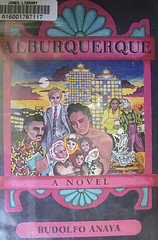
Alburqueque

alburquerque1.jpg

Anaya, Rudolfo. Alburquerque. Alburquerque: University of New Mexico Press, 1992.

My final book of January – chosen to celebrate the month New Mexico became a state. Anaya’s Alburquerque is rich with the culture of New Mexico’s Mexican population. In the center is Abran Gonzalez, a young ex-boxer from Barelas. Upon discovering he is adopted he sets out to learn as much as he can about his birth parents. It is crucial to his understanding of who he really is. Swirling around Abran there is magical realism, cutthroat politics, deep rooted culture, rich history, and tragic romance.
My one complaint – I don’t know why Anaya has Abran have a chance meeting with his birth father in the very first chapter. It seemed a little too coincidental and more than a little cheesy. He is able to come full circle with the same characters at the end. Like I said, a little cheesy.

BookLust Twist: From Book Lust in the chapter simply called, “New Mexico” (p 167).

Everyday Zen

zen.jpg

Beck, Charlotte Joko. Everyday Zen: Love and Work. San Francisco: Haper Collins, 1989.

I had a hard time wrapping my brain around the reading of this book. I think I couldn’t figure out what was bugging me until I realized the reading required more than just my brain. It asked my heart and soul, my beliefs and convictions to get involved. It became a religious thing and that was something I really struggled with in order to read Beck’s book. I admit it – I am a person wrestling with and for a belief. If that bothers you, stop reading right here. I am searching for self-acceptance for what I believe and, ultimately, do NOT have faith in.

I found it insteresting that Beck put the word love in the title of her book because in the chapter specifically on love she states, “love is a word not often mentioned in Buddhist texts. And the love (compassion) they talk about is not an emotion…” (p 71). I had an interesting time coming to terms with that concept.

The other quotes that I took to heart are:
“…the storms of life eventually hit them more lightly. If we can accept things just the way they are we’re not going to be gratly upset by anything. And if we do become upset it’s over more quickly” (p 13).
“We can’t love something we need” (p 39).
“Other people are not me” (p 68).
“Not all problems are as tough as these, but less demanding ones may still send us up the wall with worry” (p 99).

New Words:

  • sesshin
  • zazen
  • koan
  • zendo
  • samadhi

BookLust Twist: From Book Lust in the chapter “Zen Buddhism And Meditation” (p 255).

Americanization of Benjamin Franklin


Wood, Gordon S. The Americanization of Benjamin Franklin. New York: Penguin, 2004.

Benjamin Franklin celebrates a birthday in January (on the 17th day in the year 1706 to be precise; in other words, today); hence my reading of his biography (one of many on my list).
Let me say first and foremost that Mr. Franklin is a personal hero of mine for advocating for libraries so much! If it were not for him who knows where my profession would be. I do not, however, approve of his treatment of his wife Deborah. Can you imagine being married to someone who insisted on living in a different country (and only returns home after your death)? Even Franklin’s friends made no mention of Deborah’s passing after he returned to America.
Wood’s biography deals mostly with Franklin’s political aspirations and most pointedly, his “switch” from supporting Britain to supporting America (hence “americanization” in the title). Of course, Franklin’s involvement in postal services and electricity were also touched upon, but only because they are important elements to Franklin’s history.

My favorite quotes:
“Things that struck him as new and odd were always worth thinking about, for experiencing them might advance the boundaries of knowledge” (p 62).
“…but Franklin thought the electrical charge necessary to kill large animals might end up killing the cook” (p 64).
“The degree of Franklin’s Revolutionary fervor and his loathing of the king surprised even John Adams, who was no slouch himself when it came to hating (p 154).

BookLust Twist: From More Book Lust and the chapter called “Founding Fathers” (p 91).

The Dollmaker

Arnow, Harriette. The Dollmaker. New York: Avon, 1972.

Weighing in at 599 pages this book truly can be called a saga. It’s the story of Gertie Nevens, a simple country woman from Kentucky during World War II. After her husband moves to Detroit, Michigan to find work in the factories, Gertie follows with her five children. Life in the city is cold, dirty, and unkind. Gertie learns of prejudices against “hillbillies” and the importance of the word “adjust”. There is tragedy and triumph with human frailty constantly hanging in the balance. At times I couldn’t believe the hard times Gertie and her family faced. It almost seemed too much to bear. Gertie’s strongest moments are in the very beginning of the book when she has to save her baby from a life threatening illness. After moving from Kentucky it’s as if the city steals Gertie’s strength and spirit.

“…for after the bright whiteness of the hot little room, the cold rain and dark were like old friends” (p 38).
The government owed them at least one man who could fix anything and never got drunk” (p 108).
“‘Are you busy?…Yes and no…I’m in the worst kind of business – tryen to make up my mind'” (p 260).
“She stood, her mind, as always, stumbling around, picking up words, laying them down” (p 538).

BookLust Twist: From More Book Lust and the chapter “Big Ten Country: The Literary Midwest” & the section ‘Michigan’ (p 26).

Funnies (with spoiler)

funniesLennon, J. Robert. The Funnies. New York: Riverhead, 1999.
Tim Mix’s father wrote a comic strip based on his family. Growing up, this comic strip was a source of embarrassment to Tim. Yet, when his father passes away and Tim’s only inheritance is the very comic strip he hated, he decides to try his hand at taking over the strip. Tim is a sarcastic, barely ambitious man who is terrible at conversation, worse at relationships both personal and with his family. This is a formula that always works – the unlikable, unlikely hero goes through a metamorphosis and comes out a pretty decent guy. In the end he doesn’t succeed with the funnies, but he gets the girl.

“This time the pause was longer, a nice slack length of rose to hang the conversation with” (p 52).
“I pushed gently at the sore spot in me and it hurt enough for me to turn away as I talked” (p 132).”
“Susan offered me a bite of her corn dog. I refused, still queasy from the Centrifuge of Death, but didn’t tell her this, and I feared that this rebuff without explanation would give offense. Then I came to my senses and simply let it go. It was a wonderful feeling, like dropping off a box at the Goodwill” (p 155).
And my favorite quote, “I let happiness run its course through me, knowing that it wouldn’t last, but also knowing it would always be there somewhere waiting for me, if I made the effort to find it. This understanding seemed an almost criminally excessive piece of good fortune, but for the time being I accepted it without question” (p 274). For some reason this reminded me of me.

BookLust Twist: From Book Lust twice. Once in the chapter called “Brothers and Sisters” (p 46), and “Families in Trouble” (p83).

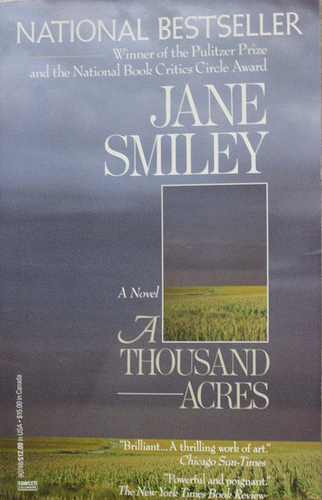
Thousand Acres

acres.jpg

Smiley, Jane. A Thousand Acres. New York: Fawcett Columbine, 1991.

I’ll admit it. It took me forever to even want to read this book even though it has been sitting on my book shelf for months, right within easy reach. I tried picking up Moo a few times and something made me keep putting it down. I have no clue why. I assumed A Thousand Acres would be the same difficult to pick up experience. I was wrong. Once I got into it, Thousand Acres was fascinating, troubling and oh so true to family life. I’ve never lived on a farm. I’ve never set foot in Iowa, but thanks to Smiley I knew exactly what both would be like.
One thing I didn’t understand, nor will I ever, is how a family can so completely and utterly fall apart. By the end of the book not one family is intact and it’s all because of a thousand acres.

“You shouldn’t think somethings changed just because you haven’t seen it in thirteen years” (p 11).
“It was exhausting just to hold ourselves at the table… You felt a palpable sense of relief when you gave up and let yourself fall away from the table and wound up in the kitchen getting something, or in the bathroom running the water and splashing it on your face” (p 101).

BookLust Twist: From More Book Lust and the chapter called “Big Ten Country: The Literary Midwest (Iowa)” (p 27) and Book Lust in the chapter “Growing Writers” (p 107). Personally, I think Pearl also could have put this in her “Families in Trouble” chapter. Not to give anything away but…who tries to poison her own sister? Who does that?

Beyond the Black Stump

Shute, Nevil. Beyond the Black Stump. New York: William Morrow, 1956.

Nancy Pearl likes Nevil Shute. There is a whole chapter on him in More Book Lust. This being my first “Shute book” I was enchanted. Beyond the Black Stump is about an American geologist, Stanton Laird, who is assigned to dig for oil in Australia. Stanton is a stand-up guy with a secret in his past, but when he meets and falls in love with Mollie Regan in the Australian outback, he realizes can’t compete with her past. This is the story of two people too different to make it work. It goes beyond race or religion. Prejudices and historical resentments run deep for both families. Despite the plot being predictable I enjoyed getting to the conclusion no matter how obvious it would be.

“It’s the greed for the gold, the curse of the modern age. Avarice kills more men than any physical disease, I am afraid. These men will not make old bones” (p 136).

BookLust Twist: From More Book Lust and the chapter “Nevil Shute: Too Good To Miss” (p 199).

Always Outnumbered


Mosley, Walter. Always Outnumbered, Always Outgunned. New York: W.W. Norton, 1998.

Always Outnumbered, Always Outgunned is like looking at snapshots of one man’s existence. Each chapter is a different time in Socrates Fortlow’s life, a different picture. His past, his friends, and his skewed sense of morality are the common threads in each scene. Socrates is a man, free after 28 years in prison, trying to make his way in Los Angeles, California. The violent streak that landed him in the penitentiary is still prominent in his personality. He is an angel and a devil all in one. A saint with a dark side. A demon with a halo. My favorite example of this split personality is when a friend’s wife comes looking for her husband at Socrates’s door. While telling Corrine she should leave her no-good husband (and be with Socrates) that same no-good husband is hiding out in Socrates’s back room.

Some of my favorite quotes describing Socrates:
“Back then he enjoyed the company of fear” (p 19).
“He wasn’t a thief. Or, if he was, the only thing he ever took was life” (p 64).

BookLust Twist: from More Book Lust and the chapter “Walter Mosley: Too Good To miss” (p 169). Happy Birthday Mr. Mosley!

Girls’ Guide To Hunting

Girls GuideBank, Melissa. The Girls’ Guide to Hunting and Fishing. New York: Penguin, 2000.

This is another book I picked up before the Book Lust Challenge. I think it’s from my sister, yet I found it in my mother’s collection at home. I loved Melissa Bank’s narrative in the beginning when the main character, Jane, is a child. She’s a little too smart for her age. Unfortunately, as Jane gets older, the voice/narrative loses some of it’s wit, sarcasm and charm. All in all what fascinated me was Bank’s ability to mature Jane through voice. The story about the neighbor was the only part that threw me because I took all the other stories to be about Jane, even the one about cancer. The neighbor story didn’t seem to fit with the sequence as well. 

I find it interesting that it’s now being made into a movie (due to be released this year).

BookLust Twist: From Pearl’s Book Lust in the chapter “Chick Lit” (p. 53). How appropriate!

Griffin & Sabine

Bantock, Nick. Griffin and Sabine: An Extraordinary Correspondence. San Francisco: Chronicle Books, 1991.

Griffin & SabineNick Bantock’s trilogy evokes very romantic feelings for me. Way before Book Lust the first offering in the trilogy, Griffin & Sabine was given to me by a secret lover. 23 years old, I was in lust/love with the bearer, and I think initially as a direct result, the book won my instant favor as well. Later, I determined it was an aphrodisiac for the mind as I repeatedly poured over each gloriously illustrated page (also by Bantock). I was as careful and as loving as a caress. The delicious unfolding, opening, and reading of letters and postcards was as tantalizing and seemingly illicit as my affair. Never mind the storyline of ill-fated lovers, destined to never be together, however passionately in love. That wasn’t only what excited me. The artwork drew me in and captivated me to no end. If candles, soft music, and wine stir passion through sight, sound and palate then Griffin & Sabine is for the artistic intellect.Bantock

My affair has long since ended. The passion cooled to cold and I went on to marry someone warmer. I have kept every Bantock book ever given to me and will continue to collect them. For kids of all ages and passions on all levels.

The Blue and the Gray

CommagerCommager, Henry Steele, ed. The Blue and the Gray: From the Battle of Gettysburg to Appomattox.2nd ed. New York: Merridian, 1994.

I’ve never been overly excited by historical novels, especially ones that spit out fact upon arid fact. To say that I was not looking forward to reading Commanger’s Civil War book was an understatement. To my surprise, I am delighted with the reading. It is a delicious combination of letters, journals, diaries, newspaper reports and so forth. With all the first-hand accounting, it lends itself to a very voyeuristic snapshot of one of the most widely studied wars of our time. Rereading the Gettysburg Address didn’t make me feel like I was back in high school. I enjoyed discovering the origin of the speech. “David Wills asked Lincoln to make “a few appropriate remarks” and the result was the most memorable of all American addresses” (p.59). Wish I knew that in 7th grade.

Some of the more pondersome passages: “I could stand by and and see a man’s head taken off I believe – you get so used to it here” (Cornelia Hancock, nurse in Gettysburg p.187). Makes you think. “We called all hands and gave three cheers and a tiger!” (Captain George Hamilton Perkins, p. 212). What exactly is a tiger? All I could think was, “They’re Grrrreat”, the Tony-The-Tiger exclamation. Something to look up later.
PS~ In addition to being a fascinating read, Commager includes maps of significant battles, although they are hard to follow. Maybe because I have the paperback version? (Not the edition pictured here.) The images are cramped and  blurry.

BookLust Twist: From Book Lust (p. 58) under the category of “Civil War Nonfiction.”

Among the Tibetans

Bishop, Isabella Bird. Among the Tibetans.New York: Fleming H. Revell Co., 1894.Isabella Bird

Holding this egg fragile book is amazing. I know there is a 2003 edition out there, but this 113 year old edition is certainly more tantalizing, magical even. What is it about an old book, with it’s tired binding nearly gone, its cover frayed and faded, its thin pages brittle and yellowed? Even the illustrations in Among the Tibetans are glorious in their ancient detail. I know I’ve said it before, but a book that is a pleasure to hold is even more enjoyable to read.

From the very beginning, I loved the narrative of Tibetans. Bird seemed like someone I would have loved chatting with over tea. With statements like, “…of whom the less that is said the better…” (p.9) and, “…was prepared to ‘wink’ at a moderate amount of dishonesty, so long as it affected only myself.” (p. 23) I formed an instant opinion that I would liked her. The fact that she carried a pistol at all times only bolsters my opinion.

As for the work of Among the Tibetans, I was drawn to images of the culture, the landscape – everything that painted a portrait of Tibet; for I imagine it to be much the same in the 21st century. I want to believe travels to Tibet in 1894 would have been similar to such a journey today and I read Bird’s narrative with that in mind. The only thing I could wrap my narrow mind around was the descriptions of polygamy. A woman marries the eldest son, always, and his younger brothers are all sub-husbands to her. While I think it’s practical to keep the land, traditions and heritage all in the same family I don’t think I could handle more than one husband. One is my limit!

BookLust Twist: Pearl appropriately calls Bird, “one of the more dashing and irresistible travelers” (Book Lust, p143). I couldn’t agree more.

PS~ Among the Tibetans is cataloged as being written by Isabella Bird. I took the author’s name from the title page where she is described as, “Isabella Bird Bishop, Hon. Fellow of the Royal Scottish Geographical Society, Etc. Author of “Unbeaten Tracks in Japan,” Etc., Etc.”