Jackson’s Dilemma

Murdoch, Iris. Jackson’s Dilemma. New York: Viking, 1995.

I hate it when I read a review that influences my way of thinking, my way of reading a book. This happened innocently enough. I was looking for more information about Jackson’s Dilemma. Was it ever made into a movie? Adapted for the stage? A musical? As a result of my searching I discovered Jackson’s Dilemma was Murdock’s last book. Not only that, but she was diagnosed with Alzheimer’s right around the time of publication. Inadvertently, I read two reviews that seemed to blame the disease for the demise of Murdoch’s craft. In other words, Jackson’s Dilemma bombed. Because of the reviews I found myself wondering about the words. I will admit, the beginning was slow and the characters, curious, but in the end I didn’t think it was all that bad.

It starts off on the eve of Edward and Marian’s wedding. Edward is enjoying dinner with friends when he discovers a note under the door: an “I can’t marry you” letter from Marian. There is no explanation but the following day there is much hoopla about making sure people are “barred” from the church and from attending a wedding that won’t happen. All of Edward’s friends are absurdly devastated by this turn of events, so much so that I started to really question their sanity. Meanwhile, both Edward and Marian disappear (separately, of course). Enter Jackson (Just Jackson, no last name). Even his arrival is peculiar.

In the end the plot becomes a garbled mess. Everyone is trying to be in love with someone else, exclaiming undying devotion left and right. Even Owen (male) and Tuan (also male) have some kind of odd, unexplained relationship going on. Despite all this, I did have two favorite lines: “The moon was not present, being elsewhere” (p 22). Who actually knows where the moon was, but I thought that was funny. The other line: “After all, as Randall said, it’s the sea that matters” (p 100). Too bad Randall would lose his life to the very thing that mattered.

BookLust Twist: Book Lust in the chapter “Iris Murdoch: Too Good To Miss”. Leave it to me to read her last book (sorta) first.

What We All Long For

Brand, Dionne. What We All Long For: a Novel. Toronto: First St. Martin (Griffin edition), 2008.

From the very beginning I thought this book looked interesting. Originally published in 2005 I had heard that it had even been used in university Lit classes. Upon knowing that tidbit I assumed a level of complication with the characters and a deeper depth of plot. Here is what I came away with: complicated characters that all want something (parallel to the title). Their relationships to one another go around and around – always circling one another – but really, going nowhere. This is where the plot came up short. That sense of longing hums along the fine lines of each relationship, and there is a common theme of boundaries but beyond those connections each character is lost. Tuyen is a lesbian in love with her straight best friend. Longing for someone she can’t have, sexual preference is Tuyen’s barrier. Carla is the biracial bike messenger Tuyen is in love with. Carla has a troubled brother. Longing to steer her brother straight, lack of money is Carla’s barrier to helping him. Oku is a music-loving college drop-out of Jamaican decent. His unrequited love for Jackie is his longing while her boyfriend is the barrier. Jackie longs for simplicity. Her barrier is being attracted to more than one man.

Oddly enough, the linear, uncomplicated character of the story (told in first person) is the one with the most depth and more intriguing story. Quy is the brother of Tuyen. He was separated from his parents in Vietnam as a very young child and has been lost to them ever since. His story is how her survived refugee camps in Thailand and how eventually, he made his way back to Tuyen and her family. Tuyen has never met this long-lost brother so when he reunites with his parents life changes for Tuyen.

The last character in What We All Long For is probably Brand’s most complex and mysterious: the city of Toronto itself. As the characters move in and out of its restaurants, nightclubs, streetcars, and alleys the city responds. It lives and breathes and entices just like its human counterparts.

Friend of My Youth

Munro, Alice. Friend of My Youth. New York: Alfred A. Knopf, 1990.

In the very first chapter of Book Lust Nancy Pearl talks about the Alices. Alice Adams, Alice Hoffman, Alice Munro, Alice McDermott…to name a few. I recognized all, and read most of the names except one: Alice Munro. The stranger Alice of the group. Now, two years after starting the project I am finally reading an Alice Munro book.

Friend of My Youth is a collection of short stories all based on the lives of women.
“Friend of My Youth” is the opening story. Imagine hearing a story from your mother, something that happened long before you were born, but has stayed in your mother’s mind all this time and important enough to be told to you when you were old enough. But, and this is the catch, you don’t know how it ends, even after your mother’s death. You simply don’t know the end. And so begins Friend of My Youth. The connection through all of the stories are women. They have lead roles emotionally as well as physically.

The best lines: “Her hair was freshly done to blind the eye with brassy reflections, and her face looked as if it would come off on a man’s jacket, should she lay it against his shoulder in the dancing” (Friend of My Youth, p 18).
“‘Watch out for him,’ Barbara told the other clerks. ‘He’s a jerk, but he knows how to stick things to his fingers'” (Oranges and Apples, p 107).
There were other charming details like the winter and summer kitchens in “Friend of My Youth” & the watching for satellites in “Oranges and Apples.”

BookLust Twist: From Book Lust in the chapter “A…My Name is Alice” (p 1).

Chasing Vermeer

Balliett, Blue. Chasing Vermeer. New York: Scholastic Press, 2004.

I love it when a book takes me somewhere new. It’s even better when it opens doors to other interests that stick. It’s best when it’s completely unexpected. Such is the case with Chasing Vermeer. When I first realized it was a young adult book I thought I would get through it in a day, get through it and move onto something more my speed. Who knew this book would be just my speed? For starters there is a play-along game involving pentominoes. If you can’t get the hidden message there is an interacted website (still active) to help you out, complete with other games to get you sidetracked. Then, there is the discovery of something completely unexpected I mentioned before. Chasing Vermeer mentions a lot of Vermeer’s work in detail so I started doing a little more research and found a fantastic website dedicated to Vermeer. It’s really great. I lost my lunch break playing with it! I love learning something new everyday in the most unexpected ways. But back to Chasing Vermeer, the book.

It’s a great mystery for kids and adults alike. Petra Andalee and her new found friend Calder Pillay find themselves in the middle of a mystery complete with codes and the crime of stolen art. It starts off with Petra and Calder as classmates with a weird assignment: find letters in art. Both Petra and Calder call the other “weird” and can’t imagine ever being friends, but soon weird coincidences bring them together to solve a mystery involving an old woman, the FBI and an international art scandal.

Here are some quotes that nabbed me: “Good letters were no longer written. He was sure of it” (p 23). Glad I’m not the only one who feels this way!
“What was art, anyway? The more she thought about it, the stranger it seemed” (p 40). My thoughts exactly!

BookLust Twist: From More Book Lust in the chapter “Best For Boys and Girls” (p 21).

Citizen of the Galaxy

Heinlein, Robert A. Citizen of the Galaxy. New York: Ballantine, 1991.

I have a confession to make. I have never settled down with a good science fiction book because I love science fiction. Because I don’t prefer science fiction. There. I said it. My father-in-law’s first book was a sci-fi thriller with the main character named after the family pet. Go figure. Luckily, he’s never asked me to read it. Otherwise, I couldn’t wouldn’t refuse and would diligently struggle through it.

I didn’t struggle through Heinlein’s Citizen of the Galaxy, though – much to my surprise. Armed with the “rule” that I could quit after the first 50 pages I attacked it with relish, thinking I would put it down after the first 50 pages in. When I stopped reading that first night I was on page 110, again, much to my surprise. It’s highly enjoyable for a genre I usually do not go out of my way to enjoy.
Thorby is a slave and in the opening scene he is “bought” by a beggar who turns out to be more than what anyone, especially Thorby, bargained for. His master hates slavery “with a cold passion” and releases Thorby and instead adopts him, training him to be a beggar and thensome. Soon Thorby is learning different customs and family structures as he travels from planet to planet. Life as he knew it is never the same again especially after he meets his real family on Earth.

Some interesting points: In Jubbulpore (capital of Jubbul) “slave” is a legally recognized status & “beggar” is a licensed profession (p 20 & 21).
“The Sargon’s police operated on a concept older than justice; they assumed a man was guilty, they questioned him by increasingly strong methods until he talked…” (p 48).
And…my favorite line:
“A Losian would come zipping toward Thorby on the wrong side of the street (there was no right side), squeal to a stop almost on Thorby’s toes, zig aside while snatching the breath off his face and the heart out of his mouth – and never touch him” (p 116). Sounds like a scene out of Star Wars.

BookLust Twist: From Book Lust in the chapter “Robert Heinlein: Too Good To Miss” (p 109).

Finding Caruso

Barnes, Kim. Finding Caruso. New York: Peguin Putnam, 2003.

Within the first two chapters of Finding Caruso I found myself calling Kim Barnes a favorite author. Despite the fact that the first chapter started off raw and violent; as shocking as a bucket of ice cold language, I loved the way she described the landscape, the emotion, the family structure. A mother timid and protective, a father despairing and drunken, brothers bound by love and loyalty. After a tragedy the brothers make their way to Idaho. Music is what keeps them going, but brotherly blood is what saves them.
It’s also the bittersweet tale of sibling rivalry. One brother being the older, better looking, the more talented, the one used to getting everything while the other looks on, burning with jealousy, brimming with pride. But, what happens when the tides turn and baby brother gets a stroke of luck, wins out?

I could have quoted the entire book for the wonderful lines that jumped off the pages at me, but here are a few of my favorites:
“The ballads were my mother’s favorite, and we let her lead, our boys’ voices blending in a harmony that had been in us since the moment our parents came together and planted the music in our bones” (p 7).
“Those nights my father disappeared down the road, I felt the house itself let loose its breath” (p 11).
“‘It’s not that I’m thirsty. It’s the memory that tastes good'” (p 50).
“‘Don’t ever think you know something of me without asking'” (p 111).

This book was definitely a favorite. The writing was sparse yet as fluid as the mountain streams Barnes describes in Finding Caruso.

BookLust Twist: From More Book Lust in the chapter “Idaho: And Nary a Potato To Be Seen” (p 122).

Blackwater

Ekman, Kerstin. Blackwater. New York: Doubleday, 1993.

Ekman’s Blackwater is possessive. It grabs you and you can’t put it down. It’s dark and gritty – peppered with angry scenes of violence and meaningless, lust driven sex. Like a maze with many twisting passages Blackwater has a community of dark stories to tell. Each tale is tangled with another and at the center, common to all, is a double murder. While everyone knows about it and is touched by it, no one can solve it for twenty years.
In the beginning Annie Raft follows a lover to Blackwater to his out-of-the-way commune. On her first day in town Annie stumbles across the murdered bodies of two tourists camping in the backwoods of Blackwater. For twenty years she is haunted by the face of the man she thinks did it until one day that face comes back in the form of her daughter’s newest boyfriend. The mystery, along with a whole host of secrets, start to unravel.
The landscape is such an important element in the novel I would have enjoyed a map, something that illustrates Annie getting lost in the forest, how far away from town the commune was, where the well was that Johan was tossed into in relation to where the murders took place, etc.

These are the really great lines: “The silence was violent after the noise of the cars” (p 10).
“He felt strangely empty inside, a green jumble of oblivion, and his skin felt licked by eyes” (p 136).
“You cannot live in the world without living off it” (p 177).
“She had lived a cautious and parched life” (p255).
“It had been an open question between them, whether you can see into your own darkness and whether it actually is your responsibility to do so. Or whether you evoke the darkness and make it into your own by toying with it” (p 422).


BookLust Twist: From More Book Lust in the chapter “Crime is a Globetrotter: Sweden” (p 59).

Bildgewater

Gardam, Jane. Bilgewater. New York: Greenwillow Books, 1977.

Marigold Green is a wonderful name. Not so wonderful when your father’s name is Bill. Marigold adopts the unavoidable nickname of Bilgewater as a result (Bill’s + daughter = Bilgewater). As so begins Gardam’s story about teenage angst from the point of view of Marigold Green. Because her father is the housemaster to the boys of a boarding school, Marigold has a lot to be anxious about. Having lost her mother at birth, Marigold is naive when it comes to friendships, fashion, relationships with the opposite sex, and even alcohol. She had never seen drunk people before the age of 18. The one thing she does know is literature and many different works are reference throughout the story.

The quotes that grabbed me: “love had always made him sad” (p 9)
“Flowers in classrooms are as depressing as flowers in hospitals – they just emphasize the fact that you can’t get out and see them growing. Classrooms break your heart” (p 44).
“The frightful, pitiless games of hockey with me always running the wrong way” (p 201).

BookLust Twist: From More Book Lust in the chapter “Jane Gardam: Too Good To Miss” (97). Pearl says of this coming-of-age tale, “…wonderful for adults who want to look back, from a safe distance, at the ups and downs of adolescence” (p 97).

July Is…

July is a ton of things. Musically, it is Sean Rowe & Mickey Hart. It’s also the theater. It’s Kisa’s birthday (yay yay yay). It’s a few anniversaries as well (past and present).
For the BookLust Challenge it’s:

  • Bilgewater by Jane Garam (to celebrate Jane’s birth month)
  • Blackwater by Kerstin Ekman (to celebrate the best time to visit Sweden)
  • Citizen of the Galaxy by Robert Heinlein (to celebrate Robert’s birth month)
  • Finding Caruso by Kim Barnes (to celebrate Idaho becomming a state)
  • Friend of My Youth: Stories by Alice Munro (to celebrate Alice’s birth month)

I’m not planning any huge get-aways so I should be able to finish this list…

Accidental Connoisseur

Accidental ConnoisseurOsborne, Lawrence. The Accidental Connoisseur: An Irreverent Journey Through the Wine World. New York: Fair Point Press, 2004.
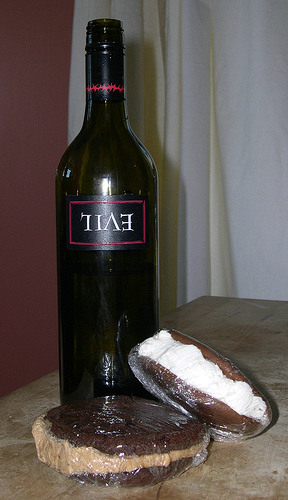
Even though I don’t know much about wine and I probably wouldn’t have picked up this book if it weren’t for the challenge, I had to admit this: ILMAO. Lawrence Osborne has a great deal of fun with the punny, the witty, and the downright funny. Right off the bat, on page four, he had me giggling with “all drinks came under the Arabic word alcohol, essentially reducing them to a level of chemical sin, and none of them could be bought on Sunday.” Especially since we had downed a wine called Evil on vacation, thanks to Stacey. See below for the proof.

Even if you aren’t a wine drinker or even a wine liker, Osborne’s writing will amuse you. He has phrases that are somewhat identifiable as my own, “when the happiness of drinking overwhelms you, you cannot resist it” (p 21) and “Wine is 99% psychological, a creation of where you are and with whom” (p 22). This makes me sound wildly alcoholic, but bear with me a second. Think of any great seduction scene. Who is usually front and center (along with soft music and sexy candlelight)? Partners in  crime – a wine bottle and two wine glasses. I found that a glass of wine is definitely more pleasurable when enjoyed in the presence of good friends and equally good scenery.
Seriously, I learned a lot from this short book. For example, how you space the vines in each row determines the complexity of a wine (according to one grower). The theory is plants with less crowding don’t have to compete for sunlight and growth space. They are more relaxed and get this, less stressed out. You see, the more stressed out a plant is, the more psychotic it is. It’s this aggrivated state that develops the complexity of flavor. Got it? I learned a new wine word, too: terroir. Makes me think of ‘terror’ but whatever.

Other favorite parts: “”what do you taste?” “Grapes,” I said. “Good. That’s what’s in it!”” (p 97)

“If wine is sex, ” I said, “this is like yoga.”
“Yoga? You’re saying it’s like yoga?”… I’m not sure I get you there. You mean athletic?”
“Virtuous. Unsexy.”
“Ah, you mean American!” (p 101)

But, probably my favorite line is an obvious one, “Wine summons ghosts out of the cupboard” (p 228).

BookLust Twist: From More Book Lust in the chapter “A Holiday Shopping List” (p 115). It’s true that I would buy this for the wine lover that I know, only I don’t think he drinks and reads. Is that a problem?
wine.jpg

1968: The Year That Rocked the World

1968Kurlansky, Mark. 1968: The Year That Rocked the World. New York: Ballentine Books, 2004.

The year before I came into being. What an amazingly troubled yet vibrant time. There is very little that Kurlansky doesn’t cover. Everything you want to know about what changed world views is here. My favorite chapters were about the civil rights movement and the protesting that went on. From sit-ins and the feminist movement to Freedom Rides and every raised sign in between. Talk about voicing your opinion! Here are my favorite quote on the subject: “The protesters can be nonviolent, but they must evoke a violent reaction. If both sides are nonviolent, there is no story” (p. 38). For this very reason women had a hard time getting their January protest march on Washington documented. They weren’t violent enough.
The harder chapters to read were about politics and the Vietnam war, two very unavoidable subjects for 1968. Both carried the weight of violence and unbridled hatred. The Chicago convention in August…”miraculously, the clubbings in Chicago killed no one…At the same time, Vietnam had its worst week of the summer, with 308 Americans killed, 1,134 wounded, and an estimated 4,755 enemy soldiers killed” (p286).

BookLust Twist: In the chapter “The 1960s in Fact & Fiction” (p 179) from More Book Lust.

Bastard out of Carolina

Bastard out of CarolinaAllison, Dorothy. Bastard out of Carolina. New York: Penguin, 1993.

The only way I can describe how I felt after finishing Bastard is raw. Raw and used up. Maybe it’s because this is my second time reading it. Maybe it’s because I reread this in two days. I don’t know. There are a thousand different ways to describe the book itself: coming of age, looking for acceptance, southern, white trash poverty, motherhood gone by the wayside. It’s a nightmare of a mother loving a cruel stepfather (Pearl calls him “violent and predatory”) more than her own daughter. I could go on and on but that would only ruin the depression. Oddly enough, I loved it. I loved Bone’s defiant voice as she tried to make her way through life as the oldest daughter of young mother Anney. I loved her keen observance of her surroundings, “It was dangerous, that heat. It wanted to pour out and burn everything up, everything they had that we couldn’t have, everything that made them think they were better than us” (p 103).
The social commentary on men and women, men against women was poignant, too. “A man belongs to the woman who feeds him…the woman belongs to the ones she feeds” (p 157).

BookLust Twist: Bastard out of Carolina is mentioned twice in Nancy Pearl’s Book Lust. First, in the chapter called “Grit Lit” (p 106), and then in the chapter simply called “Southern Fiction” (p 222).

pps~ I was wondering if this was ever made into a movie and it has…back in 1996. Where have I been?

Gift from the Sea

GiftsLindbergh, Anne Morrow. Gift From the Sea. New York: Vintage Books, 1991.

I have to say this is something every woman should read annually. The words and their meaning will change every single time and they will be different for every reader. In the simpliest of terms Gift From the Sea uses seashells, (whelk, moon shell, oyster) all gifts from the sea, as metaphors for life, vehicles for deeper thoughts. On vacation (ironically on an island, like me) Anne picks seashells and ponders religion, relationships, growing old, being young, nature, love and marriage…She picks at nagging thoughts like scabs, letting them bleed, revealing raw emotion and a tender heart. Here are a few of my favorite quotes:

“…I think best with a pencil in my hand” (p 9). I agree!
“…I have shed the shell of my life for these few weeks of vacation” (p 22). Since I was on vacation when I read that I had to smile because it happens to me, too.
“…social life is exhausting; one is wearing a mask” (p 32). Very true! Couldn’t have said it better myself.
“And since our communication seems more important to us than our chores, the chores are done without thinking” (p 100).

I read this in an afternoon. Gulls cried overhead, sea air salted my skin, waves crashed in the distance. It was the perfect setting for Gift from the Sea.

BookLust Twist: From the chapter called “Journals and Letters: We Are All Voyeurs at Heart” (p 130). I swear on everything holy I did NOT have More Book Lust with me when I wrote this review. I was still home without any of my Pearl books. So, I was incredibly surprised to read these words from Pearl, “Some of us still reread them yearly to remind ourselves of what’s important in this frantic world” (p 131). Pearl is referring to everything written by Lindbergh, but I had the exact same thought specifically about Gift from the Sea. Gift from the Sea is also in Book Lust in the chapter, “100 Good Reads, Decade by Decade” (p 175).

Under the Tuscan Sun

Mayes, Frances. Under the Tuscan Sun: At Home in Italy. New York: Broadway Books, 1997.Under the Tuscan Sun

Under the Tuscan Sun was made into a movie I have never seen, nor do I think I ever want to. I don’t see how the richness of Mayes’s Italy comes to life on the silver screen. I can’t picture the blood, sweat and tears of rebuilding a house; the glorious smells of garden fresh cooking; the love and laughter of enjoying one’s surroundings in moving pictures. I don’t see how Mayes’s  lush language is communicated. Really. Tuscan Sun is the journey of a woman (with the help of her second husband) to rebuild a Tuscan farmhouse. While she struggles with culture, language barriers and politics she falls in love with her Italian life. Try as I might I can’t see it as a movie. Okay, so now maybe I’ve convinced myself to see it out of curiosity!
I think I’m having trouble picturing a movie because I read Under the Tuscan Sun in my own personal paradise – by the dying light of fiery sunsets with the cadance of the surf as my only distractions. To say that I devoured Under the Tuscan Sun is an understatement. During the day I read it between hiking, eating, and breathing in my own love affair with a place. Every single time Mayes gushed about her Italian home I wanted to challenge her. I wanted to boast that it was I, not she, who was living the perfect life. On page 86 she says, “Where you are is who you are. The further inside you the place moves, the more your identity is intertwined with it. Never casual the choice of place is the choice of something you crave.” I found that quote so profound to my place I had to choke back tears. It is hard to explain arriving on Monhegan and reading those words on the very first night home. I had arrived to the only place my soul knows intimately. The only place where my whole being breathes a sigh of relief. Home is who I am, for sure. Later, I bought a guestbook for our rental cottage and wrote Mayes’s same words on the inside cover.

BookLust Twist: From More Book Lust in the chapter called “Ciao, Italia” (p 46). I like that Pearl describes Mayes adventure as a “love affair” (p 47). We’re both on the same page with this book.

My love affair:
875069607_94b33dab01.jpg

Autobiography of a Face

AutobiographyGrealy, Lucy. Autobiography of a Face.New York: HarperCollins, 2003.

I had all the right conditions to finish this book in two days – traveling, vacationing, but most of all, fascination. I couldn’t put it down. On the surface Autobiography of a Face is the tragic story of one woman’s struggle with cancer and journey through recovery. Only her struggle isn’t as an adult. She is a child. Confronting Ewing’s sarcoma at age nine Lucy battles through radiation therapy and chemotherapy. Her tone can only be described as matter of fact as she recounts the loneliness and pain after countless surgeries to correct the deformity of losing a third of her jaw. Deeper than that, Autobiography is about rising above the cruelty of others, shaking off the superficial prejudices of what supposedly makes a face beautiful. Lucy is defiant and remarkably stoic in her recollections of childhood taunts, adult avoidance, and across the board lack of social acceptance.
Critics call this book the vehicle with which to free oneself from self loathing and fears of rejection. It is a message to stop wallowing in self pity and live with dignity – no matter what. It’s also a call to be human and have real emotions as Lucy admits, “and as much as I wanted to love everybody in school and waft esoterically into the ether when someone called me ugly, I was plagued with petty desires and secret, evil hates” (p 181).

My favorite quote: “speaking seemed like something one could grow tired of” (p 77).

Lucy’s story ends with her getting published, finding friendships and getting on with her life. Yet, there is a darkness to it all. She is criticized for not telling the whole truth. There is mystery surrounding her untimely death in 2002. Her story leaves you asking what happened and wanting more. What the book doesn’t tell you is that her multiple surgeries led to an addiction to pain meds and subsequently, heroin. She died of an overdose at the age of 39. There is more drama after death, but I’ll leave that for you to figure out.

BookLust Twist: From More Book Lust and the chapter “Other People’s Shoes” (p 181). I can’t even begin to imagine being in Lucy’s shoes.