After the Plague

After the plagueBoyle, T. Coraghessan. After the Plague and Other Stories. New York: Viking, 2001.

After finishing A Diary from Dixie, Band Land, and The Crossley Baby I still had time for a couple more “November” reads. The topics already covered for November were: the month the civil war ended, the month Montana became a state, national train month, and national adoption month. I chose After the Plague because I hadn’t recognized National Writers Month yet (and if there is time I’ll also recognize November as the month World War I ended and read Storm in Flanders). The only thing I won’t get around to is honoring Winston Churchill’s birthday (born in November).

So, onto After the Plague. This is a collection of sixteen short stories. Pearl calls them “Boyle’s best.” They hang open, unfinished and unresolved like a to-be-continued drama on television. Each story is like being dropped into the middle of a movie, watching for a scene or two, and then being ushered away before the conclusion. If you like to hang in the balance this collection of short stories is for you. Even stories within stories are left unfinished. Boyle shows off diversity in every story. Some will shock you, some will make you remember something from your own life, but all of them will be a pleasure to read.
Some favorite lines: “I started smoking two or three nights a week, then it was five or six nights a week, then it was everyday, all day, and why not?” (p 48), and “I just watched her, like some sort of tutelary spirit, watched her till she turned over and I could see the dreams invade her eyelids” (p 164).

BookLust Twist: From Book Lust in the chapter called “Growing Writers” (p 107) and “Short Stories” (p 219). I love how Pearl describes Boyle’s work, “…nervy and disconcerting, and often very funny, leaving you uncomfortable with yourself and the world” (p 219). So true!

Diary From Dixie

Diary from DixieChestnut, Mary Boykin. A Diary from Dixie. Boston: Houghton Mifflin, 1949.

From the moment I started reading Mrs. Chestnut’s diary I felt I was in for gossip, gossip, gossip. While this is a great first hand account of life during the Civil War, I couldn’t get over how much of a name-dropping, political hob-nobbing, party-going Southerner she was! Another thing I noticed  was how humorous Mrs. Chestnut was! Here are a few of her more comical entries:

“There Mrs. Hunter told us a joke that made me sorry I had come” (p 8). But, she never does explain the joke was! Too bad!
“At camp meeting he got religion, handed round the hat, took the offering to the Lord down into the swamp to pray over it, untied his horse and fled with it, hat, contribution and all” (p 13).
“I think this journal will be disadvantageous for me, for I spend my time now like a spider, spinning my own entrails, instead of reading as my habit in all my spare moments” (p 22). See, gossip, gossip!
“Every woman in the house is ready to rush into the Florence Nightingale business” (p 70). Good ole fashion jealousy, perhaps?

I think the only quote to get to me showed the attitudes of the time, “Women need maternity to bring out their best and true loveliness” (p 86). We’ve been here before.

All in all, Mary Chestnut’s diary was a delight to read. I fell in love with some of the language: flinders, rataplan, brickbat, and best of all, envenom. Love that word! Witty and humorous, it didn’t read like a history textbook. Instead, it gave texture to the sounds and sights and warmth to the personalities from the Civil War. More importantly, it gave a sense of what it was like to be a woman during that time.

BookLust Twist: From Book Lust and the chapter called “Civil War Nonfiction” (p 58).

Crossley Baby (with spoiler)

Crossley BabyCarey, Jacqueline. The Crossley Baby. New York: Ballantine, 2003.
November is National Adoption Month. Out of everything I am currently reading, I thought this would be my favorite. I’m sorry to say I was a little disappointed. The Crossley Baby is the story of two sisters (Sunny & Jean) battling for their dead sister (Bridget)’s baby. Well, that’s what it’s supposed to be about. Instead, it’s more of a commentary on wealth (Jean has it, Sunny does not), parenting (Sunny is a mother of two, Jean is not) and manipulation (they both do it, for one reason or another). More time is spent setting up where Jean, Sunny and Bridget came from than the actual adoption process. More time is spent on describing the vast financial differences between Sunny and Jean than on their personalities. By the end of the book I didn’t know Jean or Sunny any better so I didn’t care who got the baby. I was completely indifferent to their struggle for baby Jade. Probably what bothered me most was the lack of real grief shown by either sister over the death of their elder sister. Crossley adds flickers of sadness, glimpses of sorrow, but for the most part Bridget’s death goes mostly unmourned. Possibly that is because they never got along. If there is one thing the three sisters did really well it was avoiding closeness.
In the end, Sunny wins custody. Everything points in the direction of Jean winning – money, power, people in her corner – while Sunny’s husband is filing for bankruptcy, old favors aren’t worth cashing in, and they have to sell their home. In a last minute surprise ending Jean withdraws her application for adoption and doesn’t contest the award going to Sunny. No one from Bridget’s life is there to put in a word edgewise.
Ironically enough, it was Bridget who was my favorite character because of this one line, “Bridget tasted her words before she spoke…” (p 112).

BookLust Twist: From More Book Lust and the very first chapter called “Adapting to Adoption” (p 1).

Bad Land: An American Romance

Bad LandRaban, Jonathan. The Bad Land: an American Romance.

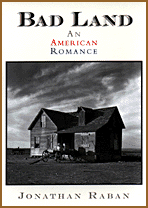
In honor of both the month Montana became a state and National Train Month I put Bad Land  on my list. It reads like a river. Some parts read like racing rapids while others slow to languid pools of near stillness. Then there are the waterfalls, where the language is cascading awe-inspiring. It was during these “waterfall” sections that I wanted to pack a bag and head west, just to see it for myself.

Raban helps you look at Montana from the point of view of the immigrant (emigrant), the artist, the ancestor, the traveler, the naturalist. Like standing back from a canvas to discover hidden colors. It’s a historical story, lyrically descriptive and informative. It’s a biography of the landscape as well as the people settled there at the turn of the century.
Favorite lines:”…mouth like a mailbox” (p 67).
“Mrs. Nemitz, scenting sarcasm, put his face on trial for a split second, but found it not guilty” (p 104).
“It’s exhilarating and scary, to lighten ship every so often, to kiss goodbye to the accumulated tonnage of ones life so far” (p 114)
“now the book is full of brittle ghosts” (p 136).

BookLust Twist: Mentioned twice in Book Lust. Once in the chapter called “Montana: In Big Sky Country” (p 156)…in which Pearl calls Bad Land  “the best book about Montana by a non-Montanan” (p 157); and “Riding the Rails: Railroad History” (p 201).

Only Daughter (with spoilers)

Anderson, Jessica. The Only Daughter. New York: Viking, 1980.

Set in Australia 1977, this is another Book Lust choice. I’m only 8 pages in but already I see similarities between my family and the Cornock family. Sisters on the telephone comparing notes on a mother’s behavior, “Did she give you the ‘I’m getting old’ speech?” “Yup.” I’m giggling already. I’m also getting schooled on Australian dialogue. A ‘tick’ is the equivalent of our ‘sec’. “Just a tick” is the same as “Just a sec.” The only annoyance with the book is that there are so many characters (already) that the author was justified in putting a family tree in the beginning of the book.

Edit: 11/30/06 – I have finished the book and there are three things I loved about it: Anderson never needed to spell out everything that happens. She implies and that kept me guessing. One mystery – why was Siddy calling Jack, “son” when Jack died? The characters constantly surprised me. Sylvia, the “only” daughter returns to Sydney (from Rome) coincidentally (?) when her father has had a stroke. She claims she didn’t know he was dying, but… she’s only been gone 20 years and she’s only his favorite child. Suddenly she is back? Get the picture? There is a twist to the will: Sylvia gets the money, but only after her mother dies (which Molly swears she won’t do). I also loved the complexity of all the relationships. Once I got them straight, I loved the power struggles between the sexes, the constant threat of ‘I’m leaving you.’

PS~ Incidentally, the cover of my copy of the book shows a swing and a hat. Probably one of the most powerful scenes in the book, IMO. Guy, a stepson by marriage is testing a rope swing. Jack, the stroke-suffered father is sitting in his wheelchair only yards away. Guy, in an evil attempt to scare his stepfather, swings close enough to kick Jack’s hat off his head. It’s a power struggle that Jack ultimately wins.

Booklust Twist: This is categorized as simply, “Australian fiction” (Book Lust, p.29).

Here First

Krupat, Arnold, and Brain Swann, eds. Here First: Autobiographical Essays by Native American Writers. New York: Modern Library, 2000.

Here First was, well, here first so I’m reading it first. I’m a little over 100 pages in and my first reaction is voyeurism. I’m peering into lives and seeing cultures I know little to nothing about. There is bitterness in their words, humor on the surface. Poetry in pieces. I’m having a tough time with the prejudice because I’m one of Them (being white) and not them. A perfect example is a favorite quote:
“The neighbor boy pointed to the screen laughing at the hooting Indians being chased by cavalry and told her that she was an “Indian.” I hugged my heartbroken daughter and said, “But you are an Indian.” She told me right back, “But I’m not that kind of Indian.” None of us are.” (Bird, Gloria. Autobiography as Spectacle: An Act of Liberation or the Illusion of Liberation? p65)

Booklust Twist: Categorized as “American Indian Literature”, (Book Lust, p.23).

Last River

Balf, Todd. Last River: the tragic race for Shangri-La. New York: Crowne Publishers, 2000.

This just came in for me. Not only is this a BookLust mention, but Todd Balf is a Massachusetts man. I’m curious about this (nonfictional) story because I have a near & dear friend who does the whitewater thing. When I’m not worried about him cracking his skull open, I’m proud of him.

EDIT: I’m still reading Here First so River will just have to wait. 11/21/06

11/23/06: I gave up on Here First so I could jump into Last River.
11/25/06: Wanna hear something weird? Back when I first ordered Last River I said I was curious about the story because I have a friend who kayaks. I’m 60 pages into it and already Balf has mentioned HACKS, which my friend is a member (okay, president), and Falls River where my friend lives AND the very house my friend lives in. It doesn’t take much to excite me. I know I won’t see his name in this print, but it thrills me to know I’m delving into his world.

11/27/06: I finished Last River. Once I really started reading I couldn’t put it down. Was it the sense of imminent doom? I did know someone would die tragically. Balf was clever never to let on who would meet his doom on that monstrous river. I think that was part of it, but I think it was more out of fascination for Balf’s respect for the Tsangpo Gorge and everything that went with the October 1998 expedition. I have a deep rooted respect for the places I’ll never see, the things I’ll never do and the dangers I’ll never comprehend. This book opened my eyes to a different way of life: a life challenged and driven and obsessed by whitewater. In the end, I think I understand my friend a little better too.

Booklust Twist: Categorized as “Adventure By the Book” the kayakers are called, “gung-ho”, (Book Lust, p.8).