Language of the Land

Hopkins, Martha and Michael Buscher. Language of the Land: The Library of Congress Book of Literary Maps. Washington: U.S. Government Printing Office, 1998.

This is a weird choice for the final book of April. I wanted to read something that represented tax time and that dreaded 4/15. Nancy didn’t include a whole lot of books on taxes in either Book Lust or More Book Lust so I decided to lump in government documents and publications as representation…It makes some sense, right?

Anyway, this book is really, really cool. I urge you to take a look at it for yourself. If you have ever seen Manguel’s The Dictionary of Imaginary Places you will get the gist of Language of the Land. I have to admit I’m a sucker for these kinds of things. To say that it is a collection of maps with the basis being about literature doesn’t really explain a whole lot. Here are some better examples (and some of my favorite “maps”): there are several Arthur Conan Doyle maps. One map shows the location of all the fictional places mentioned in the Sherlock Holmes mysteries. Another is the “Sherlock Holmes Mystery Map” (p 207) which allows SH fans to follow the famous detective’s footprints through different stories. Of course, the Odyssey has a few maps depicting the travels of Odysseus. Page 60 has a pictorial map of English literature while on page 70 shows the Beat Generation map. Every state has a map of famous authors. Of course I had to scrutinize Maine to see if they included Monhegan as a place and Stephen King as an author (they did). Then, I had to find the fictional places Robin Hood’s Sherwood Forest and Peter Pan’s Neverland. You would have to be a James Bond fan to know the significance of items in Ian Fleming’s “The Ian Fleming Thriller Map” (p 176) like the centipede in Bond’s glass or the Roman Numeral III tattooed on a blond girl’s arm. Most of the maps are in black and white although a handful are also represented in color. The Literary Map of Latin America (p 162) is beyond cool. So is The Call of The Wild by Jack London map (p 177).

BookLust Twist: From More Book Lust in the chapter “Your Tax Dollars at Work: Good Reading From the Government (Really!)” (p 239). Pearl is serious. Language of the Land is great!

Music to Fly By

As promised. Here is the setlist to Run For Darfur. As you probably can tell, I was hoping for the very angry woman run. It didn’t quite turn out that way. Madness was replaced by magic.

  1. KT Tunstall ~ Suddenly I See. I chose this as the first song because it reminds me of someone.
  2. Maroon 5 ~ Wake Up Call. Because I got my wake up call. Relates back to suddenly being able to see…
  3. Carrie Underwood ~ Before He Cheats. No reason. Just a damn funny song about an angry gal.
  4. Avril Lavign ~ Girlfriend. Because she can be a pain in the azz.
  5. Rob Thomas ~ This is How a Heart Breaks. My first training song, way back when. “Make the most out of life…” Don’t I ever!
  6. Mickey Hart ~ Baba. Kisa’s special song. This is what kicked me in the pants. Spiritual.
  7. Nickelback ~ Rockstar. Another funny song.
  8. Finger Eleven ~ Paralyzer.
  9. Matchbox20 ~ Disease.
  10. Lady Sovereign ~ Love me, Hate Me.

These are not completely in the right order because I forgot to turn off the shuffle function. It’s not that I had them in any particular order. Funny thing was, it was perfect just the way it came up. I didn’t get to hear all of Nickelback and I never got to Lady Sovereign at all. It’s ironic because I was specific about LS and why I wanted all those “fukc yous” at the end. Turns out, I didn’t need them. At all.

So, there you have it. BEB, thanks for setting the fire. I love you.

Love Song of J. Alfred Prufrock

Black Cat Red House

Eliot, T.S. “The Love Song of J. Alfred Prufrock.” The Oxford Book of American Poetry. Ed. David Lehman. Oxford: Oxford University Press, 2006. 343.

Who hasn’t read this in high school or at least college at least once? I can remember combing through line after line like primates looking for bugs. We scrutinized each word asking ourselves and each other what it all meant. Half the time we wanted to make stuff up because we just didn’t get it. Even today, there is so much to this poem that I have a hard time sorting it all out. Here are some of the ideas I have (and I would love it if someone could tell me how far off (or on) I really am). Okay, so the first idea is a comparison to Dante’s Inferno, and the whole idea of deciding who you really are. The second idea is a rant about aging, or society, or time, or relationships…or all of the above. I do know that it’s a monologue; someone talking to his or her “me, myself and moi”; or in my world, someone just having a good rant. Any takers on this theory?

Here is my favorite imagery: the cat. Of course. I love, love, love T.S. Eliot’s imagery when he decribes the yellow smoke as a cat, “…rubs its back upon the window-panes…licked its tongue into the corners of the evening…curled once about the house, and fell asleep.” It’s brilliant.

BookLust Twist: From More Book Lust  in the chapter “Poetry Pleasers” (p 188). Are you sick of me saying that yet?

Celestial Music

IMG_1223
Gluck, Louise. “Celestial Music.” The Oxford Book of American Poetry. Ed. by David Lehman. Oxford: Oxford University Press, 2006. 991.

I want to call this ‘Friends Argue then Agree to Disagree.’ For it is about (I think), two people seeing life differently. While they focus on the subject of religion (one believes in God, the other doesn’t), it is a metaphor for how each of them sees life as a whole – living, dying, coping with everything in between. It’s poignant. As the two friends walk they come across a dying catapillar. One friend can hardly stand to watch it fall victim to a swarm of ants while the other can. In the end, they know they are both right. As they should be.

My favorite line, “The love of form is a love of endings.”

BookLust Twist: From More Book Lustin the chapter “Poetry Pleasers” (p 189).

Most Ridiculous

wtfI’m calling the Darfur run “most ridiculous” for several reason. Where do I begin? First no sleep the night before. Tossed and turned in an unfamiliar bed, listened to drunks outside the window at 2am, worried about cracking my head on the nightstand, missed kisa…

The next morning checking in was odd. Confused by the box of cookies for sure….

But, here’s where it gets really ridiculous. Initially I was scared to run. I won’t lie. I wasn’t feeling up to it. A friend hadn’t shown, I kept thinking about the last time I tried to run anywhere (and failed), and I was dead tired. Suddenly, everything didn’t seem important enough. I didn’t feel important at all.
Then, the race began. Uphill. Within a few minutes I lost focus on the race and lost myself in a cemetery of souls. I will say this a million times to anyone who will listen. This was the most beautiful race of my life. From just a few minutes into it, I forgot I was running. The course was beyond spiritual. Beyond gorgeous. Beyond meaning. If I wasn’t staring at graves or flowers or water I was gazing up at some of the oldest trees I have ever seen. We went up crazy, slippery, gravel hills but I didn’t see them. We went down crazy pounding hills but I didn’t feel them. Instead, I craned my neck to read tombstones, did the math on who died when. How old? At times I would turn around and run sideways, even backwards to look one last time at someones angel in stone. From Amalia on I was lost in names. My husband’s secret track was all drums and I started to cry. Darfur’s genocide, the friend that didn’t show, these graves, and the trees that seem to live forever. The impact of everything finally overtook me.
Towards the end of the race a man yelled to me, “sprint it, baby!” and suddenly I was brought back to the race. Back to reality. Sprint it? What do you mean, ‘sprint it’? Where am I? How much more of the course is there? I honestly had no idea how far I had come or what was left. Suddenly I recognized the pavilion where we checked in, the gazebo right before the finish line, the flags for the end. I remembered I was in a race and the urge to really run kicked it (it meaning me…in the azz  🙂 ). I sprinted the last 30 seconds.

27:49. I’m irritated with myself. This is my best time ever, but I didn’t even try. I can tell. No red face. No coughing uncontrollably. No cramps. As far as running goes I didn’t give anything. I was too busy gawking at people’s final resting places. I was too busy communicating with trees. I was too busy remembering the dead. Darfur’s dead.
To Darfur, I gave everything.

Scammed By Schenectady

course mapFor weeks now I have been trying to find more information on the upcoming run. Okay, I admit it. I really wanted to check out the course and scope out the hills. Yes, I’m afraid of hills. If you have knee problems then you know what going d-o-w-n hills can feel like. But, as time went on and I wasn’t finding the slightest bit of information I began to think I was being scammed. I actually started to believe I sent money in to a race/charity that didn’t exist. Despite claims that the run was sponsored by Amnesty International I couldn’t find anything on their site supporting that. I kept finding the same website that brought me to the run in the first place.

Then, just last night – two days before I am to make the trip to NY – I get a packet of information. Scammed by Schenectady not. Directions, check-in times, and that all-important course map. Of course, hills aren’t marked but at least now I know where I’m going. At first glance I thought we would be running through a cemetery. How cool would that be! I pictured Vale souls cheering me on from beyond the grave. I love the idea of ghosts and spirits by my side. I already have an angel and a few demons, why not have a whole party?

So, now my mind is at peace. I’m not thinking the worst of this run. Instead, I’m using it to free me from the crap that haunts me, the sh!t I need to leave behind. I’ll have Daoud Hari’s courage and determination to make me strong.
And just in case that doesn’t work I’m using music from BB’s Gasparilla run to kick my azz. Forget the African beat (for now). Setlist to follow…

Dulce Et Decorum Est

Owen, Wilfred. “Dulce Et Decorum Est.” The Collected Poems of Wilfred Owen. London: Chatto & Windus, 1964. 55.

I think this has to be one of the most famous poems of all times. It is certainly the most famous poem about World War I that I can think of. It’s imagery is so vivid I often recoil from the words as I try to read them. I only think I can imagine the horror of what the soldiers experienced on the battlefields. I can only pretend to feel the pain of their mental and physical traumas. Wilfred Owen has you standing in the trenches with stench of blood and mud in your nose. He has you hearing the bombs whistle and explode in your ears. He has your eyes tearing as they burn from the green gasses and the death of friends.

Lines that killed me:
“As under a green sea, I saw him drowning”
“His hanging face, like a devil’s sick of sin…”

BookLust Twist: From More Book Lust in the chapter “Poetry Pleasers” (p 188).

Edited to add: Some people prefer their poetry in a more lyrical manner. Check out “The Latin One” (10,000 Maniacs, Hope Chest – 1990) for their interpretation.

Love, Loss, and What I Wore

Mr. StylishBeckerman, Ilene. Love, Loss, and What I Wore. Chapel Hill: Algonquin Books, 1995.

This is on the list in honor of National Fashion Month. Someone told me it really does exists (this fashion month), so I’ve added a bunch of books to the April List. Go Figure.
Anyway, back to Love, Loss, and What I Wore. What a freakin’ cute book. At first I was a cynic and thought, geeze, if this is writing then anyone can do it! Basically Beckerman’s book is small, 139 page, 50% illustrated, all about what she wore throughout major moments of her life. We’re only talking about 65 pages of text which only took me 25 minutes to read (twice). But, in all actuality I loved it. Here are a few reasons why:
I have a lot in common with Beckerman despite the fact she grew up in New York City in the 1940’s and 50’s. For example:

  • Her sister had a significant other who didn’t like her name and insisted on calling her something completely different (ahem)
  • She sometimes wore clothing backwards because it suited her better that way ( 🙂 )
  • She went to Simmon College (yup)
  • She has a fur coat from Bonwit Teller (don’t hate me)
  • She has shopped at the Short Hills Mall (you have too, RT!)
  • She prefers black (duh)

Quotes that caused me to think:
“After I went to love with my grandparents, I never saw my father again” (p 40).
“In another drawer she kept a long, thick, auburn braid of hair that my mother had saved from when she was young and had cut her hair. It was about fourteen inches in length, and sometimes I wore it as a chignon” (p 86). Does anyone else find this a little funky?

BookLust Twist: From Book Lust in the chapter “Do Clothes Make the Man (or Woman)?” (p 75).

Search for Baby Combover

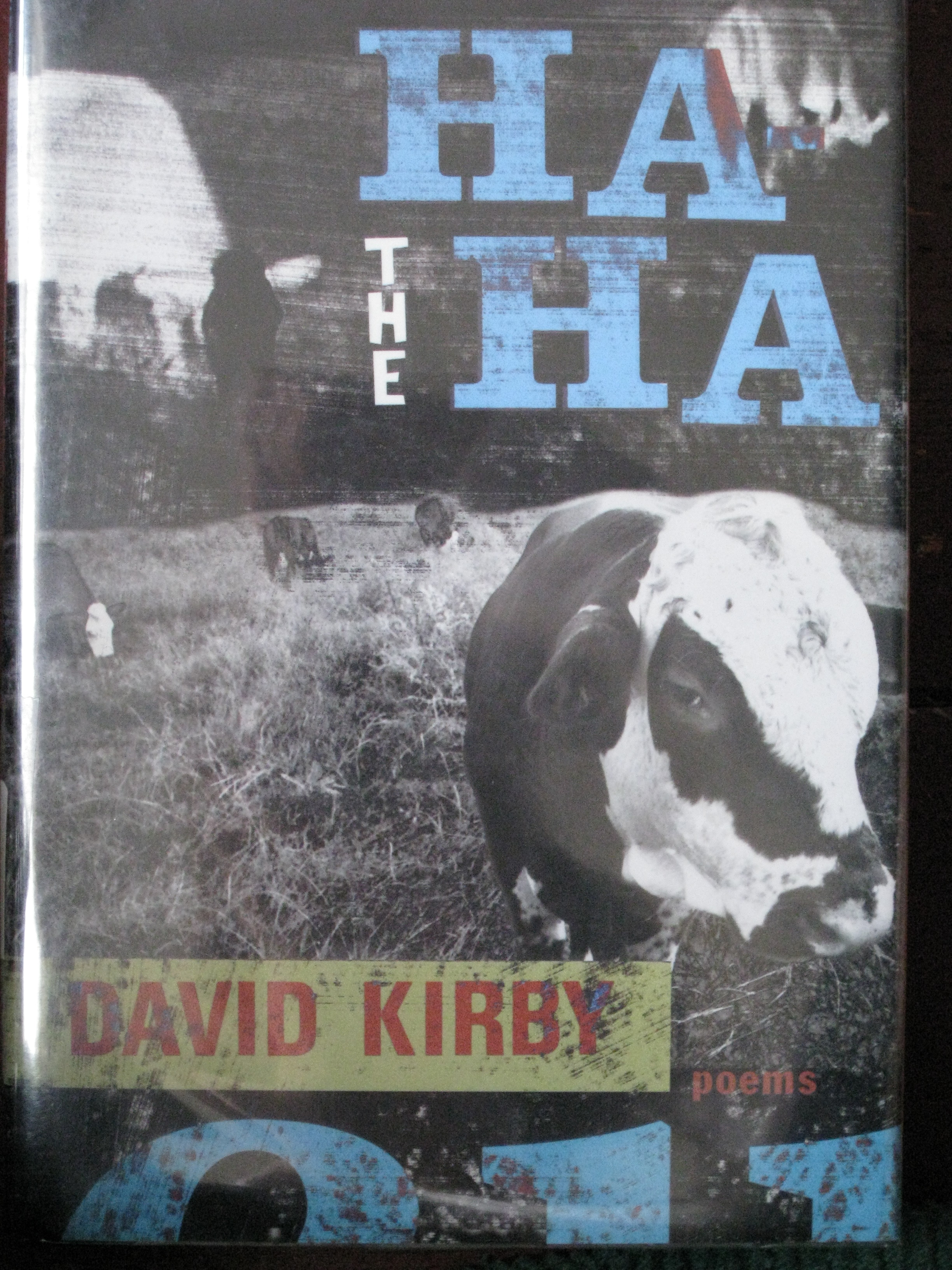
Kirby, David. “The Search for Baby Combover.” The Ha-Ha. Baton Rouge: Louisiana Univeristy Press, 2003. 41.

This is my third (and final) poem from The Ha-Ha that I had to read for the BookLust challenge. Later on, I will read a different book of poetry from David Kirby. But, for now “The Search for Baby Combover” is it. (see yesterday’s post for another Kirby.)
I couldn’t have asked to end Kirby’s collection on a better poem. “Baby Combover” is beyond delightful. It’s not a flowery prosey-prissy kind of thing. Instead, it’s inventive, sarcastic and wildly funny. It’s the story of a man who gets a knock on his door one night. His downstairs neighbor stands before him and proceeds to ask him to please refrain from (whoops wrong story) not move furniture around so late at night…because it wakes the baby. What baby? As far as our man is concerned he’s never seen a baby. Never heard a baby. So, he goes on to think the guy has invented a baby…It’s hysterical.

Here are a few of the best lines (and there are more so you might as well read the whole thing):
“…and I see he’s got something on his head, like strands of oily seaweed, something you’d expect to find on a rock after one of those big tanker spills in the Channel…”
“Baby Combover: the world’s first silent baby.”

BookLust Twist: From More Book Lust in the chapter “Poetry Pleasers” (p 189).

Ha-Ha Part II

David Kirby poetry
Kirby, David. “The Ha-Ha, Part II: I Cry My Heart, Antonio” The Ha-Ha Baton Rouge: Louisiana State University, 2003. 53.

Clever. This poem is so very clever. I like the story within a story concept. Like Shakespeare only a play on words. Here’s the quick and dirty premise: a man is having dinner with a companion. He is loving the meal and makes a comment about it. The comment reminds him of something horrible, so horrible that when his companion asks about his tragic face, he makes up another sad story to compensate for something too horrible to be discuss. The story he makes up becomes his ha-ha, his “structure against chaos”, as Kirby says.

BookLust Twist: From More Book Lust in the chapter “Poetry Pleasers” (p 188).

Franklin And Lucy

Persico, Joseph E. Franklin and Lucy: President Roosevelt, Mrs. Rutherfurd, and the Other Remarkable Women in His Life. New York: Random House, 2008.

Here’s what went on LibraryThing:
When I finally finished the last page of Franklin and Lucy I had two very different thoughts. The first was this was a well written, very thorough biography of the social side of the Roosevelts. It was written in an easy, conversational style that, at times, was hard to put down. The detail given to who, what, where, when, and why made you feel as though you were experiencing every aspect of the era. My second thought was it was an unfortunate title for a work comprised of so much more than just the relationships of Franklin D. Roosevelt. A more accurate title would have included Eleanor. A possible option could have been Franklin and Eleanor: Mrs Rutherfurd, and the Other Remarkable Women in their lives. Another option would be to remove any section dealing with Eleanor that didn’t include her husband’s involvement and focus solely on Franklin.
The other detraction from the book was Perisco’s almost obsessive need to repeatedly include Lucy Rutherfurd’s physical description in such flowery detail. While Franklin’s oft repeated “barrel chested” description was needed to stress his need to hide his disability (and to emphasize his physical decline before his death), and Eleanor’s lack of beauty was important in context to her character as being tragic and unlovable, they were not mentioned nearly as often as Lucy’s exquisiteness.

As an aside (something that didn’t go on LibraryThing), how awful is this? I kept comparing myself to Eleanor! Before you think I’ve gone crazy, hear me out: Perisco described Eleanor as:

  • when stressed Eleanor’s voice grew shrill
  • was insecure
  • was earnest instead of vivacious
  • “schoolmarm air about her”
  • Eleanor failed to recognize humor
  • oblivious to fashion, often choosing sensible over stylish
  • overwhelmed by children
  • suspicious about kindness
  • fought for the underdog

OKay, so I will never go onto greatness and my marriage is a thousand million trillion times better, but the other stuff fits. Kinda sorta maybe.

Everything is Wrong

moo cow

I cannot tell you how frustrating it is to misplace focus, to break a promise. I got on the tread last night, intending to do a quiet 35 minute tune-up session. Everything was wrong. Wrong from the very start. Everything. First of all, you and your Saturday night phone call. I know in my heart of hearts you are right. Three and a half hours of heart to heart and yes, you are right. I know what I need to do, thanks to you. But. But, but I don’t like it. I don’t deserve this. Yeah, yeah, yeah – Harry met Sally and the moral of the story is they couldn’t be friends. I hear ya. I still don’t like it. Last night I went beyond ThatSpace and deleted the phone number. Removing temptation. Cutting things off before they can cut me. I can’t bleed anymore. You are right.
Anyway. So, I thought of you and your words before I ran and they didn’t make me angry. I didn’t find the fire. Instead, they made me sad. I can’t run blue. So, the mood was wrong, the music was wrong, everything was wrong. For the first time ever I skipped Paint It Black and Have Fun Go Mad. I couldn’t find a rhythm I liked. Thanks to a friend I found Fleetwood and tried that. After 25 minutes I admitted defeat and decided nothing would help. I stopped cold. I couldn’t even rock the Aerosmith shirt I bought while shopping with RT. I couldn’t rock anything beyond 2.26 miles.

I’ve never stopped a run before. Not like that – not stopped cold. I’ve had plenty of other I Don’t Feel Like It moments. But, in every other instance of tired I struck a deal with myself and moi – run slower but don’t quit. Lower the incline to nothing, but don’t quit. Don’t you dare quit.

When I got off the tread and paced in front of my husband he was quick to offer kindness. Not your night. You just cooked a huge meal. You are tired. Work is tressing you out. I heard excuse after excuse and headed for the fridge. Chocolate Moo Cow for this quitter. 
Maybe another glass of whine…from a box.

Elephant of the Sea

elephant of the seaKirby, David. “Elephant of the Sea,” The Ha-Ha.Baton Rouge: Louisiana State University Press, 2003. 46.

Crack me up. This poem is really funny. It’s one of those comments on culture and keeping up with what’s cool. It’s also about language. Words and meanings. A French man wants to buy an automobile just like his American friend’s. Right down to the manatee on the license plate – the “elephant of the sea.” The friend doesn’t get it. He’s imagining what the clerk at the DMV are going to say and how the whole incident will shape her future.
And this is just one poem. Everything David Kirby writes is great. He is like geek rock of poetry. He’s smart and too funny for words.

Favorite line: “‘I can have zuh elephant of the zuh sea on my matriculation?’ to a clerk who’s got this grin on her face like she’s either seeing God or having an aneurysm” (p 46). 

BookLust Twist: From More Book Lustin the chapter “Poetry Pleasers” (p 188). He’s also mentioned in Book Lust in the chapter “Kitchen-Sink Poetry” (p 138).

Musee des Beaux Arts

Auden, W.H. “Musee des Beaux Arts.” The Oxford Book of American Poetry. Oxford: Oxford University Press, 2006. 501.

What do you see when you look at art? Does a painting create question in your mind? W.H. Auden wrote “Musee des Beaux Arts” in response to seeing the painter Brueghel’s Icarus. A ploughman calmly going about his business as a boy falls from the sky. While he had clues to the tragedy (a splash or cry) he does nothing. Auden’s larger observation is about how human response to an event or tragedy can vary; how life goes on beyond that event or tragedy. “Human position” as Auden puts it.

BookLust Twist: From More Book Lust in the chapter “Poetry Pleasers” (p 188).

What He Thought

McHugh, Heather. “What He Thought.” Hinge & Sign: Poems 1968-1993. Middletown: Wesleyan University Press, 1994.

I loved the conversational tone of this poem. I can see them perfectly. Intellects sitting around after dinner discussing what makes poetry poetry. In the beginning there is a snobbishness to the language, an air of I Know Better. Yet at the end there is a hint of mistaken identity which peeks through – an apology, mea culpa, my bad. It’s almost like a weak joke with a killer punchline.
Not to spoil the poem, but here’s the line that got me: “poetry is what he thought, but did not say.” How crazy is that? While this poem is in Hinge & Sign you can also read “What He Thought” on Heather’s humorous site.

BookLust Twist: From More Book Lust in the chapter called “Poetry Pleasers” (p187).