Funnies (with spoiler)

funniesLennon, J. Robert. The Funnies. New York: Riverhead, 1999.

Tim Mix’s father wrote a comic strip based on his family. Growing up, this comic strip was a source of embarrassment to Tim. Yet, when his father passes away and Tim’s only inheritance is the very comic strip he hated, he decides to try his hand at taking over the strip. Tim is a sarcastic, barely ambitious man who is terrible at conversation, worse at relationships both personal and with his family. This is a formula that always works – the unlikable, unlikely hero goes through a metamorphosis and comes out a pretty decent guy. In the end he doesn’t succeed with the funnies, but he gets the girl.

“This time the pause was longer, a nice slack length of rose to hang the conversation with” (p 52).
“I pushed gently at the sore spot in me and it hurt enough for me to turn away as I talked” (p 132).”
“Susan offered me a bite of her corn dog. I refused, still queasy from the Centrifuge of Death, but didn’t tell her this, and I feared that this rebuff without explanation would give offense. Then I came to my senses and simply let it go. It was a wonderful feeling, like dropping off a box at the Goodwill” (p 155).
And my favorite quote, “I let happiness run its course through me, knowing that it wouldn’t last, but also knowing it would always be there somewhere waiting for me, if I made the effort to find it. This understanding seemed an almost criminally excessive piece of good fortune, but for the time being I accepted it without question” (p 274). For some reason this reminded me of me.

BookLust Twist: From Book Lust twice. Once in the chapter called “Brothers and Sisters” (p 46), and “Families in Trouble” (p83).
Thousand Acres

acres.jpg

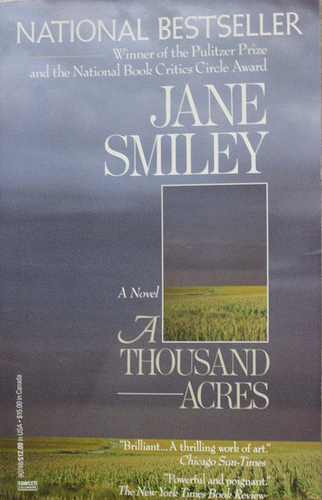
Smiley, Jane. A Thousand Acres. New York: Fawcett Columbine, 1991.

I’ll admit it. It took me forever to even want to read this book even though it has been sitting on my book shelf for months, right within easy reach. I tried picking up Moo a few times and something made me keep putting it down. I have no clue why. I assumed A Thousand Acres would be the same difficult to pick up experience. I was wrong. Once I got into it, Thousand Acres was fascinating, troubling and oh so true to family life. I’ve never lived on a farm. I’ve never set foot in Iowa, but thanks to Smiley I knew exactly what both would be like.
One thing I didn’t understand, nor will I ever, is how a family can so completely and utterly fall apart. By the end of the book not one family is intact and it’s all because of a thousand acres.

“You shouldn’t think somethings changed just because you haven’t seen it in thirteen years” (p 11).
“It was exhausting just to hold ourselves at the table… You felt a palpable sense of relief when you gave up and let yourself fall away from the table and wound up in the kitchen getting something, or in the bathroom running the water and splashing it on your face” (p 101).

BookLust Twist: From More Book Lust and the chapter called “Big Ten Country: The Literary Midwest (Iowa)” (p 27) and Book Lust in the chapter “Growing Writers” (p 107). Personally, I think Pearl also could have put this in her “Families in Trouble” chapter. Not to give anything away but…who tries to poison her own sister? Who does that?

January Is…

Here are the parameters for this month’s reading and what is at the top of the list. January is… 

  • Walter Mosley’s birth month (Always Outnumbered, Always Outgunned)
  • Nevil Shute’s birth month (Beyond the Black Stump)
  • Benjamin Franklin’s birth month (The Americanization of Benjamin Franklin)
  • National Yoga Month (Everday Zen)
  • The month Michigan became a state (The Dollmaker)

Of course, I’ve been reading something else lately….But, now that January is here, Happy New Year & Happy Reading!

Fer-De-Lance


Stout, Rex. Fer-De-Lance. Pennsylvania: Franklin Library, 1934.When I saw this book arrive in the library van box for me I got very excited about the cover alone. It’s beautiful! I didn’t even know it was my requested book, just that it had a gorgeous cover. How’s that for judging a book by its cover? I have heard so much about Rex Stout and his Nero Wolfe mysteries but had never read one before now. I have to admit, I didn’t really care for the character of Mr. Wolfe. He seems to spend a lot of time bossing other people around while being very, very particular about his own activities. The story is actually told from the point of view of his assistant, Archie Goodwin, who seems to do all the legwork work solving mysteries since Wolfe never leaves home.

So, the plot to Fer-De-Lance is this: a man is found murdered. Clues in his room lead to the death of someone else. Ultimately, it’s the solving of the second death that leads to the truth of the first death. It’s a fun story. Here are some of my favorite quotes:
“I made some sort of conversation so O’Grady’s ears wouldn’t be disappointed” (p 39).
“Maybe your salary is the only rope that holds Saturday and Sunday together for you” (p 48).
“It is always wiser, where there is a choice, to trust inertia. It is the greatest force in the world” (p 190).
“A genius may discover the hidden secrets and display them, only a god could create new ones” (p 246).

BookLust Twist: From Book Lust and the chapter “Rex Stout: Too Good To Miss”

Little Porcupine’s Christmas

Slate, Joseph. Little Porcupine’s Christmas. New York: Harper, 1982.

Cute. Cute. Cute! Felicia Bond illustrates this story and, for those of you who don’t know, Felicia Bond is the illustrator for another favorite of mine, If You Give a Mouse a Cookie. This isn’t about a mouse. This time it’s a porcupine who can’t be in the school play because of his sharp and pointy quills. It’s a typical story about how cruel “kids” can be towards an outsider, But, but, but, in the end Little Pocupine prevails and proves his worth. The adult in me hates stories like this because the other animals are never corrected when they say “you’re too — to participate. You don’t belong,” all because he is different. I worry (too much) that kids reading the story will learn that it’s okay to push someone outside the popular circle because that someone is different. I’ve been there and it isn’t fun. But, that’s the stoic, always serious adult talking. Take the book at face value and it’s a cute story about someone who is unique finding his niche and belonging after all.
Note: This story is also called How Little Porcupine Played Christmas.

BookLust Twist: From Book Lust in the chapter “Christmas Books for the Whole Family to Read” (p 56). Pearl calls Little Porcupine “heartwarming.”

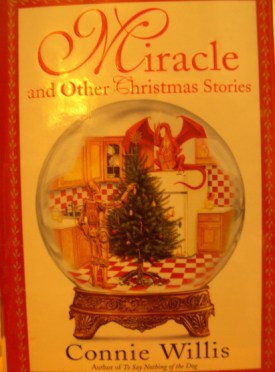
Miracle

Willis, Connie. Miracle and Other Christmas Stories. New York: Bantam, 2000.

A collection of short stories centered around Christmas.
image0001.jpg

  • Miracle ~ Lauren reminds me of me. She’s well-meaning yet corner cutting when it comes to Christmas. Her cards go out on time and she buys gifts for everyone in the office yet something is missing. Enter Spirit of Christmas Present, a environmentally exuberant specter sent to show Lauren the real meaning of Christmas.
  • Inn ~This is an odd little story about a woman who, while in choir practice for her church pageant, discovers a homeless couple who turn out to be Joseph and Mary. That Joseph and Mary, lost on their way to Bethlehem.
  • In Coppelius’s Toyshop ~ This is one of my favorites. It’s so reminiscent of Will from About a Boy lost in a crazy, confusing, chaotic toystore. Throughout the whole thing I could imagine rows and rows and floors and floors of toys, games, puzzles, colors, lights, noises, and the sounds of children everywhere.
  • Pony~ Moral of the story: it is never too late to get the ultimate present of your dreams…even if you no longer want it.
  • Adaptation ~ An interesting twist on A Christmas Carol. A divorced father wants nothing more than to give his daughter the ultimate Christmas but work and his exwife have other plans.
  • Cat’s Paw ~ A famous detective has been sent to solve a mystery on Christmas Eve. A weird tale involving monkeys and murder. “We are all capable of murder. It’s in our genes” (p 208).
  • Newsletter ~ Has the world been taking over by a parasite that causes goodness and peace of earth? How can we take humanity that’s just a little more…well…human? Turns out, we can’t.
  • Epiphany ~ Another twist on a classic tale. Mel is convinced he has had an epiphany about the Second Coming. He gets a friend and a stranger involved in his travels and suddenly they are the three wise “men.” It’s funny.
  • A Final Word~
  • BookLust Twist: From Book Lust  in the chapter “Connie Willis: Too Good To Miss” (p 248).

    Boy’s Life

    McCammon, Robert. Boy’s Life. New York: Pocket Star, 1991.

    I would almost venture to say there is almost too much adventure in this book. More stuff happens to CoreyMackenson in his life, in his boyhood life, than I can begin to explain. There is magic and imagination on nearly every page. Corey is an all-around good kid but that doesn’t mean he doesn’t have his share of trouble at school, confrontations with bullies and disagreements with his parents. All normal stuff until you add the mystery of a dead man, the mob, a dog that won’t die, a eye-blinking bike, a run-in with Nazis, kidnapping, a prostitute, the klu klux klan, several monsters and more mayhem. 

    I love a book that has almost every page flagged for a good line; a line I wish I had written, or one that made me think. Here are a few of my favorite lines from early in Boy’s Life:
    “You realize that every person in the world is a compromise of nature” (p 9).
    “Maybe crazy is what they call anyone who’s got magic inside them after they’re no longer a child” (p 10).
    “Oh, I knew what the word meant and all, but its casual use from a pretty mouth shocked the fool out of me” (p 20).
    “There are horrors that burst the bounds of screen and page, and come home all twisted up and grinning behind the face of somebody you love” (p 50).
    “I had never seen a black Jesus before, and this sight both knocked me for a loop and opened up a space in my mind that I’d never known needed light” (p 120).

    BookLust Twist: From More Book Lust and the section on Alabama in “Southern Fried Fiction” (p 207).

    Polar Express

    polar expressVan Allsburg, Chris. The Polar Express. Boston: Houghton Mifflin, 1985.

    Is it any wonder that The Polar Express won a Caldecott award? Is it any wonder that Hollywood made a movie out of it? This is a gorgeous book for adults as well as children. It’s fantastic to read aloud to a child because not only is are the pictures spectacular, but the storyline is wonderful, too. See, I can’t say enough nice things about this book!
    It’s simply the story of a boy who takes a trip by train to visit Santa at the North Pole. He is given a special gift that proves his belief in all things Christmas – the elves, the gifts, the reindeer, the North Pole, and of course, Santa Claus himself. This book was such a treat that I now want to go see the movie!

    “We climbed mountains so high it seemed as if we would scrape the moon” (p 9) and “Though I’ve grown old, the bell still rings for me as it does for all who truly believe” (p 29) are my favorite lines.

    BookLust Twist: From Book Lust  and the chapter on “Christmas Books for the Whole Family to Read” (p 55).

    Twelve Days of Christmas

    12 days of ChristmasKnight, Hilary. Hilary Knight’s Twelve Days of Christmas. New York: Simon & Schuster Books for Young Readers, 2001.

    On the surface this book looks like your average kids’ book. Cute pictures and a storyline you can sing. We all know “The Twelve Days of Christmas” – it’s that silly song that involves milking cows, egg producing hens, and ladies dancing among other things. What makes this book special is what is going on behind the scenes. There’s a whole other story unfolding in the illustrations.  On the surface Bedelia the bear is trying to tell you what her true love gave to her during the twelve days of Christmas (Dec 25- Jan 6) and then there is Benjamin, for those twelve days straight, bringing her the goods. In the background there’s Reginald the raccoon. He lives in Bedelia’s basement for some strange reason, and if you are observant, you learn that he pines for the perfect girl. Throughout Benjamin’s trips to Bedelia’s door with various (odd) gifts, you see Reginald struggling with something of his own.
    In the end (and I won’t ruin it for you), you will want to go back and look at all the illustrations just a little closer. Everything has a meaning – beyond Benjamin looking to woo Bedelia with twelve lords a~leaping (my favorite). Seriously. Check out the lords. They’ll crack you up.

    BookLust Twist: From Book Lust and the chapter “Christmas Books for the Whole Family to Read” (p 55).

    Father Christmas Letters

    Father ChristmasTolkien, J.R.R. The Father Christmas Letters. Boston: Houghton Mifflin, 1976.

    Pure magic. I loved every minute of this book! I have always loved J.R.R. Tolkien’s imagination. From The Hobbit to The Two Towers I have always enjoyed submerging myself in his work. This book is something special. I think Nancy Pearl sums it up best in Book Lust “Tolkien wrote these letters for his children, beginning in 1920 and ending in 1939. Whimsical pictures complement the descriptions of Father Christmas’s life at the North Pole” (p 56). But, what Pearl doesn’t tell you is that Tolkien is posing as Father Christmas, and each letter (one for each year) is a continuation a story (involving a polar bear, elves and ) from the year before. The illustrations that accompany the letters are as captivating as the storyline. I can truly imagine being a child, caught up in waiting for the letter from Father Christmas.
    The sobering thing about this book is that it ends the same year that World War II starts. Tolkien even makes mention of it on the last page “Half the world seems in the wrong place.” It seems like everyone needed to put aside childhood in 1939.

    BookLust Twist: From Book Lust  in the chapter “Christmas Books For The Whole Family To Read” (p 55).

    December Is

                                                                                                                                                                                                                 Christmas
                                                                    

    Here are the parameters for the December reading list (and what is at the top of the reading list):
    December is…

    • Bill Bryson’s birth month (Bill Bryson’s African Diary)
    • Connie Willis’ birth month (Bellweather)
    • Rex Stout’s birth month (Fer-de-Lance)
    • Mark Kurlansky’s birth month (Basque History of the World)
    • when Iowa became a state (Age of Grief)
    • when Pennsylvania became a state (Appointment in Samarra)
    • when New Jersey became a state (Body is Water)
    • when Mississippi became a state (24 Hours)
    • when Alabama became a state (Boy’s Life)
    • the month the Cold war ended (Last Supper)
    • the month of Christmas (Father Christmas Letters)
      By the way, I’ll read only Christmas stories during the week of Christmas 12/24 – 12/30…and a Christmas story in between the other reads.

    Anniversary Woops

    BooksThis anniversary made my realized I missed another anniversary. Not the one when I walked down the aisle, knees banging together out of trepidation. No, I’m talking about a different one – a more MeMyselfMoi one. I’m talking about the one that has made me open books. Open and read lots and lots of books. On November 10th, 2006 I made a vow to read everything indexed in Book Lust and More Book Lust. As of that date I had read 95 books. 95 books read, reviewed and relished. That equals eight books a month or two books a week (on average). It’s hard to believe I am approaching my 100th book (Appointment in Samarra by John O’Hara). I have to say it feels good to get back to being a book worm.

    Storm in Flanders

    Storm in FlandersGroom, Winston. A Storm in Flanders: The Ypres Salient, 1914 – 1918: Tragedy and Triumph on the Western Front. New York: Atlantic Monthly Press, 2001.

    I’m thinking I shouldn’t have picked this book up in the middle of my current state of mind. Don’t get me wrong, Groom’s history on World War I is impressive. Between the diary accounts, breathtaking pictures and easy language (he called someone a “military nut” and someone else “butt-headed”), this wasn’t a dry read. I know more about military warfare than ever before. For example, I learned WWI was Hitler’s introduction to war, paved the way for him, so to speak. The Germans were the first to introduce poison-gas (mustard gas) warfare; and I now know the meaning behind the poppy-like flowers veterans sell outside the grocery store. I always bought them and hung them in Gabriel without knowing why.
    There is humor to Groom’s language: “While the Germans pondered their next move, there was a four-day lull in the fighting – if you can call taking thousands of casualties a day a “lull” (p 51) and “…Germans binged on a gluttony of pork until they were virtually wursted and brattened to their limits” (p 119).

    Since Christmas is fast approaching I am drawn to the story Groom tells of Christmas 1914 when both sides put down their weapons and pretended to be friends for a day, exchanging gifts, singing carols, playing games and even laughing with one another. Yet, when the day was over they went back to killing one another.

    BookLust Twist: From Book Lust in the chapter “World War I Nonfiction” (p 251). Pearl points out that Groom writes with compassion for the soldiers and I couldn’t agree more. I think that compassion is what makes this book so interesting.

    After the Plague

    After the plagueBoyle, T. Coraghessan. After the Plague and Other Stories. New York: Viking, 2001.

    After finishing A Diary from Dixie, Band Land, and The Crossley Baby I still had time for a couple more “November” reads. The topics already covered for November were: the month the civil war ended, the month Montana became a state, national train month, and national adoption month. I chose After the Plague because I hadn’t recognized National Writers Month yet (and if there is time I’ll also recognize November as the month World War I ended and read Storm in Flanders). The only thing I won’t get around to is honoring Winston Churchill’s birthday (born in November).

    So, onto After the Plague. This is a collection of sixteen short stories. Pearl calls them “Boyle’s best.” They hang open, unfinished and unresolved like a to-be-continued drama on television. Each story is like being dropped into the middle of a movie, watching for a scene or two, and then being ushered away before the conclusion. If you like to hang in the balance this collection of short stories is for you. Even stories within stories are left unfinished. Boyle shows off diversity in every story. Some will shock you, some will make you remember something from your own life, but all of them will be a pleasure to read.
    Some favorite lines: “I started smoking two or three nights a week, then it was five or six nights a week, then it was everyday, all day, and why not?” (p 48), and “I just watched her, like some sort of tutelary spirit, watched her till she turned over and I could see the dreams invade her eyelids” (p 164).

    BookLust Twist: From Book Lust in the chapter called “Growing Writers” (p 107) and “Short Stories” (p 219). I love how Pearl describes Boyle’s work, “…nervy and disconcerting, and often very funny, leaving you uncomfortable with yourself and the world” (p 219). So true!

    Diary From Dixie

    Diary from DixieChestnut, Mary Boykin. A Diary from Dixie. Boston: Houghton Mifflin, 1949.

    From the moment I started reading Mrs. Chestnut’s diary I felt I was in for gossip, gossip, gossip. While this is a great first hand account of life during the Civil War, I couldn’t get over how much of a name-dropping, political hob-nobbing, party-going Southerner she was! Another thing I noticed  was how humorous Mrs. Chestnut was! Here are a few of her more comical entries:

    “There Mrs. Hunter told us a joke that made me sorry I had come” (p 8). But, she never does explain the joke was! Too bad!
    “At camp meeting he got religion, handed round the hat, took the offering to the Lord down into the swamp to pray over it, untied his horse and fled with it, hat, contribution and all” (p 13).
    “I think this journal will be disadvantageous for me, for I spend my time now like a spider, spinning my own entrails, instead of reading as my habit in all my spare moments” (p 22). See, gossip, gossip!
    “Every woman in the house is ready to rush into the Florence Nightingale business” (p 70). Good ole fashion jealousy, perhaps?

    I think the only quote to get to me showed the attitudes of the time, “Women need maternity to bring out their best and true loveliness” (p 86). We’ve been here before.

    All in all, Mary Chestnut’s diary was a delight to read. I fell in love with some of the language: flinders, rataplan, brickbat, and best of all, envenom. Love that word! Witty and humorous, it didn’t read like a history textbook. Instead, it gave texture to the sounds and sights and warmth to the personalities from the Civil War. More importantly, it gave a sense of what it was like to be a woman during that time.

    BookLust Twist: From Book Lust and the chapter called “Civil War Nonfiction” (p 58).