Bridge to Terabithia

Paterson, Katherine. Bridge to Terabithia. New York: Crowell, 1977.

I remember reading this in grade school. No, I take that back. Someone read it to me as “quiet time” in grade school. Then, the movie came out. When Kisa rented it I discovered I had been mispronouncing “terabithia” for years (tera-beeth-ia instead of tera-bith-ia). Not my fault since someone else read it that way.

One of the problems of seeing a movie and then reading the book is the danger of making comparisons to the visuals on the big screen. Because I couldn’t remember the plot from 32 years ago that’s what happened to me. I kept seeing the movie in my mind as I read the words. Either way, it’s a really cute story.

Jesse Aaron is a loner who lives inside his little world of solitude and art. His family is large and boisterous and often times, Jesse doesn’t feel understood by anyone, especially having three sisters. When Leslie Burke moves in next door Jesse is determined to ignore her, too. Soon he discovers they have more in common than he would like to admit. Leslie is creative, smart and a tomboy who can run faster than he can. Eventually they are inseparable friends. Jesse learns more than he bargains for by befriending Leslie.

What I found most compelling is that Paterson wrote this book for her son after he loses a friend to a lightning strike. On the dedication page she indicates her son insisted her name be included.

BookLust Twist: From More Book Lust in the chapter, “Best for Boys and Girls” (p 22). Note: Pearl indicates Bridge to Terabithia would be more suitable for girls, but I think it would be equaling interesting to boys.

November Is…

Giant
November is completely out of whack – already! I posted a review and then realized I hadn’t even listed out everything I plan to read. Woops! Truth be known, I hadn’t really decided what I wanted to read this month (hence the silly delay). But, this is what November is: November is when I wanted to turn on the heat. It actually came on 10/24 (at 56 degrees), but maybe now I’ll turn it up…to 60. This November marks the first time in my life I am not planning anything for the holidays (watch me cave and change my mind in the next two weeks). November is a marriage forever stuck at 22. November is (hopefully) a month of music. November is also the attempt to get a lot of reading done since it is National Novel Writing Month. Here’s the list:

  • Behind the Scenes at the Museum by Kate Atkinson (in honor of first novels) -already finished and reviewed!
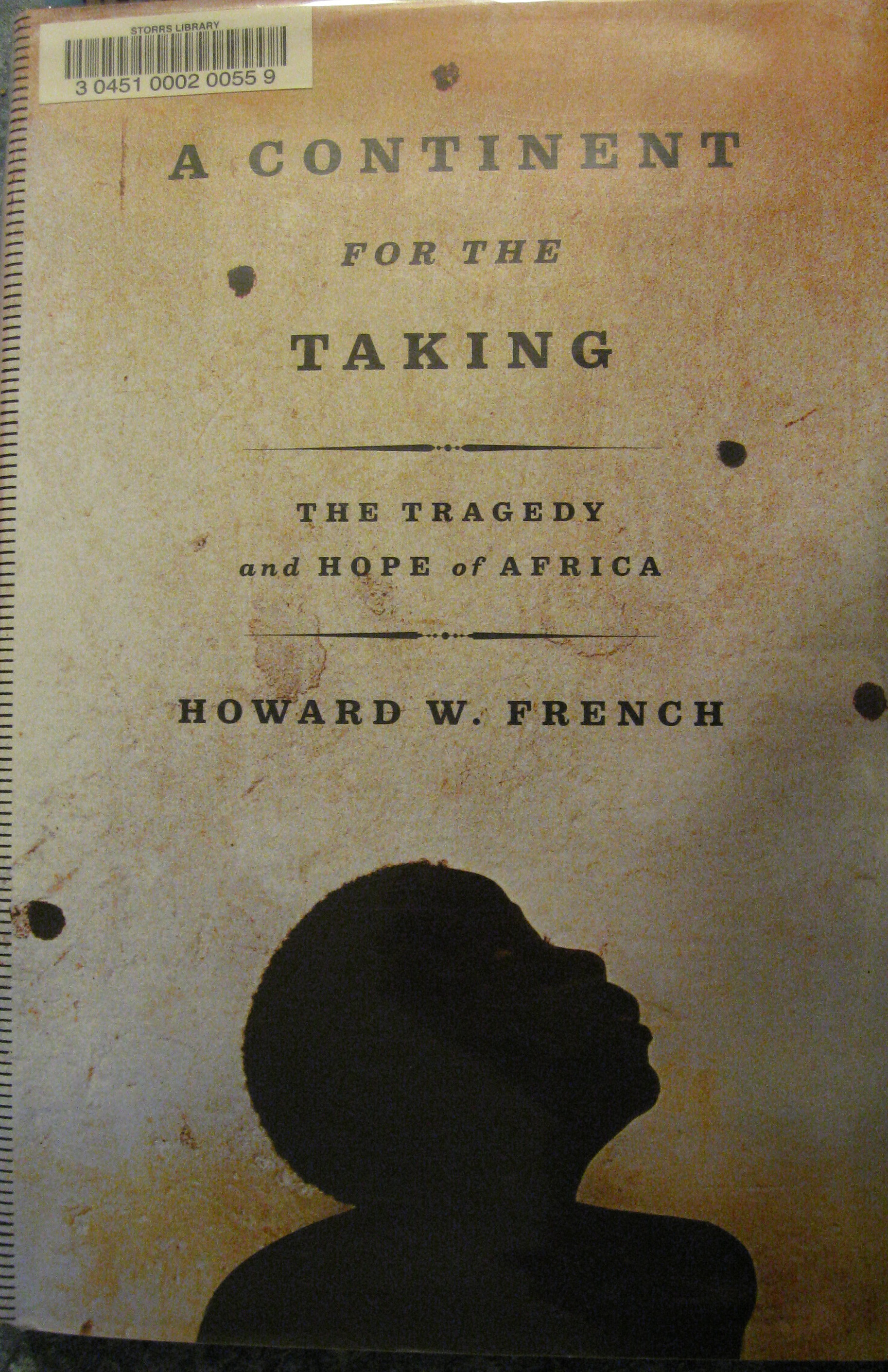
  • A Continent for the Taking by Howard W. French (in honor of the best time to visit Africa).
  • The Darling by Russell Banks (in honor of Transgender month*, but, conveniently, also about Africa).
  • Passionate Nomad by Jane Geniesse (in honor of National Travel Month – or one of them, at least!).

and if there is time:

  • As I Live and Breathe: Notes of a Patient Doctor by Jamie Weisman (in honor of National Healing Month).
  • Battle Cry of Freedom: the Civil War Era by James M. McPherson (in honor of November being the month the Civil War ended).

And a few “goals” such as they were: getting my car fixed & getting life as I know it back on track. Period.

*None of the books I will be reading in honor of Transgender Month actually are about people of transgender. Nancy Pearl has a chapter called “Men Channeling Women” in More Book Lust (p 166), but since National Men Channeling Women month doesn’t exist (yet), I thought this would be a good tongue-in-cheek substitute.

Cask of Amontillado

Poe, Edgar Allan. The Cask of Amontillado. Mahwah: Troll Publications, 1982.

Okay, okay. I admit it. The version I read of Edgar Allan Poe’s Cask of Amontillado was from my library’s Education Curriculum Library – a kids version. Only 32 pages long and brightly illustrated, it was a pleasure to read… in about five minutes. But, that’s not to say I haven’t read it before in it’s original text. And…I reread it online again thanks to the Gutenberg project.

The Cask of Amontillado is a psychological, creepy thriller. Perfect for October. Montressor has had his ego wounded badly by Fortunato. Looking for revenge Montressor waits until Fortunato is well in the drink and can be lured away to his death. The entire story is a study in human failings.
Montressor is able to convince Fortunato to come with him because Fortunato cannot bear the idea of another man playing the expert in identifying Montressor’s Amontillado wine. Montressor uses this jealousy to spur Fortunato deeper into the catacombs. At the same time Montressor showers Fortunato with concerns for his health in an effort to steer Fortunato away from suspicion. For Fortunato cannot suspect a trap if he is the one insistent on continuing deeper into Montressor’s underground chambers.
The reader never does find out what insults Montressor has suffered at the hands of Fortunato. The wrong doing is certainly not as important as the revenge.

Favorite scene: Fortunato questions Montressor’s membership as a brother, a mason. Montressor unveils his trowel as a sign but Fortunato never questions why he would have such a thing with him at that moment.

BookLust Twist: From More Book Lust in the chapter, “Horror for Sissies” (p 119).

Off the Run and All Over the Place

newshoes2
On Tuesday I put in a quiet 3.7 mile run on the treadmill. No gerbil jokes, no blogging about it, no fanfare. Just a quiet run for quiet me. I was feeling good enough to almost put in another one on Wednesday but the presidential (and final) debate was on and I was feeling political. How could I not be after the last debaucle – errr, debate? Have you ever seen such one-sided moderating in your life? Sheesh!

Anyway, I ignored the run thinking Thursday would be better. I argued with me and myself saying, the body needs a day of rest in between runs; the mind needs a day of rest in between worries. A day of rest would do us all some good. What I didn’t count on was putting in a 12 hour day at my work and then hanging out at Kisa’s work for another four. We left home around 6am and didn’t see our doorstep until well after 11pm. I’m sure poor Indiana thought we were putting her up for adoption. She certainly could claim abandonment these days!
I think of my mother. “Can’t you find someone else to push the buttons?” she says through the phone to my husband who is miles away, and “Geeze, they must not be doing a very good job if things keep breaking!” she mutters to me, right next to her. She sounds 97, all piss and vingar without a good thing to say. It’s no use arguing, trying to defend the technology I don’t understand. With a sigh I admit, “I don’t know, Ma. It’s television.” But, what I want to say is this, “It’s what made me fall in love with him in the first place; that tireless get-it-done work ethic. That commitment to working his azz off when everyone else has given up and gone home.”

So, I am happy to give up the run for another night. I’ll call it another day of rest even though it was work that kept me off the run.

Big If

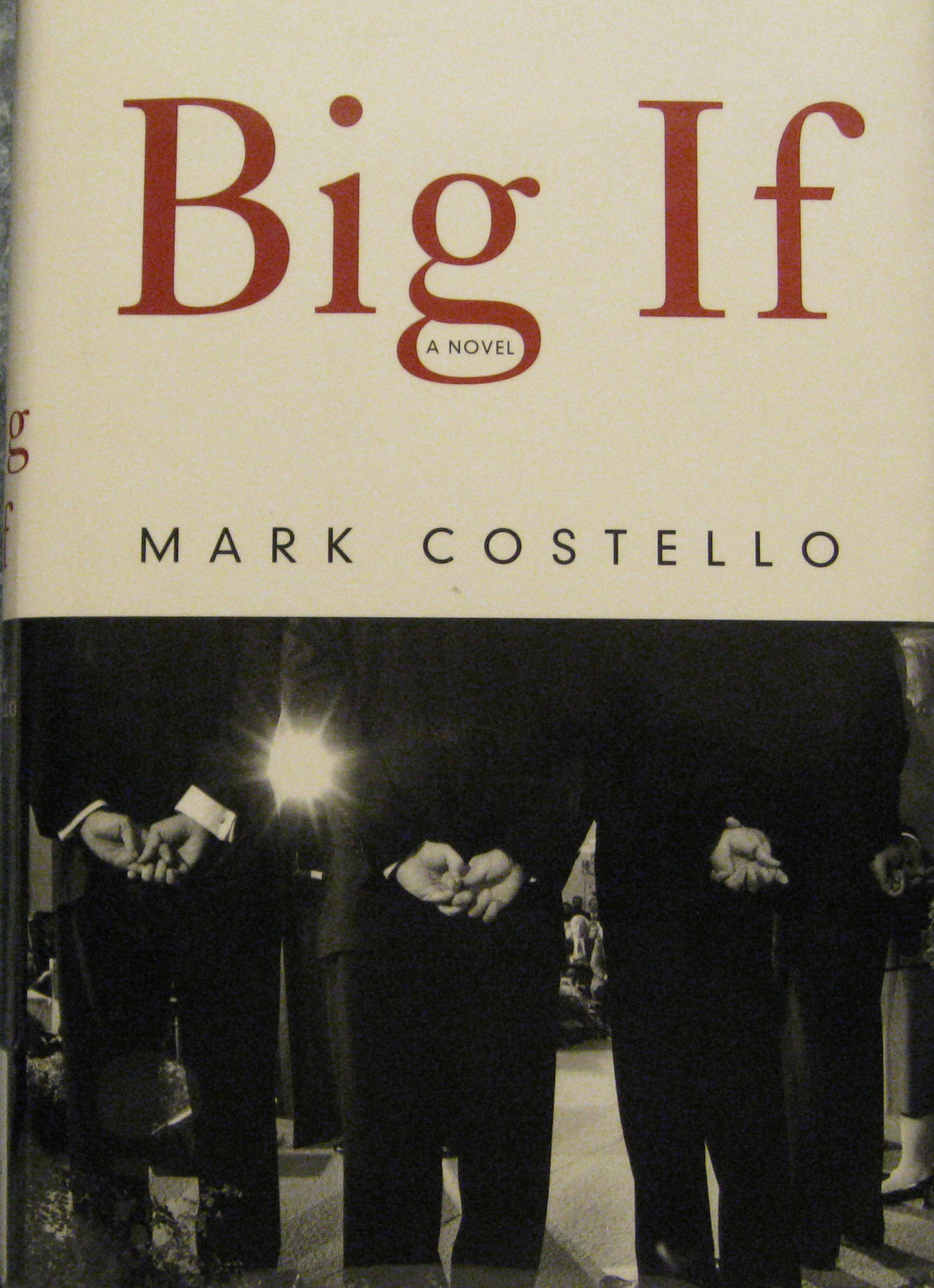
Costello, Mark. Big If: a Novel. New York: W. W. Norton, 2002.

I love it when everything about a book comes together. Meaning, when the plot is exciting and moves along like a river after a good hard rain and characters are detailed and dynamic and even the small stuff is interesting. When all these things come together I can’t put a book down. I read this over the weekend. that should tell you something.

Jens and Vi Asplund are adult siblings with very different lives. Jens lives in New Hampshire with his real estate wife and toddler son. He spends his days as a computer programmer writing programs for violent video games his patriotic father never approved of. His sister, Violet is Secret Service bodyguard sworn to protect the life of the Vice President of the United States during an election campaign. She has nothing that resembles a social life, a love life, or even a home life. If she is lonely she would never admit it.

Big If  takes you inside the creative and neurotic genius of software programmers. Simultaneously, you are drawn into every potential threat made to high powered public officials, as well as reliving old threats-come-true like the assassination attempt on President Reagan. Jens and Vi couldn’t have different lives and seem worlds apart…until they collide.

Favorite line: “This was another Rocky trick, fukc this legalistic sh!t, talk to crazy people in the crazy people language” (p36).

BookLust Twist: From More Book Lust in the chapter “New England Novels” (p 177).

Special thanks to the Hot One for posting…

Carry On, Jeeves

IMG_3756
Wodehouse, P.G. Carry On, Jeeves. New York: A.L. Burt, 1927.

This book just feels good in my hands. Published 10 years before my father was even born, it even looks its age. I guess I just like old books.

Carry on, Jeeves is a series of stories about how Jeeves acts as man-servant while repeatedly saving the day for Bertram Wooster. Each chapter sets up a different dilemma “Bertie” and/or his friends face and how Jeeves cleverly resolves every one of those dilemmas. There is a formula to these moments of crisis: someone is usually misleading a family member (usually an aunt) to think he is wealthy, in another part of the country, worth marrying, not worth marrying, etc. Jeeves’s solution is to mislead the “aunt” with a lie or two.  The lie is the smallest of gestures and usually something humorous happens – like the plan backfiring. While the general plot seems repetitious, Wodehouse’s style of writing is very funny. Side note: Bertie and Jeeves always seem to get into curious arguments about fashion.

Lines I liked: “I strained the old bean to meet this emergency” (p 47).
“I’m never much of a lad till I’ve engulfed an egg or two and a beaker of coffee (p 89).
“If this was going to be a fish-story, I needed stimulants” (p 167).

BookLust Twist: From More Book Lust in the chapter “P.G. Wodehouse: Too Good To Miss” (p 235). What I find hysterical about Pearl’s entry is her first sentence: “If you can ignore his somewhat rummy behavior…” (p 235). “Rummy” is a word Wodehouse uses over and over and over in Carry On, Jeeves.

Nowhere city


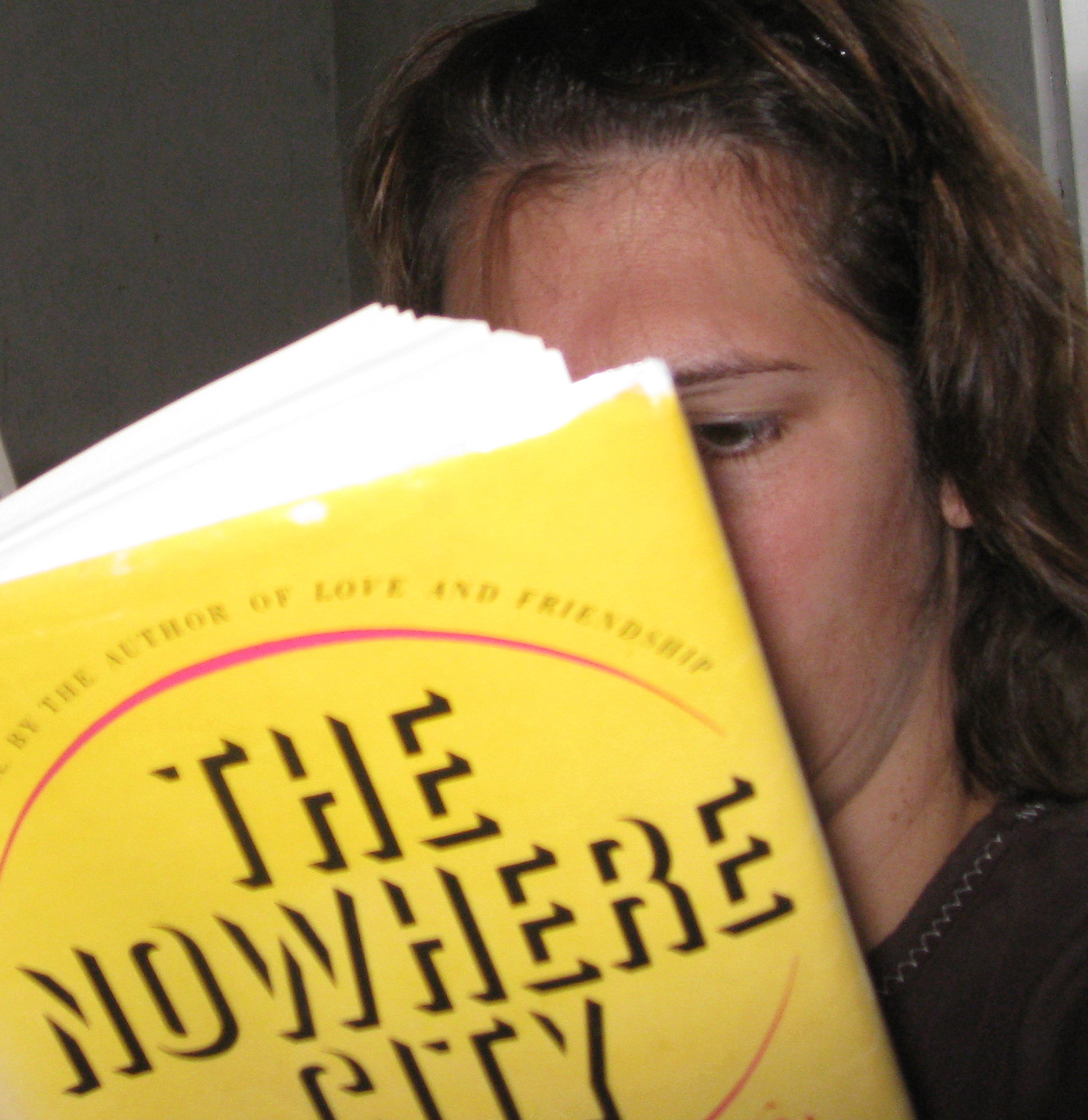
Lurie, Alison. The Nowhere City. New York: Coward-McCain, 1966.

I just literally put this book down minutes ago. All during the reading I stressed aboult what to say about it. It’s not that I hated it. It’s really enjoyable – a short, fun read. What I didn’t care for were the main characters.

New Englanders Paul and Katherine move to Los Angeles so that Paul can write the history of a rather large (and secretive) corporation. Paul has been hired by them (as a historian) to write this book for them, yet there are all sorts of confidentiality issues. Katherine hates LA. From the moment she arrives her sinuses have been acting up and she hates everything and nearly everyone around her…including her husband. Paul is the polar opposite and in his exuberance for the city and culture, finds himself involved with a local bohemian artist/waitress. Soon, Paul’s new life spins out of control while Katherine has a more gradual, precise metamorphosis. It’s no surprise that in the end it’s Katherine who loves L.A. and Paul who can’t wait to leave. It is hard to drum up sympathy for either character. Right from the start Katherine comes across as overly whiny and Paul is eager to have his first Californication affair. Of course there are movie stars and counter-culture characters that make the rest of the plot lively.

Favorite lines: “She had forgotten handbags, suitcases, packages, contracts, and every imaginable  and unimaginable piece of clothing, in every imaginable and unimaginable place. She had also, at one time or another, misplaced a pregnant police dog, a pink Edsel automobile, and two husbands” (p 24).

BookLust Twist: From More Book Lust in the chapter, “Marriage Blues” (p 161).

Code Book

Singh, Simon. The Code Book: The Science of Secrecy from Ancient Egypt to Quantum Cryptography. New York: Anchor Books, 1999.

My first September book and I started it a little late. I think it got to me by September 8th.

Much like how Mark Kurlansky makes a subject like salt interesting, Simon Singh makes all things code fascinating. From the very beginning The Code Book was informative and interesting. Peppered with photographs and diagrams, The Code Bookrecounted the events in history where the ability to break a code (or not) meant life or death. Beginning with Queen Mary of Scot’s attempted plot to murder Queen Elizabeth on through the first and second World Wars. The only time I really got bogged down was, of course, when Singh would get a little too detailed with mathematical explanations of more difficult codes and ciphers.

Love love love this line (from the introduction): “The only people who are in a position to point out my errors are also those who are not at liberty to reveal them” (p xvii). Brilliant!
Another good line: “This was clearly a period of history that tolerated a certain lack of urgency” (p 5). This sentence doesn’t make such sense as is. What I need to explain is that during the period of 480 B.C. secret messages were written on the shaved scalps of messengers. To disguise the message there was a waiting period while the messenger’s hair grew back in. I wish I could have told my nephew this story! He would have loved the idea of being a spy (see below)!

Dancing with Wrench

BookLust Twist: More Book Lust in the chapter, “Codes and Ciphers” (p 50), and in the introduction as an off-hand mention (p xi).

Devil in a Blue Dress

Mosley, Walter. Devil in a Blue Dress. New York: Pocket Books, 1990.

I have to admit I picked this book up by accident. I was vacationing and needed a quick book. Something to pick up while I waited for the pasta water came to a boil, or while the boys were still sleeping. I remembered this being part of the Challenge and decided to see if I could read it in less than 36 hours.

Devil in a Blue Dress is Walter Mosley’s first book and kicks off the Easy Rawlins series. Ezekiel “Easy” Rawlins is a black war WWII vet prone to violent flashbacks. In the beginning Devil in a Blue Dress he is fired from his defense plant job and doesn’t know how he’s going to pay the mortgage next month. By the second chapter Easy has been hired to locate a missing girlfriend, a devil in a blue dress, as they say. Throughout the next 200 pages Easy faces his share of violence, sex, racism and mystery but in the end, discovers a new found career – private investigations.

My favorite line: “He put up his hand as if he wanted me to bend down so he could whisper something but I didn’t think that anything he had to offer could improve my life” (p25). It’s that kind of sense of humor and sarcasm that carries Devil in a Blue Dress. You don’t realize that Mosley is telling you more than a story. He’s giving you a social commentary on what it meant to be a black man, riding the line of poverty in the 1940’s.

BookLust Twist: From More Book Lust in the chapter “Walter Mosley: Too Good To Miss” (p 169).

Postcards

Proulx, Annie E., Postcards. New York: Fourth Estate, 2004.

This was a hard book to read. Really dark and disconnected. I prefer books that have more flow to them. I haven’t read a lot of Proulx. I have to admit I don’t really even remember the title of the one I did read. How pathetic is that? I’m looking forward to the short stories because I think they will have less opportunity to be so disconnected and choppy.

I think what struck me about Postcards was how powerful the language was. While the plot was hard and gritty, the way it was told was strong and confident. Almost like someone yelling emphatically, if that makes sense. It’s the story of a farming family in New England. They are torn apart by the departure of the eldest son, Loyal. He has just killed his girlfriend and left her body under a pile of rocks in a nearby field. While the death was an accident, Loyal’s leaving and the slow disintegration of the farm was not. Tragedy follows the family wherever they go. The beauty of the saga is how each chapter is punctuated with a postcard. It’s these postcards that illustrate the changing times both for the nation and the family. Loyal often writes home, careful not to tell anyone where he really is. He continues to stay disconnected and this is apparent in what he shares with his family.

BookLust Twist: From More Book Lust in the chapter “It was a Dark and Stormy Novel” (p 128).

Heartbreaking Work

Eggers, Dave. A Heartbreaking Work of Staggering Genius. New York: Vintage Books, 2001.

I didn’t even have to touch this book to know it was going to be great. It landed on my desk upside down. the first words I read from the back cover were, “Yes lets and then can we leave and run in shallow warm water.” I was intrigued, to say the least!

It’s the story of Eggers as a young adult faced with having to take care of his younger brother after losing both his parents to cancer. It’s sad and funny. Witty and sarcastic. It took my much longer to read because I had to drink every little word. I read the Rules and Suggestions for Enjoyment of This Book, the Preface to this Edition, the Contents, Achknowledgments, even Mistakes We Knew We Were Making which contains notes, corrections, clarifications, apologies, and addenda. Too funny.

A few of my favorite lines:
“I have visions of my demise: When I know I have only so much time left – for example, if I do in fact have AIDS as I believe I probably do, if anyone does, it’s me, why not – when the time comes, I will just leave, say goodbye and leave, and then throw myself into a volcano” (p xiii)
“Beth and I take turns driving him to and fro, down the hill and up again and otherwise we lose weeks like buttons, like pencils” (p 55).
Then there’s this scene. I don’t know how to describe it other than to say I’ve been there: “I want to put the box somewhere else…The box which is not my mother cannot go in the trunk because she would be livid if I put her in the trunk. She would fucking kill me” (p 383). This is so, so, dare I say it? Heartbreaking.

BookLust Twist: Pearl really liked this book. It’s mentioned four different times between her two books Book Lust and More Book Lust. From Book Lust: in the chapter “Memoirs” (p 152), and “The Postmodern Condition” (p 191) and again in the preface on page xi. Then again in More Book Lust in the chapter “And The Award for Best Title Goes To…” ( p 12).

Chasing Vermeer

Balliett, Blue. Chasing Vermeer. New York: Scholastic Press, 2004.

I love it when a book takes me somewhere new. It’s even better when it opens doors to other interests that stick. It’s best when it’s completely unexpected. Such is the case with Chasing Vermeer. When I first realized it was a young adult book I thought I would get through it in a day, get through it and move onto something more my speed. Who knew this book would be just my speed? For starters there is a play-along game involving pentominoes. If you can’t get the hidden message there is an interacted website (still active) to help you out, complete with other games to get you sidetracked. Then, there is the discovery of something completely unexpected I mentioned before. Chasing Vermeer mentions a lot of Vermeer’s work in detail so I started doing a little more research and found a fantastic website dedicated to Vermeer. It’s really great. I lost my lunch break playing with it! I love learning something new everyday in the most unexpected ways. But back to Chasing Vermeer, the book.

It’s a great mystery for kids and adults alike. Petra Andalee and her new found friend Calder Pillay find themselves in the middle of a mystery complete with codes and the crime of stolen art. It starts off with Petra and Calder as classmates with a weird assignment: find letters in art. Both Petra and Calder call the other “weird” and can’t imagine ever being friends, but soon weird coincidences bring them together to solve a mystery involving an old woman, the FBI and an international art scandal.

Here are some quotes that nabbed me: “Good letters were no longer written. He was sure of it” (p 23). Glad I’m not the only one who feels this way!
“What was art, anyway? The more she thought about it, the stranger it seemed” (p 40). My thoughts exactly!

BookLust Twist: From More Book Lust in the chapter “Best For Boys and Girls” (p 21).

Finding Caruso

Barnes, Kim. Finding Caruso. New York: Peguin Putnam, 2003.

Within the first two chapters of Finding Caruso I found myself calling Kim Barnes a favorite author. Despite the fact that the first chapter started off raw and violent; as shocking as a bucket of ice cold language, I loved the way she described the landscape, the emotion, the family structure. A mother timid and protective, a father despairing and drunken, brothers bound by love and loyalty. After a tragedy the brothers make their way to Idaho. Music is what keeps them going, but brotherly blood is what saves them.
It’s also the bittersweet tale of sibling rivalry. One brother being the older, better looking, the more talented, the one used to getting everything while the other looks on, burning with jealousy, brimming with pride. But, what happens when the tides turn and baby brother gets a stroke of luck, wins out?

I could have quoted the entire book for the wonderful lines that jumped off the pages at me, but here are a few of my favorites:
“The ballads were my mother’s favorite, and we let her lead, our boys’ voices blending in a harmony that had been in us since the moment our parents came together and planted the music in our bones” (p 7).
“Those nights my father disappeared down the road, I felt the house itself let loose its breath” (p 11).
“‘It’s not that I’m thirsty. It’s the memory that tastes good'” (p 50).
“‘Don’t ever think you know something of me without asking'” (p 111).

This book was definitely a favorite. The writing was sparse yet as fluid as the mountain streams Barnes describes in Finding Caruso.

BookLust Twist: From More Book Lust in the chapter “Idaho: And Nary a Potato To Be Seen” (p 122).

Blackwater

Ekman, Kerstin. Blackwater. New York: Doubleday, 1993.

Ekman’s Blackwater is possessive. It grabs you and you can’t put it down. It’s dark and gritty – peppered with angry scenes of violence and meaningless, lust driven sex. Like a maze with many twisting passages Blackwater has a community of dark stories to tell. Each tale is tangled with another and at the center, common to all, is a double murder. While everyone knows about it and is touched by it, no one can solve it for twenty years.
In the beginning Annie Raft follows a lover to Blackwater to his out-of-the-way commune. On her first day in town Annie stumbles across the murdered bodies of two tourists camping in the backwoods of Blackwater. For twenty years she is haunted by the face of the man she thinks did it until one day that face comes back in the form of her daughter’s newest boyfriend. The mystery, along with a whole host of secrets, start to unravel.
The landscape is such an important element in the novel I would have enjoyed a map, something that illustrates Annie getting lost in the forest, how far away from town the commune was, where the well was that Johan was tossed into in relation to where the murders took place, etc.

These are the really great lines: “The silence was violent after the noise of the cars” (p 10).
“He felt strangely empty inside, a green jumble of oblivion, and his skin felt licked by eyes” (p 136).
“You cannot live in the world without living off it” (p 177).
“She had lived a cautious and parched life” (p255).
“It had been an open question between them, whether you can see into your own darkness and whether it actually is your responsibility to do so. Or whether you evoke the darkness and make it into your own by toying with it” (p 422).


BookLust Twist: From More Book Lust in the chapter “Crime is a Globetrotter: Sweden” (p 59).

Bildgewater

Gardam, Jane. Bilgewater. New York: Greenwillow Books, 1977.

Marigold Green is a wonderful name. Not so wonderful when your father’s name is Bill. Marigold adopts the unavoidable nickname of Bilgewater as a result (Bill’s + daughter = Bilgewater). As so begins Gardam’s story about teenage angst from the point of view of Marigold Green. Because her father is the housemaster to the boys of a boarding school, Marigold has a lot to be anxious about. Having lost her mother at birth, Marigold is naive when it comes to friendships, fashion, relationships with the opposite sex, and even alcohol. She had never seen drunk people before the age of 18. The one thing she does know is literature and many different works are reference throughout the story.

The quotes that grabbed me: “love had always made him sad” (p 9)
“Flowers in classrooms are as depressing as flowers in hospitals – they just emphasize the fact that you can’t get out and see them growing. Classrooms break your heart” (p 44).
“The frightful, pitiless games of hockey with me always running the wrong way” (p 201).

BookLust Twist: From More Book Lust in the chapter “Jane Gardam: Too Good To Miss” (97). Pearl says of this coming-of-age tale, “…wonderful for adults who want to look back, from a safe distance, at the ups and downs of adolescence” (p 97).