Americanization of Benjamin Franklin


Wood, Gordon S. The Americanization of Benjamin Franklin. New York: Penguin, 2004.

Benjamin Franklin celebrates a birthday in January (on the 17th day in the year 1706 to be precise; in other words, today); hence my reading of his biography (one of many on my list).
Let me say first and foremost that Mr. Franklin is a personal hero of mine for advocating for libraries so much! If it were not for him who knows where my profession would be. I do not, however, approve of his treatment of his wife Deborah. Can you imagine being married to someone who insisted on living in a different country (and only returns home after your death)? Even Franklin’s friends made no mention of Deborah’s passing after he returned to America.
Wood’s biography deals mostly with Franklin’s political aspirations and most pointedly, his “switch” from supporting Britain to supporting America (hence “americanization” in the title). Of course, Franklin’s involvement in postal services and electricity were also touched upon, but only because they are important elements to Franklin’s history.

My favorite quotes:
“Things that struck him as new and odd were always worth thinking about, for experiencing them might advance the boundaries of knowledge” (p 62).
“…but Franklin thought the electrical charge necessary to kill large animals might end up killing the cook” (p 64).
“The degree of Franklin’s Revolutionary fervor and his loathing of the king surprised even John Adams, who was no slouch himself when it came to hating (p 154).

BookLust Twist: From More Book Lust and the chapter called “Founding Fathers” (p 91).

The Dollmaker

Arnow, Harriette. The Dollmaker. New York: Avon, 1972.

Weighing in at 599 pages this book truly can be called a saga. It’s the story of Gertie Nevens, a simple country woman from Kentucky during World War II. After her husband moves to Detroit, Michigan to find work in the factories, Gertie follows with her five children. Life in the city is cold, dirty, and unkind. Gertie learns of prejudices against “hillbillies” and the importance of the word “adjust”. There is tragedy and triumph with human frailty constantly hanging in the balance. At times I couldn’t believe the hard times Gertie and her family faced. It almost seemed too much to bear. Gertie’s strongest moments are in the very beginning of the book when she has to save her baby from a life threatening illness. After moving from Kentucky it’s as if the city steals Gertie’s strength and spirit.

“…for after the bright whiteness of the hot little room, the cold rain and dark were like old friends” (p 38).
The government owed them at least one man who could fix anything and never got drunk” (p 108).
“‘Are you busy?…Yes and no…I’m in the worst kind of business – tryen to make up my mind'” (p 260).
“She stood, her mind, as always, stumbling around, picking up words, laying them down” (p 538).

BookLust Twist: From More Book Lust and the chapter “Big Ten Country: The Literary Midwest” & the section ‘Michigan’ (p 26).

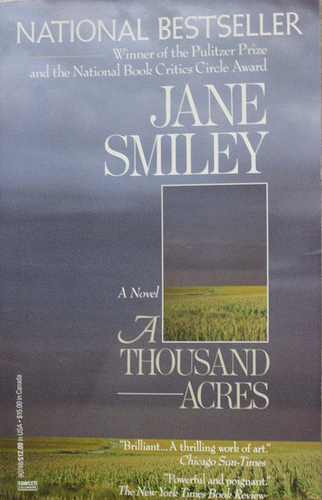
Thousand Acres

acres.jpg

Smiley, Jane. A Thousand Acres. New York: Fawcett Columbine, 1991.

I’ll admit it. It took me forever to even want to read this book even though it has been sitting on my book shelf for months, right within easy reach. I tried picking up Moo a few times and something made me keep putting it down. I have no clue why. I assumed A Thousand Acres would be the same difficult to pick up experience. I was wrong. Once I got into it, Thousand Acres was fascinating, troubling and oh so true to family life. I’ve never lived on a farm. I’ve never set foot in Iowa, but thanks to Smiley I knew exactly what both would be like.
One thing I didn’t understand, nor will I ever, is how a family can so completely and utterly fall apart. By the end of the book not one family is intact and it’s all because of a thousand acres.

“You shouldn’t think somethings changed just because you haven’t seen it in thirteen years” (p 11).
“It was exhausting just to hold ourselves at the table… You felt a palpable sense of relief when you gave up and let yourself fall away from the table and wound up in the kitchen getting something, or in the bathroom running the water and splashing it on your face” (p 101).

BookLust Twist: From More Book Lust and the chapter called “Big Ten Country: The Literary Midwest (Iowa)” (p 27) and Book Lust in the chapter “Growing Writers” (p 107). Personally, I think Pearl also could have put this in her “Families in Trouble” chapter. Not to give anything away but…who tries to poison her own sister? Who does that?

Beyond the Black Stump

Shute, Nevil. Beyond the Black Stump. New York: William Morrow, 1956.

Nancy Pearl likes Nevil Shute. There is a whole chapter on him in More Book Lust. This being my first “Shute book” I was enchanted. Beyond the Black Stump is about an American geologist, Stanton Laird, who is assigned to dig for oil in Australia. Stanton is a stand-up guy with a secret in his past, but when he meets and falls in love with Mollie Regan in the Australian outback, he realizes can’t compete with her past. This is the story of two people too different to make it work. It goes beyond race or religion. Prejudices and historical resentments run deep for both families. Despite the plot being predictable I enjoyed getting to the conclusion no matter how obvious it would be.

“It’s the greed for the gold, the curse of the modern age. Avarice kills more men than any physical disease, I am afraid. These men will not make old bones” (p 136).

BookLust Twist: From More Book Lust and the chapter “Nevil Shute: Too Good To Miss” (p 199).

Always Outnumbered


Mosley, Walter. Always Outnumbered, Always Outgunned. New York: W.W. Norton, 1998.

Always Outnumbered, Always Outgunned is like looking at snapshots of one man’s existence. Each chapter is a different time in Socrates Fortlow’s life, a different picture. His past, his friends, and his skewed sense of morality are the common threads in each scene. Socrates is a man, free after 28 years in prison, trying to make his way in Los Angeles, California. The violent streak that landed him in the penitentiary is still prominent in his personality. He is an angel and a devil all in one. A saint with a dark side. A demon with a halo. My favorite example of this split personality is when a friend’s wife comes looking for her husband at Socrates’s door. While telling Corrine she should leave her no-good husband (and be with Socrates) that same no-good husband is hiding out in Socrates’s back room.

Some of my favorite quotes describing Socrates:
“Back then he enjoyed the company of fear” (p 19).
“He wasn’t a thief. Or, if he was, the only thing he ever took was life” (p 64).

BookLust Twist: from More Book Lust and the chapter “Walter Mosley: Too Good To miss” (p 169). Happy Birthday Mr. Mosley!

January Is…

Here are the parameters for this month’s reading and what is at the top of the list. January is… 

  • Walter Mosley’s birth month (Always Outnumbered, Always Outgunned)
  • Nevil Shute’s birth month (Beyond the Black Stump)
  • Benjamin Franklin’s birth month (The Americanization of Benjamin Franklin)
  • National Yoga Month (Everday Zen)
  • The month Michigan became a state (The Dollmaker)

Of course, I’ve been reading something else lately….But, now that January is here, Happy New Year & Happy Reading!

The Book Lover’s Cookbook


Wenger, Shaundra Kennedy and Janet Kay Jensen. The Book Lover’s Cookbook: Recipes Inspired by Celebrated Works of Literature, and the Passages That Feature Them. New York: Ballantine Books, 2003.

I grazed on this book a while ago. The hardcover (borrowed) version sat on my desk for a few days and every so often I would pick it up, skim the pages, eye the recipes, until it was time to send it back. I couldn’t get into it because I was truly afraid I would mark up a book that wasn’t mine. I have that habit with cookbooks – writing in them. So, I sent it back, barely digested.
Fast forward to last year. Book Lover’s Cookbook was on The List. I was thinking I could call it accomplished until I remembered how I didn’t devour it.
Skip to this Christmas. My sister and brother-in-law gave me the softcover version and suddenly, I’m not only devouring the book I’m dedicated to cooking every recipe, reading every book mentioned. This version is mine, mine, mine and I can write in it all I want.

What is so special about this book is that it includes a variety of books and are not all standard Oprah favorites. There are classics, stories for children, chick lit, murder mysteries, nonfiction, and even poetry. Same goes for the dishes – they aren’t all typical recipes. There is something for everyone.

BookLust Twist: From More Book Lust in the chapter “Dewey Deconstructed” (in the 600s, p72).

24 hours

Iles, Greg. 24 Hours. New York: G.P. Putnam’s Sons, 2000.

A kidnapping mystery set in Mississippi…sort of an odd read for the holiday season, but December is the month Mississippi became a state.
Here’s the storyline: Basically, this guy, Joe, has set up the perfect kidnapping scheme. He targets a doctor who has a spouse and child, learns all he can about the doctor’s family and then while the doc is at an annual convention he kidnaps his/her child. His cousin (a hulking man with the IQ of a chipmunk) holds the child in a remote location while his “wife” entertains the male parent and Joe entertains the female parent for 24 hours. They call each other every 30 minutes and if a call is missed Cousin Chipmunk kills the kid. In the AM one parent wires the ransom to the other parent so the kidnapper doesn’t have any connection to the withdrawal. The money is always an amount the doctor can afford and the kidnapping always works because the child is worth more than getting the money back or calling the police. The detail that makes the whole thing work are the every 30 minutes phone calls. Everything hinges on those calls and the convention – because the convention is the guarantee the doctor will be separated from the rest of the family for at least 24 hours.
Despite the brilliant plot I have two problems with detail. In the beginning both parents are told their family has been scrutinized and studied in great detail. The kidnappers claim to know everything about the family. If that is true then why did they not know their latest kidnapping victim was diabetic? If they knew everything how did they miss such a large piece of a child’s life? The second problem with detail is on page 164 – one of the kidnappers says “You have to chill, Will!” and is delighted by the rhyme of the doctor’s name, yet two pages later Iles writes, “Why don’t you at least face the truth about something, Will.” It was the first time she [the kidnapper] had used his Christian name” (p 166). No, actually it wasn’t. She told Will to chill two pages earlier. Ugh.
All in all, this moved fast and was a constant page turner. Every time I had to put it down I was at “the good part” and hated to stop reading. The end is a little over-the-top dramatic and there are loose ends, but well worth the read.

BookLust Twist: In More Book Lust in the “Southern Fried Fiction (Mississippi)” chapter (p 208).

Age of Grief

Smiley, Jane. The Age of Grief. New York: Fawcett Columbine, 1987.

A collection of short stories. Instead of summarizing them I have decided to quote my favorite lines instead because there was one from every story.

  • Pleasure of her company~ “I felt like your child or your sister or something”    (p 25).
  • Lily~ “Love was like an activity, you had to put in the hours” (p 33).
  • Jeffrey, Believe Me~ “Who can tell the lifelong effect of a cacophonous conception” (p 60), and “you would indeed be spending the night but in a near coma” (p 64).
  • Long Distance~ “Can a melancholy sound have a quality of desperation?” (p 71)
  • Dynamite~ “When they would ask me, I was fine, too, but I had the excuse of making bombs, something, I told myself, they didn’t want to know (p 96).
  • And finally, the novella, The Age of Grief~ I couldn’t find one or two quotesI liked best -too many to mention so I won’t mention at all; and I can’t tell you what I think of this final story. A dentist and his wife (also a dentist) go through the ups and downs of marriage & parenting. It’s haunting because I can’t imagine this kind of grief.

BookLust Twist: From More Book Lust in the chapter “Big Ten Country: The Literary Midwest (Iowa)” (p 26).

The Body is Water

Schumacher, Julie. The Body is Water. New York: SoHo, 1995.

I love it when reading fits the day. I don’t know how to describe it other than the perfect marriage between a book and time. It was snowing, sleeting, windy and freezing cold. Every so often a gust of wind would send pellets of freezing rain drumming against the windows, yet the Christmas tree glowed softly, the cat purred at my feet, a balsam candle burned bright, a fleece blanket was thrown over my lap, a cup of tea at my elbow and I was content. If I could ignore the wind, all was quiet, all was still; the perfect time to lose myself in The Body is Water.
I’m still reading December picks and The Body is Water celebrates the month New Jersey became a state, oddly enough. It’s also the story of single and pregnant Jane, and her return to her New Jersey shore childhood home. In one sitting I read 184 of the 262 pages.

“All my life I’ve never been certain of where I should be” (p 20).
“In a crisis, other families probably rush to hold the ailing person’s hand; our family rushes to the general vicinity of the crisis and putters around, hoping the patient will spontaneously recover on her own” (p 61).
“No matter where I lived, I never knew my way around; there was no ocean, no rushing noise of a heartbeat from the east” (p 230).
“I start to cry, remembering the days before my mother died, before Bee slept in another room. That was when we loved each other best and didn’t know it” (p 262).

I ended this book sobbing. I connected with Jane even though she was the younger sister (Bee was four years older); even though Jane lost a mother and I lost a father; even though she became a mother and I remain sans motherhood. I connected through the simple loss of a parent, the soothing sound of the ocean, and the complex closeness of sisters.

BookLust Twist: From More Book Lustin the chapter called “Jersey Guys and Gals” (p 129). This also could have been mentioned in chapter called “Maiden Voyages” (p 158) because this was Schmacher’s first novel.

Appointment in Samarra

appointment in samarraO’Hara John. Appointment in Samarra. New York: Vintage, 2003.

In honor of Pennsylvania becoming a state in the month of December Appointment in Samarra was my first novel pick. I was excited to see the introduction was written by John Updike. He is another author I have enjoyed over the years. Set in the 1930’s with a keen eye on society, O’Hara tells the story of Caroline & Julian English and their how their elite status is washed away with alcohol and attitude. In an instance the English couple go from being the toast of the town to the talk of trash.

“I love you more than a tongue can tell” (p 63).
“…their position in Gibbsville was just that certain and insecure…” (p 83).
“…she was too conscious of looking like the wrath of God to enjoy any of it” (p 121).
“The worst of that drive was that the sun glare on the snow made you smile before you were ready” (p 200).

As an aside: I don’t remember where I was when I learned that the Lenape Indians believed the turtle was the center of the universe. To this day, it remains the only thing I know about this particular tribe. It was interesting to see O’Hara mention the tribe in his historical ancestry of the English family.

BookLust Twist: From More Book Lust in the chapter “Big Ten Country: The Literary Midwest (Pennsylvania)” (p 30). 

Bill Bryson’s African Diary

African DiaryBryson, Bill. Bill Bryson’s African Diary. New York, Broadway Books, 2002.

I added this to the December list when I read a review describing it as “short.” It’s much shorter than I thought – only 49 pages of “diary” and a few more pages of statistical information. So short that I was able to read it over a lunch break. I’m glad it was a quick read because I couldn’t put it down. I’m a sucker for charitable tactics, especially unique ones, and this book definitely qualifies. CARE International (a non-profit organization dedicated to fighting global poverty) funded Bill Bryson’s trip to Nairobi, Africa with the request that he write about his eight day adventure. Bryson is known for his travel literature, his humor, and his expressive way of describing life around him. He would certainly be able to describe the poverty, the landscape, and best of all, the people of Africa. Many reviewers called this book a charity puff-piece, a lengthy advertisement for the work of CARE, and were bitter about the $12 price tag. What they missed out on was the stunning photography, the wry humor and the painless way to do good (all royalties and profit from the sale of the book went to CARE International).
Speaking of humor, here are a few of my favorite lines: “…tireless commitment to mediocrity” (p 2), “you had to be really unlucky to be shot and stabbed” (p 4), “Kenyan Railways has something of a tradition of killing its passengers” (p 21) and, “Watamu was tranquil to the point of being comatose” (25). There are other funny moments: “flying toilets,” and flying for real, to name two.

For more information on CARE, International go here.

BookLust Twist: From More Book Lust and the chapter “Bill Bryson: Too Good to Miss” (p 36). This being my first introduction to Bryson I am looking forward to more.

December Is

                                                                                                                                                                                                             Christmas
                                                                

Here are the parameters for the December reading list (and what is at the top of the reading list):
December is…

  • Bill Bryson’s birth month (Bill Bryson’s African Diary)
  • Connie Willis’ birth month (Bellweather)
  • Rex Stout’s birth month (Fer-de-Lance)
  • Mark Kurlansky’s birth month (Basque History of the World)
  • when Iowa became a state (Age of Grief)
  • when Pennsylvania became a state (Appointment in Samarra)
  • when New Jersey became a state (Body is Water)
  • when Mississippi became a state (24 Hours)
  • when Alabama became a state (Boy’s Life)
  • the month the Cold war ended (Last Supper)
  • the month of Christmas (Father Christmas Letters)
    By the way, I’ll read only Christmas stories during the week of Christmas 12/24 – 12/30…and a Christmas story in between the other reads.

Anniversary Woops

BooksThis anniversary made my realized I missed another anniversary. Not the one when I walked down the aisle, knees banging together out of trepidation. No, I’m talking about a different one – a more MeMyselfMoi one. I’m talking about the one that has made me open books. Open and read lots and lots of books. On November 10th, 2006 I made a vow to read everything indexed in Book Lust and More Book Lust. As of that date I had read 95 books. 95 books read, reviewed and relished. That equals eight books a month or two books a week (on average). It’s hard to believe I am approaching my 100th book (Appointment in Samarra by John O’Hara). I have to say it feels good to get back to being a book worm.

Crossley Baby (with spoiler)

Crossley BabyCarey, Jacqueline. The Crossley Baby. New York: Ballantine, 2003.

November is National Adoption Month. Out of everything I am currently reading, I thought this would be my favorite. I’m sorry to say I was a little disappointed. The Crossley Baby is the story of two sisters (Sunny & Jean) battling for their dead sister (Bridget)’s baby. Well, that’s what it’s supposed to be about. Instead, it’s more of a commentary on wealth (Jean has it, Sunny does not), parenting (Sunny is a mother of two, Jean is not) and manipulation (they both do it, for one reason or another). More time is spent setting up where Jean, Sunny and Bridget came from than the actual adoption process. More time is spent on describing the vast financial differences between Sunny and Jean than on their personalities. By the end of the book I didn’t know Jean or Sunny any better so I didn’t care who got the baby. I was completely indifferent to their struggle for baby Jade. Probably what bothered me most was the lack of real grief shown by either sister over the death of their elder sister. Crossley adds flickers of sadness, glimpses of sorrow, but for the most part Bridget’s death goes mostly unmourned. Possibly that is because they never got along. If there is one thing the three sisters did really well it was avoiding closeness.
In the end, Sunny wins custody. Everything points in the direction of Jean winning – money, power, people in her corner – while Sunny’s husband is filing for bankruptcy, old favors aren’t worth cashing in, and they have to sell their home. In a last minute surprise ending Jean withdraws her application for adoption and doesn’t contest the award going to Sunny. No one from Bridget’s life is there to put in a word edgewise.
Ironically enough, it was Bridget who was my favorite character because of this one line, “Bridget tasted her words before she spoke…” (p 112).

BookLust Twist: From More Book Lust and the very first chapter called “Adapting to Adoption” (p 1).