24 hours

Iles, Greg. 24 Hours. New York: G.P. Putnam’s Sons, 2000.

A kidnapping mystery set in Mississippi…sort of an odd read for the holiday season, but December is the month Mississippi became a state.
Here’s the storyline: Basically, this guy, Joe, has set up the perfect kidnapping scheme. He targets a doctor who has a spouse and child, learns all he can about the doctor’s family and then while the doc is at an annual convention he kidnaps his/her child. His cousin (a hulking man with the IQ of a chipmunk) holds the child in a remote location while his “wife” entertains the male parent and Joe entertains the female parent for 24 hours. They call each other every 30 minutes and if a call is missed Cousin Chipmunk kills the kid. In the AM one parent wires the ransom to the other parent so the kidnapper doesn’t have any connection to the withdrawal. The money is always an amount the doctor can afford and the kidnapping always works because the child is worth more than getting the money back or calling the police. The detail that makes the whole thing work are the every 30 minutes phone calls. Everything hinges on those calls and the convention – because the convention is the guarantee the doctor will be separated from the rest of the family for at least 24 hours.
Despite the brilliant plot I have two problems with detail. In the beginning both parents are told their family has been scrutinized and studied in great detail. The kidnappers claim to know everything about the family. If that is true then why did they not know their latest kidnapping victim was diabetic? If they knew everything how did they miss such a large piece of a child’s life? The second problem with detail is on page 164 – one of the kidnappers says “You have to chill, Will!” and is delighted by the rhyme of the doctor’s name, yet two pages later Iles writes, “Why don’t you at least face the truth about something, Will.” It was the first time she [the kidnapper] had used his Christian name” (p 166). No, actually it wasn’t. She told Will to chill two pages earlier. Ugh.
All in all, this moved fast and was a constant page turner. Every time I had to put it down I was at “the good part” and hated to stop reading. The end is a little over-the-top dramatic and there are loose ends, but well worth the read.

BookLust Twist: In More Book Lust in the “Southern Fried Fiction (Mississippi)” chapter (p 208).

Age of Grief

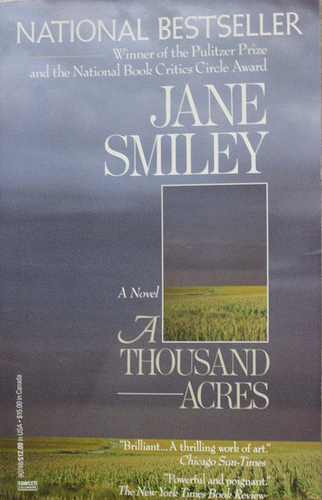
Smiley, Jane. The Age of Grief. New York: Fawcett Columbine, 1987.

A collection of short stories. Instead of summarizing them I have decided to quote my favorite lines instead because there was one from every story.

  • Pleasure of her company~ “I felt like your child or your sister or something”    (p 25).
  • Lily~ “Love was like an activity, you had to put in the hours” (p 33).
  • Jeffrey, Believe Me~ “Who can tell the lifelong effect of a cacophonous conception” (p 60), and “you would indeed be spending the night but in a near coma” (p 64).
  • Long Distance~ “Can a melancholy sound have a quality of desperation?” (p 71)
  • Dynamite~ “When they would ask me, I was fine, too, but I had the excuse of making bombs, something, I told myself, they didn’t want to know (p 96).
  • And finally, the novella, The Age of Grief~ I couldn’t find one or two quotesI liked best -too many to mention so I won’t mention at all; and I can’t tell you what I think of this final story. A dentist and his wife (also a dentist) go through the ups and downs of marriage & parenting. It’s haunting because I can’t imagine this kind of grief.

BookLust Twist: From More Book Lust in the chapter “Big Ten Country: The Literary Midwest (Iowa)” (p 26).

The Body is Water

Schumacher, Julie. The Body is Water. New York: SoHo, 1995.

I love it when reading fits the day. I don’t know how to describe it other than the perfect marriage between a book and time. It was snowing, sleeting, windy and freezing cold. Every so often a gust of wind would send pellets of freezing rain drumming against the windows, yet the Christmas tree glowed softly, the cat purred at my feet, a balsam candle burned bright, a fleece blanket was thrown over my lap, a cup of tea at my elbow and I was content. If I could ignore the wind, all was quiet, all was still; the perfect time to lose myself in The Body is Water.
I’m still reading December picks and The Body is Water celebrates the month New Jersey became a state, oddly enough. It’s also the story of single and pregnant Jane, and her return to her New Jersey shore childhood home. In one sitting I read 184 of the 262 pages.

“All my life I’ve never been certain of where I should be” (p 20).
“In a crisis, other families probably rush to hold the ailing person’s hand; our family rushes to the general vicinity of the crisis and putters around, hoping the patient will spontaneously recover on her own” (p 61).
“No matter where I lived, I never knew my way around; there was no ocean, no rushing noise of a heartbeat from the east” (p 230).
“I start to cry, remembering the days before my mother died, before Bee slept in another room. That was when we loved each other best and didn’t know it” (p 262).

I ended this book sobbing. I connected with Jane even though she was the younger sister (Bee was four years older); even though Jane lost a mother and I lost a father; even though she became a mother and I remain sans motherhood. I connected through the simple loss of a parent, the soothing sound of the ocean, and the complex closeness of sisters.

BookLust Twist: From More Book Lustin the chapter called “Jersey Guys and Gals” (p 129). This also could have been mentioned in chapter called “Maiden Voyages” (p 158) because this was Schmacher’s first novel.

Appointment in Samarra

appointment in samarraO’Hara John. Appointment in Samarra. New York: Vintage, 2003.

In honor of Pennsylvania becoming a state in the month of December Appointment in Samarra was my first novel pick. I was excited to see the introduction was written by John Updike. He is another author I have enjoyed over the years. Set in the 1930’s with a keen eye on society, O’Hara tells the story of Caroline & Julian English and their how their elite status is washed away with alcohol and attitude. In an instance the English couple go from being the toast of the town to the talk of trash.

“I love you more than a tongue can tell” (p 63).
“…their position in Gibbsville was just that certain and insecure…” (p 83).
“…she was too conscious of looking like the wrath of God to enjoy any of it” (p 121).
“The worst of that drive was that the sun glare on the snow made you smile before you were ready” (p 200).

As an aside: I don’t remember where I was when I learned that the Lenape Indians believed the turtle was the center of the universe. To this day, it remains the only thing I know about this particular tribe. It was interesting to see O’Hara mention the tribe in his historical ancestry of the English family.

BookLust Twist: From More Book Lust in the chapter “Big Ten Country: The Literary Midwest (Pennsylvania)” (p 30). 

Bill Bryson’s African Diary

African DiaryBryson, Bill. Bill Bryson’s African Diary. New York, Broadway Books, 2002.

I added this to the December list when I read a review describing it as “short.” It’s much shorter than I thought – only 49 pages of “diary” and a few more pages of statistical information. So short that I was able to read it over a lunch break. I’m glad it was a quick read because I couldn’t put it down. I’m a sucker for charitable tactics, especially unique ones, and this book definitely qualifies. CARE International (a non-profit organization dedicated to fighting global poverty) funded Bill Bryson’s trip to Nairobi, Africa with the request that he write about his eight day adventure. Bryson is known for his travel literature, his humor, and his expressive way of describing life around him. He would certainly be able to describe the poverty, the landscape, and best of all, the people of Africa. Many reviewers called this book a charity puff-piece, a lengthy advertisement for the work of CARE, and were bitter about the $12 price tag. What they missed out on was the stunning photography, the wry humor and the painless way to do good (all royalties and profit from the sale of the book went to CARE International).
Speaking of humor, here are a few of my favorite lines: “…tireless commitment to mediocrity” (p 2), “you had to be really unlucky to be shot and stabbed” (p 4), “Kenyan Railways has something of a tradition of killing its passengers” (p 21) and, “Watamu was tranquil to the point of being comatose” (25). There are other funny moments: “flying toilets,” and flying for real, to name two.

For more information on CARE, International go here.

BookLust Twist: From More Book Lust and the chapter “Bill Bryson: Too Good to Miss” (p 36). This being my first introduction to Bryson I am looking forward to more.

December Is

                                                                                                                                                                                                             Christmas
                                                                

Here are the parameters for the December reading list (and what is at the top of the reading list):
December is…

  • Bill Bryson’s birth month (Bill Bryson’s African Diary)
  • Connie Willis’ birth month (Bellweather)
  • Rex Stout’s birth month (Fer-de-Lance)
  • Mark Kurlansky’s birth month (Basque History of the World)
  • when Iowa became a state (Age of Grief)
  • when Pennsylvania became a state (Appointment in Samarra)
  • when New Jersey became a state (Body is Water)
  • when Mississippi became a state (24 Hours)
  • when Alabama became a state (Boy’s Life)
  • the month the Cold war ended (Last Supper)
  • the month of Christmas (Father Christmas Letters)
    By the way, I’ll read only Christmas stories during the week of Christmas 12/24 – 12/30…and a Christmas story in between the other reads.

Anniversary Woops

BooksThis anniversary made my realized I missed another anniversary. Not the one when I walked down the aisle, knees banging together out of trepidation. No, I’m talking about a different one – a more MeMyselfMoi one. I’m talking about the one that has made me open books. Open and read lots and lots of books. On November 10th, 2006 I made a vow to read everything indexed in Book Lust and More Book Lust. As of that date I had read 95 books. 95 books read, reviewed and relished. That equals eight books a month or two books a week (on average). It’s hard to believe I am approaching my 100th book (Appointment in Samarra by John O’Hara). I have to say it feels good to get back to being a book worm.

Crossley Baby (with spoiler)

Crossley BabyCarey, Jacqueline. The Crossley Baby. New York: Ballantine, 2003.

November is National Adoption Month. Out of everything I am currently reading, I thought this would be my favorite. I’m sorry to say I was a little disappointed. The Crossley Baby is the story of two sisters (Sunny & Jean) battling for their dead sister (Bridget)’s baby. Well, that’s what it’s supposed to be about. Instead, it’s more of a commentary on wealth (Jean has it, Sunny does not), parenting (Sunny is a mother of two, Jean is not) and manipulation (they both do it, for one reason or another). More time is spent setting up where Jean, Sunny and Bridget came from than the actual adoption process. More time is spent on describing the vast financial differences between Sunny and Jean than on their personalities. By the end of the book I didn’t know Jean or Sunny any better so I didn’t care who got the baby. I was completely indifferent to their struggle for baby Jade. Probably what bothered me most was the lack of real grief shown by either sister over the death of their elder sister. Crossley adds flickers of sadness, glimpses of sorrow, but for the most part Bridget’s death goes mostly unmourned. Possibly that is because they never got along. If there is one thing the three sisters did really well it was avoiding closeness.
In the end, Sunny wins custody. Everything points in the direction of Jean winning – money, power, people in her corner – while Sunny’s husband is filing for bankruptcy, old favors aren’t worth cashing in, and they have to sell their home. In a last minute surprise ending Jean withdraws her application for adoption and doesn’t contest the award going to Sunny. No one from Bridget’s life is there to put in a word edgewise.
Ironically enough, it was Bridget who was my favorite character because of this one line, “Bridget tasted her words before she spoke…” (p 112).

BookLust Twist: From More Book Lust and the very first chapter called “Adapting to Adoption” (p 1).

Bean Trees

Bean TreesKingsolver, Barbara. The Bean Trees.New York: HarperPerennial, 1989. 

Barbara Kingsolver is my favorite author. I’ve said it before and I’ll say it again. I love the way she writes. The Bean Trees is on my Book Lust list and I’ve already read it hundreds of time. It’s the book I grab when I am in between other reads. It’s the book I reach for when I have a few minutes to kill while the rice bubbles on the stove. Given the chance to read it again just for Book Lust I am more than happy to jump at the chance.

Taylor Greer isn’t Taylor until she takes to the highway. Leaving her hometown of Kentucky to see something other than small town rumors and ruts she finds herself on the road, “adopting” a three year old American Indian girl on the way then finally landing in Tucson, Arizona.  Taylor is smart, witty and, for lack of a better word, feisty. She tells us her story with great observance to the spirit of humanity.

One of the things I love about Kingsolver’s work is the reoccurring themes: respect for nature described in gorgeous, vibrant detail, immigration and the political implications, the joys and struggles of motherhood (especially the single mother), the value of both belonging to a community and having independence. The Bean Trees is no different. All of these themes are carefully woven into the framework of the novel.

My favorite lines (okay some of them): “Whatever you want the most, it’s going to be the worst thing for you” (p 62).
“There were two things about Mama. One is she always expected the best out of me. And the other is that then no matter what I did, whatever I came home with, she acted like it was the moon I had just hung up in the sky and plugged in all the stars. Like I was that good” (p 10).

BookLust Twist: From More Book Lust’s first chapter called”Adapting to Adoption” (p 1). I have to admit I don’t agree with Pearl’s description of how Taylor “acquires” the American Indian child. Pearl says “When Taylor Greer leaves Kentucky for points west in order to escape the confines of small-town life, she finds an abandoned and abused Cherokee child left in her car…” (p 2). It actually went more like this: “Then she set this bundle down on the seat of my car. “Take this baby,” she said….”where do you want me to take it?” She looked back at the bar, and then looked at me. “Just take it.” I waited a minute, thinking that soon my mind would clear and I would understand what she was saying. It didn’t.” (The Bean Trees p 17). This is a poignant scene to me and it makes a big difference (to me) whether the child was left or handed over.

ps~ November is National Adoption month. I reread this just a tad early.

Update on the Lust

I’m approaching 100 books in the Book Lust challenge. I’m proud of this because 1) I have been reading Random House books at the same time (I’ve read four so far with another one the way). 2) I started a new job so I’m not only reading “How to be a director” bullsh!t but I’m reading up on how to get my library ready for NEASC. In other words, I don’t read what I want to all the time.

I’ve amended my “rules” too. I had to with all the book reviews I’ve been asked to do. It just seemed like the right thing to do.
And I’ve come up with a strategy for how to decide when to read certain books. It will take me some time to compile the data but since I have four days of alone time coming up and I’m not going anywhere for Thanksgiving (have to work) I’ll make the time.

What I’m reading now:
Bean Trees by Barbara Kingsolver

Yellow Raft in Blue Water

Yellow raft in blue waterDorris, Michael. A Yellow Raft in Blue Water. New York: Warner Books, 1987.

This is high school to me. I remember being holed up somewhere reading this nonstop. Hot off the press, freshly published and oh so new I couldn’t put it down. I reread it and reread it until finally I could move on to other Michael Dorris creations, which somehow were never quite as good. Nothing compared to A Yellow Raft in Blue Water back then and it is still a faovrite to this day.

Someone described this book as an onion, reading it was like peeling back the layers of a story, and while that imagery is accurate enough, I like to think of Yellow Raft as a game of telephone. First, there is Rayona. She tells the story from her perspective. She is all of fifteen years old…at that difficult age where rebellion against your mother is the easiest thing to do. As she says, “when mom and I have conversations, they mostly involve subjects not personal to our lives” (p 26). She tells her story like it’s the honest truth. Then, there is Christine, her alcoholic mother, and her story. In the beginning you want to hate her for how seemingly unfair she had been to Rayona. But, learning about Christine’s heartbreak you realize Rayona’s reality is only her perception. The wires of communication have been crossed and in some cases, completely disconnected. Christine had her reasons for everything she did (and didn’t do). “I never had been good company for myself” says Christine (p 185). Finally, there is Ida, Christine’s mother. Her story is, by far, the most revealing and tragic. Everything you heard whispered from Rayona through Christina is trapped in the warped truth of Ida. All three women are stubborn, flawed by fate, and determined to make the best of life as they know it even if it means coming off as cruel to others. Being on the inside, privy to their hearts, makes you want to shake each one screaming, “talk to your daughter!”

Favorite lines:
“Ghosts were more lonesome than anything else. They watched the living through a thick plate of glass, a one-way mirror” (p176).
“A bath brought me peace, made me float free” (p340).

BookLust Twist: In both Book Lust and More Book Lust. In Book Lust Pearl mentions A Yellow Raft in Blue Water early; on page 23 in the chapter “American Indian Literature.” In the chapter “Men Chanelling Women” (p 166) in More Book Lust Pearl adds A Yellow Raft in Blue Water because Michael Dorris does an amazing job setting the voices of three very different women free.

A Map of the World

map of the worldHamilton, Jane. A Map of the World. New York: Anchor Books, 1995.

National bestseller. Oprah book. A movie. All that should tell you something. Normally, I don’t try to read reviews before I myself have read the very last page. This one was a little different. Praise for A Map of the World was on the inside cover and I couldn’t resist. One line really said it all for me, “the story of how a single mistake can forever change the lives of everyone involved.” If you read my blogs you know I am fascinated by the what could have been, fate and serendipity. The path less taken, the path not known to take at all. This is the story of a mistake, an err in judgment, and the time and effort it takes to get back to good.

Told in first person from both Alice & Howard, husband and wife. Alice begins and ends the tale with Howard interjecting in the middle. Details that overlap her story and his tie the couple and their voices together. It’s their marriage talking. Yet, their views on life are very different. There is a moment when Howard is driving by the library and he thinks of the librarian, a man with a hook for one hand. Howard remembers that his wife thinks of the librarian as Captain Hook, not only because of the hook, but because the librarian was supposedly “cranky and unhelpful” to her. Howard recalls learning from the librarian and how he “never even noticed his hand.” Walking down the road of life Alice and Howard see the scenery differently, despite being hand in hand.

Favorite lines:
“I used to think if you fell from grace it was more likely than not the result of one stupendous error, or else an unfortunate accident” (p 3).
“She was all nerve, so energized by rage she had a hard time sorting out what she most hated” (p 291).
“It is one thing to be in a car with someone who is quiet, and another to be with someone who is silent” (p 364).

BookLust Twist: From More Book Lust and the chapter “Big Ten Country: The Literary Midwest (Wisconsin)” (p 25). I started reading A Map of the Worldbefore I double-checked what Pearl had to say about it. I had just finished the part about a major tragedy. I have to say it was a shock to read there was another one in store for me. I almost wished I hadn’t known that.

Reading Lolita in Tehran

Reading lolitaNafisi, Azar. Reading Lolita in Tehran: A Memoir in Books. New York: Random House, 2004.

The first thing I think as I am 13 chapters into Reading Lolita in Tehran is maybe, just maybe I should have read Lolita first. Yet, it is not just about Lolita. It’s also about Gatsby, Daisy Miller and Pride & Prejudice. Those, I have read. But, these four books are not the only ones Nafisi recommends. There is a whole list of them. I am tempted to start another challenge and add them to my “must read” list.

But, back to Reading Lolita in Tehran. Where do I start? Blanketing the entire story (nonfiction) is the outrage I felt. Professor Azar Nafisi must secretly meet with seven students to study Western classics, books that are forbidden in the Islamic Republic of Iran. I don’t know how they dared. Morality squads roamed the streets, raiding homes and shops whenever they wanted, fundamentalists took over the university where Nafisi formally taught, women are arrested for not wearing the veil, being seen in public with men other than their husbands, brothers or fathers, for wearing makeup…It just reminds me I am a spoiled Westerner who can paint my eyes black as night, show the curve of my neck, and most importantly, read any book I want.
Think of a braid. One strand is politics, another literature, the last society. This is Reading Lolita in Tehran. Woven over and under and throughout is Azar Nafisi’s life. Her personal views on relationships, society and of course, the books she loves. Because it’s her point of view and hers alone we have to trust that she is telling us the truth. Her truth. Here are my favorite quotes – some with my commentary after.

Reality has become so intolerable, she said, so bleak, that all can paint now are the colors of my dreams” (p 11).
“I think I somehow felt that as long as I was conscious, nothing bad could happen, that bad things would come in the middle of my dreams” (p 45).
“Some people take up alcohol during periods of stress. I took up Jeff” (106).
“In the midst of gunshots and chants we hugged and chatted about the almost two decades since we had last seen each other” (p 148).
“The administration wanted us to stop working and at the same time pretend that nothing has changed” (p 151). ** I’m reminded of a relationship I once had when the entrapment was the same. **
If I turned towards books, it was because they were the only sanctuary I knew, one I needed in order to survive, to protect some aspect of myself that was now in constant retreat” (p 170).
I became more anxious. Until then I had worried for the safety of my parents, husband, brother and friends, but my anxiety for my children overshadowed all” (170). ** I thought of my sister when I read this line. I think she would agree. **

Random comments~ I want someone to explain these things to me. How someone can be pompous and meek at the same time; how someone can speak precisely and leisurely; and how someone can murmur a defiant no. Just odd descriptors in my opinion.

BookLust Twist: From More Book Lust and the chapter called “Me, Me, Me: Autobiographies and Memoirs” (p 162). I would say Nafisi’s story is a chapter of a memoir; a partial snapshot of a life.

Middlesex

MiddlesexEugenides, Jeffrey. Middlesex. New York: Picador, 2002.

First the cover. Before I even read a word it frightens me. Inky black (my cancer) smoke swirls from a cigarrette-bearing person lounging with a friend. That same smoke meets up with the smoke stack of an ocean-going vessel and encircles the skyline of a city. I instantly recoil from the seductive swirls and think, “I’m gonna hate this book.”

But I don’t. It’s long (529 pages), but I’ve enjoyed every page. I can see why it won a Pulitzer Prize. It’s the story of Calliope Stephanides and the two generations that brought her into this world. It’s Greece and Germany and Grosse Point. It’s the science of genetics meeting the mother of all family secrets. Calliope is also Cal, one and the same. Girl meets Boy. Girl is Boy. Boy is Girl. Sound confusing? It isn’t. It’s poetic and sad, funny and smart. Something you just have to read for yourself. Cal will tell you the story. His story. Her story. My favorite lines:

“…German wasn’t good for conversation because you had to wait to the end of the sentence for the verb, and so couldn’t interrupt” (p 7).
“Filling her head with music, she escaped her body” (p 115).
“The only thing that roused her was her daily lineup of soap operas. She watched the cheating husbands and scheming wives as faithfully as ever, but she didn’t reprimand them anymore, as if she’d given up correcting the errors of the world” (p 271).
“…her application to join her husband in heaven was still working its was through a vast, celestial bureaucracy” (p 286).

BookLust Twist: From More Book Lust. Pearl mentions this book several times. First, on page 97 in the chapter “Gender Bending” then on page 141 in the chapter “Lines That Linger, Sentences That Stick.” She is referring to Middlesex‘s opening line. It’s a doozy. Finally, on page 166 in “Men Channeling Women” Middlesex is listed one last time. As you can see Jeffrey Eugenides hit a homerun with this one.

ps~ The cover makes perfect sense to me now.

The Odd Sea (with spoiler)

odd seaReiken, Frederick. The Odd Sea. New York: Delta, 1998.

From the very first page I thought the location of this book sounded really familiar. Westfield River, the Hilltowns, Dalton, Cummington…like seeing a familiar face while on vacation far, far from home. You can’t place it, yet you know it. Why? Work? School? The neighborhood? Until finally, one last detail seals the deal and suddenly you remember – the cashier from your favorite grocery store. It was “Mohawk Trail” that finally brought Western Massachusetts into sharp focus for me. Without a doubt, I was reading about my stomping grounds (and lately, stomp I do).

So, back to The Odd Sea. This is Frederick Reiken’s first novel and I have to say, I have a soft spot for firsts. This is the haunting story of the Shumway family and their lives after the dissapearance of 16 year old Ethan Shumway. It’s told from the point of view of younger brother Philip. My copy of The Odd Sea has notes in the margins that I found distracting. They made suggestions and speculations I wouldn’t have considered otherwise as well as ones overly obvious. One of the repeating, clear-as-day themes of the notes was Philip’s inability to accept his brother’s vanishing as never-coming-back final. I considered that obvious because otherwise, there wouldn’t be a story to tell. Philip can’t move on like the rest of his family. He needs to dig for answers, search for clues, and come up empty, bewildered, and denying every single time. I wasn’t surprised when, by the end of the book, Ethan is never found.
After reading Ordinary People I was ready to start my own BookLust chapter on “Mothers Who Lose It.” Probably one of my favorite descriptions in the book is of Philip’s mother’s insomnia. Having been afflicted with sleeplessness I could picture her nocturnal habits perfectly. “Some nights she did not bake or read. Instead she’d stand out with the stars. She said on clear nights the sky could draw the sadness from her heart” (p 10). I also enjoyed the scene when Victoria teaches Philip’s sister, Dana, to eat rose petals. Having eaten a few island roses in my day, I could taste the silkiness on my own tongue.

BookLust Twist: From More Book Lust and the chapter called “Small Town Life” (p 203).