Devil in a Blue Dress

Mosley, Walter. Devil in a Blue Dress. New York: Pocket Books, 1990.

I have to admit I picked this book up by accident. I was vacationing and needed a quick book. Something to pick up while I waited for the pasta water came to a boil, or while the boys were still sleeping. I remembered this being part of the Challenge and decided to see if I could read it in less than 36 hours.

Devil in a Blue Dress is Walter Mosley’s first book and kicks off the Easy Rawlins series. Ezekiel “Easy” Rawlins is a black war WWII vet prone to violent flashbacks. In the beginning Devil in a Blue Dress he is fired from his defense plant job and doesn’t know how he’s going to pay the mortgage next month. By the second chapter Easy has been hired to locate a missing girlfriend, a devil in a blue dress, as they say. Throughout the next 200 pages Easy faces his share of violence, sex, racism and mystery but in the end, discovers a new found career – private investigations.

My favorite line: “He put up his hand as if he wanted me to bend down so he could whisper something but I didn’t think that anything he had to offer could improve my life” (p25). It’s that kind of sense of humor and sarcasm that carries Devil in a Blue Dress. You don’t realize that Mosley is telling you more than a story. He’s giving you a social commentary on what it meant to be a black man, riding the line of poverty in the 1940’s.

BookLust Twist: From More Book Lust in the chapter “Walter Mosley: Too Good To Miss” (p 169).

Postcards

Proulx, Annie E., Postcards. New York: Fourth Estate, 2004.

This was a hard book to read. Really dark and disconnected. I prefer books that have more flow to them. I haven’t read a lot of Proulx. I have to admit I don’t really even remember the title of the one I did read. How pathetic is that? I’m looking forward to the short stories because I think they will have less opportunity to be so disconnected and choppy.

I think what struck me about Postcards was how powerful the language was. While the plot was hard and gritty, the way it was told was strong and confident. Almost like someone yelling emphatically, if that makes sense. It’s the story of a farming family in New England. They are torn apart by the departure of the eldest son, Loyal. He has just killed his girlfriend and left her body under a pile of rocks in a nearby field. While the death was an accident, Loyal’s leaving and the slow disintegration of the farm was not. Tragedy follows the family wherever they go. The beauty of the saga is how each chapter is punctuated with a postcard. It’s these postcards that illustrate the changing times both for the nation and the family. Loyal often writes home, careful not to tell anyone where he really is. He continues to stay disconnected and this is apparent in what he shares with his family.

BookLust Twist: From More Book Lust in the chapter “It was a Dark and Stormy Novel” (p 128).

Dog Handling

Naylor, Clare. Dog Handling. New York: Ballentine Books, 2004.

When it comes to chick lit I think there has to be a trick to reading it. At least for me there are two tricks. Suspension of belief, first and foremost…and the ability to laugh out loud at some of the nonsense.

Dog Handling is the story (cute story!) of Liv Elliot, a soon-to-be married accountant in London’s Notting Hill district. When Liv’s fiance breaks off the engagement she flees to Australia to mend her not so broken heart. Australia brings new friendships, a new career opportunity, new men (of course), and a whole new way of dating them. Liv’s outlook on life changes once she learns the rules of “dog handling.”

Traditionally, I am not a big fan of mind games, overextended cliches and predictable sappy-happy endings and Dog Handling had all of the above. It took me sometime to stop making Bridget Jones comparisons and seeing Liv Elliot in her own bumbling, lovable, all’s well that ends well movie. Once I was able to get past all that I truly enjoyed the story. The characters were delightful and the plot, humorous. It was a great summer read.

Favorite lines: “After all, a foreign city is a foreign city, and until she knew the precise location of the nearest places to buy newspapers, tampons, and beer she wasn’t taking any chances” (p 40).
“Liv had been cutting split ends off her hair with a potato peeler” (p 232). What a great idea!

BookLust Twist: From Book Lust in the chapter “Chick Lit” (p 54). Where else?

August Was…

Where did August go? Sweet August raced by me like lightning in a stormy sky. For reading I was all messed up. I read two books out of turn and one completely by mistake! So much for planning! Anyway, August was:

  • All is Vanity by Christina Schwarz (Others will tell you Schwarz has put out better, but I say this one was good, too!)
  • Boy with Loaded Gun by Lewis Nordan (really, really interesting book)
  • A Heartbreaking Work of Staggering Genius by Dave Eggers (another nonfiction…okay, I admit it. I read this out of turn!)
  • Postcards by E. Annie Proulx (really dark!)
  • Devil in a Blue Dress by Walter Mosley (I need to explain this one!)

What I admitted defeat on was Far Field because it just wasn’t light reading for the last month of sumer. I’ll pick it back up again eventually.

For the Early Review Program on LibraryThing:

  • Blackbird, Farewell by Robert Greer ( a really fun whodunit about a basketball star murder before his big NBA contract even began).

For the fun of it:

  • Top Chef: The Cookbook by Brett Martin
  • Islandsby Anne Rivers Siddon

August was also Sean Rowe, the Police, and Swell Season. It was getting a chance to hang out with really good friends, even for a second. It was Monhegan and a restoration of resolve.

Admitting Defeat

Forgive me, but I can’t get into The Far Field: a novel of Ceylon by Edie Meidav. I feel like a failure because she has been compared to my all time favorite author, Barbara Kingsolver. That should afford me some loyalty. And yet, yet I can’t wrap my brain around this 600 page novel. Not at this time. It’s not that I find it boring. It’s not that I find it difficult. It’s neither of those things and nothing like that. I think in my twisted sense of summer it’s not entertaining enough for the dying days of August. It’s not a fun in the sun, beachy kind of read. Not right now. Never mind the fact I haven’t been to any beach since June. Never mind that I haven’t seen the sun for days and days.
So, I am admitting defeat and putting down Far Field for now. Sorry.

In the meantime, I got two Early Review books (one already finished & reviewed – in the bag, as they say). I’m saving Emily Post’s biography for September to even out the reading just a little. I want to get through Egger’s The Heartbreaking Work of a Staggering Genius if nothing else.

ps~ I have decided to take all my “attempted” books back and give them all second chances. It slows the BL challenge down a little, but everyone deserves a second chance. Right? Of course I’m setting myself up to feel like sh!t if I can’t finish something for a second time!

Blackbird, Farewell

Greer, Robert. Blackbird, Farewell. Berkley: Frog Books, 2008.

I took a chance requesting Blackbird, Farewell for the Early Review program. For one thing, I don’t know that much about basketball (the little I do know I learned this season from watching the Celtics win the championship this year). For another, I have never read a CJ Floyd novel. I didn’t want to make comparisons or see how it stacked up against to other CJ Floyd books. None of that really mattered when I got down to the serious reading.

Blackbird, Farewell starts out a little rough. It begins with Shandell “Blackbird” Bird going to make a deposit at a bank. Within 27 pages he is dead. Leading up to his murder Bird is described as “having a problem”, jittery, frustrated, sad, mechanical, dismissive and blank. It seems excessive considering the reader already knows he is to die. The cliches did little to pique my interest as to what was really wrong with Bird or care when he was killed.

When Bird’s best friend and college teammate, Damion “Blood” Madrid decides he needs to solve the murder the plot of Blackbird, Farewell  picks up. Madrid is the godson of famed CJ Floyd, a Denver, Colorado bail bondsman. While rough around the edges Madrid does a good job tracking down key players in the mystery. Of course he has his beautiful girlfriend, Niki, for a sidekick as well as the mafia, a hitman, and a Persian Gulf war vet (flora Jean Benson, CJ’s partner). Blackbird has enough drama (violence & sex) to make it interesting but not overly stereotypical of murder mysteries. The streets of Denver, as well as surrounding towns of Fort Collins and Boulder serve as an accurate and appealing backdrop for Greer’s mystery to play itself out.

Final thought: If Greer is trying to sell Blackbird, Farewell on the popularity of other CJ Floyd mysteries he shouldn’t. CJ Floyd doesn’t even enter the picture until the final 20 pages of the book. It is misleading to lure readers in by saying CJ Floyd is there to watch Madrid’s back (back cover) when he isn’t even in the book until the very end. Floyd fans are sure to be disappointed. Blackbird, Farewell stands alone a fun read apart from the CJ Floyd series.

Edited to add: If I were Greer’s editor I would have asked him to change Flora Jean’s “gasket popping” comment to something else, especially since not even five pages later a completely differently character is using a very similar gasket phrase.

All is Vanity

Schwarz, Christina. All is Vanity. New York: Doubleday, 2002.

This book cracked me up. It’s the story of a friendship between two women and how friendships can be taken advantage of. Margaret is a New York City woman (displaced from California) who gave up her teaching career to write a novel. She has subtle hubris (described as “cynical roilings” p138. ) that she tries to disguise to Letty and anyone else who listens to her (mainly her husband, Ted). Letty is Margaret’s childhood friend who became (Poor Letty!) a stay-at-home mom with four kids and a great kitchen in Los Angeles, California. They keep in touch via email and almost immediately I noticed that between the two friends, despite Margaret being the one trying to write a book, Letty is the better writer. I love Letty’s writing, but I think that’s the point. It’s only a matter of time before Margaret starts using Letty as the subject of her first book. When Letty’s life starts to spiral out of control Margaret does nothing to help thinking it helps her own fictional plot.

Funny line: “Also, as a preteen, I half believed I could do anything, as long as I set my mind to it, but was never actually willing to set my mind to anything that threatened to take up a good portion of the rest of my life” (p 12).

BookLust Twist: From Book Lust in the chapter “Women’s Friendships” (p 247). Pearl calls this book “delightful” and I would have to agree! It’s a really fun read!

Boy With Loaded Gun

Nordan, Lewis. Boy With Loaded Gun. Chapel Hill: Algonquin, 2000.

Lewis Nordan celebrates a birthday in August. I am pleased to have started off with his nonfiction/fiction memoir, Boy with Loaded Gunas my introduction to Nordan’s writing. I think it will bring insight to everything else I read of his. While this may or may not be a good thing, I am looking forward to it just the same.
Boy with Loaded Gunis heartbreaking and humorous at the same time. Pulling the reader down into sadness, lifting him or her back up with laughter. I found myself comparing the reading experience to that of a fast moving, slightly rickety, out of control rollercoaster. At times I didn’t know whether to laugh or cry. I didn’t know what was real or an exaggeration. But, I did know one thing, I loved every minute of it; page by page.
Nordan’s memoir begins with the chapter called “Voodoo” and Nordan’s inexplicable love for a voodoo practicing woman. It is at this time Nordan professes, “In these lonely backwaters and days of grief my memory begins” (p 7). We are then taken on a journey through Nordan’s young life while he struggles to love his step-father and escape the confines of small town Itta Bena, Mississippi. Later, it’s coming-of-age encounters with sex and marriage. Babies and buying houses. Alcohol and writing. Down and outs, ups and accomplishements. At times you want to love him. Other times you have to hate him. Just like real life. In other words, human.

Best quotes: “Two men got into an argument about whether a tree was willow or a weed. It was a small knife, and not a deep wound, so neither of the men went home, they just didn’t talk to each other for a while. Then they seemed to forget all about it, and before long they were talking about something else” (p 49).
“Eventually I tried to kill my father, of course” (p 69). Nordan does address the “of course” part of the statement, but it struck me as funny the first time I read it.
“I could scarcely tolerate standing in my own skin, let alone being strong” (p 188).

BookLust Twist: From Book Lust in the chapter “Lewis Nordan: Too Good To Miss” (p 172).

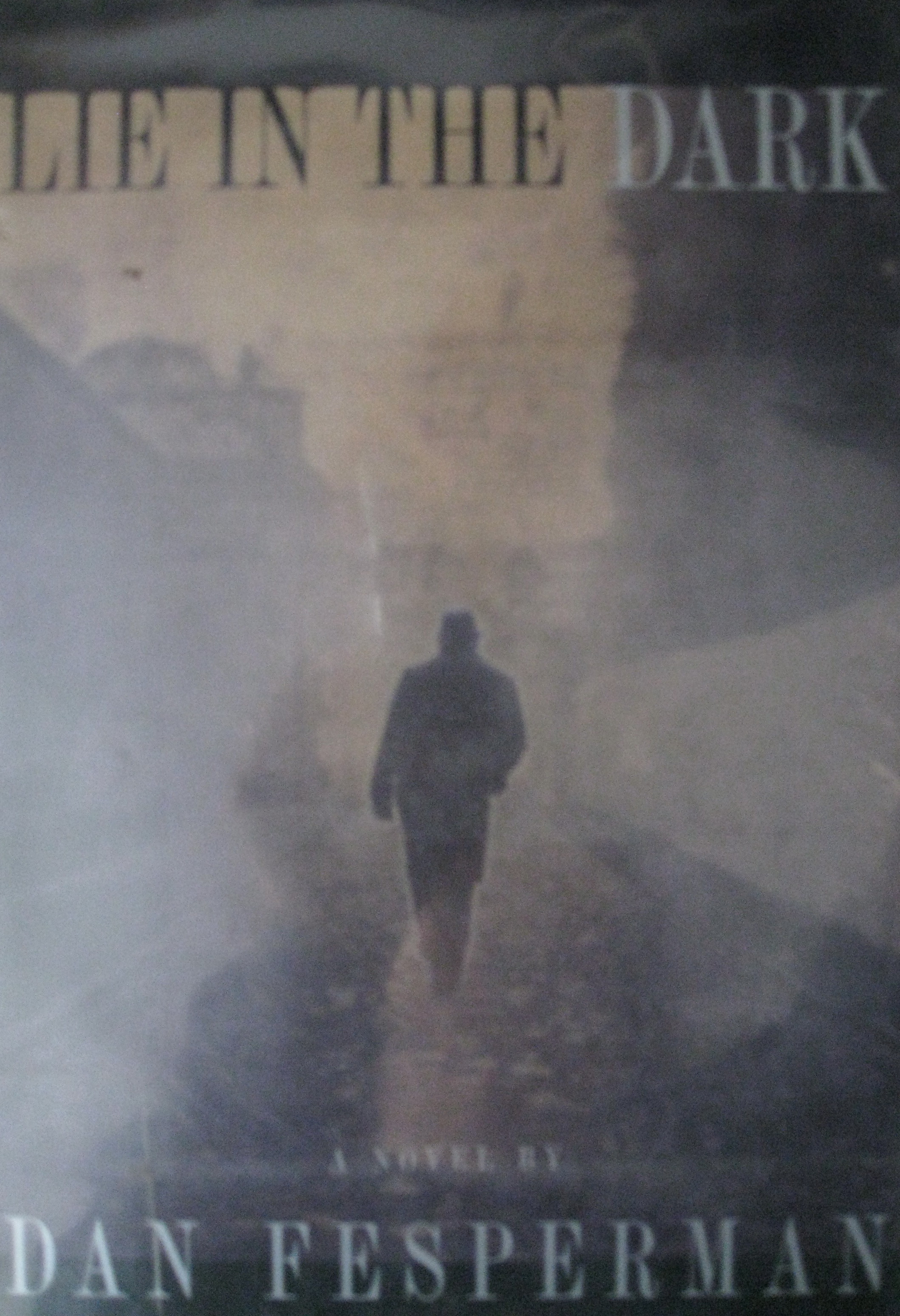
Lie in the Dark


Fesperman, Dan. Lie in the Dark. New York: Soho Press, 1999.

 I can remember this intense sadness when the civil war in Sarajevo broke out…the second time. It seemed like yesterday the Olympics were held there & it was a city of promise, of dreams come true.

Lie in the Dark is an interesting tale about life in war-torn Sarajevo and one police inspector’s fight to win his own private war. In the beginning of the conflict Vlado Petrics’s wife and infant daughter were allowed to escape to Germany. Vlado, as with all men of military serving age, stayed behind. He escaped being drafted into the military because of his employment as a policeman.
While investigating a murder Vlado is confronted with a much bigger scandal than he bargained for. Not knowing who to trust he works alone, unraveling the mystery while the civil war continues all around him. Woven into the plot are the harsh realities of what war can do to economics, politics, families, the landscape and the human spirit.

Right away I knew I would like this book. Fesperman does a great job describing the absurdity of investigating a murder in the middle of a war. As Fesperman says (p 2) “Vlado’s task was that of a plumber fixing leaky toilets in the middle of a flood.” It makes you realize that people will grasp and struggle for normalcy even if it doesn’t make sense.

Favorite lines: ” They never stopped retreating, ending up at the bottom of either a bottle or a grave” (p 5).
I found this next line profoundly sad: “It had taken the first few weeks of separation to rediscover her as lover, as something more than the wife and mother she’d become” (p 83).
“He felt himself beginning to deaden, to go numb and cold and dreary as he left the truth behind” (p 86).

BookLust Twist: From More Book Lust in the chapter “Crime is a Globetrotter” (p 59).

August Is…

booklit2

August is a day late. Sorry about that!

It is awful to wish the summer away. To look forward to Labor Day…but I can’t help it. The time has (finally) come for me to go home. And I haven’t been there since last October!  August is all about going back to the island. I’m bringing a truckload of books:

  • All is Vanity by Christina Schwartz (in honor of Womens Friendship Month)
  • Boy with Loaded Gun by Lewis Nordan (in honor of Lewis Nordan’s birthday)
  • Far Field by Edie Meidav (August is the best time to visit Sri Lanka, believe it or not)
  • Dog Handling by Clare Naylor (August has a “woman’s day” so I’m reading what Pearl calls “chick lit”)
  • Professor and the Madman by Simon Winchester (National Language Month)

It seems traitorish to think that the island’s library won’t have any of these books, but I can’t take the chance by assuming they do…and here’s the funny part- I don’t leave until the latter half of the month. I’m acting as if I won’t read a word before then! I’m actually hoping to have All is Vanity and Boy with Loaded Gun finished and off my list before leaving.

I scored another LibraryThing Early Review:

Blackbird, Farewell by Robert Greer. I am excited about this new book for odd reasons. For starters, I love the title! There is something about blackbirds. I love how they are associated with something dark and ominous. Dangerous. If you ever get the chance, check out Jamie Wyeth’s art. He has some great blackbird paintings. I also love the song ‘Blackbird’ (Jerry Garcia’s version is my favorite). Nearly everyone who has ever made me a mixed tape has put that song on one for me. I don’t know why…Maybe they have insight about my broken wings and the need to fly? Anyway, this book doesn’t have anything to do with blackbirds….funny.

August is also a Police concert (awesome, awesome, awesome by the way – blog coming soon), more trips to see Sean Rowe, Swell Season in my back yard, maybe Rebecca Correia. Should be an interesting month! Speaking of flying, I hope it does!

Jackson’s Dilemma

Murdoch, Iris. Jackson’s Dilemma. New York: Viking, 1995.

I hate it when I read a review that influences my way of thinking, my way of reading a book. This happened innocently enough. I was looking for more information about Jackson’s Dilemma. Was it ever made into a movie? Adapted for the stage? A musical? As a result of my searching I discovered Jackson’s Dilemma was Murdock’s last book. Not only that, but she was diagnosed with Alzheimer’s right around the time of publication. Inadvertently, I read two reviews that seemed to blame the disease for the demise of Murdoch’s craft. In other words, Jackson’s Dilemma bombed. Because of the reviews I found myself wondering about the words. I will admit, the beginning was slow and the characters, curious, but in the end I didn’t think it was all that bad.

It starts off on the eve of Edward and Marian’s wedding. Edward is enjoying dinner with friends when he discovers a note under the door: an “I can’t marry you” letter from Marian. There is no explanation but the following day there is much hoopla about making sure people are “barred” from the church and from attending a wedding that won’t happen. All of Edward’s friends are absurdly devastated by this turn of events, so much so that I started to really question their sanity. Meanwhile, both Edward and Marian disappear (separately, of course). Enter Jackson (Just Jackson, no last name). Even his arrival is peculiar.

In the end the plot becomes a garbled mess. Everyone is trying to be in love with someone else, exclaiming undying devotion left and right. Even Owen (male) and Tuan (also male) have some kind of odd, unexplained relationship going on. Despite all this, I did have two favorite lines: “The moon was not present, being elsewhere” (p 22). Who actually knows where the moon was, but I thought that was funny. The other line: “After all, as Randall said, it’s the sea that matters” (p 100). Too bad Randall would lose his life to the very thing that mattered.

BookLust Twist: Book Lust in the chapter “Iris Murdoch: Too Good To Miss”. Leave it to me to read her last book (sorta) first.

What We All Long For

Brand, Dionne. What We All Long For: a Novel. Toronto: First St. Martin (Griffin edition), 2008.

From the very beginning I thought this book looked interesting. Originally published in 2005 I had heard that it had even been used in university Lit classes. Upon knowing that tidbit I assumed a level of complication with the characters and a deeper depth of plot. Here is what I came away with: complicated characters that all want something (parallel to the title). Their relationships to one another go around and around – always circling one another – but really, going nowhere. This is where the plot came up short. That sense of longing hums along the fine lines of each relationship, and there is a common theme of boundaries but beyond those connections each character is lost. Tuyen is a lesbian in love with her straight best friend. Longing for someone she can’t have, sexual preference is Tuyen’s barrier. Carla is the biracial bike messenger Tuyen is in love with. Carla has a troubled brother. Longing to steer her brother straight, lack of money is Carla’s barrier to helping him. Oku is a music-loving college drop-out of Jamaican decent. His unrequited love for Jackie is his longing while her boyfriend is the barrier. Jackie longs for simplicity. Her barrier is being attracted to more than one man.

Oddly enough, the linear, uncomplicated character of the story (told in first person) is the one with the most depth and more intriguing story. Quy is the brother of Tuyen. He was separated from his parents in Vietnam as a very young child and has been lost to them ever since. His story is how her survived refugee camps in Thailand and how eventually, he made his way back to Tuyen and her family. Tuyen has never met this long-lost brother so when he reunites with his parents life changes for Tuyen.

The last character in What We All Long For is probably Brand’s most complex and mysterious: the city of Toronto itself. As the characters move in and out of its restaurants, nightclubs, streetcars, and alleys the city responds. It lives and breathes and entices just like its human counterparts.

Friend of My Youth

Munro, Alice. Friend of My Youth. New York: Alfred A. Knopf, 1990.

In the very first chapter of Book Lust Nancy Pearl talks about the Alices. Alice Adams, Alice Hoffman, Alice Munro, Alice McDermott…to name a few. I recognized all, and read most of the names except one: Alice Munro. The stranger Alice of the group. Now, two years after starting the project I am finally reading an Alice Munro book.

Friend of My Youth is a collection of short stories all based on the lives of women.
“Friend of My Youth” is the opening story. Imagine hearing a story from your mother, something that happened long before you were born, but has stayed in your mother’s mind all this time and important enough to be told to you when you were old enough. But, and this is the catch, you don’t know how it ends, even after your mother’s death. You simply don’t know the end. And so begins Friend of My Youth. The connection through all of the stories are women. They have lead roles emotionally as well as physically.

The best lines: “Her hair was freshly done to blind the eye with brassy reflections, and her face looked as if it would come off on a man’s jacket, should she lay it against his shoulder in the dancing” (Friend of My Youth, p 18).
“‘Watch out for him,’ Barbara told the other clerks. ‘He’s a jerk, but he knows how to stick things to his fingers'” (Oranges and Apples, p 107).
There were other charming details like the winter and summer kitchens in “Friend of My Youth” & the watching for satellites in “Oranges and Apples.”

BookLust Twist: From Book Lust in the chapter “A…My Name is Alice” (p 1).

Chasing Vermeer

Balliett, Blue. Chasing Vermeer. New York: Scholastic Press, 2004.

I love it when a book takes me somewhere new. It’s even better when it opens doors to other interests that stick. It’s best when it’s completely unexpected. Such is the case with Chasing Vermeer. When I first realized it was a young adult book I thought I would get through it in a day, get through it and move onto something more my speed. Who knew this book would be just my speed? For starters there is a play-along game involving pentominoes. If you can’t get the hidden message there is an interacted website (still active) to help you out, complete with other games to get you sidetracked. Then, there is the discovery of something completely unexpected I mentioned before. Chasing Vermeer mentions a lot of Vermeer’s work in detail so I started doing a little more research and found a fantastic website dedicated to Vermeer. It’s really great. I lost my lunch break playing with it! I love learning something new everyday in the most unexpected ways. But back to Chasing Vermeer, the book.

It’s a great mystery for kids and adults alike. Petra Andalee and her new found friend Calder Pillay find themselves in the middle of a mystery complete with codes and the crime of stolen art. It starts off with Petra and Calder as classmates with a weird assignment: find letters in art. Both Petra and Calder call the other “weird” and can’t imagine ever being friends, but soon weird coincidences bring them together to solve a mystery involving an old woman, the FBI and an international art scandal.

Here are some quotes that nabbed me: “Good letters were no longer written. He was sure of it” (p 23). Glad I’m not the only one who feels this way!
“What was art, anyway? The more she thought about it, the stranger it seemed” (p 40). My thoughts exactly!

BookLust Twist: From More Book Lust in the chapter “Best For Boys and Girls” (p 21).

Citizen of the Galaxy

Heinlein, Robert A. Citizen of the Galaxy. New York: Ballantine, 1991.

I have a confession to make. I have never settled down with a good science fiction book because I love science fiction. Because I don’t prefer science fiction. There. I said it. My father-in-law’s first book was a sci-fi thriller with the main character named after the family pet. Go figure. Luckily, he’s never asked me to read it. Otherwise, I couldn’t wouldn’t refuse and would diligently struggle through it.

I didn’t struggle through Heinlein’s Citizen of the Galaxy, though – much to my surprise. Armed with the “rule” that I could quit after the first 50 pages I attacked it with relish, thinking I would put it down after the first 50 pages in. When I stopped reading that first night I was on page 110, again, much to my surprise. It’s highly enjoyable for a genre I usually do not go out of my way to enjoy.
Thorby is a slave and in the opening scene he is “bought” by a beggar who turns out to be more than what anyone, especially Thorby, bargained for. His master hates slavery “with a cold passion” and releases Thorby and instead adopts him, training him to be a beggar and thensome. Soon Thorby is learning different customs and family structures as he travels from planet to planet. Life as he knew it is never the same again especially after he meets his real family on Earth.

Some interesting points: In Jubbulpore (capital of Jubbul) “slave” is a legally recognized status & “beggar” is a licensed profession (p 20 & 21).
“The Sargon’s police operated on a concept older than justice; they assumed a man was guilty, they questioned him by increasingly strong methods until he talked…” (p 48).
And…my favorite line:
“A Losian would come zipping toward Thorby on the wrong side of the street (there was no right side), squeal to a stop almost on Thorby’s toes, zig aside while snatching the breath off his face and the heart out of his mouth – and never touch him” (p 116). Sounds like a scene out of Star Wars.

BookLust Twist: From Book Lust in the chapter “Robert Heinlein: Too Good To Miss” (p 109).