Great Expectations

Dickens, Charles. Great Expectations. New York: Oxford University Press, 1998.

Believe it or not, I had never read this before. Not in high school, not in college, not in fun. Go figure. It’s a classic which translated (back in the day) into the assumption of being boring. It was written in 1861 which translated into practically a foreign language (ekerval?). All that translated into me being narrow minded. Great Expectations is wonderful. It opens with Pip (our young main character) encountering an escaped convict in a field. The convict threatens bodily harm if Pip can’t produce some food and, of course, a file. Why was Pip targeted? His brother-in-law is a blacksmith. Of course he is going to have instruments strong enough to tackle something like…leg irons. So, it starts out pretty exciting and not at all unrealizable.

Here are some of my (early) favorite quotes from Pip’s life with his sister and her husband, Joe:
“She concluded by throwing me – I often served as a connubial missle- at Joe, who, glad to get hold of me on any terms, passed me onto the chimney and quietly fenced me up there with his great leg” (p 7).
“My sister having much to do, was going to church vicariously; that is to say, Joe and I were going” (p 20). While Pip’s sister is seen as cruel I cannot help but find humor in both these passages.
After Pip decides to become a gentleman he makes an observation that struck me: “So, throughout life, our worst weaknesses and meannesses are usually committed for the sake of the people whom we most despise” (p 206). Estrella, his love interest, has another observation akin to Pip’s: “I’ll tell you what real love is…It is blind devotion, unquestioning self-humiliation, utter submission, trust and belief against yourself and against the whole world, giving up your whole heart and soul to the smiter…! (p 227).

The LibraryThing review:
A classic from Charles Dickens. All of the characters are so well developed that the reader cannot help but drawn into their individual plots. From Pip, the blacksmith apprentice turned gentleman in the making (and the hero of our story) to Miss Havisham, a wealthy woman locked away in self-induced seclusion. “

BookLust Twist: From Book Lust and the chapter “A Dickens of a Tale” (p 72). It’s funny that Pearl laments about Dickens having to be a high school mandatory read that students had to “choke down” because many of the reviews I have read recently about Great Expectations mention having to read it in this manner.

His Excellency

IMG_0571Ellis, Joseph J. His Excellency: George Washington. New York: Afred A Knopf, 2004.

In honor of Presidents’ Day and Washington’s birthday. The LT review: Ellis writes in an easy, flowing style. Almost conversational in tone, Washington’s life comes alive as the pages turn. While not a great deal of evidence of Washington’s personal life has survived, Ellis does a fantastic job filling in the gaps with Washington’s military career and political rise to power. The text is supplemented by a few pages of photographs – mostly portraits Washington had commissioned of himself.

A few of my favorite quotes that make Washington seem less historical and more human. First, a  description of Washington as a 20-something year old man: “He was the epitome of the man’s man: physically strong, mentally enigmatic, emotionally restrained” (p 12).
A commnet on Washington’s unique military order: “…when a ranger…is killed in action, continue his salary for 28 days to pay for his coffin” (p 26).

BookLust Twist: From More Book Lust in the chapter “Founding Fathers” (p 91). Last month I read about Benjamin Franklin from the same chapter. Note to self: Self, don’t read anything from that chapter in March!

Defiant Hero

IMG_0573
Brockman, Suzanne. The Defiant Hero. New York, Ivy Books, 2001.

I am not a big fan of romance novels. I’m just not into the language they all seem to require. While the plot of The Defiant Hero is riveting, I am more than a little bored by how good looking the three pivotal couples are. The women are all drop dead gorgeous, “impossibly beautiful” with amazing legs, eyes, breasts, you name it… while the men are chiseled, rugged, handsome, can cry on command, etc, etc. These people are so achingly beautiful and yet…there is something keeping every couple apart. They either hate one another, or are suspicious of each other, or something.
Okay, first the plot (The LibraryThing version): Meg is a translator for a European embassy. Her daughter and grandmother get kidnapped by an “Extremist” group. Meg’s love interest is Navy SEAL Lieutenant John. He’s called in by the FBI to help Meg. She specifically asks for him. Alyssa and Sam are the second couple – Alyssa is FBI and Sam is Navy SEAL – both involved with getting Meg because she has become a kidnapper herself. The third couple is Meg’s grandmother and her past. She reminisces about her first husband while being held captive by the “Extremists.” Got all that? In between the macho FBI/kidnapping violence there is a good amount of romance novel sex – the pantie ripping, throbbing kind.
My favorite quotes:
“Unfortunately, though, penises came attached to men. And therein lay one of her biggest problems” (p 9).
“He was gazing at her as if she were a gourmet delicacy the chef had just presented” (p 218).
“He was supposed to spend the night cuffed to a woman he craved more than oxygen” (p 260).

BookLust Twist: From Book Lust and the chapter ” Romance Novels: Our Love is Here to Stay” (p 203). Obviously chosen in honor of Valentine’s Day. Wanna know something else that’s cheesy? I waited until 2/14 to crack it open, too. It was a fast and fun read!

Bridget Jones

IMG_0570Fielding, Helen. Bridget Jones’ Diary. New York: Penguin, 1996.

When I first learned this chick-lit was on my list I didn’t know whether to groan or grin. But, after pages and pages of stuffy political biographies I knew I’d need a fluffy change. I just didn’t expect it to be so funny! Luckily, my good friend let me borrow it…Here’s the LibraryThing Review:
Bridget Jones is a likable 30-something Londoner. A little on the plump side (so she thinks) and more than a little single (so everyone keeps pointing out), her year long diary takes the reader on a journey through her attempts at weight loss and dating. While her weight gain is more that her ultimate loss and her initial love interest cheats on her, Bridget triumphs with humor and a naivete that is undeniably charming. Obsessive and narcisstist characteristics aside, Bridget could be any woman’s best friend. A delightful (quick) read.

My favorite lines:
“I know what her secret is: she’s discovered power” (p 58).
“Love the friends, better than extended Turkish family in weird headscarves any day” (p 74).
“There’s nothing worse than people telling you you look tired. They might as well have done with it and say you look like five kinds of shit” (p 92).
“By 11:30 Sharon was in full and splendid auto-rant” (p 108).

The only disappointment was a discrepancy with dates. On Wednesday, March 15 Bridget writes “only two weeks to go until birthday” yet, on Tuesday, March 21 she claims it’s her birthday. Two weeks from the 15th is the 29th or at least the 28th. Even if she is counting work weeks it would have been the 25th. Not sure what to think of that. Then there is the time she spends doing something. How is it possible to spend 230 minutes inspecting your face for wrinkles? I’ve done the math. That’s nearly 4 hours – unless London has more minutes to an hour than we do…(ps~ I’m being a snob here. Of course I know Bridget isn’t spending that much time on one activity…)
Another weirdness is that Bridget makes reference to Goldie Hawn and Susan Sarandon a lot. I couldn’t figure out what the reference was all about considering The Banger Sisters didn’t come out until 2002. I’m thinking she meant Thelma and Louise but in that case she didn’t mean Goldie Hawn, but rather Geena Davis. Whatever.

BookLust Twist: From Nancy Pearl’s Book Lust in the chapter called, you guessed it, “Chick-Lit” (p 53).

American Century

IMG_0397

Evans, Harold. The American Century. New York: Alfred A. Knopf, 1998.

Weighing in at over 700 pages, American Century is nothing short of gorgeous. Bold black and white photos stand out on nearly every page, while satiric comics adorn the others. I have always loved the Brown Brothers photo of the construction workers on the Woolworth Building and was pleasantly surprised to see its inclusion on page xvii. 

I liked learning that President Cleveland bought the “dirt” on an opponent and upon receiving the envelope burned it, unopened, on the spot. He also suffered from cancer of the mouth and had an entire artificial jaw.

“You feel small in the presence of dead men, and you don’t ask silly questions” (p 332).
Here’s the LibraryThing version of my review:
“Any history buff should have this sitting on his or her shelf (and have a shelf sturdy enough to support this 700+ book). Chock full of intriguing cartoons and mesmerizing photographs, American Century covers every aspect of U.S. history from 1889 to the mid 1990s. Well written with commentaries and first hand accounts, history comes alive. The people, the politics, the power, the pitiful downfalls. The 20th century is laid out and every historical moment of worth is described and detailed.”

BookLust Twist: From Book Lust and the chapter “American History: Fiction” (p 21). I have to explain that this isn’t fiction. Pearl referenced The American Century while talking about Ken Baker’s novels. Ken Baker helped Harold Evans with The American Century.

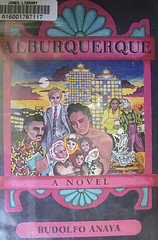
Alburqueque

alburquerque1.jpg

Anaya, Rudolfo. Alburquerque. Alburquerque: University of New Mexico Press, 1992.

My final book of January – chosen to celebrate the month New Mexico became a state. Anaya’s Alburquerque is rich with the culture of New Mexico’s Mexican population. In the center is Abran Gonzalez, a young ex-boxer from Barelas. Upon discovering he is adopted he sets out to learn as much as he can about his birth parents. It is crucial to his understanding of who he really is. Swirling around Abran there is magical realism, cutthroat politics, deep rooted culture, rich history, and tragic romance.
My one complaint – I don’t know why Anaya has Abran have a chance meeting with his birth father in the very first chapter. It seemed a little too coincidental and more than a little cheesy. He is able to come full circle with the same characters at the end. Like I said, a little cheesy.

BookLust Twist: From Book Lust in the chapter simply called, “New Mexico” (p 167).

Everyday Zen

zen.jpg

Beck, Charlotte Joko. Everyday Zen: Love and Work. San Francisco: Haper Collins, 1989.

I had a hard time wrapping my brain around the reading of this book. I think I couldn’t figure out what was bugging me until I realized the reading required more than just my brain. It asked my heart and soul, my beliefs and convictions to get involved. It became a religious thing and that was something I really struggled with in order to read Beck’s book. I admit it – I am a person wrestling with and for a belief. If that bothers you, stop reading right here. I am searching for self-acceptance for what I believe and, ultimately, do NOT have faith in.

I found it insteresting that Beck put the word love in the title of her book because in the chapter specifically on love she states, “love is a word not often mentioned in Buddhist texts. And the love (compassion) they talk about is not an emotion…” (p 71). I had an interesting time coming to terms with that concept.

The other quotes that I took to heart are:
“…the storms of life eventually hit them more lightly. If we can accept things just the way they are we’re not going to be gratly upset by anything. And if we do become upset it’s over more quickly” (p 13).
“We can’t love something we need” (p 39).
“Other people are not me” (p 68).
“Not all problems are as tough as these, but less demanding ones may still send us up the wall with worry” (p 99).

New Words:

  • sesshin
  • zazen
  • koan
  • zendo
  • samadhi

BookLust Twist: From Book Lust in the chapter “Zen Buddhism And Meditation” (p 255).

Funnies (with spoiler)

funniesLennon, J. Robert. The Funnies. New York: Riverhead, 1999.
Tim Mix’s father wrote a comic strip based on his family. Growing up, this comic strip was a source of embarrassment to Tim. Yet, when his father passes away and Tim’s only inheritance is the very comic strip he hated, he decides to try his hand at taking over the strip. Tim is a sarcastic, barely ambitious man who is terrible at conversation, worse at relationships both personal and with his family. This is a formula that always works – the unlikable, unlikely hero goes through a metamorphosis and comes out a pretty decent guy. In the end he doesn’t succeed with the funnies, but he gets the girl.

“This time the pause was longer, a nice slack length of rose to hang the conversation with” (p 52).
“I pushed gently at the sore spot in me and it hurt enough for me to turn away as I talked” (p 132).”
“Susan offered me a bite of her corn dog. I refused, still queasy from the Centrifuge of Death, but didn’t tell her this, and I feared that this rebuff without explanation would give offense. Then I came to my senses and simply let it go. It was a wonderful feeling, like dropping off a box at the Goodwill” (p 155).
And my favorite quote, “I let happiness run its course through me, knowing that it wouldn’t last, but also knowing it would always be there somewhere waiting for me, if I made the effort to find it. This understanding seemed an almost criminally excessive piece of good fortune, but for the time being I accepted it without question” (p 274). For some reason this reminded me of me.

BookLust Twist: From Book Lust twice. Once in the chapter called “Brothers and Sisters” (p 46), and “Families in Trouble” (p83).

Fer-De-Lance


Stout, Rex. Fer-De-Lance. Pennsylvania: Franklin Library, 1934.When I saw this book arrive in the library van box for me I got very excited about the cover alone. It’s beautiful! I didn’t even know it was my requested book, just that it had a gorgeous cover. How’s that for judging a book by its cover? I have heard so much about Rex Stout and his Nero Wolfe mysteries but had never read one before now. I have to admit, I didn’t really care for the character of Mr. Wolfe. He seems to spend a lot of time bossing other people around while being very, very particular about his own activities. The story is actually told from the point of view of his assistant, Archie Goodwin, who seems to do all the legwork work solving mysteries since Wolfe never leaves home.

So, the plot to Fer-De-Lance is this: a man is found murdered. Clues in his room lead to the death of someone else. Ultimately, it’s the solving of the second death that leads to the truth of the first death. It’s a fun story. Here are some of my favorite quotes:
“I made some sort of conversation so O’Grady’s ears wouldn’t be disappointed” (p 39).
“Maybe your salary is the only rope that holds Saturday and Sunday together for you” (p 48).
“It is always wiser, where there is a choice, to trust inertia. It is the greatest force in the world” (p 190).
“A genius may discover the hidden secrets and display them, only a god could create new ones” (p 246).

BookLust Twist: From Book Lust and the chapter “Rex Stout: Too Good To Miss”

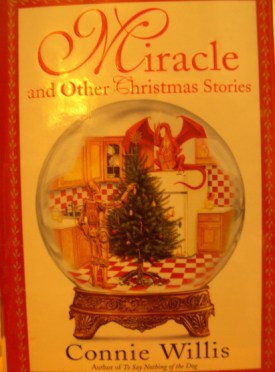
Miracle

Willis, Connie. Miracle and Other Christmas Stories. New York: Bantam, 2000.

A collection of short stories centered around Christmas.
image0001.jpg

  • Miracle ~ Lauren reminds me of me. She’s well-meaning yet corner cutting when it comes to Christmas. Her cards go out on time and she buys gifts for everyone in the office yet something is missing. Enter Spirit of Christmas Present, a environmentally exuberant specter sent to show Lauren the real meaning of Christmas.
  • Inn ~This is an odd little story about a woman who, while in choir practice for her church pageant, discovers a homeless couple who turn out to be Joseph and Mary. That Joseph and Mary, lost on their way to Bethlehem.
  • In Coppelius’s Toyshop ~ This is one of my favorites. It’s so reminiscent of Will from About a Boy lost in a crazy, confusing, chaotic toystore. Throughout the whole thing I could imagine rows and rows and floors and floors of toys, games, puzzles, colors, lights, noises, and the sounds of children everywhere.
  • Pony~ Moral of the story: it is never too late to get the ultimate present of your dreams…even if you no longer want it.
  • Adaptation ~ An interesting twist on A Christmas Carol. A divorced father wants nothing more than to give his daughter the ultimate Christmas but work and his exwife have other plans.
  • Cat’s Paw ~ A famous detective has been sent to solve a mystery on Christmas Eve. A weird tale involving monkeys and murder. “We are all capable of murder. It’s in our genes” (p 208).
  • Newsletter ~ Has the world been taking over by a parasite that causes goodness and peace of earth? How can we take humanity that’s just a little more…well…human? Turns out, we can’t.
  • Epiphany ~ Another twist on a classic tale. Mel is convinced he has had an epiphany about the Second Coming. He gets a friend and a stranger involved in his travels and suddenly they are the three wise “men.” It’s funny.
  • A Final Word~
  • BookLust Twist: From Book Lust  in the chapter “Connie Willis: Too Good To Miss” (p 248).

    Polar Express

    polar expressVan Allsburg, Chris. The Polar Express. Boston: Houghton Mifflin, 1985.

    Is it any wonder that The Polar Express won a Caldecott award? Is it any wonder that Hollywood made a movie out of it? This is a gorgeous book for adults as well as children. It’s fantastic to read aloud to a child because not only is are the pictures spectacular, but the storyline is wonderful, too. See, I can’t say enough nice things about this book!
    It’s simply the story of a boy who takes a trip by train to visit Santa at the North Pole. He is given a special gift that proves his belief in all things Christmas – the elves, the gifts, the reindeer, the North Pole, and of course, Santa Claus himself. This book was such a treat that I now want to go see the movie!

    “We climbed mountains so high it seemed as if we would scrape the moon” (p 9) and “Though I’ve grown old, the bell still rings for me as it does for all who truly believe” (p 29) are my favorite lines.

    BookLust Twist: From Book Lust  and the chapter on “Christmas Books for the Whole Family to Read” (p 55).

    Twelve Days of Christmas

    12 days of ChristmasKnight, Hilary. Hilary Knight’s Twelve Days of Christmas. New York: Simon & Schuster Books for Young Readers, 2001.

    On the surface this book looks like your average kids’ book. Cute pictures and a storyline you can sing. We all know “The Twelve Days of Christmas” – it’s that silly song that involves milking cows, egg producing hens, and ladies dancing among other things. What makes this book special is what is going on behind the scenes. There’s a whole other story unfolding in the illustrations.  On the surface Bedelia the bear is trying to tell you what her true love gave to her during the twelve days of Christmas (Dec 25- Jan 6) and then there is Benjamin, for those twelve days straight, bringing her the goods. In the background there’s Reginald the raccoon. He lives in Bedelia’s basement for some strange reason, and if you are observant, you learn that he pines for the perfect girl. Throughout Benjamin’s trips to Bedelia’s door with various (odd) gifts, you see Reginald struggling with something of his own.
    In the end (and I won’t ruin it for you), you will want to go back and look at all the illustrations just a little closer. Everything has a meaning – beyond Benjamin looking to woo Bedelia with twelve lords a~leaping (my favorite). Seriously. Check out the lords. They’ll crack you up.

    BookLust Twist: From Book Lust and the chapter “Christmas Books for the Whole Family to Read” (p 55).

    Father Christmas Letters

    Father ChristmasTolkien, J.R.R. The Father Christmas Letters. Boston: Houghton Mifflin, 1976.

    Pure magic. I loved every minute of this book! I have always loved J.R.R. Tolkien’s imagination. From The Hobbit to The Two Towers I have always enjoyed submerging myself in his work. This book is something special. I think Nancy Pearl sums it up best in Book Lust “Tolkien wrote these letters for his children, beginning in 1920 and ending in 1939. Whimsical pictures complement the descriptions of Father Christmas’s life at the North Pole” (p 56). But, what Pearl doesn’t tell you is that Tolkien is posing as Father Christmas, and each letter (one for each year) is a continuation a story (involving a polar bear, elves and ) from the year before. The illustrations that accompany the letters are as captivating as the storyline. I can truly imagine being a child, caught up in waiting for the letter from Father Christmas.
    The sobering thing about this book is that it ends the same year that World War II starts. Tolkien even makes mention of it on the last page “Half the world seems in the wrong place.” It seems like everyone needed to put aside childhood in 1939.

    BookLust Twist: From Book Lust  in the chapter “Christmas Books For The Whole Family To Read” (p 55).

    After the Plague

    After the plagueBoyle, T. Coraghessan. After the Plague and Other Stories. New York: Viking, 2001.

    After finishing A Diary from Dixie, Band Land, and The Crossley Baby I still had time for a couple more “November” reads. The topics already covered for November were: the month the civil war ended, the month Montana became a state, national train month, and national adoption month. I chose After the Plague because I hadn’t recognized National Writers Month yet (and if there is time I’ll also recognize November as the month World War I ended and read Storm in Flanders). The only thing I won’t get around to is honoring Winston Churchill’s birthday (born in November).

    So, onto After the Plague. This is a collection of sixteen short stories. Pearl calls them “Boyle’s best.” They hang open, unfinished and unresolved like a to-be-continued drama on television. Each story is like being dropped into the middle of a movie, watching for a scene or two, and then being ushered away before the conclusion. If you like to hang in the balance this collection of short stories is for you. Even stories within stories are left unfinished. Boyle shows off diversity in every story. Some will shock you, some will make you remember something from your own life, but all of them will be a pleasure to read.
    Some favorite lines: “I started smoking two or three nights a week, then it was five or six nights a week, then it was everyday, all day, and why not?” (p 48), and “I just watched her, like some sort of tutelary spirit, watched her till she turned over and I could see the dreams invade her eyelids” (p 164).

    BookLust Twist: From Book Lust in the chapter called “Growing Writers” (p 107) and “Short Stories” (p 219). I love how Pearl describes Boyle’s work, “…nervy and disconcerting, and often very funny, leaving you uncomfortable with yourself and the world” (p 219). So true!

    Diary From Dixie

    Diary from DixieChestnut, Mary Boykin. A Diary from Dixie. Boston: Houghton Mifflin, 1949.

    From the moment I started reading Mrs. Chestnut’s diary I felt I was in for gossip, gossip, gossip. While this is a great first hand account of life during the Civil War, I couldn’t get over how much of a name-dropping, political hob-nobbing, party-going Southerner she was! Another thing I noticed  was how humorous Mrs. Chestnut was! Here are a few of her more comical entries:

    “There Mrs. Hunter told us a joke that made me sorry I had come” (p 8). But, she never does explain the joke was! Too bad!
    “At camp meeting he got religion, handed round the hat, took the offering to the Lord down into the swamp to pray over it, untied his horse and fled with it, hat, contribution and all” (p 13).
    “I think this journal will be disadvantageous for me, for I spend my time now like a spider, spinning my own entrails, instead of reading as my habit in all my spare moments” (p 22). See, gossip, gossip!
    “Every woman in the house is ready to rush into the Florence Nightingale business” (p 70). Good ole fashion jealousy, perhaps?

    I think the only quote to get to me showed the attitudes of the time, “Women need maternity to bring out their best and true loveliness” (p 86). We’ve been here before.

    All in all, Mary Chestnut’s diary was a delight to read. I fell in love with some of the language: flinders, rataplan, brickbat, and best of all, envenom. Love that word! Witty and humorous, it didn’t read like a history textbook. Instead, it gave texture to the sounds and sights and warmth to the personalities from the Civil War. More importantly, it gave a sense of what it was like to be a woman during that time.

    BookLust Twist: From Book Lust and the chapter called “Civil War Nonfiction” (p 58).