Friend of My Youth

Munro, Alice. Friend of My Youth. New York: Alfred A. Knopf, 1990.

In the very first chapter of Book Lust Nancy Pearl talks about the Alices. Alice Adams, Alice Hoffman, Alice Munro, Alice McDermott…to name a few. I recognized all, and read most of the names except one: Alice Munro. The stranger Alice of the group. Now, two years after starting the project I am finally reading an Alice Munro book.

Friend of My Youth is a collection of short stories all based on the lives of women.
“Friend of My Youth” is the opening story. Imagine hearing a story from your mother, something that happened long before you were born, but has stayed in your mother’s mind all this time and important enough to be told to you when you were old enough. But, and this is the catch, you don’t know how it ends, even after your mother’s death. You simply don’t know the end. And so begins Friend of My Youth. The connection through all of the stories are women. They have lead roles emotionally as well as physically.

The best lines: “Her hair was freshly done to blind the eye with brassy reflections, and her face looked as if it would come off on a man’s jacket, should she lay it against his shoulder in the dancing” (Friend of My Youth, p 18).
“‘Watch out for him,’ Barbara told the other clerks. ‘He’s a jerk, but he knows how to stick things to his fingers'” (Oranges and Apples, p 107).
There were other charming details like the winter and summer kitchens in “Friend of My Youth” & the watching for satellites in “Oranges and Apples.”

BookLust Twist: From Book Lust in the chapter “A…My Name is Alice” (p 1).
Chasing Vermeer

Balliett, Blue. Chasing Vermeer. New York: Scholastic Press, 2004.

I love it when a book takes me somewhere new. It’s even better when it opens doors to other interests that stick. It’s best when it’s completely unexpected. Such is the case with Chasing Vermeer. When I first realized it was a young adult book I thought I would get through it in a day, get through it and move onto something more my speed. Who knew this book would be just my speed? For starters there is a play-along game involving pentominoes. If you can’t get the hidden message there is an interacted website (still active) to help you out, complete with other games to get you sidetracked. Then, there is the discovery of something completely unexpected I mentioned before. Chasing Vermeer mentions a lot of Vermeer’s work in detail so I started doing a little more research and found a fantastic website dedicated to Vermeer. It’s really great. I lost my lunch break playing with it! I love learning something new everyday in the most unexpected ways. But back to Chasing Vermeer, the book.

It’s a great mystery for kids and adults alike. Petra Andalee and her new found friend Calder Pillay find themselves in the middle of a mystery complete with codes and the crime of stolen art. It starts off with Petra and Calder as classmates with a weird assignment: find letters in art. Both Petra and Calder call the other “weird” and can’t imagine ever being friends, but soon weird coincidences bring them together to solve a mystery involving an old woman, the FBI and an international art scandal.

Here are some quotes that nabbed me: “Good letters were no longer written. He was sure of it” (p 23). Glad I’m not the only one who feels this way!
“What was art, anyway? The more she thought about it, the stranger it seemed” (p 40). My thoughts exactly!

BookLust Twist: From More Book Lust in the chapter “Best For Boys and Girls” (p 21).

Citizen of the Galaxy

Heinlein, Robert A. Citizen of the Galaxy. New York: Ballantine, 1991.

I have a confession to make. I have never settled down with a good science fiction book because I love science fiction. Because I don’t prefer science fiction. There. I said it. My father-in-law’s first book was a sci-fi thriller with the main character named after the family pet. Go figure. Luckily, he’s never asked me to read it. Otherwise, I couldn’t wouldn’t refuse and would diligently struggle through it.

I didn’t struggle through Heinlein’s Citizen of the Galaxy, though – much to my surprise. Armed with the “rule” that I could quit after the first 50 pages I attacked it with relish, thinking I would put it down after the first 50 pages in. When I stopped reading that first night I was on page 110, again, much to my surprise. It’s highly enjoyable for a genre I usually do not go out of my way to enjoy.
Thorby is a slave and in the opening scene he is “bought” by a beggar who turns out to be more than what anyone, especially Thorby, bargained for. His master hates slavery “with a cold passion” and releases Thorby and instead adopts him, training him to be a beggar and thensome. Soon Thorby is learning different customs and family structures as he travels from planet to planet. Life as he knew it is never the same again especially after he meets his real family on Earth.

Some interesting points: In Jubbulpore (capital of Jubbul) “slave” is a legally recognized status & “beggar” is a licensed profession (p 20 & 21).
“The Sargon’s police operated on a concept older than justice; they assumed a man was guilty, they questioned him by increasingly strong methods until he talked…” (p 48).
And…my favorite line:
“A Losian would come zipping toward Thorby on the wrong side of the street (there was no right side), squeal to a stop almost on Thorby’s toes, zig aside while snatching the breath off his face and the heart out of his mouth – and never touch him” (p 116). Sounds like a scene out of Star Wars.

BookLust Twist: From Book Lust in the chapter “Robert Heinlein: Too Good To Miss” (p 109).

Finding Caruso

Barnes, Kim. Finding Caruso. New York: Peguin Putnam, 2003.

Within the first two chapters of Finding Caruso I found myself calling Kim Barnes a favorite author. Despite the fact that the first chapter started off raw and violent; as shocking as a bucket of ice cold language, I loved the way she described the landscape, the emotion, the family structure. A mother timid and protective, a father despairing and drunken, brothers bound by love and loyalty. After a tragedy the brothers make their way to Idaho. Music is what keeps them going, but brotherly blood is what saves them.
It’s also the bittersweet tale of sibling rivalry. One brother being the older, better looking, the more talented, the one used to getting everything while the other looks on, burning with jealousy, brimming with pride. But, what happens when the tides turn and baby brother gets a stroke of luck, wins out?

I could have quoted the entire book for the wonderful lines that jumped off the pages at me, but here are a few of my favorites:
“The ballads were my mother’s favorite, and we let her lead, our boys’ voices blending in a harmony that had been in us since the moment our parents came together and planted the music in our bones” (p 7).
“Those nights my father disappeared down the road, I felt the house itself let loose its breath” (p 11).
“‘It’s not that I’m thirsty. It’s the memory that tastes good'” (p 50).
“‘Don’t ever think you know something of me without asking'” (p 111).

This book was definitely a favorite. The writing was sparse yet as fluid as the mountain streams Barnes describes in Finding Caruso.

BookLust Twist: From More Book Lust in the chapter “Idaho: And Nary a Potato To Be Seen” (p 122).

Blackwater

Ekman, Kerstin. Blackwater. New York: Doubleday, 1993.

Ekman’s Blackwater is possessive. It grabs you and you can’t put it down. It’s dark and gritty – peppered with angry scenes of violence and meaningless, lust driven sex. Like a maze with many twisting passages Blackwater has a community of dark stories to tell. Each tale is tangled with another and at the center, common to all, is a double murder. While everyone knows about it and is touched by it, no one can solve it for twenty years.
In the beginning Annie Raft follows a lover to Blackwater to his out-of-the-way commune. On her first day in town Annie stumbles across the murdered bodies of two tourists camping in the backwoods of Blackwater. For twenty years she is haunted by the face of the man she thinks did it until one day that face comes back in the form of her daughter’s newest boyfriend. The mystery, along with a whole host of secrets, start to unravel.
The landscape is such an important element in the novel I would have enjoyed a map, something that illustrates Annie getting lost in the forest, how far away from town the commune was, where the well was that Johan was tossed into in relation to where the murders took place, etc.

These are the really great lines: “The silence was violent after the noise of the cars” (p 10).
“He felt strangely empty inside, a green jumble of oblivion, and his skin felt licked by eyes” (p 136).
“You cannot live in the world without living off it” (p 177).
“She had lived a cautious and parched life” (p255).
“It had been an open question between them, whether you can see into your own darkness and whether it actually is your responsibility to do so. Or whether you evoke the darkness and make it into your own by toying with it” (p 422).


BookLust Twist: From More Book Lust in the chapter “Crime is a Globetrotter: Sweden” (p 59).

Bildgewater

Gardam, Jane. Bilgewater. New York: Greenwillow Books, 1977.

Marigold Green is a wonderful name. Not so wonderful when your father’s name is Bill. Marigold adopts the unavoidable nickname of Bilgewater as a result (Bill’s + daughter = Bilgewater). As so begins Gardam’s story about teenage angst from the point of view of Marigold Green. Because her father is the housemaster to the boys of a boarding school, Marigold has a lot to be anxious about. Having lost her mother at birth, Marigold is naive when it comes to friendships, fashion, relationships with the opposite sex, and even alcohol. She had never seen drunk people before the age of 18. The one thing she does know is literature and many different works are reference throughout the story.

The quotes that grabbed me: “love had always made him sad” (p 9)
“Flowers in classrooms are as depressing as flowers in hospitals – they just emphasize the fact that you can’t get out and see them growing. Classrooms break your heart” (p 44).
“The frightful, pitiless games of hockey with me always running the wrong way” (p 201).

BookLust Twist: From More Book Lust in the chapter “Jane Gardam: Too Good To Miss” (97). Pearl says of this coming-of-age tale, “…wonderful for adults who want to look back, from a safe distance, at the ups and downs of adolescence” (p 97).

American Ambassador

Just, Ward. The American Ambassador. Boston: Houghton Mifflin, 1987.

I think this novel is a dark example of fatherhood failed and an odd choice for celebrating Father’s Day. Oh well. Quite literally this is a story of father against son. Bill North is a Foreign Service Officer with strong loyalty to his job and marriage. His son, Bill Jr., sees his father as all things corrupt and sets himself apart from first his family, then his country in the ultimate betrayal of his father. After abandoning his family Bill Jr. joins a German terrorist group. Ward Just’s story takes the reader from Boston & Washington D.C. to France, Germany, and Africa as the hunt goes from father to son and back again. I was fascinated with this falling out of family and couldn’t put it down until the devastating end. I almost want to say what happens, but you really should read it for yourself.

Favorite quotes: “His favorite word, injustice, applied equally to underdone hamburgers, a Red Sox loss in extra innings, a quarrel with the houseboy, a missed airplane connection, or a death” (p 55).
“The son is always the shadow of the thatther, is that not true?” (p 153).

BookLust Twist: From Book Lust”  in the chapter “Fathers and Sons” (p 85) and “Ward Just: Too Good To Miss” (p 135).

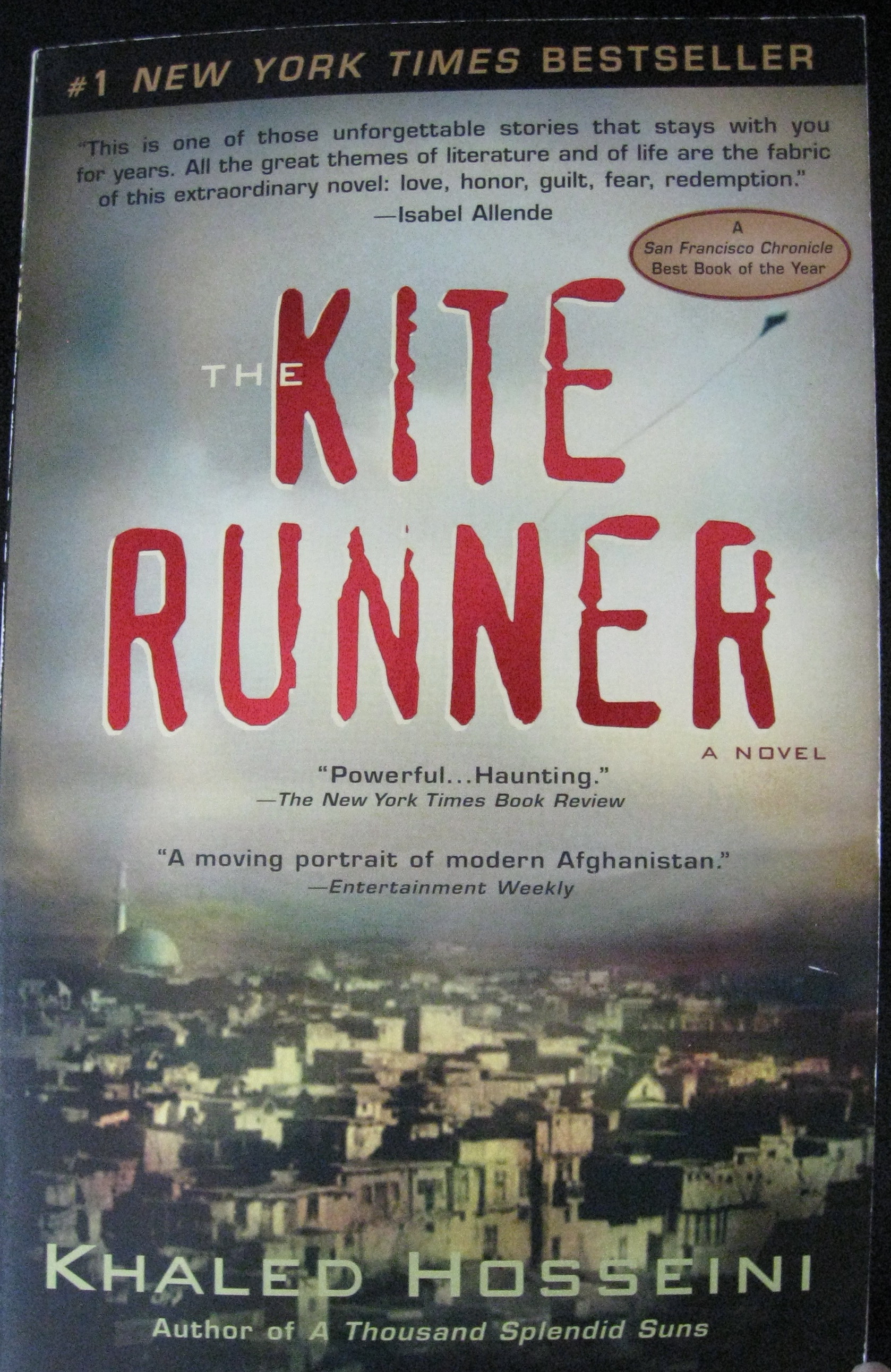
Kite Runner

Hosseini, Khaled. The Kite Runner. New York: Riverhead, 2003.

It is hard to believe The Kite Runner is Khaled Hosseini’s first novel. I am reminded of a favored race horse, one that is described as “strong out of the gate.” I couldn’t put it down (read it from start to finish on the flight back from California). The Kite Runner is a powerful story of friendship and family in a time of political and cultural upheaval. Amir tells the story of his childhood in Kabul, Afghanistan. As a privileged son, Amir grows up in the shadow of his Baba, his father’s affection, constantly looking for ways to win his father’s love and admiration. Occasionally Amir finds the sunshine and basks in the approval, but those moments are fleeting, overshadowed by Baba’s obvious and puzzling devotion to Hassan, a servant’s son. Amir spends his childhood balancing a friendship with Hassan while enduring blinding bouts of jealousy. Amir’s personal turmoil forces him to make regrettable choices and soon his life parallels his country’s dramatic revolution. For both boy and country, life as they knew it is over in a dramatic upheaval.

BookLust Twist: In More Book Lust twice:  First in the chapter called, “Central Asia: Crossroads of Empires, Cauldron of War” (p 40), and again in “Maiden Voyages” (p 159), for being Hosseini’s first book. 

Amateur Marriage

Tyler, Anne. The Amateur Marriage: a Novel. New York: Ballantine, 2004.

It’s weird to say I finished this book poolside in Las Vegas, Nevada. Who would have predicted that? Certainly not me.

This is a book I will definitely read again someday. When thinking about this review I wanted to box this story into a corner and call it a sad book, but I couldn’t. It’s such an accurate portrait of how a marriage (and ultimately, a life) can end up that I can’t just call it “sad.” How can I when it’s beautiful, funny, tragic, infuriating, intelligent, frightening and honest all at the same time?
Michael and Pauline are two teenagers whose lives collide at the start of World War II. Their romance is the result of a marriage between a fear of the future and the desire to be someone else at that very instant. Michael wants a girlfriend, any girlfriend. Sensing Pauline’s fascination with the war effort he spontaneously enlists. Pauline wants a soldier for a boyfriend. Any soldier. The culture and uncertainly of the times have thrown these two people together in such a way that neither of them can back out, despite the growing realization they were never meant to be together.
One things leads to another and soon thirty years have gone by. Pauline and Michael divorce and life goes on. And on. While the marriage didn’t survive more than halfway through the novel, Michael and Pauline go on. Their relationship from beginning to end and beyond is captured beautifully.

Favorite quotes: “You know how men are about wearing ties on a Saturday” (p 31).
“I’ve reached the stage where I got so hungry that I’ve gone beyond  hunger” (p 71) …and Kisa didn’t think that was possible!
“Sometimes, Pauline got a feeling like a terrible itch, like a kind of all-over vibration, and she thought that any moment she might jump clear out of her skin” (p 71).

BookLust Twist: From More Book Lust in the chapter “Marriage Blues” (p 161). 

Act of the Damned

Antunes, Antonio Lobo. Act of the Damned. New York: Grove Press, 1995.

I have to admit this was not one of my favorite books this month. Maybe something was lost in the translation (literally from Portuguese to English), but there were too many layers of storytelling going on. Dr. Nuno Souza, a dentist, tells his story in first person, but his imagination works overtime to include an Edward G. Robinson, a cigar smoking, gun toting tough guy. Nuno is married to Ana, but has a drug addicted girlfriend on the side.
Even though Nuno is telling the story in the first part, it’s Ana’s family that is the center of the story. Her family is beyond corrupt. Incest and greed come second nature to these people. Ana’s mother is the voice in part two. I think what makes the story so confusing is that no one really uses names. When Ana’s mother tells the story she uses family connections, “my brother-in-law, sister-in-law, my husband, his father, her brother…” Later, Ana herself tells the story…then someone else who uses the same technique…

These are the quotes that caught my attention:
“I opened the drawer to take out a shirt and tie, and was met by enough sicks for an army of ankles” (p 5).
“I laid down the receiver while the two voices tussled, scratched and bit each other in an electric desert of screws and wires” (p 17).
“‘I want her out by the thirtieth at the latest. She can go to tell and listen to conversations down there'” (p 42).
“I wiped the smile off my mouth with a napkin” (p 71).

BookLust Twist: From Book Lust from the chapter “Families in Trouble” (p 83).

Language of the Land

Hopkins, Martha and Michael Buscher. Language of the Land: The Library of Congress Book of Literary Maps. Washington: U.S. Government Printing Office, 1998.

This is a weird choice for the final book of April. I wanted to read something that represented tax time and that dreaded 4/15. Nancy didn’t include a whole lot of books on taxes in either Book Lust or More Book Lust so I decided to lump in government documents and publications as representation…It makes some sense, right?

Anyway, this book is really, really cool. I urge you to take a look at it for yourself. If you have ever seen Manguel’s The Dictionary of Imaginary Places you will get the gist of Language of the Land. I have to admit I’m a sucker for these kinds of things. To say that it is a collection of maps with the basis being about literature doesn’t really explain a whole lot. Here are some better examples (and some of my favorite “maps”): there are several Arthur Conan Doyle maps. One map shows the location of all the fictional places mentioned in the Sherlock Holmes mysteries. Another is the “Sherlock Holmes Mystery Map” (p 207) which allows SH fans to follow the famous detective’s footprints through different stories. Of course, the Odyssey has a few maps depicting the travels of Odysseus. Page 60 has a pictorial map of English literature while on page 70 shows the Beat Generation map. Every state has a map of famous authors. Of course I had to scrutinize Maine to see if they included Monhegan as a place and Stephen King as an author (they did). Then, I had to find the fictional places Robin Hood’s Sherwood Forest and Peter Pan’s Neverland. You would have to be a James Bond fan to know the significance of items in Ian Fleming’s “The Ian Fleming Thriller Map” (p 176) like the centipede in Bond’s glass or the Roman Numeral III tattooed on a blond girl’s arm. Most of the maps are in black and white although a handful are also represented in color. The Literary Map of Latin America (p 162) is beyond cool. So is The Call of The Wild by Jack London map (p 177).

BookLust Twist: From More Book Lust in the chapter “Your Tax Dollars at Work: Good Reading From the Government (Really!)” (p 239). Pearl is serious. Language of the Land is great!

Franklin And Lucy

Persico, Joseph E. Franklin and Lucy: President Roosevelt, Mrs. Rutherfurd, and the Other Remarkable Women in His Life. New York: Random House, 2008.

Here’s what went on LibraryThing:
When I finally finished the last page of Franklin and Lucy I had two very different thoughts. The first was this was a well written, very thorough biography of the social side of the Roosevelts. It was written in an easy, conversational style that, at times, was hard to put down. The detail given to who, what, where, when, and why made you feel as though you were experiencing every aspect of the era. My second thought was it was an unfortunate title for a work comprised of so much more than just the relationships of Franklin D. Roosevelt. A more accurate title would have included Eleanor. A possible option could have been Franklin and Eleanor: Mrs Rutherfurd, and the Other Remarkable Women in their lives. Another option would be to remove any section dealing with Eleanor that didn’t include her husband’s involvement and focus solely on Franklin.
The other detraction from the book was Perisco’s almost obsessive need to repeatedly include Lucy Rutherfurd’s physical description in such flowery detail. While Franklin’s oft repeated “barrel chested” description was needed to stress his need to hide his disability (and to emphasize his physical decline before his death), and Eleanor’s lack of beauty was important in context to her character as being tragic and unlovable, they were not mentioned nearly as often as Lucy’s exquisiteness.

As an aside (something that didn’t go on LibraryThing), how awful is this? I kept comparing myself to Eleanor! Before you think I’ve gone crazy, hear me out: Perisco described Eleanor as:

  • when stressed Eleanor’s voice grew shrill
  • was insecure
  • was earnest instead of vivacious
  • “schoolmarm air about her”
  • Eleanor failed to recognize humor
  • oblivious to fashion, often choosing sensible over stylish
  • overwhelmed by children
  • suspicious about kindness
  • fought for the underdog

OKay, so I will never go onto greatness and my marriage is a thousand million trillion times better, but the other stuff fits. Kinda sorta maybe.

Apologizing to Dogs

Apologizing To Dogs
Coomer, Joe. Apologizing to Dogs. New York: Scribner, 1999.

LibraryThing Review: The first thing I thought when I started to read this book is odd, odd, odd. For one, the first character you meet is a man named “Bone.” He’s not called Bone because he’s super skinny. Nothing obvious like that. He’s called Bone because he sucks on a chicken bone all the time. How bizarre.
The whole story just gets weirder and weirder. Elderly Effie sits out on her porch and spies on the neighborhood. She keeps a journal of everything her paranoid self sees. Her neighbors come and go around her, all of them quirky, too. I found the development of each character too shallow to muster up any real feelings for them. In fact, there are so many characters and their development so shallow I had trouble keeping them straight. In all, there are over 18 different characters and each get barely a paragraph at one time. If anyone, I liked Carl the best. In an effort to impress a woman he builds a boat…from inside his house – using the insides of his house. And. And, I liked Himself, the dog. Himself is the star of the story, but you wouldn’t know right away.

Here are a couple of funny/good quotes:
“‘You know what’s wrong with you, Mrs. Haygood? You’ve got opticum rectitus, a growth connecting the optic nerve to the rectum, producing a continual sh!tty outlook,’ Mr. Haygood said. He was oiling a gear on a blue tin tank” (p 34). 
“10:57 Strong marijuana odor from That Big Indian’s. I think one of his bathtubs is creeping over my property line” (p 37). Obviously, this is from Effie’s journal. She’s the funniest one in the book. Her paranoia is great.

BookLust Twist: From Book Lust in the chapter “Great Dogs in Fiction” (p 105). Himself is a great dog but he was barely in it.

Continental Drift

continental driftBanks, Russell. Continental Drift. New York: HarperPerennial, 2007.

This book was spellbinding.
Thing on LibraryThing: Russell Banks really knows how to tell a good story. On the surface, it’s about Bob Dubois and his downward spiral. Bob is a New Hampshire man who seems to have it all: a wife, two kids, a decent job, a house, a boat to take out on the weekends and even a girlfriend on the side. His problem: greed. He is a man who compares himself too often to the people around him: his brother, his best friend. He doesn’t let go of grudges or jealousies all that easily. Feeling like the man who has nothing to lose, he gives up everything to move to Florida for a “fresh start.” His tale is just the vessel for Banks to describe a society fueled by the overwhelming need for more and more. Excess is not enough. Bob soon learns the meaning of “good enough” when his life spins out of control.
One of my favorite parts is about halfway through the book, the two brothers, Bob and Eddie, are trying to have a conversation. Each one takes a turn to say something then the other responds. Only they aren’t talking about the same thing. Bob is trying to explain to Eddie that he (Eddie) needs to take away a handgun because Bob doesn’t understand himself anymore. He’s afraid of what would happen if the gun stays in his possession. Eddie responds that he has ulcers and his epilepsy has come back. Bob says he doesn’t want to kill anyone and Eddie reponds that he hates fukcing his wife. It’s comical and sad.

My favorite quotes:
“He’s never skied on water before; in fact, he’s never skied on any kind of surface, despite having been raised where people drive from cities hundreds of miles away just so they can spend a few hours careening down mountains on slats strapped to their feet” (p150). Having gone to school in “ski country” yet never skied, I can identify with this!
“She and her father never speak of the event again, not to each other and not to anyone else. There’s nothing to say about it to each other that is not already fully understood, so they remain silent about it, almost as if it never happened” (p 176). Can’t you just see this scene in a movie?
“There’s a mixture of passivity and will that he does not understand. They risk everything, their homes, their families, forsake all they know, and then strike out across the open sea for a place they’ve only heard about” (p 340). What struck me about this quote is where it’s coming from: Bob. Doesn’t he realize he’s just like them?

BookLust Twist: From More Book Lust and the chapter “It Was a Dark and Stormy Novel” (p 129). Pearl isn’t kidding. I’m surprised this hasn’t been made into a movie yet.

Bluest Eye

IMG_0663 Morrison, Toni. The Bluest Eye. New York: Plume, 1970.

The LibraryThing Review:
“Because The Bluest Eye doesn’t have a traditional storyline plot the reader is free to concentrate on the complexities of the characters. The entire work is like a patchwork quilt of human suffering. Each character a different patch of sadness and survival. With each square, the ugly underbelly of society is exposed: poverty, racism, rape, incest, abuse, violence…Toni Morrison is the eye that never blinks in the face of such harsh subjects.”

These are the quotes that stopped me short. “They did not talk, groan or curse during these beatings. There was only the muted sound of falling things, and flesh on unsurprised flesh” (p 43). It’s the word ‘unsurprised’ that speaks volumes.
“He urges his eyes out of his thoughts to encounter her” (p 49). Another way of describing a deep-seeded prejudice.

One aspect of this novel that caught me up was the narrator hearing certain words in colors like light green, black and red. I have done the same thing with my imagination. I see words as certain shades or hues. Aside from the colors, this was a hard book to read and I can’t say anything that hasn’t already been said.

BookLust Twist: From More Book Lust and the chapter called “Big Ten Country: The Literary Midwest (Ohio)” (p 29).