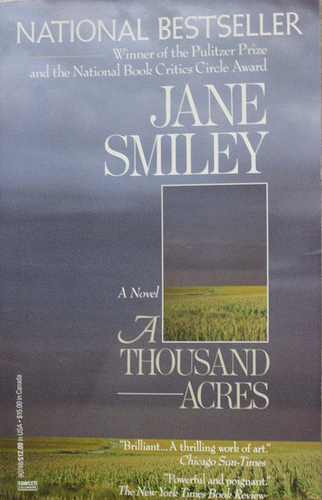
Thousand Acres

acres.jpg

Smiley, Jane. A Thousand Acres. New York: Fawcett Columbine, 1991.

I’ll admit it. It took me forever to even want to read this book even though it has been sitting on my book shelf for months, right within easy reach. I tried picking up Moo a few times and something made me keep putting it down. I have no clue why. I assumed A Thousand Acres would be the same difficult to pick up experience. I was wrong. Once I got into it, Thousand Acres was fascinating, troubling and oh so true to family life. I’ve never lived on a farm. I’ve never set foot in Iowa, but thanks to Smiley I knew exactly what both would be like.
One thing I didn’t understand, nor will I ever, is how a family can so completely and utterly fall apart. By the end of the book not one family is intact and it’s all because of a thousand acres.

“You shouldn’t think somethings changed just because you haven’t seen it in thirteen years” (p 11).
“It was exhausting just to hold ourselves at the table… You felt a palpable sense of relief when you gave up and let yourself fall away from the table and wound up in the kitchen getting something, or in the bathroom running the water and splashing it on your face” (p 101).

BookLust Twist: From More Book Lust and the chapter called “Big Ten Country: The Literary Midwest (Iowa)” (p 27) and Book Lust in the chapter “Growing Writers” (p 107). Personally, I think Pearl also could have put this in her “Families in Trouble” chapter. Not to give anything away but…who tries to poison her own sister? Who does that?

The Body is Water

Schumacher, Julie. The Body is Water. New York: SoHo, 1995.

I love it when reading fits the day. I don’t know how to describe it other than the perfect marriage between a book and time. It was snowing, sleeting, windy and freezing cold. Every so often a gust of wind would send pellets of freezing rain drumming against the windows, yet the Christmas tree glowed softly, the cat purred at my feet, a balsam candle burned bright, a fleece blanket was thrown over my lap, a cup of tea at my elbow and I was content. If I could ignore the wind, all was quiet, all was still; the perfect time to lose myself in The Body is Water.
I’m still reading December picks and The Body is Water celebrates the month New Jersey became a state, oddly enough. It’s also the story of single and pregnant Jane, and her return to her New Jersey shore childhood home. In one sitting I read 184 of the 262 pages.

“All my life I’ve never been certain of where I should be” (p 20).
“In a crisis, other families probably rush to hold the ailing person’s hand; our family rushes to the general vicinity of the crisis and putters around, hoping the patient will spontaneously recover on her own” (p 61).
“No matter where I lived, I never knew my way around; there was no ocean, no rushing noise of a heartbeat from the east” (p 230).
“I start to cry, remembering the days before my mother died, before Bee slept in another room. That was when we loved each other best and didn’t know it” (p 262).

I ended this book sobbing. I connected with Jane even though she was the younger sister (Bee was four years older); even though Jane lost a mother and I lost a father; even though she became a mother and I remain sans motherhood. I connected through the simple loss of a parent, the soothing sound of the ocean, and the complex closeness of sisters.

BookLust Twist: From More Book Lustin the chapter called “Jersey Guys and Gals” (p 129). This also could have been mentioned in chapter called “Maiden Voyages” (p 158) because this was Schmacher’s first novel.

Crossley Baby (with spoiler)

Crossley BabyCarey, Jacqueline. The Crossley Baby. New York: Ballantine, 2003.

November is National Adoption Month. Out of everything I am currently reading, I thought this would be my favorite. I’m sorry to say I was a little disappointed. The Crossley Baby is the story of two sisters (Sunny & Jean) battling for their dead sister (Bridget)’s baby. Well, that’s what it’s supposed to be about. Instead, it’s more of a commentary on wealth (Jean has it, Sunny does not), parenting (Sunny is a mother of two, Jean is not) and manipulation (they both do it, for one reason or another). More time is spent setting up where Jean, Sunny and Bridget came from than the actual adoption process. More time is spent on describing the vast financial differences between Sunny and Jean than on their personalities. By the end of the book I didn’t know Jean or Sunny any better so I didn’t care who got the baby. I was completely indifferent to their struggle for baby Jade. Probably what bothered me most was the lack of real grief shown by either sister over the death of their elder sister. Crossley adds flickers of sadness, glimpses of sorrow, but for the most part Bridget’s death goes mostly unmourned. Possibly that is because they never got along. If there is one thing the three sisters did really well it was avoiding closeness.
In the end, Sunny wins custody. Everything points in the direction of Jean winning – money, power, people in her corner – while Sunny’s husband is filing for bankruptcy, old favors aren’t worth cashing in, and they have to sell their home. In a last minute surprise ending Jean withdraws her application for adoption and doesn’t contest the award going to Sunny. No one from Bridget’s life is there to put in a word edgewise.
Ironically enough, it was Bridget who was my favorite character because of this one line, “Bridget tasted her words before she spoke…” (p 112).

BookLust Twist: From More Book Lust and the very first chapter called “Adapting to Adoption” (p 1).

Yellow Raft in Blue Water

Yellow raft in blue waterDorris, Michael. A Yellow Raft in Blue Water. New York: Warner Books, 1987.

This is high school to me. I remember being holed up somewhere reading this nonstop. Hot off the press, freshly published and oh so new I couldn’t put it down. I reread it and reread it until finally I could move on to other Michael Dorris creations, which somehow were never quite as good. Nothing compared to A Yellow Raft in Blue Water back then and it is still a faovrite to this day.

Someone described this book as an onion, reading it was like peeling back the layers of a story, and while that imagery is accurate enough, I like to think of Yellow Raft as a game of telephone. First, there is Rayona. She tells the story from her perspective. She is all of fifteen years old…at that difficult age where rebellion against your mother is the easiest thing to do. As she says, “when mom and I have conversations, they mostly involve subjects not personal to our lives” (p 26). She tells her story like it’s the honest truth. Then, there is Christine, her alcoholic mother, and her story. In the beginning you want to hate her for how seemingly unfair she had been to Rayona. But, learning about Christine’s heartbreak you realize Rayona’s reality is only her perception. The wires of communication have been crossed and in some cases, completely disconnected. Christine had her reasons for everything she did (and didn’t do). “I never had been good company for myself” says Christine (p 185). Finally, there is Ida, Christine’s mother. Her story is, by far, the most revealing and tragic. Everything you heard whispered from Rayona through Christina is trapped in the warped truth of Ida. All three women are stubborn, flawed by fate, and determined to make the best of life as they know it even if it means coming off as cruel to others. Being on the inside, privy to their hearts, makes you want to shake each one screaming, “talk to your daughter!”

Favorite lines:
“Ghosts were more lonesome than anything else. They watched the living through a thick plate of glass, a one-way mirror” (p176).
“A bath brought me peace, made me float free” (p340).

BookLust Twist: In both Book Lust and More Book Lust. In Book Lust Pearl mentions A Yellow Raft in Blue Water early; on page 23 in the chapter “American Indian Literature.” In the chapter “Men Chanelling Women” (p 166) in More Book Lust Pearl adds A Yellow Raft in Blue Water because Michael Dorris does an amazing job setting the voices of three very different women free.

A Map of the World

map of the worldHamilton, Jane. A Map of the World. New York: Anchor Books, 1995.

National bestseller. Oprah book. A movie. All that should tell you something. Normally, I don’t try to read reviews before I myself have read the very last page. This one was a little different. Praise for A Map of the World was on the inside cover and I couldn’t resist. One line really said it all for me, “the story of how a single mistake can forever change the lives of everyone involved.” If you read my blogs you know I am fascinated by the what could have been, fate and serendipity. The path less taken, the path not known to take at all. This is the story of a mistake, an err in judgment, and the time and effort it takes to get back to good.

Told in first person from both Alice & Howard, husband and wife. Alice begins and ends the tale with Howard interjecting in the middle. Details that overlap her story and his tie the couple and their voices together. It’s their marriage talking. Yet, their views on life are very different. There is a moment when Howard is driving by the library and he thinks of the librarian, a man with a hook for one hand. Howard remembers that his wife thinks of the librarian as Captain Hook, not only because of the hook, but because the librarian was supposedly “cranky and unhelpful” to her. Howard recalls learning from the librarian and how he “never even noticed his hand.” Walking down the road of life Alice and Howard see the scenery differently, despite being hand in hand.

Favorite lines:
“I used to think if you fell from grace it was more likely than not the result of one stupendous error, or else an unfortunate accident” (p 3).
“She was all nerve, so energized by rage she had a hard time sorting out what she most hated” (p 291).
“It is one thing to be in a car with someone who is quiet, and another to be with someone who is silent” (p 364).

BookLust Twist: From More Book Lust and the chapter “Big Ten Country: The Literary Midwest (Wisconsin)” (p 25). I started reading A Map of the Worldbefore I double-checked what Pearl had to say about it. I had just finished the part about a major tragedy. I have to say it was a shock to read there was another one in store for me. I almost wished I hadn’t known that.

The Odd Sea (with spoiler)

odd seaReiken, Frederick. The Odd Sea. New York: Delta, 1998.

From the very first page I thought the location of this book sounded really familiar. Westfield River, the Hilltowns, Dalton, Cummington…like seeing a familiar face while on vacation far, far from home. You can’t place it, yet you know it. Why? Work? School? The neighborhood? Until finally, one last detail seals the deal and suddenly you remember – the cashier from your favorite grocery store. It was “Mohawk Trail” that finally brought Western Massachusetts into sharp focus for me. Without a doubt, I was reading about my stomping grounds (and lately, stomp I do).

So, back to The Odd Sea. This is Frederick Reiken’s first novel and I have to say, I have a soft spot for firsts. This is the haunting story of the Shumway family and their lives after the dissapearance of 16 year old Ethan Shumway. It’s told from the point of view of younger brother Philip. My copy of The Odd Sea has notes in the margins that I found distracting. They made suggestions and speculations I wouldn’t have considered otherwise as well as ones overly obvious. One of the repeating, clear-as-day themes of the notes was Philip’s inability to accept his brother’s vanishing as never-coming-back final. I considered that obvious because otherwise, there wouldn’t be a story to tell. Philip can’t move on like the rest of his family. He needs to dig for answers, search for clues, and come up empty, bewildered, and denying every single time. I wasn’t surprised when, by the end of the book, Ethan is never found.
After reading Ordinary People I was ready to start my own BookLust chapter on “Mothers Who Lose It.” Probably one of my favorite descriptions in the book is of Philip’s mother’s insomnia. Having been afflicted with sleeplessness I could picture her nocturnal habits perfectly. “Some nights she did not bake or read. Instead she’d stand out with the stars. She said on clear nights the sky could draw the sadness from her heart” (p 10). I also enjoyed the scene when Victoria teaches Philip’s sister, Dana, to eat rose petals. Having eaten a few island roses in my day, I could taste the silkiness on my own tongue.

BookLust Twist: From More Book Lust and the chapter called “Small Town Life” (p 203).

Above The Thunder

Above the ThunderManfredi, Renee. Above the Thunder. San Francisco: MacAdam & Cage, 2004.

Once I started reading Above the Thunder it was like a giant boulder building momentum down a hill. I couldn’t stop turning the pages. I like that it’s all about journeys, big and small. Personal and global. On the surface its four people, on the whole it’s humanity. The plot is simple – it’s about the life of Anna. She starts out being a cynical, bitter widow who “doesn’t want to get involved.”‘ She doesn’t want to get involved in living, period. She has all but disowned her daughter whom she hasn’t seen in 12 years. She has one friend. When her son-in-law and granddaughter return to live with her and she reluctantly agrees to help moderate an aids support group she ends up being the center of a collection of people so diverse and wonderful she can’t help but change and, in the process, grow. Sounds predictable and nice, but it isn’t. There is a harsh reality to this coming-into-the-light story: aids, suicide, divorce, miscarriage and sadness all play an important part in the plot.

The thing I liked best about Above the Thunder are the characters. They are believable. Anna is introduced to us as closed off and inflexible. In time she changes, but when faced with a new tragedy she reverts back her old self and craves solitude where she can grieve in private. In shrugging off the comfort of others she is still the same person we meet in chapter one. Even Jack, a homosexual with problems with fidelity, doesn’t change his desire for sexual freedom once he discovers he is hiv positive. All the characters go through a period of growth and acceptance, but at the core are all still the same unique individuals.
Some favorite lines:

  • “She doubted it was possible to understand someone else’s suffering. Even her beloved husband whose pain had become a private geography on which she couldn’t trespass.” (p 21)
  • “Holy God, man, how long does it take to cook a hot dog? I’ve been in line long enough to break a habit, backslide, and recommit.” (p 183)

And a favorite scene: two homosexual men trying to teach a pubescent girl how to use a tampon for the first time. It’s hysterical and poignant all at once.

BookLust Twist: From More Book Lust in the chapter called, “Maiden Voyages” (p 159). I have always loved discovering someone’s very first novel. Katherine Weber’s maiden voyage is one of my favorite, but Above the Thunder rates right up there, too.

The Paperboy (with Spoiler)

PaperboyDexter, Pete. The Paperboy. New York: Random House, 1995.

For the longest time I have been concentrating on books that begin with the letter ‘A’ such as About Time, Animal Dreams, and Awakening. As if getting through the A titles would be the most reasonable thing to do first. When The Paperboy by Pete Dexter showed up at my library I felt it was a sign to read it. Especially since it’s on The List and academics don’t keep books like The Paperboy around. I listen to signs.

The Paperboy is an intriguing first-person tale about two brothers working to prove the innocence of a man convicted of murdering Moat County Sheriff Thurmond Call. As Hillary Van Wetter sits on death row, looking as guilty as a child with his hand caught in the cookie jar, Jack James and his journalist brother Ward investigate the events leading up to the murder. They get help along the way from Van Wetter’s girlfriend – an apparent death row groupie – as well as other interesting characters.
All the evidence leads towards Van Wetter’s innocence until one day it doesn’t. Instead of all hell breaking loose purgatory unfolds, unwinds for the brothers, slow and sinister like a boa constrictor unfurling itself from a tree limb. Things go from bad to worse until dark becomes death. I couldn’t put it down for three days straight. Even though I saw Ward’s suicide coming the instant he wanted to know more about swimming it still took me by surprise when it finally happened. 

BookLust Twists: From Nancy Pearl’s Book Lust and More Book Lust. In Book Lust in the chapter “First Lines to Remember” Pearl draws attention to Dexter’s first line, “My brother Ward was once a famous man”‘ (p.86) and in More Book Lust in the chapter called “O Brother!” (p180).

House of Sand & Fog (w/ sorta spoiler)

House of Sand and FogDubus III, Andre. House of Sand and Fog. New York: Vintage, 2000.

The whole time I was reading this I kept thinking two things. First, why can’t these people communicate, and how much am I missing because I’m not understanding the culture? What’s getting lost because I’m lost on the psychology? I kept mentally screaming, “you simply are not getting it!” first at one character, then another and another.

From the very beginning of this novel I felt as if I were a puppet – being played by both and all sides. I felt sorry for everyone involved and couldn’t decide who deserved my sorrow more. The Iranian family because Father had to work two jobs and they lived beyond their means behind a veil of pride and culture? The down-on-her-luck girl who lost her house because she wasn’t on top of her A game? The cop who was stuck in a loveless marriage and displayed Robin Hood crookedness whenever he saw fit? Everyone in our society who can’t pronounce Middle Eastern names? The drowning in paperwork county that messed everything up in the first place?

It’s the story of misunderstanding. When Kathy Nicolo loses her house to the country for owed taxes on a business she never had the miscommunications begin. When her house is sold to Massoud Amir Behrani the misunderstandings continue. Things become further complicated by Lester Burdon, a deputy sherrif who does things his own way. Caught in the web are Behrani’s family. Innocent and slightly less obsessed.

When people start to die, I decided I was sorry for everyone involved. Most of all I was sorry for the lack of communication whether it was complicated by culture or not.

BookLust Twist: From More Book Lust (p.129): Included in the chapter “It Was a Dark & Stormy Novel.”

Things Fall Apart

Achebe, Chinua. Things Fall Apart. Portsmouth: Reed Publishing, Inc. 1992.

achebe I started The Plague (you all have read Albert Camus) before I got sick. Not a good thing while you’re puking as you can surely imagine. So, I’ve started Things Fall Apart, instead. It’s another Booklust choice (of course). My library has a pretty cool edition complete with a list of principal characters, a glossary of terms, a background history of culture, and suggestions for further reading – all before you even get into the story by Achebe. I’m only at the part where it’s announced that Ezeugo, the wife of Ogbuefi, is murdered. Page eight. More later.
12/7/06: Puzzlement: Okonkwo learns that when is father is called, “agbala” it’s not only another name for a woman, but it’s also a term for a man without a title, a purpose. A seemingly derogatory term for sure. But, wait! The Oracle was also called Agbala and people came from all over to consult it. Maybe being called, “agbala” isn’t so bad after all.

Booklust Twist: this is categorized as “African Literature in English” and as a companion read with Heart of Darkness by Joseph Conrad, The Poisonwood Bible by Barbara Kingsolver, and King Leopold’s Ghost by Adam Hoschild (Book Lust, p.15 & 63).

Only Daughter (with spoilers)

Anderson, Jessica. The Only Daughter. New York: Viking, 1980.

Set in Australia 1977, this is another Book Lust choice. I’m only 8 pages in but already I see similarities between my family and the Cornock family. Sisters on the telephone comparing notes on a mother’s behavior, “Did she give you the ‘I’m getting old’ speech?” “Yup.” I’m giggling already. I’m also getting schooled on Australian dialogue. A ‘tick’ is the equivalent of our ‘sec’. “Just a tick” is the same as “Just a sec.” The only annoyance with the book is that there are so many characters (already) that the author was justified in putting a family tree in the beginning of the book.

Edit: 11/30/06 – I have finished the book and there are three things I loved about it: Anderson never needed to spell out everything that happens. She implies and that kept me guessing. One mystery – why was Siddy calling Jack, “son” when Jack died? The characters constantly surprised me. Sylvia, the “only” daughter returns to Sydney (from Rome) coincidentally (?) when her father has had a stroke. She claims she didn’t know he was dying, but… she’s only been gone 20 years and she’s only his favorite child. Suddenly she is back? Get the picture? There is a twist to the will: Sylvia gets the money, but only after her mother dies (which Molly swears she won’t do). I also loved the complexity of all the relationships. Once I got them straight, I loved the power struggles between the sexes, the constant threat of ‘I’m leaving you.’

PS~ Incidentally, the cover of my copy of the book shows a swing and a hat. Probably one of the most powerful scenes in the book, IMO. Guy, a stepson by marriage is testing a rope swing. Jack, the stroke-suffered father is sitting in his wheelchair only yards away. Guy, in an evil attempt to scare his stepfather, swings close enough to kick Jack’s hat off his head. It’s a power struggle that Jack ultimately wins.

Booklust Twist: This is categorized as simply, “Australian fiction” (Book Lust, p.29).