“By a Swimming Pool…”

Collins, Billy. “By a Swimming Pool Outside Siracusa.” Nine Horses: Poems.New York: Random House, 2002.

I have to start off by saying every time I have a Billy Collins poem on my “read list” I know I’m in for a treat. His poetry is not the stuff of stuffy, if that makes sense. His poetry is the jeans and sneakers variety, hanging out just waiting to be approached. Take, for example, “By a Swimming Pool Outside Siracusa.” Here are the tags I jotted down the first time I read it, “first person, communication, language, weather, Italy.” Here are the tags I added the second time I read it, “vacation, alcohol, drunk, humor.” Because, as I read it, the narrator became less stringent about formality of words to the point of funny. You can almost feel the ooze of relaxation seep into the words.

BookLust Twist: From Book Lust in the chapter called “Kitchen-Sink Poetry” (p 138).

Bear Went Over the Mountain

Kotzwinkle, William. The Bear Went Over the Mountain. New York: Doubleday, 1996.

If you remembered I had already tried a Kotzwinkle book and failed, kudos to you. Because I didn’t. At first glance I thought The Bear Went Over the Mountain was a book for kids. The cover sure looked that way and the plot definitely looked that way. I should have known this was something I wasn’t going to be able to wrap my brain around. Call me rigid. Call me StickIntheMud, but I really, really couldn’t enjoy The Bear Went Over the Mountain because I have no ability to half suspend belief.

Here’s the premise: Miserable University of Maine professor, Arthur Bramhall, has written a book he hopes will save him from teaching ever again. He thinks the manuscript is a winner and will make him millions. Unfortunately, the story goes up in flames when his secluded farmhouse goes up in flames. Never mind. He rewrites it practically word for word only this time it’s better. In order to avoid another book ablaze he hides it in a briefcase under a tree…only to have a bear steal it. The bear reads the manuscript and knows a good story when he sees it. He travels to New York to hawk the book and ends up making movie deals and having sex with humans. While the bear (Hal Jam) becomes more human, the professor (Arthur Bramhall) becomes more animal after the loss of his manuscript.

I will admit The Bear Went Over the Mountain solicited a giggle here and there but for the most part I found myself scolding the stupid humans for not being able to recognize a bear wearing pants and a clip-on tie.

Author Fact: William Kotzwinkle lives on a island off the coast of Maine, according to the inside flap of The Bear Went Over the Mountain. All I know is that island isn’t Monhegan.

BookLust Twist: From Book Lust in the chapter simply called “Humor” (p 116) and again, in “My Own Private Dui” (p 165) another chapter in Book Lust.

Feb ’11 was…

February was a strange, strange month. On the one hand, my birthday (which was good), yet on the other hand, many different family dramas (not so good). Other oddities include getting robbed, the roof leaking, a mysterious flat tire, and lots of great PT (what’s different?). My list of books for the month included some behemoths – two over 700 pages long. It took me longer than expected to get through my list because I also got an Early Review book from LibraryThing and I decided to read a few “off-list” titles. February was also a month of personal challenges (yay for physical therapy and the return to running for real). I can’t forget to mention that!

  • Carry Me Home: Birmingham, Alabama: The Climactic Battle of the Civil Rights Revolution by Diane McWhorter ~ in honor of National Civil Rights month. This was a nice blend of didactic and personal.
  • Big Year: a Tale of Man, Nature, and Fowl Obsession by Mark Obmascik ~ in honor of February being a bird feeding month (as apposed to watching). Funny, funny, funny.
  • Night Soldiers by Alan Furst ~ in honor of Furst’s birth month. This was really heavy, but I actually got into it.
  • Belly of Paris by Emile Zola ~ in honor of Charles Dickens (writing style is similar). Word to the wise – don’t read this when you are hungry. The food descriptions are amazing!

For the Early Review Program with LibraryThing I finally received and read My Korean Deli by Ben Ryder Howe. I’m still waiting for a second Early Review book from LibraryThing.

  • Runner’s World The Complete Book of Running: Everything You Need To Run For Weight Loss, Fitness and Competition by Amby Burfoot. I picked this up because someone had given me a gift certificate for B&N and I wanted to get something I would keep for a very long time.
  • It Must Be..(a Grand Canyon Trip : Drawings and Thoughts From a Winter’s Trip From Lee’s Ferry to Diamond Creek (December 19, 2010 – January 2, 2011).. by Scott P. Barnes ~ this was such a surreal read for me! I’ve always wanted to see this author’s name in print.

Big Year

Obmascik, Mark. Big Year: A Tale of Man, Nature, and Fowl Obsession. New York: Free Press, 2004.

Have you ever tried to have a conversation with a birder when he or she can see, and be distracted by, the outside world? I have and in my experience it’s a lot like having a conversation with a new mother when she has one eye (and her full attention) on her runaway, get-into-everything toddler. It’s nearly impossible. Here’s an example – I was hiking with such a friend, a big time birder. He was explaining and detailing renovations on his house when all of a sudden he stopped in mid-sentence to listen to something my ears could not detect. Impulsively, he grabbed my arm and his eyes bugged out. “Did you hear that? That was a yellow-billed something-er-rather! Female!” Up whipped his binoculars while I stood there unsure of what I was missing out on. Awhile later he stopped again to whistle, listen intently, whistle again and smile, obviously forgetting he was interrupting himself. Again. To me it was like listening for a snowflake to land.
Even strangers try to rub their enthusiasm for all things feathered on our uninterested minds. My husband and I were hiking along the rocky coast of Monhegan. It was the day after a terrific storm had blown away so the waves were breathtaking. We met a pair of birders on the trail and paused to let them pass when suddenly a particularly large wave crashed upon the rocks behind them. The sound was thunderous and both Kisa and I gasped. “What?! what did you see?!” the birders eagerly asked scanning the tree lines, “did you spot a black-legged kittiwake? A great-tailed grackle?” Errrr, no. When we explained it was a rogue wave capable of dragging a tank out to sea the birders just stared at us. Luckily, they were soon distracted by the mating call of some brown spotted something-er-rather and we went on our way. This line from the introduction of Big Year illustrates this obsession perfectly, “There even were twitters about a new species of grouse…having sex in the sagebrush somewhere in the Utah high country” (p xi). Exactly.

Mark Obmascik likes birds, but he likes birders even better. In Big Year: A Tale of Man, Nature, and Fowl Obsession Obmascik chronicles a year of birding with several different hardcore birders and their quest for “the big year.” The Big Year, as explained by Obmascik, is a birder’s attempt to chronicle as many birds as possible within a solitary calendar year. There are many different strategies for obtaining the biggest “birds seen” list and competitors will stop at nothing to hone their strategies while sabotaging those of others. It’s cutthroat, surprisingly so. All for the sake of something so small. Competing birders will spend thousands of dollars, millions of minutes, and countless miles to trek across North America looking for elusive, rare, and unusual birds. To see one is an accomplishment, but to photograph one is triumph. To be known as the biggest list is the best of all. Obmascik delivers humor and respect when sharing these birding tales. You will never look at a common sparrow the same way again.

BookLust Twist: From More Book Lust in the chapter called “Living Your Dream” (p 157).

My Formerly Hot Life

Dolgoff, Stephanie. My Formerly Hot Life: Dispatches From Just the Other Side of Young. New York: Ballantine Books, 2010.

Funny, funny, funny. I loved My Formerly Hot Life and not because I am over 40 and formerly had a hot life. I am over 40 but I would call my past “fireside cozy” and leave it at that. Dolgoff, however, claims to have had a hot life. Her book is all about how “formerly” her life has become now that she is over 40 and married with children. She dishes out how reality bites when gravity takes over. Sexy clothes don’t fit anymore, bars are too loud and it takes forever to plan a girls night out. Yet, all that doesn’t matter because you’re too tired to go out anyway.
My Formerly Hot Life is not just all fun and games. There is a serious side to Dolgoff as well, especially when she delves into subjects such as aging parents, the question of having kids at a Formerly age, health issues, and ultimately recognizing your own mortality. These are sections of the book I hope she keeps because as fun as it is to poke fun at sagging breasts and lumpy butts, there is this not-so-fun side to aging that shouldn’t be ignored.

I Don’t Know Why I Swallowed the Fly

Maxwell, Jessica. I Don’t Know Why I Swallowed the Fly: My Fly Fishing Rookie Season. Seattle: Sasquach, 1997.

Jessica Maxwell takes on fly fishing. I Don’t Know Why I Swallowed the Fly is an account of her very first year learning the sport. As with any hunting sport Jessica needed to learn how to think like her prey. She needed to teach her body, muscle, bones and nerve, to perform the movements necessary for a perfect, flowing cast. As psychological as the game of golf, Jessica found herself untangling the intricacies of throwing out the flawless line. Rod and reel in perfect harmony with human dynamics. Aside from Jessica’s expanse of humor throughout I Don’t Know Why.. I was drawn to the vibrant imagery of the landscapes around her. I adored the way she described, nature – especially when it came to light. Sunlight, especially. Her words had a way of dancing like rays on water, sparkling and bright.
But I Don’t Know Why… isn’t just about one woman’s fly fishing adventure. Jessica subtly deals with the loss of her father with poignant memories and in the end, revelations about the man who shaped her future with a simple love for nature and of course, fishing.

I don’t know anything about fly fishing so, for me, this was a nice 101 about a typically male-dominated sport.

Favorite lines: “Every day somebody somewhere becomes obsessed with an idea that won’t turn them loose” (p 50), “Now the radio static was so bad, Sting sounded like Bob Denver” (p 101), and “My mind was gone to the joy of the memory of what was for a moment so long ago but couldn’t last, and to the pain of what could have been but wasn’t” (p 214).

Small question for Jessica: where is the wrong side of Oregon? I couldn’t find it on a map…

Side note: Make no mistake about it. I always at least glance at the acknowledgments. They are usually a long blahblahblah list filled with family names and “I’d like to thank my editor…” It’s like looking at a yearbook from a school you have never heard of. Names and faces mean nothing. Jessica Maxwell’s acknowledgment page is another yearbook, but a fun one. True, it’s all names I don’t know, but for once Jessica made me want an introduction.

BookLust Twist: From More Book Lust in the chapter called, “Gone Fishin’ (p 101).

Wobegone Boy

Keillor, Garrison. Wobegon Boy. New York: Viking, 1997.

It is strange to (finally) read something written by Garrison Keillor. For years and years and years I have heard wonderful things about Lake Wobegon Days and it seems,  for even longer, I have heard Keillor on NPR radio. Yet – nothing in print has been before my eyes or in my hands. Ever. Go figure.

John Tollefson is the manager of an academic public radio station. He has an idyllic life that is boring him to tears. His job, his home, his relationships, all are going well – so well that he no longer feels like he is in the drivers seat. Coasting through everything his life lacks depth and more importantly, it lacks meaning. John, with the help of his can’t-commit-to-marriage girlfriend Alida, sets out to make his life more interesting by opening a farm restaurant and other daring risks. John is perpetually guided by history, the life stories of his ancestors – a butcher, publisher, politician, among a wild cast of others, and a philosophical slant unlike any other.

While the plot of Wobegon Boy is a little slow and laborious, the voice is exceptional. As John Tollefson tells his story you cannot help but often laugh out loud. The sly wit and juicy humor radiate from every page. I wanted to quote line after line until I realized I what I really wanted was to quote the entire book.

Here are a few of my favorites: “Lake Wobegon was a rough town then, where, all on one block, for less than five dollars, you could get a tattoo, a glass of gin, and a social disease, and have enough left over to get in a poker game” (p2). See, by page 2 it’s funny! Here’s another one, “You could romp naked in periodicals and copulate on the carpet, and the librarians would be grateful if, after climax, you took down a magazine and thumbed through it” (p 7-8). Knowing the importance of circulation statistics, yes. Yes, we would be grateful.

BookLust Twist: From More Book Lust in the chapter called, “Big Ten Country: The Literary Midwest (Minnesota)” (p 28).

Homer’s Odyssey

Cooper, Gwen. Homer’s Odyssey: A Fearless Feline Tale, or How I Learned About Love and Life with a Blind Wonder Cat. New York: Delacorte Press, 2009.

A friend of mine gave this to me a few weeks ago. No, I take that back. She gave it to me several, several weeks ago. I meant to write a review about it in April but I wasn’t quite finished reading it. I wanted to make sure I was on page 287 (which is the last page in case you were wondering) before I wrote anything about it. The sad truth is, it took me until now to get to page 287. The training for Just ‘Cause simply took reading away from me for a few months (18 weeks to be exact). But, now that I am back on track I can finish what I started.

Gwen is great. Her story of Homer (the blind wonder cat) makes you fall in love with all things cats. I am clearly defined as a cat person (either you are or you aren’t) so this wasn’t a stretch for me. What I wasn’t prepared for was enjoying Gwen’s style of writing as much as I did. She is funny, sensible (dare I say logical?), and sometimes downright sassy. Homer’s Odyssey takes you on a journey from Homer’s start as a kitten, but you also get a sense of Gwen’s growth as well. How she handled the events of September 11th, 2001 and its aftermath are heroic and probably my favorite part of the entire story. If I had to gripe about any of it, it would be a small gripe and it would have to be about a story  towards the end. Homer gets sick and stops eating. I had a cat who stopped eating. I didn’t have to Google this to know what it could mean: cancer, tumors… Indeed, My Chessie died a few weeks later. But, I digress. Gwen’s detailed account of Homer’s listlessness and refusal to nibble at the most favorite of meals brought back painful memories. As I was reading I feared the worst and I honestly think that was Gwen’s plan. Decidedly, it was nothing more than a dirty drama trick. Homer regained his health and the illness was explained away as an unsolved mystery. But, as I said before this is a trivial gripe. It didn’t ruin the read for me. I’m sure Gwen has been asked (and asked and asked) about a Homer sequel. I, for one, would read it.

You Make Me Feel…

Newman, Judith. You Make Me Feel Like an Unnatural Woman: Diary of a New (Older) Mother. New York: Miramax Books, 2004.

There are three reoccurring themes in You Make Me Feel Like an Unnatural Woman. Judith likes to portray herself as an over-forty, unhappily married,  yet wealthy woman with a moral on parenting: be careful what you wish for. While she is extremely funny about it, she is constantly criticizing her husband, John, for not being around more to help with twins, born after seven years and & $70,000 worth of IVF procedures. As an over-sixty man living at a different address, what exactly did she expect? He’s not about to change. Judith handles the trials and tribulations of raising twins with more aplomb and name dropping than any new mom I know. Having a $250 a day nanny certainly helps!

Favorite funny lines, “If he’s like most men I’ve known he’ll spend the rest of his life thinking of his dick as a masterpiece anyway. “Yes, honey, that’s art,” I said” (p 215).

My only complaint? Newman tries so freakin’ hard to be funny all the time that the tenderness of what she has (supposedly) longed for for so long gets lost. There were glimpses of caring at times, like, when she describes thinking her babies are beautiful. But, on the whole, it was if Newman was constantly “on” all the time. I never really thought I saw the real mother because she was veiled behind a thousand jokes.

BookLust Twist: From More Book Lust in the chapter called, “Nagging Mothers, Crying children” (p 172). Appropriate for Mother’s Day, don’t you think?

Dingley Falls

 Malone, Michael. Dingley Falls. New York: Harcourt, Brace & Jovanovich, 1980.

I chose Dingley Falls in honor of National Author’s Day being in November. Nothing more random than that.

Even if you didn’t know anything about Michael Malone you would swear his novel, Dingley Falls, is supposed to be a script, or at least the backdrop, to a titillating, slightly scandalous soap opera. The town of Dingley Falls, fictitiously located somewhere in Connecticut, is teeming with odd characters with even more bizarre stories to tell. It is as if the entire community has digested some mild altering hallucinogenic that causes everyone to come unglued. To give a few examples, mild-mannered Mrs. Abernathy suddenly ends up under a tree in the pouring rain having wild sex with a poet she has just met; post mistress Mrs. Haig is forced to retire because of a bad heart. It’s not the job that is stressing her out, it’s a snapping, snarling dog who chases her home five nights a week; Headmaster Mr. Saar has trouble controlling his sexual appetite and will wind up handcuffed to a bed in a seedy motel in New York City, naked and dead, if he isn’t careful. Mrs. Ransom tries masturbation for the very first time only to have some stranger catch her in the act.
The list of characters goes on and on, so much so that Malone needed to list his crazy community individual by individual at the start of his book.

When you discover Michael Malone has years and year of experience as the senior writer for One Life to Live then Dingley Falls begins to make sense. The heightened drama, the outrageous characters, the never-ending bizarre situations in Dingley Falls suddenly become par for the course…just a little more graphic with the sex scenes and violence, the things you can’t show as vividly on daytime television.

Favorite lines: “The elderly shut-in bought a new car every year – each racier than the last – as if she thought she could outdrag death if she only had the horsepower” (p 94). “‘Did you know that until I drink this cup of coffee, anything you know is knowing too much?'” (p 145). “He drank in order to pose count; not like Walter Saar, to get in touch with who he was, but to stay out of touch with who he might have been” (p 157).

BookLust Twist: In Book Lust and More Book Lust. This is a popular book in Pearl’s world. First, from Book Lust in the chapter called, “Southern Fiction” (p 222). From More Book Lust in the chapter called, “Michael Malone: Too Good To Miss” (p 160).

Running and Being

Sheehan, George. Running and Being: the Total Experience.New York: Simon and Schuster, 1978.

I didn’t know what to think of this book when it came across my desk. Everyone knows George Sheehan is a renowned expert on distance running. Everyone also knows he isn’t exactly the friendliest of runners. What I didn’t know was how funny he would be in Running and Being. Part philosophy, part psychology, part memoir, and all about running,  Running and Being was above all else, entertaining. Amidst the advice about pace, hills, racing, losing, injuries, and accomplishments there is humor, sarcasm and wit. Even the illustrations are funny.
Here are two examples of nonrunning humor: “I was born with the dread that someone would punch me in the nose or, even worse, put his arm around me” (p 26), and “I never smoked. Buying something and then setting it on fire is incomprehensible” (p 47). Crack me up.

Despite Sheehan’s “keep away” attitude I found his advice to be warm, solid and comforting. If words could actually be all those things. I consider his expertise on the subject of putting one foot in front of another to be priceless.

This is not a Book Lust challenge book – just something I picked up because it’s reputation preceded it.

Up the Down Staircase

Kaufman, Bel. Up the Down Staircase. New York: Avon Books, 1964.

I admit it. I left work in a hurry. I didn’t clean up my desk and I didn’t pack my books. So, I had a weekend with nothing to read. True, I had some loose ends to finish up (Close Range turned out to be not my thing), but determining that didn’t take all weekend. Desperate for something that would be a quick read I found Up the Down Staircase by Bel Kaufman. Funny! I was supposed to read this sometime in May. Oh well. It ended up being a July 11th read.

In the spirit of every new-to-the-business, green educator, Sylvia Barrett is no different than all the rest. Every first year teacher can claim Up the Down Staircase illustrates his or her career. When Sylvia begins her first term in New York’s Calvin Coolidge high school she has nothing short of big dreams and great expectations. Within days she discovers her classes, her students, fellow teachers and the entire school administration are nothing like she imagined. Getting through to the students is an exercise in swimming in quicksand. Getting through to the administration is like screaming into the wind. In both situations Sylvia plods through with humor and grace. What makes this book such a pleasure to read is how the story is communicated. Through “intraschool communications,” homework assignments, suggestion box missives, and letters to a friend Sylvia’s teaching triumphs and tragedies come to life.

BookLust Twist: From Book Lust in the chapter called, “Teachers and Teaching Tales” (p 230).

Tattoo Machine

Johnson, Jeff. Tattoo Machine: Tall Tales, True Stories, and My Life in Ink. New York: Spiegel and Grau, 2009.

When I first requested this book it was one I felt inadequate to review. In the world of tattoos I have just one. One small, no bigger than a quarter, simple black and white outline of a sleeping cat. It’s not even in a dangerous place of pain. It’s snuggled on the fatty flesh of my hip. No tender skin of an ankle, inner arm or neck was sacrificed to the needle. I am largely unqualified to even begin to understand the culture of a tattoo, let alone the artist behind one. That being said, I wanted to request Tattoo Machine as a place to start. It’s if I’m saying to Jeff Johnson, “Okay. I’m game. Tell me your story and maybe I’ll learn something breathtaking in the process.” For the simple act of getting a tattoo was enough to take my breath away.

Johnson’s style of writing is very tell it like it is. He’s straightforward to the point of unflinching. Drugs, sex, rock and roll are frequent guests to the party but the guest of honor is all about getting and giving tattoos. Johnson reconfirms the stereotype that tattoo artists are seen as dangerous, on the edge kind of people. EMTs are wary of teaching them CPR. But, the unavoidable truth is that there is another side to tattoo artists. Artists such as Johnson can be well-read, intellectual, funny and yes, even sensitive. 

My only real complaint? Johnson includes an incredibly helpful lexicon of commonly used words and phrases in the world of tattooing. However, that dictionary comes after he has already written a chapter or two using the secret, somewhat strange language. The dictionary should come first.

ps~ Can I say I am disappointed I didn’t get any temporary tattoos with my advance proof? That would have been so cool!

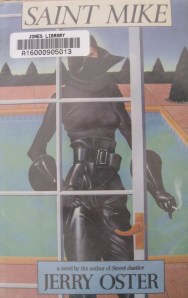
Saint Mike

saint mikeOster, Jerry. Saint Mike. New York: Harper & Row, 1987.

I love it when a book has me scratching my head and asking why in the first chapter. In Saint Mike it actually took the last paragraph at the end of the first chapter before the “huh?” kicked in, but just imagine this: two knights jousting in a field. At the end of the battle one of the knights unscrews his sword to reveal a vial of cocaine. After a good snort he gives it to his jousting mate and tells him they’ll get breakfast afterwards. The kicker is, the scene is neither here nor there in the overall description of the book as described by Nancy Peal in Book Lust, “When Susan Van Meter’s federal narcotics investigator husband is found murdered…she leaves her research position and takes on the task of tracking down and bringing to justice the murderer” (p 6).
I enjoyed every page of Saint Mike. With such a heavy plot (drugs, murder, avenging wife, federal agents) I didn’t expect such playful, witty, sexy language. Granted, there are some really weird scenes (yes, the armor comes back and someone dies by the sword in the most unusual way, but that’s all I’ll say about that). Overall it was an entertaining, fast read.

Favorite scene: I urge every parent of a child on the verge of becoming a teenager to read pages 12-14. Susan is trying to get her daughter up for breakfast, “The sound of drugs and drug paraphernalia and semiautomatic weapons being thrown out the window” (p 13). It’s hysterical.
Favorite line: “Rita tossed her head like a fandango dancer. “It is not just the penis that is flawed; it is the whole organism.”” (p 15).

BookLust Twist: From Book Lust in the chapter called, “Action Heroines” (p 5).

Snobs

Fellowes, Julian. Snobs. New York: St. Martin Press, 2004.

This seems like an odd choice for a Christmas season pick. After all, this is supposed to be peace on Earth, goodwill towards men time. With a name like Snobs it doesn’t seem to fit, but this is in honor of one of Nancy Pearl’s gift choices for the holidays.

Edith Lavery is middle class society with big upper class ambitions. When she inadvertently meets the Earl of Broughton, Charles, it is with an admission ticket to tour his home in her hand. Little does she know, but the introduction, with her good looks, is also her ticket to upper echelon snobbery. Soon Edith works her way into the aristocratic family by marrying Charles. As his wife she discovers the high life isn’t all that it’s cracked up to be and finds herself becoming bored. The real trouble begins when Edith’s wandering eye settles on a less than successful actor. Things turn from bad to worse when it’s more than Edith’s eye that starts to wander. What makes this hungry-for-status story so funny is the wicked clashes of culture. Julian Fellowes seductively pokes fun at all types of cliques: actors, the fashion world, the genders, society, but none are funnier than the English.

Sarcastically good lines: “To an outsider it seems a vital ingredient of many marriages that each partner should support the illusions of the other” (p 5).
“…Mrs Lavery was passionately snobbish to a degree verging on insanity…” (p 12).
“Edith rolled her eyes. ‘She’s beside herself. She’s afraid she’ll find Bobby in the shower and it’ll all have been a dream” (p 40).
“At least he seemed to feel that something momentous had taken place, even if her body had never left the station…” (p71).

BookLust Twist: From More Book Lust in the chapter, “A Holiday Shopping List” (p 114).